It’s a common but puzzling experience: you’ve had consistently brown hair since childhood, only to notice that your beard—especially as it grows in—is taking on a reddish or auburn hue. You’re not alone. Many men with dark or brown hair find themselves asking, “Why is my beard turning red?” The answer lies deep within your DNA, where complex genetic mechanisms control pigment production in different parts of your body. This article dives into the science of hair color genetics, explains why facial hair can differ from scalp hair, and explores the role of pigments, genes, and even age in this fascinating transformation.
The Science of Hair Pigmentation
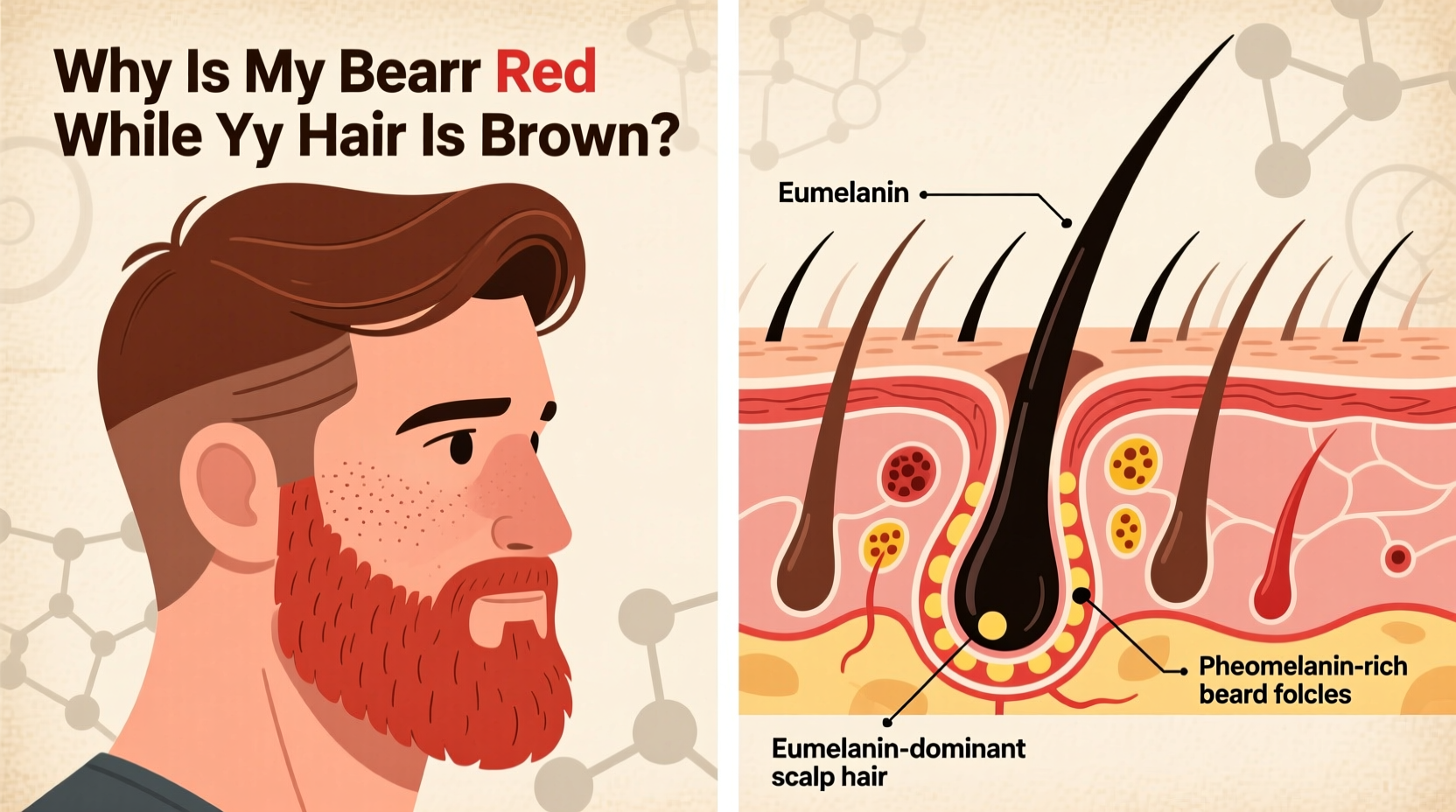
Hair color is determined by two types of melanin: eumelanin and pheomelanin. Eumelanin produces brown to black shades, while pheomelanin is responsible for red and yellow tones. The ratio and concentration of these pigments in your hair follicles define your natural color. Most people produce both types, but the dominant pigment determines the visible shade.
In individuals with brown hair, eumelanin is typically the dominant pigment. However, the distribution of melanin isn’t always uniform across all hair follicles. Facial hair follicles may express different genetic instructions than those on the scalp, leading to variations in pigment type and intensity. This biological inconsistency is why some men grow beards that are lighter, darker, or even a completely different hue than their head hair.
Tip: Lighting can affect how you perceive beard color. Natural daylight reveals true tones better than indoor lighting, which may cast warm or cool hues.Genetic Factors Behind Reddish Beard Growth
The primary reason for a red beard on a brown-haired man is genetic variation in melanin expression. Unlike many traits governed by a single gene, hair color is polygenic—controlled by multiple genes interacting in complex ways. Key players include the MC1R gene (Melanocortin 1 Receptor), which regulates the switch between eumelanin and pheomelanin production.
Even if you don’t have red hair, you might carry recessive variants of the MC1R gene. These variants reduce the activity of the MC1R protein, causing hair follicles to produce more pheomelanin relative to eumelanin. While this effect may be subtle or suppressed in scalp hair due to other genetic influences, facial hair follicles can be more sensitive to these signals, resulting in a noticeable reddish tint.
Think of it like a dimmer switch: in scalp hair, the \"red\" signal is turned down low, but in beard hair, it's slightly brighter. This differential gene expression is normal and often hereditary. If a grandparent or distant relative had red hair or a red-tinted beard, that trait may resurface in you—even without full red hair.
“Facial hair can act as a genetic echo, revealing pigmentation patterns masked elsewhere in the body.” — Dr. Lena Torres, Dermatogeneticist at the Institute of Skin Biology
Why Facial Hair Differs From Scalp Hair
It might seem odd that hair growing just inches apart can vary so much in color, but biologically, it makes sense. Scalp and beard follicles develop from different embryonic origins and are influenced by distinct hormonal environments. Beard growth is heavily driven by androgens like testosterone and dihydrotestosterone (DHT), which can influence pigment production.
Additionally, beard hairs have a longer anagen (growth) phase and greater density of pigment-producing melanocytes in some individuals. These factors allow for more pronounced expression of underlying genetic traits, including latent red tones. Over time, as your beard matures, these characteristics become more apparent.
Another factor is sun exposure. Beard hair is often more exposed to UV radiation than scalp hair, especially in shorter hairstyles. Sunlight can oxidize melanin, breaking down eumelanin faster than pheomelanin and enhancing red or golden undertones. This photochemical change can make a naturally reddish beard appear even more vibrant over time.
Key Differences Between Scalp and Beard Hair
| Feature | Scalp Hair | Beard Hair |
|---|---|---|
| Primary Hormonal Influence | Moderate androgen sensitivity | High androgen sensitivity (DHT-driven) |
| Genetic Expression | Uniform across follicles | Variable; may express recessive traits |
| Exposure to Elements | Often covered or shaded | Frequent sun and environmental exposure |
| Pigment Stability | Generally stable | More prone to oxidation and fading |
| Growth Cycle Length | 2–6 years | Up to 7+ years (longer pigment accumulation) |
Age and Hormonal Changes: Triggers for Color Shifts
Many men first notice their beard turning red during their late 20s or 30s. This timing isn't coincidental—it aligns with shifts in hormone levels and prolonged androgen exposure. As testosterone and DHT accumulate over time, they can amplify the activity of certain follicular genes, including those involved in pheomelanin synthesis.
Moreover, aging affects melanocyte function. While graying occurs when melanocytes stop producing pigment altogether, earlier in life, these cells may simply shift their output. A follicle that once produced mostly eumelanin might begin favoring pheomelanin due to changes in receptor sensitivity or local signaling molecules.
This transition is gradual. You might first see reddish strands near the jawline or chin—areas with high DHT concentration—before the tone spreads across the full beard. In some cases, the redness fades with age as overall pigment production declines, but for others, it becomes a permanent feature.
Tip: Track changes over months rather than days. Pigment shifts occur slowly and are best assessed with consistent observation under natural light.Real-Life Example: Mark’s Unexpected Beard Transformation
Mark, a 31-year-old software engineer from Chicago, grew up with thick, dark brown hair. When he started growing his first serious beard at age 26, he expected a similar shade. Instead, after a few weeks, he noticed coppery highlights appearing around his sideburns and lower cheeks. At first, he thought it was sun bleaching. But as the beard filled in, the red tones persisted—and deepened.
Confused, Mark consulted a dermatologist who explained the role of the MC1R gene and asked about family history. Mark recalled that his maternal grandfather had a striking red mustache despite having brown hair as a young man. The doctor confirmed that this was likely a case of recessive trait expression in facial hair, amplified by hormonal activity. Today, Mark embraces his unique look, calling it “the surprise gift from my DNA.”
How to Determine If This Is Genetic
If you're experiencing a red beard with brown scalp hair, consider these steps to assess whether it's genetic:
- Review family history: Ask relatives about unusual hair color patterns, especially in beards or body hair.
- Observe early growth: Check the color of your initial beard stubble. If it’s consistently reddish from the root, it’s likely genetic—not sun damage.
- Compare with siblings: Siblings share similar genetic profiles. If one has a red-tinged beard, others may too.
- Monitor consistency: True genetic color remains stable across seasons. Sun-bleached tones fade in winter.
- Rule out deficiencies: Rarely, nutrient imbalances (like copper or vitamin B12) can alter hair color. Consult a doctor if changes are sudden or patchy.
Do’s and Don’ts When Dealing With a Red Beard
| Action | Do | Don’t |
|---|---|---|
| Color Assessment | Check in natural sunlight daily for a week | Rely on bathroom lighting or mirrors with yellow tints |
| Hair Care | Use sulfate-free beard wash to preserve natural oils | Over-wash or use harsh shampoos meant for scalp |
| Sun Protection | Apply beard-safe SPF or wear a hat in strong sun | Assume all discoloration is genetic—sun can enhance redness |
| Dye Consideration | Test semi-permanent dye on small area first | Use permanent dyes without patch testing |
Frequently Asked Questions
Can my beard turn red even if no one in my family has red hair?
Yes. Recessive genes like MC1R variants can remain hidden for generations. You might be the first in your family to express the trait visibly in facial hair, especially if hormonal or environmental factors amplify it.
Will my entire beard eventually turn red?
Not necessarily. Some men maintain a mix of brown and red hairs indefinitely. The proportion depends on individual follicle sensitivity and genetic expression patterns. Complete color dominance varies widely.
Is a red beard a sign of a health problem?
Almost never. A reddish beard on a brown-haired person is typically a benign genetic variation. However, if the change is sudden, patchy, or accompanied by texture changes or hair loss, consult a dermatologist to rule out autoimmune or nutritional issues.
What If You Want to Change or Enhance the Look?
Some men embrace the contrast between their brown hair and red beard as a distinctive feature. Others prefer a more uniform appearance. If you fall in the latter group, options exist:
- Beard dye: Use natural-looking, semi-permanent dyes formulated for facial hair. Opt for warm browns rather than black to avoid harsh contrasts.
- Grooming techniques: Trim your beard shorter to minimize color contrast, or style it to highlight the red tones as a deliberate aesthetic choice.
- Embrace the uniqueness: Many fashion and grooming experts now celebrate multi-tonal beards as a mark of individuality. Think of it as nature’s ombre effect.
“The most memorable looks often come from unexpected genetic quirks. A red-tinged beard isn’t a flaw—it’s a signature.” — Julian Reed, Men’s Grooming Editor at *Urban Man Journal*
Final Thoughts: Embracing Your Genetic Story
Your beard isn’t just facial hair—it’s a living record of your ancestry, hormones, and genetic complexity. The fact that it may differ in color from your scalp hair isn’t a mistake; it’s a testament to the intricate way our bodies express inherited traits. The red tones you see could be echoes of a great-grandparent’s hair, activated by the hormonal environment of adulthood.
Understanding the science behind this phenomenon doesn’t diminish its curiosity—it enhances it. Instead of questioning whether something is “wrong,” you can appreciate that your body is telling a deeper story than you realized. Genetics isn’t always about obvious inheritance; sometimes, it reveals itself subtly, strand by strand.
💬 Have a brown-haired, red-bearded story to share? Join the conversation. Comment below and let others know how you discovered your unique genetic twist—and whether you’ve learned to love it.