
America’s identity as a “nation of immigrants” is deeply embedded in its national narrative. From school textbooks to political speeches, this phrase echoes across generations as both a historical fact and a cultural ideal. Yet, beneath its widespread acceptance lies a complex and contested history—one that includes displacement, exclusion, and evolving definitions of belonging. Understanding why America is called a nation of immigrants requires examining not only who came, when they arrived, and under what conditions, but also who was excluded from that label and why.
The Historical Foundations of a Nation Built by Migration
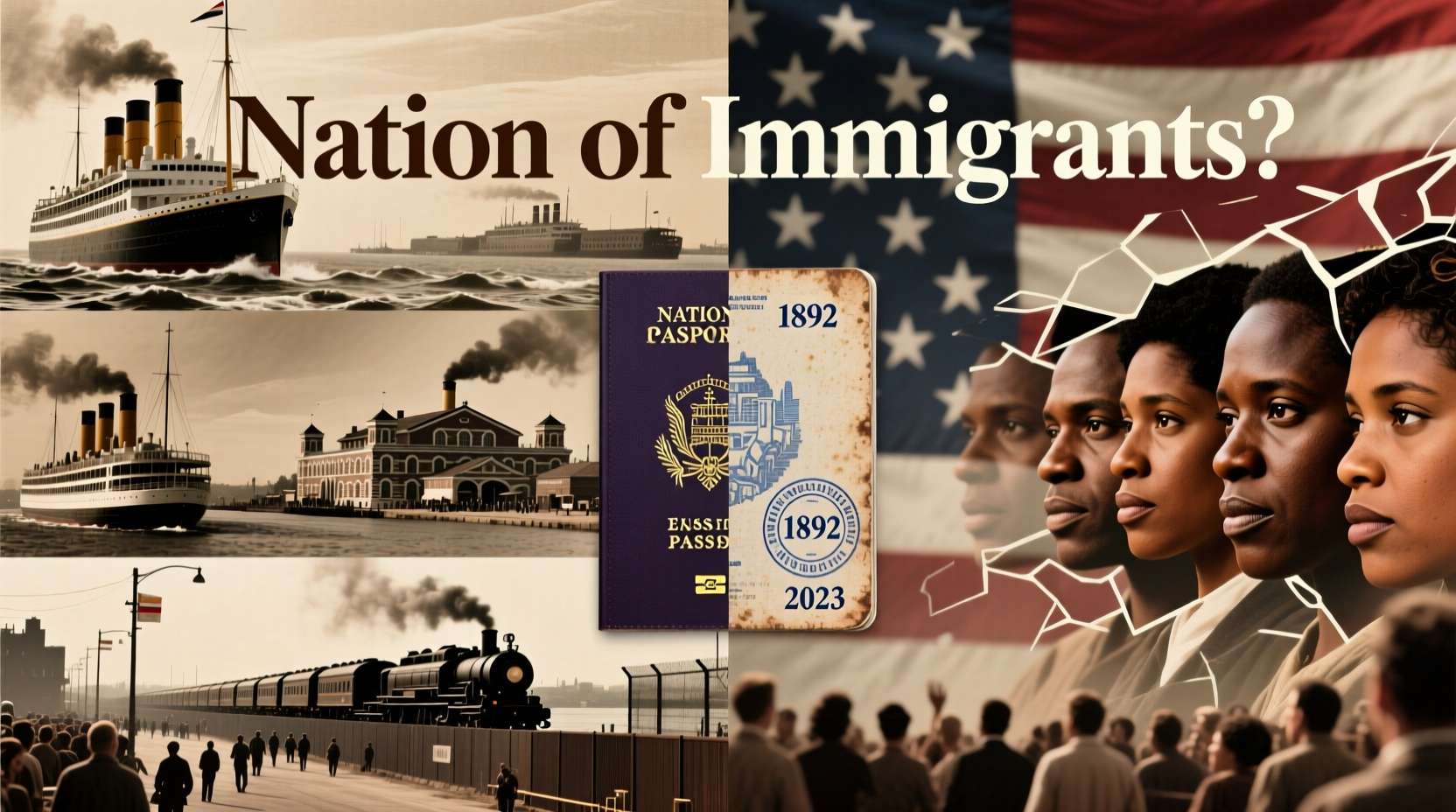
The term \"nation of immigrants\" often begins with the arrival of Europeans in the 17th century. English settlers established colonies along the Atlantic coast, but they were soon joined by Germans, Scots-Irish, Dutch, and others seeking economic opportunity or religious freedom. By the time of the American Revolution, the population was already a mosaic of European ethnicities, each contributing to regional cultures and economies.
However, this narrative overlooks two critical truths: first, that Native Americans were the original inhabitants, and second, that millions of Africans were brought to the continent through the transatlantic slave trade—not as immigrants, but as enslaved people stripped of agency. This contradiction forms the core of the debate: can a nation built on both voluntary migration and forced labor honestly claim to be solely a “nation of immigrants”?
“America has always been a land shaped by movement—but not all movement was free, and not all newcomers were welcomed.” — Dr. Maria Chen, Historian of U.S. Immigration
Waves of Immigration and the Shaping of National Identity
Between 1820 and 1924, over 34 million immigrants arrived in the United States, transforming cities and industries. These waves can be broadly categorized:
- 1820–1880: Primarily from Northern and Western Europe (Ireland, Germany, Scandinavia), many fleeing famine or political unrest.
- 1880–1920: Shifted to Southern and Eastern Europe (Italy, Poland, Russia, Greece), including large numbers of Jews and Catholics.
- Post-1965: Following the Hart-Celler Act, immigration diversified dramatically, with growing numbers from Asia, Latin America, Africa, and the Middle East.
Each wave faced resistance. The Irish were stereotyped as lazy and criminal; Italians were associated with organized crime; Chinese laborers were barred by the Chinese Exclusion Act of 1882—the first law to restrict immigration based on nationality. These patterns reveal that while immigration built the country, it did not always come with inclusion.
Tip: When studying immigration history, consider not just the laws that allowed entry, but also those that restricted or excluded entire groups.The Legal Evolution: From Open Doors to Border Control
For much of the 19th century, the U.S. had few formal immigration restrictions. Entry was relatively unrestricted until the late 1800s, when concerns about public health, labor competition, and racial purity led to increasing regulation.
| Era | Key Legislation | Impact |
|---|---|---|
| 1882 | Chinese Exclusion Act | Banned Chinese laborers; first race-based immigration law |
| 1924 | Johnson-Reed Act | Established national origin quotas favoring Northern Europeans |
| 1965 | Hart-Celler Act | Abolished quotas; prioritized family reunification and skilled workers |
| 1986 | Immigration Reform and Control Act | Granted amnesty to nearly 3 million undocumented immigrants |
| 1996 | Illegal Immigration Reform and Immigrant Responsibility Act | Increased deportations and border enforcement |
The 1965 Immigration and Nationality Act marked a turning point. It dismantled the racially biased quota system and opened doors to non-European countries. Since then, the demographic face of immigration has changed fundamentally. Today, over three-quarters of U.S. immigrants come from Latin America or Asia, challenging older notions of what an “immigrant” looks like.
Contested Narratives: Who Belongs in the Story?
Critics argue that calling the U.S. a “nation of immigrants” erases Indigenous histories and marginalizes African Americans whose ancestors were brought in chains. For many Native communities, the phrase romanticizes colonization. Similarly, descendants of enslaved Africans often point out that their ancestors were not immigrants—they were property.
This tension surfaced prominently in 2018 when Senator Elizabeth Warren faced backlash for citing DNA results to claim Native ancestry. The incident highlighted how claims to identity—and inclusion in national narratives—are politically and emotionally charged.
At the same time, immigrant advocacy groups embrace the label as aspirational—a reminder of America’s capacity for renewal and inclusion. For them, the phrase represents hope, resilience, and the possibility of reinvention.
Mini Case Study: The Rodriguez Family, 1998–Present
Maria and José Rodriguez crossed the U.S.-Mexico border in 1998 seeking work after a drought devastated their farm in Oaxaca, Mexico. They settled in North Carolina, where José found seasonal jobs in agriculture and Maria cleaned homes. Their children, born in the U.S., are citizens. Over time, the family learned English, saved money, and opened a small landscaping business.
They embody the classic immigrant story—hard work, upward mobility, integration. Yet they live with uncertainty; José remains undocumented. When asked if they feel part of a “nation of immigrants,” Maria replies: “We contribute, we pay taxes, we raise good kids. But sometimes, it feels like we’re tolerated, not welcomed.”
Their experience reflects a broader truth: being part of a nation of immigrants does not guarantee full social or legal recognition.
Expert Perspectives and Modern Relevance
Today, approximately 13.7% of the U.S. population is foreign-born—the highest share since 1910. Immigrants make up a significant portion of the workforce in sectors like agriculture, healthcare, technology, and hospitality.
“The myth of the ‘nation of immigrants’ persists because it serves a purpose—it unites us around a shared story of striving. But myths must evolve to include uncomfortable truths.” — Dr. James T. Lee, Sociologist at Columbia University
Experts emphasize that immigration is not just a historical phenomenon but an ongoing process shaping schools, neighborhoods, and politics. Debates over border security, asylum policies, and pathways to citizenship reflect deeper questions about national identity: Who gets to belong? On what terms?
Checklist: Understanding the Full Scope of America’s Immigration Legacy
- Recognize that Native peoples were here long before any immigrants arrived.
- Acknowledge that African Americans were not immigrants but victims of enslavement.
- Study the major immigration waves and the discrimination each faced.
- Examine key immigration laws and how they reflected societal fears.
- Consider how current policies affect real families today.
- Reflect on your own family’s migration story, if applicable.
- Challenge oversimplified narratives that ignore exclusion and inequality.
Frequently Asked Questions
Is everyone in America descended from immigrants?
No. Native Americans are indigenous to the land and were not immigrants. Additionally, the ancestors of most African Americans were brought forcibly through slavery and did not immigrate voluntarily. While the vast majority of Americans have immigrant ancestors, the phrase doesn’t apply universally.
When did the U.S. start restricting immigration?
The first major restriction was the Chinese Exclusion Act of 1882. Before that, immigration was largely unregulated. Federal oversight expanded in the early 20th century with medical inspections, literacy tests, and eventually the national origins quota system established in 1924.
Does calling America a 'nation of immigrants' ignore slavery?
Yes, for many, it does. The phrase often overlooks the fact that millions of Africans were transported against their will and denied basic rights. Scholars increasingly advocate for more inclusive language, such as “a nation shaped by migration”—one that accounts for both voluntary and forced movement.
Conclusion: Reimagining a Shared Future
The label “nation of immigrants” captures a powerful truth about America’s diversity and dynamism. But it is incomplete without acknowledging the full spectrum of human experiences that shaped the country—colonization, genocide, slavery, exclusion, and resilience.
To move forward, the national conversation must expand beyond simplistic slogans. We can honor the contributions of immigrants while also recognizing the rights and histories of Indigenous peoples and African Americans. A more honest narrative doesn’t weaken patriotism—it deepens it.
🚀 What does 'American' mean to you? Share your thoughts, family stories, or reflections on immigration in the comments. Let’s build a more inclusive understanding—together.