The night sky has fascinated humanity for millennia, serving as a guide for navigation, a canvas for mythology, and a laboratory for astronomy. Among its most enduring features is Polaris—the North Star—famously known for its apparent stillness while other stars trace circular paths across the heavens. Unlike its celestial neighbors, Polaris seems to hang motionless above the northern horizon. This phenomenon isn’t magic or coincidence; it’s the result of precise astronomical alignment and Earth’s rotational dynamics. Understanding why the North Star doesn’t appear to move offers insight into our planet’s orientation in space and the mechanics that govern the visible universe.
The Celestial Pole and Earth’s Axis
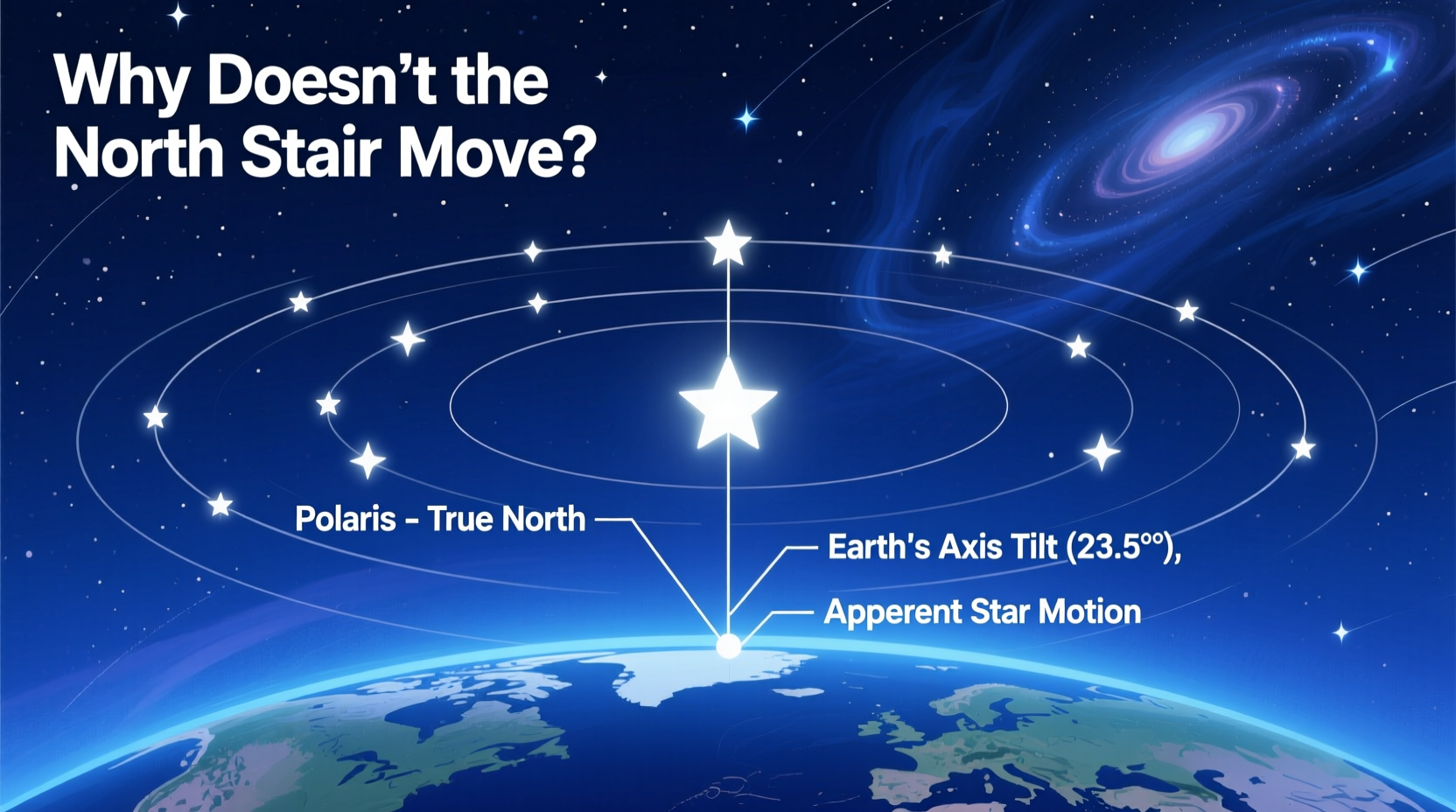
Earth rotates on an axis tilted at approximately 23.5 degrees relative to its orbital plane around the Sun. This axis extends from the North Pole to the South Pole and continues outward into space. The point in the northern sky where Earth’s rotational axis points is called the North Celestial Pole. Polaris lies extremely close to this point—within less than 0.5 degrees—as seen from Earth. Because it aligns so nearly with the axis of rotation, Polaris appears fixed while all other stars seem to revolve around it.
To visualize this, imagine spinning a globe with a small LED light placed directly above the North Pole. From the perspective of someone standing near the pole, that light would remain stationary, while everything else on the globe’s surface rotates beneath it. Similarly, as Earth spins, stars farther from the celestial pole describe larger arcs across the sky, while those closer to it—including Polaris—move in tighter circles. Polaris, being almost perfectly aligned, traces only a tiny circle each night, imperceptible to the naked eye over short periods.
Tip: To locate Polaris, find the Big Dipper and follow the two stars at the end of its “bowl” upward—they point directly to the North Star.Polaris’ Unique Position in the Sky
Polaris is not the brightest star in the night sky—that distinction belongs to Sirius—but its positional significance outweighs its luminosity. Located about 433 light-years away, Polaris is a triple star system dominated by a bright Cepheid variable supergiant. Its usefulness stems not from brightness but from alignment. Currently, Polaris marks true north with remarkable accuracy, making it indispensable for celestial navigation, especially before the advent of GPS technology.
Historically, mariners and explorers relied on Polaris to determine latitude in the Northern Hemisphere. By measuring the angle between the horizon and Polaris using instruments like the sextant, navigators could estimate their distance from the equator. At the North Pole, Polaris appears directly overhead (at 90° altitude); at the equator, it hovers just above the horizon (0°). This direct correlation between geographic latitude and stellar altitude underscores its practical value.
“Polaris is more than a beacon—it’s a direct projection of Earth’s spin axis onto the dome of the sky.” — Dr. Lena Torres, Astrophysicist, Harvard-Smithsonian Center for Astrophysics
Why Other Stars Move But Polaris Doesn’t
All stars, including Polaris, are in constant motion through space. However, their vast distances make these movements imperceptible over human timescales. The apparent nightly movement of stars is primarily due to Earth’s rotation, not their own travel. As Earth turns eastward once every 24 hours, the sky appears to rotate westward around us.
Stars located near the celestial equator rise and set dramatically, traversing long arcs from horizon to horizon. In contrast, circumpolar stars—those within about 40 degrees of the celestial pole—never dip below the horizon for observers in mid-northern latitudes. They continuously circle the pole. Polaris, sitting almost exactly at the center of this rotation, acts like the hub of a wheel, with other stars forming the spokes.
This effect can be observed over several hours. Time-lapse photography of the night sky reveals stunning concentric trails centered on a single point—Polaris. The star itself shows only a minuscule shift, a tiny dot surrounded by swirling arcs of light. This visual proof confirms both Earth’s rotation and Polaris’ privileged alignment.
Precession: The Slow Wobble That Changes the Pole Star
While Polaris appears stable now, it hasn’t always been—and won’t remain—the North Star. Earth’s axis undergoes a slow wobble called precession, similar to the motion of a spinning top losing momentum. This cycle takes approximately 26,000 years to complete. As the axis shifts, the direction it points in space gradually changes, causing the celestial pole to drift among nearby stars.
About 3,000 years ago, the star Thuban in the constellation Draco served as the pole star. In another 12,000 years, Vega in Lyra will take over. Polaris reached its closest alignment to the celestial pole around the year 2100 and will begin slowly moving away thereafter. So, while Polaris is currently unmatched in its stability, this status is temporary on an astronomical timescale.
| Era | Pole Star | Distance from Celestial Pole |
|---|---|---|
| 3000 BCE | Thuban (α Draconis) | ~3° off |
| Present Day | Polaris (α Ursae Minoris) | ~0.5° off |
| 14,000 CE | Vega (α Lyrae) | Will be ~5° off |
Observational Tips and Practical Applications
Understanding Polaris’ stability isn’t just academic—it has real-world applications for stargazers, photographers, and educators. Here’s how you can use this knowledge:
- Use Polaris as a reference point to identify constellations in the northern sky.
- Align telescopes or astrophotography equipment using Polaris for accurate tracking.
- Teach students about Earth’s rotation by demonstrating star trails centered on Polaris.
- Navigate outdoors without electronics by locating true north via the North Star.
Mini Case Study: Navigation in the Arctic Wilderness
In 2018, a team of researchers conducting fieldwork in northern Greenland lost GPS signal due to solar interference. With limited visibility and no landmarks, they relied on traditional celestial navigation. Using a simple clinometer and star chart, they identified Polaris and measured its elevation at 78° above the horizon. Knowing this matched their expected latitude, they confirmed their position and safely returned to base camp. Their success highlighted how fundamental astronomical knowledge remains vital even in the digital age.
Frequently Asked Questions
Is Polaris completely stationary?
No star is truly motionless. Polaris moves slightly due to Earth’s precession and its own proper motion through space. However, its position changes so slowly that it appears fixed over decades. Over one night, its movement is negligible to the unaided eye.
Can you see Polaris from the Southern Hemisphere?
Generally, no. Polaris lies very close to the north celestial pole, so it sinks below the horizon as you move south of the equator. Observers south of about 1° latitude typically cannot see it. Navigators in the Southern Hemisphere use the Southern Cross and other asterisms to approximate south.
Why is Polaris important if we have GPS?
While GPS dominates modern navigation, Polaris provides a reliable backup during technological failures—such as satellite outages, electromagnetic storms, or equipment damage. It also plays a key role in education, astronomy, and cultural heritage.
Step-by-Step Guide: Finding and Using Polaris
- Step 1: Face north and locate the Big Dipper (Ursa Major).
- Step 2: Identify the two stars forming the outer edge of the Dipper’s bowl—Dubhe and Merak.
- Step 3: Draw an imaginary line from Merak through Dubhe and extend it about five times that distance.
- Step 4: The bright star you reach is Polaris, part of the Little Dipper (Ursa Minor).
- Step 5: Confirm by checking that no other bright stars are nearby—Polaris stands alone near the celestial pole.
Conclusion: Embracing the Stability of the Night Sky
Polaris may not be eternal, but for now, it offers a rare glimpse of cosmic order—a steady point in an ever-changing universe. Its unwavering presence reminds us of Earth’s place in space and the elegant mechanics that shape our experience of the night. Whether you’re navigating uncharted terrain, capturing the beauty of star trails, or simply gazing upward in wonder, Polaris stands as a symbol of orientation and continuity. Take time tonight to find it. Let its quiet constancy inspire curiosity, resilience, and a deeper connection to the cosmos.
💬 Did you know Polaris changes over millennia? Share your thoughts or experiences observing the North Star—we’d love to hear how it guides your nights!