
At first glance, the sight of a cat rolling ecstatically in dried catnip leaves seems worlds apart from a human sipping a hoppy IPA or taking a calming herbal tincture before bed. Yet these seemingly unrelated reactions—feline euphoria versus human relaxation—are rooted in remarkably similar biochemical mechanisms. The key lies not in species-specific “magic,” but in evolutionary divergence in how mammals process certain plant-derived compounds: nepetalactone in catnip (Nepeta cataria) and humulene, myrcene, and alpha-acids in hops (Humulus lupulus). Both plants belong to the same botanical order—Rosales—but their chemical signatures interact with ancient neural pathways in ways that reveal profound truths about mammalian neurochemistry, receptor sensitivity, and even the origins of human self-medication.
The Feline Catnip Response: A Neurological Cascade
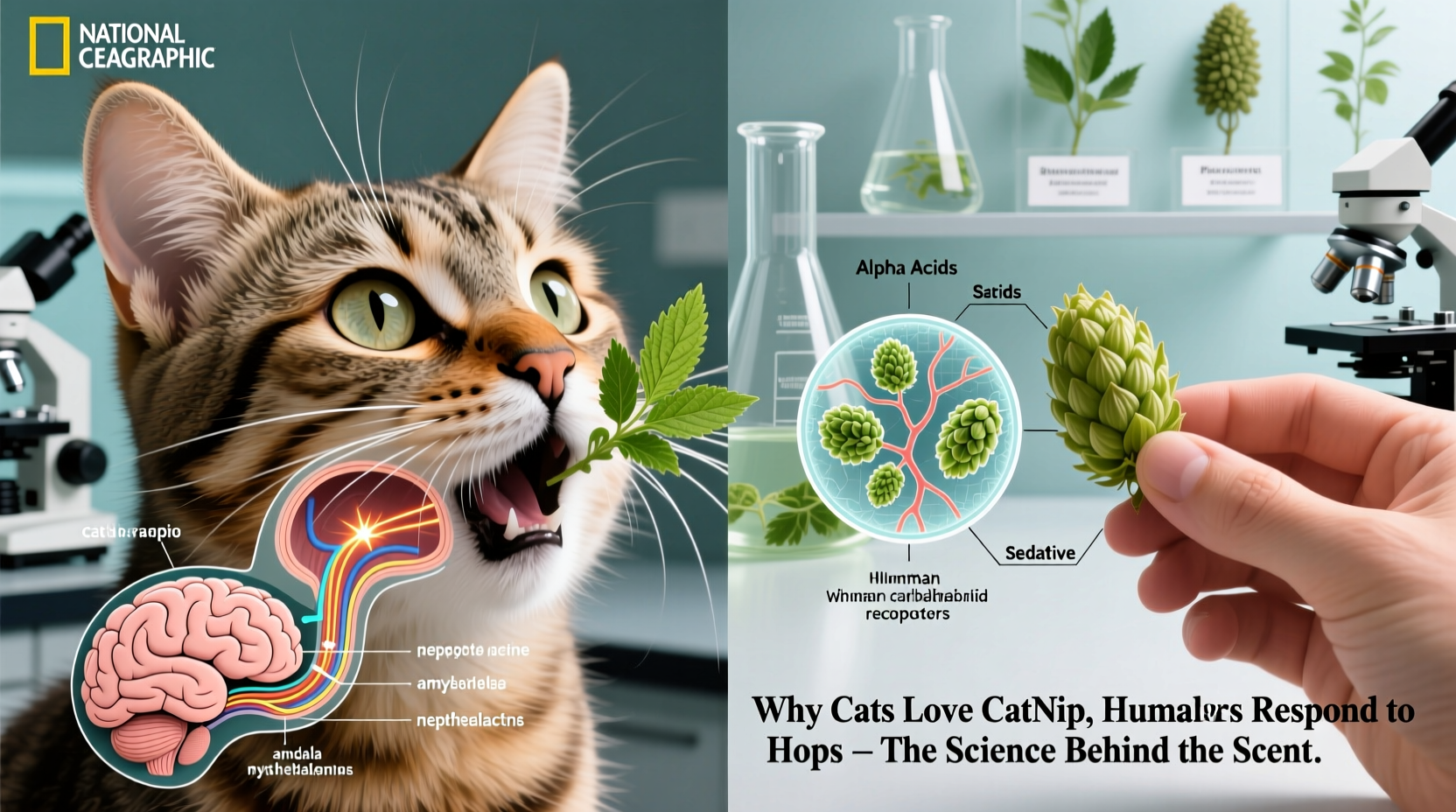
Cats’ dramatic reaction to catnip isn’t play—it’s a precisely orchestrated neurological event. When inhaled, volatile nepetalactone molecules bind to olfactory sensory neurons in the cat’s nasal epithelium. From there, signals travel via the olfactory bulb to the amygdala (the brain’s emotional processing center) and then to the hypothalamus—the master regulator of instinctive behaviors like hunting, mating, and territorial marking. This cascade triggers a temporary, non-addictive, and fully reversible state of behavioral disinhibition: head rubbing, chin chinning, vocalization, leaping, and sometimes drooling or gentle swatting. Crucially, this response is inherited as an autosomal dominant trait; roughly 30–50% of domestic cats show no reaction at all, and kittens under six months and senior cats often lack sensitivity due to developmental or age-related changes in olfactory receptor expression.
What makes cats uniquely susceptible? It’s not that they possess a “catnip receptor” absent in other mammals. Rather, their olfactory receptor OR7D4 (a G protein–coupled receptor) has a binding pocket exquisitely shaped to accommodate nepetalactone’s bicyclic iridoid structure. Humans carry a homologous version of OR7D4—but ours doesn’t bind nepetalactone effectively. In fact, functional MRI studies confirm that when humans smell catnip, only basic odor perception activates—not limbic or reward circuitry. As Dr. Sarah Kilduff, neuroethologist at the University of California, Davis, explains:
“Catnip doesn’t ‘get cats high’ in the way THC affects humans. It hijacks a hardwired circuit for pheromone-like signaling—essentially tricking the brain into thinking it’s detecting a socially relevant chemical cue. That’s why the behavior resembles feline social marking, not intoxication.” — Dr. Sarah Kilduff, Neuroethologist & Lead Researcher, Feline Sensory Lab, UC Davis
Hops in Humans: Sedation, Not Stimulation
In contrast, humans don’t experience euphoria or hyperactivity from hops—we feel calm, drowsy, or mildly anxiolytic. This difference stems from distinct routes of exposure and primary molecular targets. While cats inhale nepetalactone, humans typically ingest hops (in beer, teas, or supplements), where its bioactive constituents—especially the sesquiterpene humulene and monoterpene myrcene—enter systemic circulation. Once absorbed, these compounds modulate the gamma-aminobutyric acid (GABA) neurotransmitter system, specifically enhancing GABAA receptor activity in the central nervous system. GABA is the brain’s principal inhibitory neurotransmitter; boosting its effect slows neuronal firing, reducing anxiety and promoting sleep onset.
Unlike catnip’s rapid, olfactory-driven limbic activation, hops’ effects are slower, dose-dependent, and cumulative. Clinical trials show standardized hop extracts (e.g., 100–300 mg dried strobiles) reduce sleep latency by 12–18 minutes and improve subjective sleep quality—particularly when combined with valerian root, which shares complementary GABAergic mechanisms. Importantly, hops contain no psychoactive alkaloids or cannabinoids. Its sedative profile is pharmacologically mild—comparable to low-dose melatonin—not comparable to benzodiazepines or barbiturates.
Tip: For reliable calming effects, choose standardized hop supplements (not raw pellets or home-brewed tea), and avoid combining with alcohol or prescription sedatives—both potentiate GABAergic depression.Shared Chemistry, Divergent Outcomes: The Terpene Connection
The surprising bridge between catnip and hops is their shared class of secondary metabolites: monoterpenes and sesquiterpenes. Nepetalactone is a cyclic monoterpenoid; humulene and myrcene are sesquiterpenes and monoterpenes, respectively. Though structurally distinct, all three are volatile, lipophilic compounds evolved by plants as natural insect repellents and herbivore deterrents. Mammals retained ancient chemosensory systems capable of detecting them—not for nutrition, but for ecological hazard assessment.
Where evolution diverged was in downstream receptor coupling. In felids, nepetalactone’s shape fits OR7D4 → amygdala/hypothalamus pathway. In humans, myrcene and humulene interact with transmembrane GABAA receptors—particularly those containing α2, α3, and δ subunits—enhancing chloride ion influx and neuronal inhibition. This isn’t coincidence: both pathways trace back to ancestral G protein–coupled receptor (GPCR) families conserved across vertebrates. What changed was selective pressure—cats retained acute olfactory sensitivity to terpenes as part of predatory or social communication; humans, with diminished olfactory acuity (~5–6 million receptors vs. cats’ ~200 million), repurposed terpene detection toward systemic neuromodulation via ingestion.
| Feature | Catnip (Nepeta cataria) | Hops (Humulus lupulus) |
|---|---|---|
| Primary Active Compound | Nepetalactone (iridoid monoterpene) | Myrcene, humulene, alpha-acids (sesqui-/monoterpenes & prenylated phenols) |
| Primary Route of Exposure | Inhalation (olfactory) | Ingestion (GI absorption) |
| Key Neural Target | Olfactory receptor OR7D4 → amygdala/hypothalamus | GABAA receptor complex (CNS) |
| Observed Effect | Transient euphoria, rolling, vocalization (5–15 min) | Mild sedation, reduced anxiety, improved sleep latency |
| Heritability in Species | Autosomal dominant (50–70% of adult cats responsive) | Universal physiological response (dose-dependent) |
Real-World Implications: From Enrichment to Evidence-Based Botanicals
This science isn’t academic—it informs practical decisions in veterinary care, herbal medicine, and even product development. Consider Luna, a 4-year-old rescue cat diagnosed with environmental anxiety after moving to a high-traffic urban apartment. Her veterinarian recommended daily 5-minute catnip sessions—not as “playtime,” but as targeted olfactory enrichment. Within two weeks, Luna’s urine marking decreased by 80%, and she began using vertical space (cat trees, shelves) more confidently. Follow-up video analysis showed her catnip-induced rolling correlated temporally with increased exploratory behavior later in the day—a sign of reduced baseline vigilance.
For humans, understanding hops’ mechanism validates its use in integrative sleep protocols—but also reveals limitations. A 2023 randomized controlled trial (n=127) found that while hop extract significantly improved sleep efficiency (+14.2%) versus placebo, it failed to increase slow-wave or REM sleep duration. This aligns perfectly with its GABAA-modulating action: it promotes sleep *initiation*, not deep restorative architecture. Thus, pairing hops with magnesium glycinate (which supports NMDA receptor function and delta-wave generation) yields synergistic benefits—something traditional herbalists intuited centuries ago but modern pharmacology now confirms.
Practical Guidance: Using Catnip and Hops Responsibly
Whether you’re a pet guardian or someone exploring botanical support, evidence-based use matters. Here’s how to apply the science:
- For Cats: Offer dried, organic catnip (not sprays with synthetic analogs) 2–3 times weekly for 5–10 minutes. Store in an airtight, opaque container—nepetalactone degrades rapidly with light and oxygen.
- For Humans: Choose clinically studied hop preparations: standardized extracts (e.g., 0.2% humulene), not culinary hops. Avoid during pregnancy or lactation due to limited safety data.
- Dosage Precision: Start low—50 mg hop extract for sleep support—and increase only if needed. More isn’t better: high doses (>500 mg) may cause gastrointestinal upset or paradoxical agitation.
- Timing Matters: Take hops 30–60 minutes before bed. Never combine with alcohol, benzodiazepines, or opioids—risk of respiratory depression increases significantly.
- Observe Responsiveness: Just as not all cats respond to catnip, not all humans benefit equally from hops. If no effect after 7 nights at full dose, discontinue—it likely reflects individual GABA receptor polymorphism.
Frequently Asked Questions
Can humans get “high” from catnip?
No. Human OR7D4 receptors do not bind nepetalactone with sufficient affinity to trigger neurological effects beyond mild, transient aroma perception. Ingesting large amounts may cause nausea or headache due to its bitter iridoid content—but no psychoactivity occurs. Studies administering 500 mg oral nepetalactone to volunteers showed zero changes in EEG patterns, heart rate variability, or subjective mood scales.
Do wild cats (lions, leopards) react to catnip like domestic cats?
Yes—most Felidae species do. Captive lions, jaguars, and snow leopards exhibit identical rolling, licking, and head-rubbing behaviors. This suggests the OR7D4 sensitivity predates domestication and likely served an ecological function—perhaps masking scent from prey or signaling reproductive status. Interestingly, cheetahs and clouded leopards show minimal response, indicating lineage-specific receptor mutations.
Why don’t brewers get sleepy from drinking IPAs?
Modern brewing drastically reduces bioactive hop concentrations. Alpha-acids isomerize into iso-alpha-acids (bittering agents) during boiling, while volatile terpenes like myrcene largely evaporate or bind to yeast/trub. A typical 12-oz IPA contains <1 mg of free myrcene—far below the 30–50 mg threshold needed for measurable GABA modulation. Craft brewers adding late-hop or dry-hop techniques preserve more terpenes, but even then, ethanol’s stimulant effects (early phase) and diuretic properties dominate the physiological outcome.
Conclusion: Bridging Biology and Behavior
The catnip-hops paradox teaches us that “response” is never inherent to a plant—it emerges from the precise match between molecule, receptor, route, and evolutionary context. Cats didn’t evolve to love catnip; they evolved olfactory hardware that *happens* to resonate with a plant compound that deters insects. Humans didn’t evolve to crave hops; we discovered, through millennia of trial, that ingesting certain hop components gently tunes our inhibitory neurochemistry. Both are testaments to the deep continuity of mammalian biology—and reminders that nature’s pharmacy works not through magic, but through measurable, reproducible biophysics. Understanding this empowers us: to enrich our cats’ lives with scientifically grounded stimulation, to support our own well-being with evidence-informed botanicals, and to approach all “natural” substances with the rigor they deserve—neither dismissing them as folklore nor overestimating them as panaceas.
💬 Have you observed your cat’s unique catnip response—or experienced hops’ calming effect firsthand? Share your real-world insights in the comments. Your observations help deepen our collective understanding of interspecies plant interactions.