
The Vietnam War remains one of the most controversial and defining conflicts in American history. Lasting over two decades and spanning multiple presidential administrations, U.S. involvement was not the result of a single decision but rather a complex web of ideological, political, and strategic factors. To understand why the United States became deeply entangled in a distant Southeast Asian conflict, it is essential to examine the historical context, foreign policy doctrines, and global dynamics that shaped American actions from the late 1940s through the 1970s.
The Domino Theory and Cold War Ideology
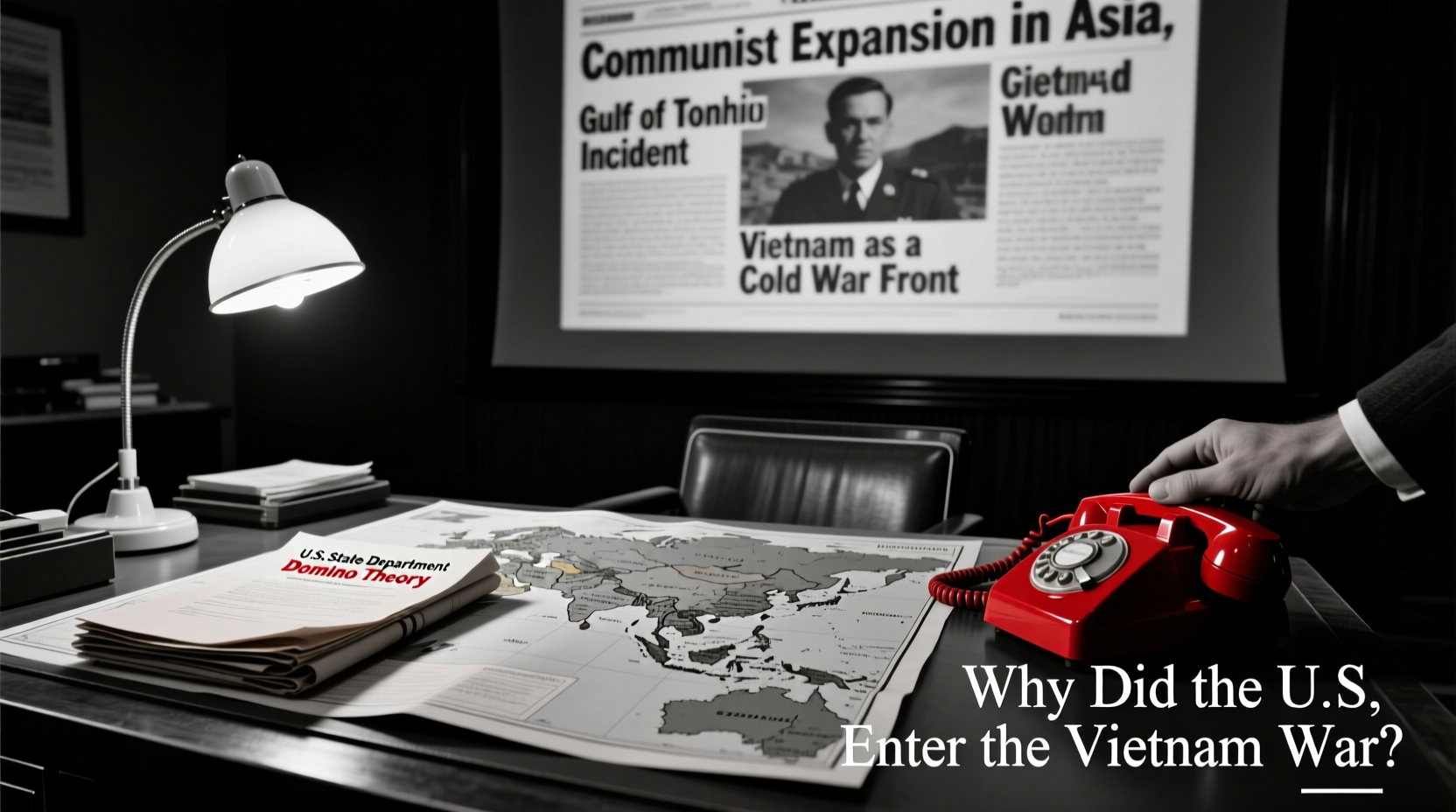
At the heart of U.S. intervention in Vietnam was the Cold War mindset. After World War II, the United States and the Soviet Union emerged as superpowers with opposing ideologies—capitalism and democracy versus communism and authoritarianism. The fear that communism could spread like falling dominos across Asia, Africa, and Latin America drove American foreign policy for decades.
The \"domino theory,\" popularized by President Dwight D. Eisenhower in 1954, posited that if one country in a region fell to communism, neighboring nations would follow in quick succession. Vietnam, then under French colonial rule, became a focal point when nationalist and communist forces led by Ho Chi Minh defeated the French at Dien Bien Phu. Washington feared that a communist victory in Vietnam would embolden insurgencies in Laos, Cambodia, Thailand, and beyond.
“We must help free peoples resist attempted subjugation by armed minorities or outside pressures.” — President Harry S. Truman, Truman Doctrine (1947)
This quote encapsulates the broader commitment the U.S. made to contain communism globally, setting the foundation for later military and economic support to South Vietnam.
Containment Policy and Escalation Under Multiple Presidents
The doctrine of containment, first articulated by diplomat George F. Kennan, guided U.S. foreign policy throughout the Cold War. It advocated for active resistance to Soviet expansion without initiating full-scale war. In Vietnam, this meant supporting non-communist regimes to prevent a unified, communist-led government.
U.S. involvement evolved gradually:
- 1950s: The Truman and Eisenhower administrations provided financial and military aid to France during its war against Ho Chi Minh’s Viet Minh forces.
- 1961–1963: President John F. Kennedy increased the number of American military advisors in South Vietnam from fewer than 1,000 to over 16,000.
- 1964: Following the Gulf of Tonkin incident, Congress passed the Gulf of Tonkin Resolution, granting President Lyndon B. Johnson broad authority to escalate military action.
- 1965–1968: Johnson authorized large-scale troop deployments, bombing campaigns (Operation Rolling Thunder), and ground offensives, peaking at over 500,000 U.S. troops in Vietnam.
- 1969–1973: President Richard Nixon implemented “Vietnamization,” withdrawing American forces while continuing air support until the Paris Peace Accords were signed in 1973.
Support for the South Vietnamese Government
A key justification for U.S. involvement was the belief that South Vietnam needed protection from external aggression and internal insurgency. After the 1954 Geneva Accords temporarily divided Vietnam at the 17th parallel, elections were scheduled for 1956 to reunify the country. However, South Vietnamese leader Ngo Dinh Diem, backed by the U.S., canceled the election, fearing Ho Chi Minh would win.
The U.S. invested heavily in building a stable, anti-communist regime in Saigon. But Diem’s repressive policies, favoritism toward Catholics in a predominantly Buddhist country, and failure to implement land reform alienated much of the population. This created fertile ground for the National Liberation Front (Viet Cong), which received support from North Vietnam.
Rather than viewing the conflict solely as a civil war, American policymakers interpreted it as part of a larger pattern of Soviet and Chinese-backed aggression. This perception justified deeper military engagement despite growing evidence that the South Vietnamese government lacked legitimacy and popular support.
Geopolitical Strategy and Global Credibility
Beyond ideology, the U.S. had strategic interests in maintaining its global credibility. During the Cold War, alliances such as NATO and bilateral pacts depended on the belief that America would honor its commitments. Failure to act decisively in Vietnam, officials argued, would undermine trust among allies in Europe, Asia, and elsewhere.
As Secretary of State Dean Rusk stated, “Once we started down the road in Vietnam, we had to keep going because our word was at stake.” This concern about “losing face” or appearing weak contributed to the reluctance to disengage, even as public opposition grew.
Additionally, Southeast Asia was seen as economically and strategically significant due to its location along major shipping routes and its natural resources. Preventing a communist-dominated Indochina was viewed as vital to long-term U.S. influence in the Asia-Pacific region.
Military and Political Turning Points
Certain events dramatically shaped the trajectory of U.S. involvement:
- Gulf of Tonkin Incident (August 1964): Alleged attacks on U.S. destroyers led to near-unanimous congressional approval for military escalation.
- Tet Offensive (January 1968): Although a military defeat for the North, this surprise attack shattered American confidence in an imminent victory and turned public opinion sharply against the war.
- Pentagon Papers (1971): Leaked documents revealed that successive administrations had misled the public about the war’s progress and prospects.
| Event | Year | Impact on U.S. Involvement |
|---|---|---|
| Geneva Accords | 1954 | Division of Vietnam; U.S. backs South |
| Gulf of Tonkin Resolution | 1964 | Authorized full-scale military intervention |
| Troop Peak | 1968 | Over 500,000 U.S. soldiers deployed |
| Tet Offensive | 1968 | Turning point in public opinion |
| Paris Peace Accords | 1973 | U.S. withdrawal; temporary ceasefire |
Frequently Asked Questions
Was the Vietnam War officially declared by Congress?
No. The Vietnam War was never formally declared. Instead, it was conducted under the authority of the Gulf of Tonkin Resolution, which gave the president wide discretion to use military force without a formal declaration of war.
Did the U.S. achieve its objectives in Vietnam?
No. Despite immense financial and human costs—over 58,000 American deaths and millions of Vietnamese casualties—the U.S. failed to prevent a communist takeover. North Vietnamese forces captured Saigon in April 1975, leading to the reunification of Vietnam under communist rule.
Why didn’t the U.S. use nuclear weapons in Vietnam?
While some military leaders considered extreme measures, nuclear weapons were deemed disproportionate and politically catastrophic. Their use risked direct confrontation with the Soviet Union or China and would have severely damaged America’s international reputation.
Conclusion: Lessons and Legacy
The U.S. involvement in the Vietnam War stemmed from a combination of ideological conviction, strategic calculation, and institutional momentum. Driven by the desire to contain communism, uphold alliance commitments, and project strength during the Cold War, American leaders escalated their presence incrementally, often without a clear exit strategy or understanding of local realities.
The war left deep scars on American society—fueling widespread protests, eroding trust in government, and prompting a reevaluation of foreign policy principles. It also demonstrated the limits of military power in resolving complex political and social conflicts.
💬 Understanding history helps shape better futures. Reflect on the lessons of Vietnam—how ideology, fear, and credibility can drive nations into prolonged conflicts. Share your thoughts or discuss with others how these patterns still resonate in today’s global challenges.