
Perched on a rocky island in the middle of San Francisco Bay, Alcatraz once stood as one of the most infamous federal prisons in American history. Known for housing notorious criminals like Al Capone and Robert Stroud, “The Rock” was designed to be escape-proof and symbolized the ultimate punishment for the nation’s most dangerous inmates. Yet despite its fearsome reputation, Alcatraz closed its doors permanently in 1963—just 29 years after it opened. The official reason often cited is that it became too expensive to maintain, but the reality is far more complex. Behind the scenes, a combination of financial strain, deteriorating infrastructure, political shifts, and evolving penal philosophies led to its downfall.
The High Cost of Isolation
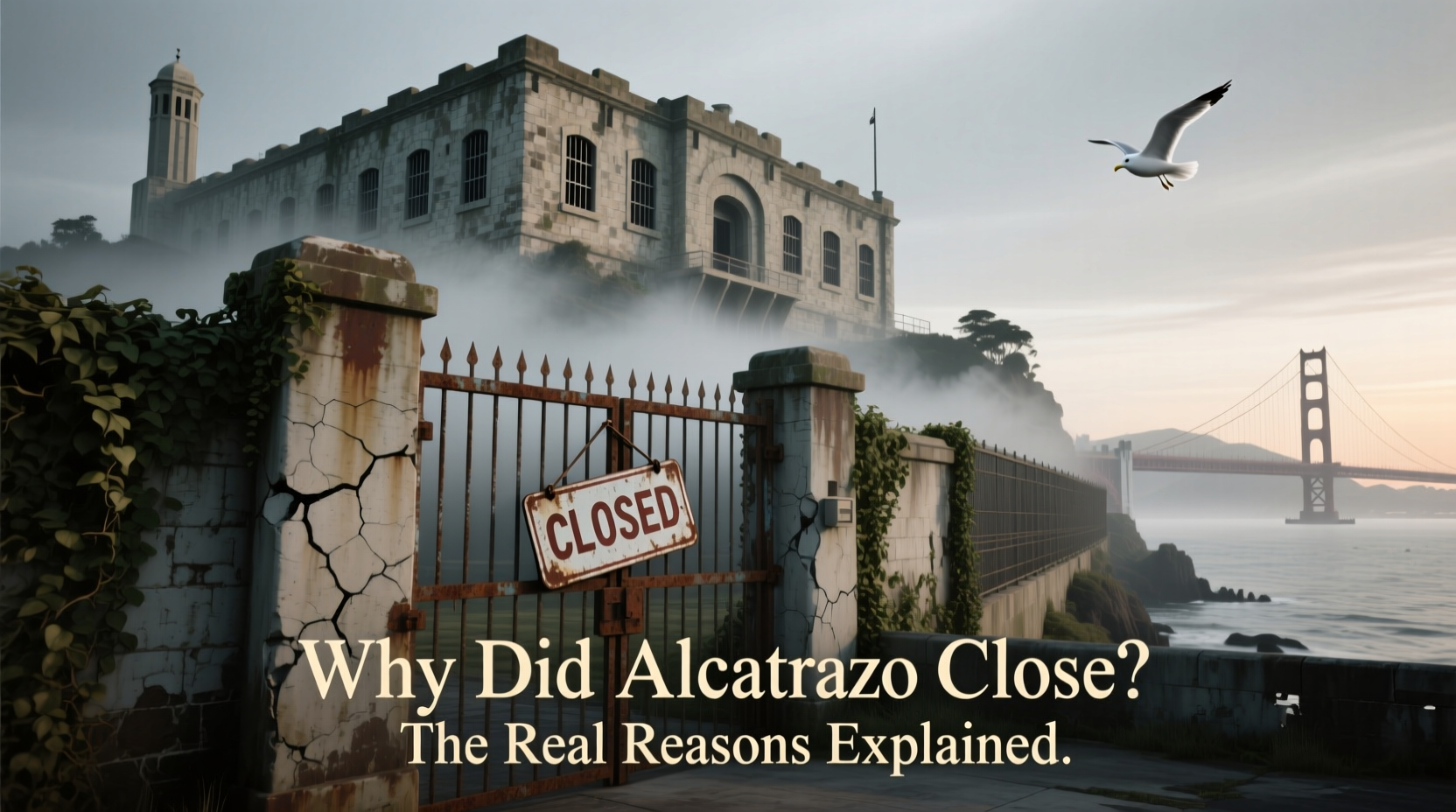
One of the most frequently cited reasons for Alcatraz’s closure was its exorbitant operating cost. Unlike mainland prisons, Alcatraz required everything—from food and water to electricity and staff—to be transported across the bay. This logistical challenge drove up expenses significantly.
Federal records from the early 1960s show that it cost nearly $10 per day to house a single inmate at Alcatraz—more than double the average cost at other federal facilities at the time. With around 250 inmates, daily expenses exceeded $2,500 (over $25,000 today when adjusted for inflation). These costs included:
- Daily barge transport of supplies and personnel
- Desalination systems to convert seawater into drinkable water
- Constant maintenance due to saltwater corrosion
- Higher staffing ratios due to security concerns
Structural Decay and Environmental Damage
Built on a barren, wind-swept island exposed to relentless Pacific weather, Alcatraz suffered from severe structural deterioration. Saltwater spray corroded metal fixtures, weakened concrete foundations, and damaged plumbing and electrical systems. By the late 1950s, repair needs had become overwhelming.
A 1959 Bureau of Prisons engineering report revealed that the prison’s heating system was failing, sewage lines were leaking into the bay, and cellhouse walls were cracking. The National Park Service later confirmed that decades of exposure had left much of the building structurally unsound.
Efforts to modernize the facility were deemed impractical. Retrofitting the aging structure with updated plumbing, insulation, and safety systems would have cost millions—money the government was unwilling to spend on a prison with declining strategic value.
“Alcatraz wasn’t just expensive—it was literally crumbling into the sea.” — Dr. Sarah Chen, Historian of American Penal Institutions
Shifting Philosophies in Criminal Justice
By the mid-20th century, the philosophy of incarceration in the United States was undergoing a transformation. The era of purely punitive justice—where prisoners were isolated and punished with little hope of rehabilitation—was giving way to more progressive models focused on reform, education, and reintegration.
Alcatraz, with its solitary confinement cells, strict silence rules, and minimal programming, represented the old guard. Inmates had limited access to vocational training, counseling, or educational opportunities. This made the prison increasingly out of step with emerging correctional standards.
The Federal Bureau of Prisons began shifting focus toward institutions that offered rehabilitative services. As J. Edgar Hoover himself noted in internal memos, “The purpose of incarceration must evolve beyond mere containment.”
| Era | Prison Philosophy | Example Facility |
|---|---|---|
| Pre-1950s | Punishment & Deterrence | Alcatraz |
| 1960s–1970s | Rehabilitation & Reform | USP Marion (early years) |
| 1980s–Present | Incapacitation & Security | ADX Florence |
Logistical Challenges and Staff Morale
Life on Alcatraz was not only hard on inmates—it was tough on staff too. Guards and administrators lived off-island and commuted daily by boat, regardless of weather. Stormy conditions often delayed shifts, disrupted supply deliveries, and created operational chaos.
Living conditions for employees were spartan. There were no recreational facilities, limited family accommodations, and constant exposure to the psychological weight of such a high-security environment. Employee turnover rose steadily in the final decade of operation.
Moreover, the isolation made emergency response difficult. Fire, medical emergencies, or riots could not be addressed quickly by outside agencies. A 1961 fire drill simulation showed that outside fire units would take over 30 minutes to arrive—far too long in a crisis.
Timeline: The Final Years of Alcatraz
- 1959: Engineering report highlights critical infrastructure failures.
- 1961: Federal audit reveals Alcatraz is the most expensive prison per inmate.
- 1962: The famous escape by Frank Morris and the Anglin brothers increases scrutiny.
- March 1963: Attorney General Robert F. Kennedy orders closure citing cost and condition.
- July 1963: Last inmate transferred; Alcatraz officially shuts down.
Mini Case Study: The 1962 Escape and Its Aftermath
The daring escape of June 1962, carried out by inmates Frank Morris and brothers John and Clarence Anglin, did not directly cause Alcatraz’s closure—but it intensified existing concerns. Using handmade tools, the men chiseled through cell walls, created dummy heads to fool guards, and launched a makeshift raft into the frigid bay. They were never found.
While the FBI concluded they likely drowned, the incident shattered the myth of Alcatraz’s infallibility. Media coverage questioned whether such a costly prison could truly be secure. More importantly, it sparked debate about whether extreme isolation actually increased desperation and ingenuity among inmates.
Internal Bureau of Prisons memos from 1962 noted, “The escape has undermined confidence in the facility’s operational integrity,” accelerating discussions about decommissioning.
Common Misconceptions About the Closure
Several myths persist about why Alcatraz closed. While some contain grains of truth, they oversimplify a multifaceted decision:
- Myth: It closed because of the 1962 escape.
Reality: The escape raised concerns but was not the primary cause. - Myth: Inmates were too dangerous to keep.
Reality: Most were transferred to other federal prisons without incident. - Myth: It was shut down due to human rights abuses.
Reality: While conditions were harsh, no formal abuse charges prompted closure.
FAQ
Was Alcatraz really escape-proof?
No prison is truly escape-proof. While Alcatraz was designed to deter escapes with its location and security, at least 14 escape attempts were recorded. The 1962 incident remains the most famous—and unresolved.
Where did the inmates go after Alcatraz closed?
Most were transferred to other federal penitentiaries, including Leavenworth, Marion, and McNeil Island. These facilities absorbed Alcatraz’s population without major issues.
Could Alcatraz have stayed open if better maintained?
Theoretically, yes—but at a prohibitive cost. Given the shift in penal policy and the availability of newer, more efficient prisons, investing in Alcatraz was seen as impractical.
Conclusion: Why the Real Reasons Matter
Alcatraz didn’t close because of a single event or scandal. It fell victim to a convergence of economic, structural, and philosophical forces. The prison was a relic of an earlier era—one that could not adapt to changing times. Its closure wasn’t just about saving money; it reflected a broader evolution in how America views justice and incarceration.
Today, Alcatraz stands as a tourist destination managed by the National Park Service, drawing over 1.5 million visitors annually. But beneath its eerie corridors and ocean views lies a deeper story: institutions, no matter how iconic, must either evolve or fade away.
🚀 What can we learn from Alcatraz’s closure? Share your thoughts in the comments below—how should society balance security, cost, and humanity in the justice system?