
Sloths are among the most iconic animals in the rainforest, not for their speed, but for their near-total absence of it. Moving at a pace that rarely exceeds 0.15 miles per hour, these arboreal mammals seem to operate on a different timeline than the rest of the animal kingdom. While their sluggishness is often the subject of humor or curiosity, it’s actually the result of a highly refined and evolutionarily successful metabolic strategy. Far from being inefficient, the sloth’s slow pace is a masterclass in energy conservation, shaped by millions of years of adaptation to a low-energy environment.
Their famously lethargic behavior isn’t due to laziness—it’s a calculated survival mechanism. By minimizing energy expenditure at every level, from movement to digestion, sloths have carved out a unique ecological niche. To understand why sloths are so slow, we must look beyond surface-level observations and examine the intricate interplay between their metabolism, diet, body temperature regulation, and environmental pressures.
The Role of Metabolism in Sloth Behavior
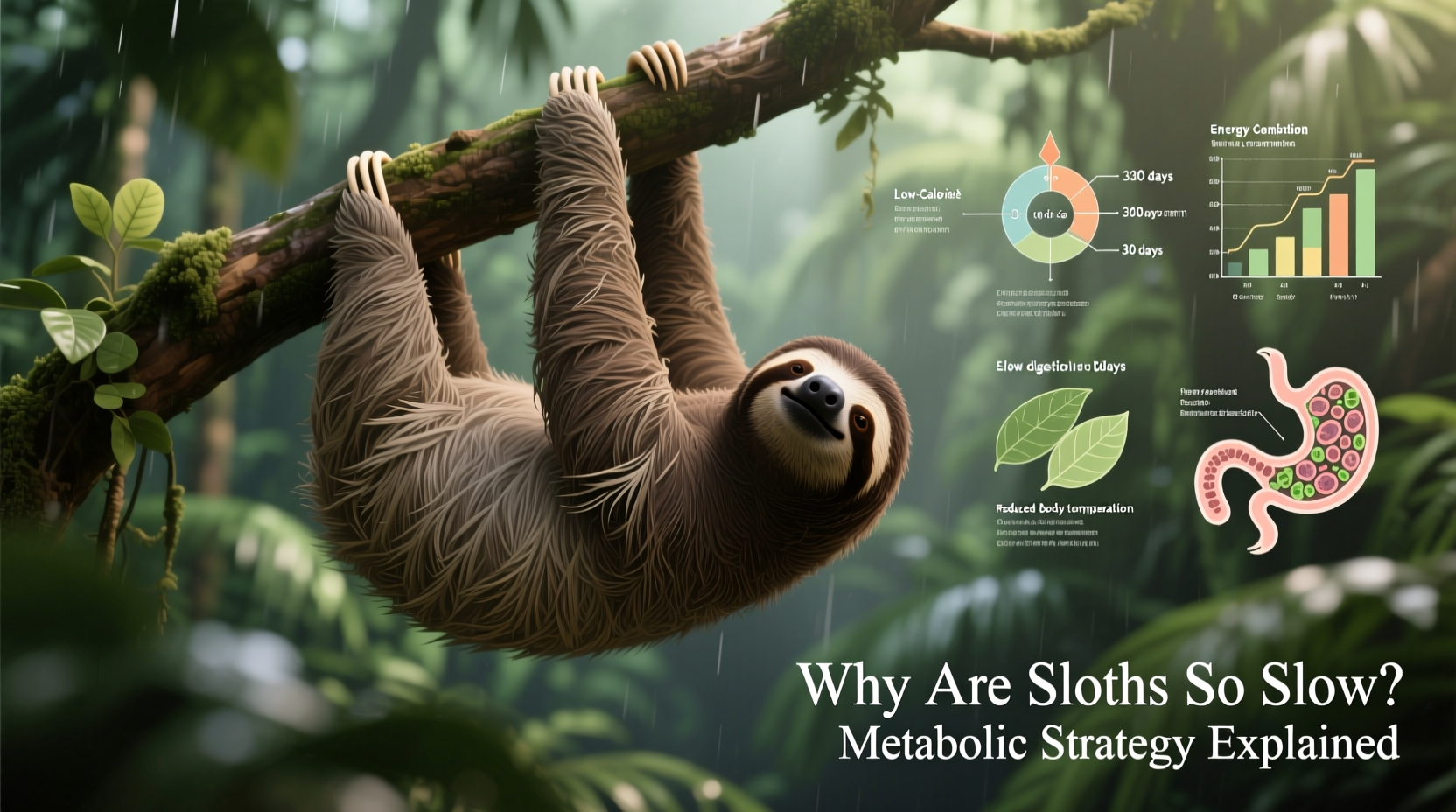
At the heart of the sloth’s slowness lies an exceptionally low metabolic rate—one of the lowest among all mammals. On average, a sloth’s metabolism operates at just 40% to 60% of what would be expected for an animal of its size. This means they burn calories at a fraction of the rate of similar-sized mammals like monkeys or rodents.
This reduced metabolic rate directly influences nearly every aspect of a sloth’s life. Because they generate less internal heat and require fewer calories to survive, sloths don’t need to eat frequently or move quickly to find food. Instead, they subsist on a diet primarily composed of leaves—a food source that is abundant in their habitat but extremely low in nutritional value and difficult to digest.
Their slow metabolism allows them to extract maximum energy from minimal intake. Where other animals might require several meals a day, a two-toed sloth may only defecate once a week, reflecting how slowly food moves through its digestive tract. In fact, digestion in sloths can take up to 30 days for a single meal—compared to mere hours in most mammals.
Tip: The key to understanding sloth behavior lies not in judging their speed, but in appreciating their energy efficiency.Diet and Digestive Adaptations
Leaves, particularly those of the Cecropia tree, form the bulk of a sloth’s diet. These leaves are high in fiber, toxic compounds, and low in calories—making them unappealing to most herbivores. However, sloths have evolved specialized digestive systems to cope with this challenging menu.
Like cows, sloths possess multi-chambered stomachs filled with symbiotic bacteria that break down cellulose over extended periods. This fermentation process is slow but effective, allowing sloths to extract nutrients from otherwise indigestible plant matter. However, because fermentation generates little energy relative to effort, the payoff is small—which reinforces the need for minimal activity.
To further conserve energy, sloths minimize unnecessary movements. They spend up to 15 to 20 hours a day resting or sleeping, and when they do move, it’s done deliberately and with minimal muscle engagement. Their long limbs and curved claws are perfectly adapted for hanging rather than walking, reducing muscular strain while maximizing energy savings.
“Sloths aren’t slow because they’re lazy—they’re slow because moving fast wouldn’t help them survive. Their entire physiology is tuned to energy scarcity.” — Dr. Rebecca Cliffe, Founder of the Sloth Conservation Foundation
Thermoregulation: Living Without a Thermostat
Unlike most mammals, sloths cannot effectively regulate their body temperature internally. They are heterothermic, meaning their body temperature fluctuates with the ambient environment. While typical mammals maintain a stable core temperature (around 98°F), sloths allow theirs to vary between 86°F and 93°F depending on external conditions.
This lack of precise thermoregulation is another energy-saving adaptation. Maintaining a constant body temperature requires significant caloric investment—something sloths simply cannot afford given their low-energy diet. Instead, they rely on behavioral thermoregulation: basking in sunlight to warm up or retreating into shade to cool down.
This dependence on external heat sources limits their activity to certain times of day and makes them vulnerable to sudden weather changes. But again, this trade-off supports their overall strategy: survive on less by doing less.
Energy Budgeting: A Life of Calculated Efficiency
Think of a sloth’s daily existence as a strict budget where calories are currency. Every action—from climbing to grooming to mating—must be justified in terms of energy cost versus benefit. This concept, known as “energy budgeting,” explains why sloths appear so inactive.
For example, a three-toed sloth may travel only 35 meters per day on average. When they do descend from trees to defecate (a risky journey that exposes them to predators), they do so only once a week and complete the process in minutes before returning to safety. Even mating encounters are brief and infrequent.
Their muscles are also adapted for efficiency. Sloths have a higher proportion of slow-twitch muscle fibers, which contract slowly but resist fatigue—ideal for sustained hanging but poor for rapid movement. Additionally, their organs are smaller relative to body size, further reducing basal energy demands.
| Physiological Trait | Function | Energy Benefit |
|---|---|---|
| Low metabolic rate | Burns fewer calories at rest | Reduces daily caloric needs by up to 60% |
| Multiphase stomach | Ferments tough leaves slowly | Maximizes nutrient extraction from poor diet |
| Heterothermy | Allows body temp to drift | Eliminates energy spent on heating/cooling |
| Slow-twitch muscles | Prolonged grip without fatigue | Minimizes exertion during hanging |
| Limited brain size | Smaller organ = lower energy use | Saves energy compared to larger-brained mammals |
Evolutionary Trade-Offs: Slowness as Survival
In evolutionary biology, trade-offs define how organisms allocate limited resources. For sloths, the trade-off has been clear: sacrifice speed and agility for enhanced survival through stealth and energy efficiency.
Their slow movements make them nearly invisible to predators like eagles and jaguars, which rely on motion detection. A sloth swaying gently in the canopy resembles a bundle of leaves more than prey. Moreover, algae grow in their fur, giving them a greenish tint that provides camouflage and even additional nutrients when licked off.
Reproduction rates are also low—females give birth to one offspring per year after a six-month gestation. But this slow reproductive cycle aligns with their overall strategy: invest minimally in each phase of life to ensure long-term sustainability.
Tip: Speed isn't always an advantage in nature—sometimes, survival favors those who move least.Mini Case Study: Observing Energy Use in Wild Sloths
In a 2012 field study conducted in Costa Rica, researchers fitted nine brown-throated sloths with GPS trackers and accelerometers to monitor their daily movements and energy expenditure. Over several weeks, data revealed that sloths used only about 370 kilocalories per day—less than half the predicted amount for a mammal of their mass.
One individual traveled just 120 meters over four days, spending 90% of its time completely motionless. Interestingly, the most energy-intensive activity wasn’t locomotion—it was raising body temperature after a cold night. This finding reinforced the idea that thermoregulation, not movement, is one of the biggest challenges for sloths in their natural habitat.
The study concluded that sloths live perpetually on the edge of energy deficit, surviving not by acquiring more resources, but by needing fewer. Their lifestyle represents one of the most extreme examples of energy minimization in terrestrial mammals.
Common Misconceptions About Sloth Slowness
Despite growing scientific understanding, myths persist about why sloths are slow. Some believe their sluggishness is due to intoxication from fermented leaves, while others assume they are unintelligent or poorly evolved. None of these hold up under scrutiny.
- Myth: Sloths are drugged by their diet.
Reality: There is no evidence of leaf fermentation producing alcohol in their guts. Their slow pace is physiological, not pharmacological. - Myth: Slow animals are less evolved.
Reality: Evolution doesn’t favor “progress” toward speed or complexity. It favors fitness—and sloths are exquisitely fit for their niche. - Myth: They sleep all day because they’re lazy.
Reality: Early studies claiming sloths sleep 15–20 hours were based on captive animals. Wild sloths rest extensively to conserve energy, not due to idleness.
Step-by-Step: How a Sloth Manages Its Daily Energy
- Wake slowly: As temperatures rise, the sloth begins to stir, relying on sunlight to raise its body temperature.
- Reach for nearby leaves: It feeds while remaining suspended, avoiding unnecessary movement.
- Digest over weeks: Food enters the multi-chambered stomach, where bacteria break down cellulose gradually.
- Conserve heat: During cooler nights, the sloth curls tightly to reduce surface area and retain warmth.
- Move only when necessary: Whether shifting to a sunnier branch or descending to defecate, motion is planned and efficient.
- Avoid predators: Stillness and camouflage serve as primary defense mechanisms.
- Rest again: After any activity, the sloth returns to inactivity to replenish its minimal energy reserves.
FAQ
Do sloths ever move quickly?
Rarely. In emergencies—such as predator threats—sloths can move faster than usual, but even then, their top speed is only slightly above normal. They generally avoid flight and instead rely on concealment.
Can sloths survive in colder climates?
No. Due to their inability to regulate body temperature and dependence on external heat, sloths cannot survive in temperate or cold environments. They are restricted to tropical forests where temperatures remain stable year-round.
Are two-toed sloths faster than three-toed ones?
Slightly. Two-toed sloths tend to be more active and have a somewhat higher metabolic rate than three-toed sloths, but both species are still considered extremely slow by mammalian standards.
Checklist: Key Factors Behind Sloth Slowness
- ✔ Low basal metabolic rate (40–60% below expected)
- ✔ Leaf-based diet requiring slow digestion
- ✔ Multi-chambered stomach with fermenting bacteria
- ✔ Inability to regulate body temperature internally
- ✔ Behavioral reliance on sun exposure for warmth
- ✔ High proportion of slow-twitch muscle fibers
- ✔ Camouflage through algae growth and minimal movement
- ✔ Weekly defecation to minimize risky ground visits
“The sloth teaches us that survival isn’t about dominance or speed—it’s about fitting perfectly into your environment.” — Jonathan Pauli, Professor of Integrative Biology, University of Wisconsin-Madison
Conclusion
The question “Why are sloths so slow?” reveals far more about human assumptions than it does about the animals themselves. We equate speed with success, activity with vitality. Yet in the dense canopies of Central and South American rainforests, success looks very different. For sloths, survival is achieved not through exertion, but through restraint.
Their slowness is not a flaw—it’s a finely tuned adaptation honed by evolution. From their sluggish digestion to their drifting body temperatures, every aspect of their biology reflects a singular goal: to thrive on as little energy as possible. In a world increasingly defined by haste and consumption, the sloth stands as a quiet testament to the power of patience, efficiency, and balance.
💬 What can we learn from nature’s ultimate energy savers? Reflect on how efficiency—not speed—might improve your own routines. Share your thoughts and insights with others exploring the wisdom of slow living.