
For decades, anime fans have been divided by a simple but passionate question: should you watch anime with subtitles (subbed) or with English voice acting (dubbed)? Traditionally, purists championed subbed versions, citing authenticity and emotional fidelity to the original Japanese performances. Dubs were often dismissed as awkward, over-the-top, or poorly timed. But in recent years, that rigid divide has begun to blur. The reason? A quiet revolution in English dubbing—driven by higher budgets, professional voice direction, and a new generation of voice actors who treat anime not as a novelty, but as serious storytelling.
The shift isn’t just about technical improvements. It reflects deeper changes in how anime is consumed, produced, and respected globally. Streaming platforms now release dubs alongside subs on day one. Major studios like Crunchyroll, Funimation (now merged), and Netflix invest heavily in localization. And audiences—especially younger viewers raised on Western animation and video games—are increasingly open to dubs as legitimate, even preferable, viewing experiences. The subbed vs dubbed debate hasn’t ended, but it’s evolving into something more nuanced: a conversation about accessibility, performance art, and cultural translation.
The Roots of the Sub vs Dub Divide
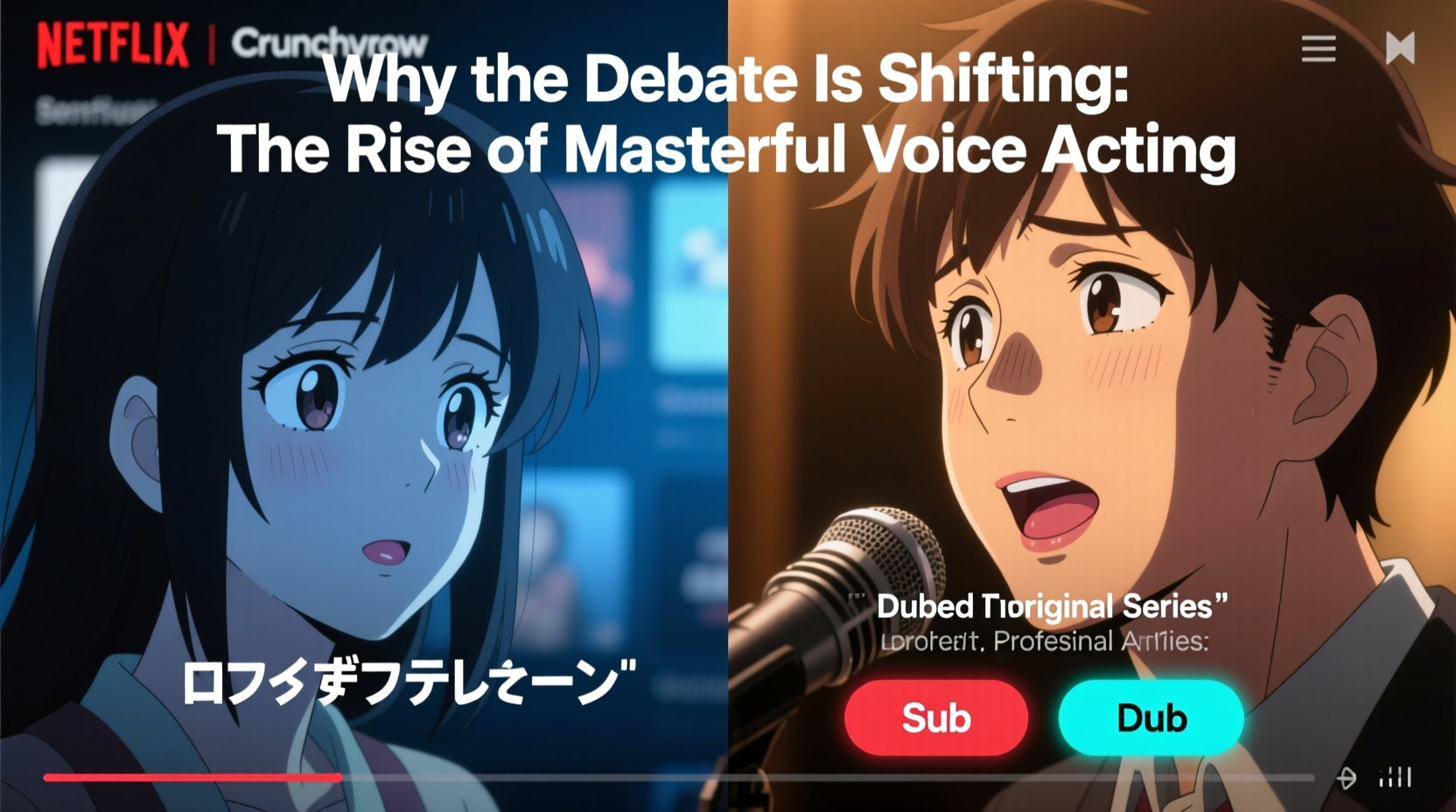
The tension between subbed and dubbed anime traces back to the early days of international distribution. In the 1980s and 1990s, anime was often licensed cheaply and adapted aggressively for Western markets. Shows like Sailor Moon and Dragon Ball Z were heavily edited—dialogue rewritten, cultural references removed, music replaced—to appeal to children’s TV standards. These changes alienated older fans and created a lasting stigma around dubs as “inauthentic” or “watered down.”
At the same time, subbed anime gained traction among niche communities who valued fidelity. Watching with subtitles meant hearing the original performances—the subtle vocal inflections, the emotional weight, the precise timing of delivery. For these viewers, the Japanese voice cast wasn’t just part of the experience; it was inseparable from it. They argued that no translation could fully capture the nuances of tone, pitch, and cultural context embedded in the original audio.
This created a hierarchy: subbed = authentic, intellectual, respectful; dubbed = commercialized, compromised, childish. That perception persisted well into the 2000s, even as some dubs began to improve. Series like Fullmetal Alchemist and Cowboy Bebop demonstrated that high-quality English dubs could be both faithful and artistically compelling. Yet they remained exceptions in a landscape still dominated by inconsistent casting and rushed post-production schedules.
Why Dub Quality Has Improved Dramatically
The turning point came in the 2010s, when streaming services began treating anime as premium content rather than disposable kids’ programming. With global audiences growing rapidly, companies realized that investing in better dubs wasn’t just nice—it was profitable. Today, major releases often feature:
- Professional voice directors with deep anime knowledge
- Experienced voice actors paid union-scale rates
- Script adaptations that preserve intent over literal meaning
- Synchronized lip-flap correction using advanced software
- Original music retention and minimal censorship
Crunchyroll’s acquisition of Funimation in 2022 consolidated resources and talent, enabling larger casting pools and more consistent production values. Meanwhile, Netflix has brought Hollywood-level budgets to select titles, hiring actors like Paul Castro Jr. (Jujutsu Kaisen) and Kayleigh McKee (Yu Yu Hakusho remake) who deliver performances rivaling their Japanese counterparts in emotional depth.
“Dubbing isn’t about replacing the original—it’s about recreating the experience for a different audience.” — Mary Elizabeth McGlynn, Voice Director & Singer (Ghost in the Shell: SAC_2045)
Take Chainsaw Man, which launched with a simultaneous dub in 2022. Its English cast—including Fairouz Ai reprising her role as Power—delivered exaggerated yet intentional performances that matched the show’s chaotic tone. Critics praised the dub for capturing the manic energy of the source material, not diluting it. Similarly, Oshi no Ko featured nuanced emotional range in its English version, particularly in scenes involving grief and identity, proving that dubs can handle complex drama just as effectively as action.
A Comparative Look: Subbed vs Dubbed in Practice
To understand the current state of the debate, consider how each format performs across key criteria:
| Criteria | Subbed Anime | Dubbed Anime |
|---|---|---|
| Authenticity | Highest—original voices, cultural context preserved | Moderate—depends on script adaptation and vocal direction |
| Accessibility | Lower—requires reading ability and focus | Higher—immediate auditory comprehension |
| Emotional Impact | Strong when viewer connects with original performance | Can match or exceed subs with skilled casting |
| Lip Sync Accuracy | N/A—text appears regardless of mouth movement | Now highly accurate due to digital correction tools |
| Viewing Comfort | Tiring for long sessions; requires visual attention | More relaxed; ideal for multitasking or casual viewing |
| Global Reach | Limited to literate audiences | Expands access to children, elderly, dyslexic viewers |
Real Example: How Jujutsu Kaisen Changed Minds
When Jujutsu Kaisen premiered in 2020, many fans assumed the English dub would fail to capture the intensity of Megumi Fushiguro’s stoicism or Gojo Satoru’s charismatic flair. Early skepticism was common. But within weeks, the dub gained viral attention—not for being “good for a dub,” but for standing shoulder-to-shoulder with the original.
Adam McArthur, voicing protagonist Yuji Itadori, balanced youthful energy with raw vulnerability during pivotal moments like Sukuna’s possession. His scream in Episode 14 became a meme, yes—but also a testament to vocal commitment. Meanwhile, Kaiji Tang’s portrayal of Gojo blended arrogance, humor, and gravitas in a way that resonated deeply with fans.
On Reddit and Twitter, longtime sub-only viewers admitted switching to the dub mid-season. One user wrote: “I started with subs, but after Episode 7, I couldn’t stop thinking about how good the English voices sounded. Now I alternate depending on my mood.” This kind of conversion story has become increasingly common, signaling a cultural shift in what fans expect—and accept—from dubs.
Changing Audience Expectations and Viewing Habits
Demographics play a crucial role in the changing debate. Gen Z and younger Millennials grew up with streaming, where autoplay and algorithm-driven recommendations favor passive consumption. Reading subtitles demands active engagement; dubs allow for background viewing, shared experiences, and easier access for non-native English speakers.
Moreover, many young viewers don’t carry the historical baggage of past dub controversies. They didn’t endure the 90s-era edits of Sailor Moon or the infamous “It’s Over 9000!” moment from Dragon Ball Z. To them, a well-made dub isn’t a betrayal—it’s another valid interpretation.
Platforms are responding accordingly. Crunchyroll now prioritizes same-day dubs for flagship titles. Netflix localizes anime into multiple languages, including Spanish, German, and French dubs, recognizing that global audiences expect native-language options. Even traditionally sub-focused regions like parts of Europe are seeing increased demand for localized audio.
Checklist: How to Choose Between Subbed and Dubbed
Instead of defaulting to one format, consider these factors when deciding how to watch:
- Evaluate the studio: Check if the dub is produced by Crunchyroll, Bang Zoom!, or Studiopolis—known for high standards.
- Sample both versions: Watch the first 10 minutes of each to compare pacing and emotion.
- Consider the genre: Action-heavy shows may benefit from dub immersion; dialogue-driven dramas might feel more authentic in Japanese.
- Assess your focus level: Are you watching attentively or while doing chores? Dubs work better for low-attention scenarios.
- Check fan reception: Look at forums like r/anime to see if the dub is widely praised or criticized.
- Try bilingual viewing: Use subtitles with the dub to catch nuances without losing immersion.
Frequently Asked Questions
Is it okay to prefer dubs over subs?
Absolutely. Preference is personal. With modern dubs matching the quality of originals, there’s no “wrong” way to enjoy anime. Accessibility, comfort, and emotional connection matter more than ideological purity.
Do Japanese creators care about English dubs?
Many do. Directors like Hideaki Anno (Evangelion) and Tite Kubo (Bleach) have expressed appreciation for respectful dubs. Some even attend recording sessions or provide feedback. While the original is always primary, creators increasingly recognize dubs as extensions of their work’s global reach.
Are dubs still censored?
Rarely in premium releases. Most modern dubs retain violence, themes, and dialogue intact. However, children’s programming on broadcast TV may still undergo edits. Always check the distributor—streaming-exclusive dubs are typically uncensored.
The Future of Anime Localization
The line between subbed and dubbed anime will continue to blur. Advances in AI-assisted lip-syncing and real-time translation could one day enable dynamic dubbing that adapts to viewer preferences. We’re already seeing hybrid models: some platforms offer “simuldubs” within weeks of a Japanese premiere, closing the gap that once gave subs a monopoly on timeliness.
More importantly, the conversation is maturing. Rather than asking “Which is better?” fans are beginning to ask, “What does this version add?” A great dub isn’t a copy—it’s a reinterpretation. Just as stage productions differ from films, or translated novels carry unique rhythms, dubs offer alternative lenses through which to experience a story.
Voice actors are gaining recognition as performers in their own right. Awards like the Behind the Voice Actors (BTVA) People’s Choice Awards spotlight standout roles, helping legitimize dubbing as an art form. As union protections strengthen and career longevity increases, we’ll likely see even greater consistency and depth in future casts.
Tip: Support voice actors by following them on social media, attending conventions, or purchasing official merchandise. Their work makes anime accessible to millions.Conclusion
The subbed vs dubbed debate no longer hinges on quality alone. It’s shifting toward questions of accessibility, intention, and personal preference. While nothing replaces the original performance, today’s best dubs are no longer inferior—they’re complementary. They invite new audiences into the world of anime, honor the emotional core of stories, and prove that excellent voice acting transcends language.
Whether you read every word or let the voices carry you, what matters most is connection—to characters, to themes, to the art itself. The next time you press play, don’t feel bound by old rules. Try the other format. Listen closely. You might discover that the story speaks to you just as clearly in English as it does in Japanese.
🚀 Ready to rethink your anime habits? Pick a show you love, switch formats, and experience it anew. Then share your thoughts—has better voice acting changed your mind?