The absence of Russia from the official medal tables and national ceremonies at the 2024 Paris Olympics has raised questions worldwide. While some Russian athletes will participate, they will do so under strict conditions—without their flag, anthem, or national identity. This exclusion stems from a complex web of geopolitical conflict, doping violations, and international sanctions that have unfolded over nearly a decade. Understanding why Russia is effectively banned from the 2024 Olympics requires unpacking both historical precedents and current global policies.
Background: The Origins of Russia’s Olympic Sanctions
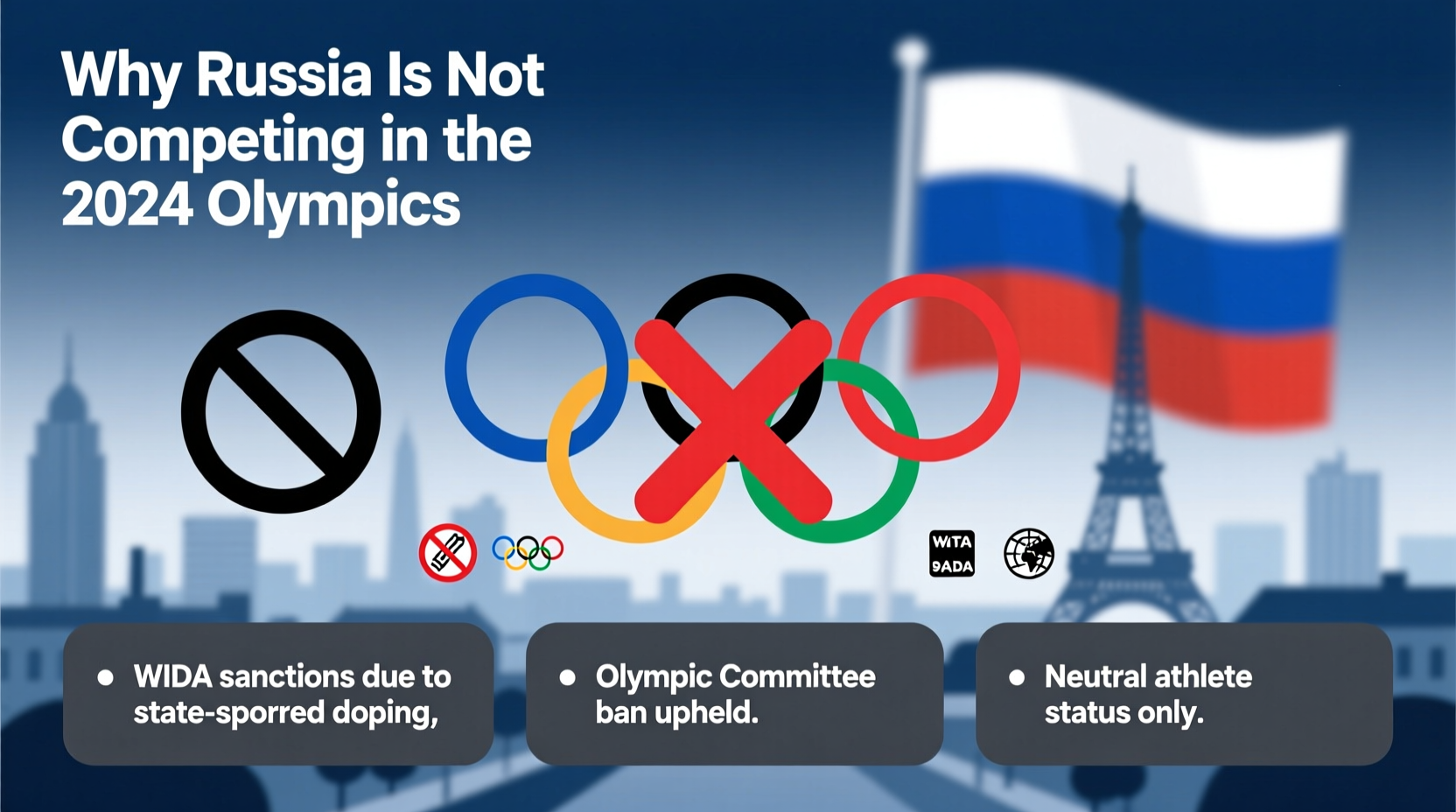
The roots of Russia’s current Olympic ban trace back to 2015, when allegations of state-sponsored doping were first exposed by the World Anti-Doping Agency (WADA). A subsequent investigation led by Canadian lawyer Richard McLaren confirmed that between 2011 and 2015, hundreds of Russian athletes benefited from a systematic cover-up involving tampered samples, forged documents, and collusion with government officials.
In response, WADA imposed sanctions in 2019 banning Russia from all major international sporting events for four years. Though partially overturned by the Court of Arbitration for Sport (CAS), the ruling still prohibited Russia from hosting, bidding for, or representing itself under its national symbols at events like the Olympics and World Championships.
The 2022 invasion of Ukraine intensified these restrictions. The International Olympic Committee (IOC) urged all international federations to exclude Russian and Belarusian athletes and officials from competitions, citing the “integrity of sport” and safety concerns. While outright blanket bans have since been relaxed, participation remains conditional and highly restricted.
Current Status: How Russian Athletes Can Compete in 2024
Russian athletes are not entirely barred from the 2024 Summer Games—but their participation comes with significant limitations:
- They cannot compete under the Russian flag.
- The national anthem will not be played if they win.
- Team uniforms must not display national symbols, colors, or emblems.
- All competitors must qualify individually and be vetted for neutrality.
Athletes who meet IOC criteria may compete as \"Individual Neutral Athletes\" (AINs), a designation created specifically for those from Russia and Belarus. To qualify, they must not actively support the war in Ukraine, not be contracted to military or state security agencies, and comply with anti-doping regulations.
As of mid-2024, fewer than 30 Russian athletes have been approved to compete under the AIN banner across various disciplines, including athletics, gymnastics, and swimming. Their names appear without country affiliation; on leaderboards, they are listed as “AIN” rather than “RUS.”
Tip: When watching the 2024 Olympics, look for 'AIN' next to athlete names instead of national flags—this indicates neutral status due to ongoing sanctions.Timeline of Key Events Leading to the 2024 Ban
- 2015: WADA suspends the Russian Anti-Doping Agency (RUSADA) after evidence of widespread manipulation emerges.
- 2016: The IOC allows Russian athletes to compete in Rio under strict testing protocols, but bans the track and field team.
- 2018: At the PyeongChang Winter Games, cleared Russians compete as \"Olympic Athletes from Russia\" (OAR).
- 2019: WADA imposes a four-year ban on Russia for non-compliance and data tampering.
- 2020: CAS reduces the ban to two years, allowing neutral participation until December 2022.
- 2022: Following the invasion of Ukraine, the IOC recommends full suspension of Russian and Belarusian teams.
- 2023–2024: IOC establishes Individual Neutral Athlete pathway with stringent eligibility checks.
Expert Insight: Why Neutrality Matters
“Allowing individual athletes to compete while excluding national representation strikes a balance between fairness and accountability. We protect clean sport without punishing individuals for actions beyond their control.” — Dr. Linda Hofmann, Senior Advisor at the European Institute for Sports Governance
This nuanced approach reflects growing pressure on sports bodies to remain politically neutral while upholding ethical standards. The IOC maintains that sport should not be used as a tool of propaganda, especially during times of armed conflict. Allowing Russian athletes under a neutral banner acknowledges their personal achievements while distancing the Games from state endorsement.
Comparison Table: Russian Participation Across Recent Olympics
| Olympics | Status | National Symbols? | Team Name Used | Notes |
|---|---|---|---|---|
| 2016 Rio | Limited participation | No (for some teams) | Russia (with exceptions) | Athletics team fully banned; others competed under normal conditions after review. |
| 2018 PyeongChang | Neutral participation | No | Olympic Athletes from Russia (OAR) | Banned due to doping scandal; only clean athletes invited. |
| 2020 Tokyo | Neutral participation | No | Russian Olympic Committee (ROC) | Doping-related ban in effect; ROC allowed as transitional entity. |
| 2024 Paris | Highly restricted individual entries | No | AIN (Individual Neutral Athletes) | No team events; no public support from Russian institutions permitted. |
Frequently Asked Questions
Can Russian athletes win medals in 2024?
Yes, but any medals won by Individual Neutral Athletes will not count toward an official national tally. There will be no flag-raising or anthem ceremony if they finish on the podium.
Why aren’t all Russian athletes banned?
The IOC distinguishes between state actions and individual responsibility. Athletes who can prove they are untainted by doping programs or military affiliations—and who do not publicly support the war—are considered eligible on a case-by-case basis.
Will Russia be allowed back in future Olympics?
Potential reinstatement depends on several factors: improved compliance with anti-doping rules, geopolitical developments, and decisions by international sports federations. Full return could take years, assuming conditions improve significantly.
Mini Case Study: Darya Klishina – A Precedent for Neutral Athletes
Darya Klishina, a Russian long jumper, set a precedent during the 2016 Rio Olympics. While most Russian track and field athletes were banned due to systemic doping, Klishina was allowed to compete because she lived and trained in the United States and underwent regular drug testing outside Russia.
She competed under the Russian flag in Rio but faced intense scrutiny. Her experience highlighted how individual circumstances can diverge from national narratives. Today’s AIN policy builds on such cases, formalizing pathways for athletes disconnected from state misconduct.
Actionable Checklist: Understanding Neutral Athlete Policies
- ✅ Verify whether an athlete competes under a national or neutral designation.
- ✅ Check official Olympic results for “AIN” or similar codes instead of country abbreviations.
- ✅ Avoid assuming political stance based on participation—neutral athletes must renounce military ties and war support.
- ✅ Follow updates from WADA and IOC on eligibility criteria changes.
- ✅ Support clean sport initiatives that prioritize transparency and fairness.
Conclusion: The Future of International Sport in a Divided World
The exclusion of Russia from official representation at the 2024 Olympics underscores the evolving role of sports in global politics. While competition remains open to individuals meeting rigorous standards, national pride cannot override accountability for unethical conduct.
This moment challenges fans, athletes, and administrators alike to reflect on what sport represents: unity, excellence, and integrity. As new models like the AIN framework emerge, they offer a path forward—one that protects the spirit of fair play without closing doors to redemption.
🚀 Stay informed. Question narratives. Celebrate clean athletes. Share this article to help others understand the truth behind Russia’s Olympic absence in 2024.