There’s a persistent cultural myth: that moonshine — clear, unaged, often homemade whiskey — is the “authentic” or “purer” ancestor of bourbon, and that crafting it yourself is a noble, cost-effective shortcut to premium spirit enjoyment. Meanwhile, craft bourbon commands $45–$90 per bottle, with tasting notes like “caramelized pear,” “blackstrap molasses,” and “charred oak vanillin.” But does the romanticized DIY narrative hold up under scrutiny? Not in law, not in safety, not in sensory experience — and certainly not in consistency. This isn’t about dismissing tradition; it’s about separating folklore from fact, and understanding why the regulated, transparent, and patient work of craft distillers delivers something fundamentally different — and more valuable — than what most homemade stills produce.
The Legal and Safety Chasm
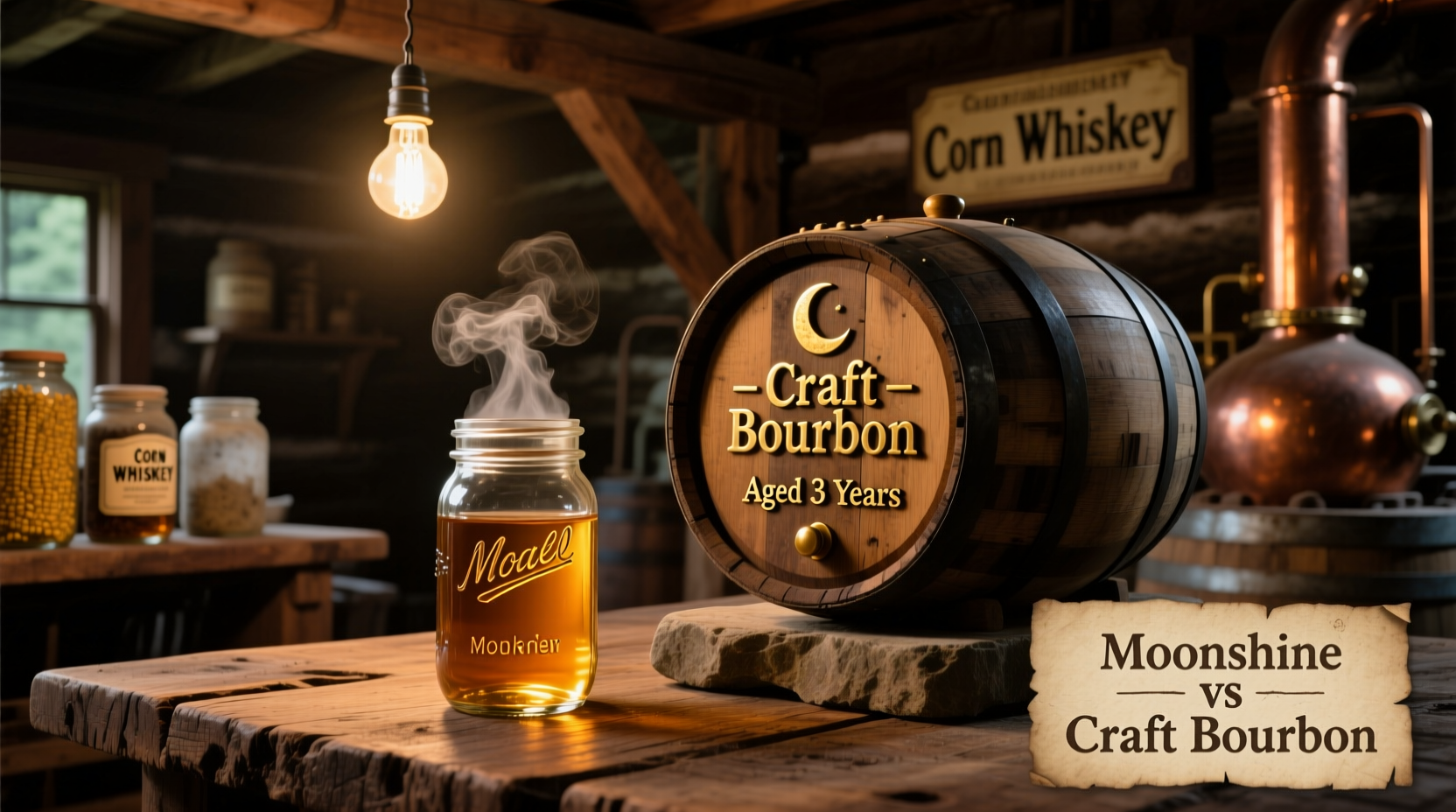
Legally, there is no such thing as legal, non-commercial “moonshine” in the United States. Federal law (26 U.S.C. § 5601) prohibits distillation of spirits for personal consumption without a federal distilled spirits plant permit — a rigorous, multi-year process requiring facility inspections, bonded storage, tax reporting, and compliance with the Alcohol and Tobacco Tax and Trade Bureau (TTB). What’s sold as “moonshine” in stores — like Ole Smoky or Junior Johnson’s — is legally defined as unaged corn whiskey, produced under full regulatory oversight. It is *not* illicitly made, nor is it historically accurate moonshine.
True homemade distillation carries serious, documented risks. Methanol — a toxic byproduct of fermentation and distillation — concentrates early in the distillation run (“foreshots”). Without precise temperature control, calibrated reflux columns, and lab-grade testing equipment, home distillers cannot reliably separate methanol from ethanol. The CDC reports dozens of methanol poisoning cases annually linked to unregulated spirits, including permanent blindness and fatalities. In contrast, every batch of licensed craft bourbon undergoes third-party lab analysis for congeners, heavy metals, and fusel oils before bottling.
Tip: If you see a “homemade moonshine” kit advertised online, it’s almost certainly marketing illegal activity. Legitimate home distillation kits are restricted to water purification or essential oil extraction — never alcohol production.What Bourbon Actually Is — And Why Moonshine Isn’t Its “Raw Form”
Bourbon isn’t just aged moonshine. It’s a tightly defined American whiskey with six statutory requirements: (1) made in the U.S., (2) mash bill of ≥51% corn, (3) distilled to no more than 160 proof (80% ABV), (4) entered into new, charred oak barrels at ≤125 proof (62.5% ABV), (5) aged in those barrels (no minimum time unless labeled “straight bourbon,” which requires ≥2 years), and (6) bottled at ≥80 proof (40% ABV).
Moonshine — even when legally produced — meets none of these aging or barrel requirements. It’s typically distilled to higher proofs (180–190+), filtered through charcoal (like Tennessee whiskey), and bottled immediately. The result is a spirit dominated by raw grain character and volatile esters — sharp, hot, and one-dimensional. Bourbon, by contrast, undergoes transformative chemical reactions during aging: lignin breaks down into vanillin, hemicellulose yields caramel and nutty furans, and tannins polymerize into smoother mouthfeel. These changes cannot be rushed or faked.
“People call unaged corn whiskey ‘moonshine,’ but it’s really just unfinished bourbon — like serving raw dough instead of baked bread. Time in wood isn’t optional; it’s where the magic happens.” — Dr. Nicole Martin, Whiskey Chemist & Former TTB Sensory Panel Lead
A Side-by-Side Reality Check: Flavor, Consistency, and Craft
Let’s compare how these two categories perform across measurable dimensions — not on nostalgia, but on objective criteria that matter to drinkers.
| Criterion | Craft Bourbon (e.g., Four Roses Small Batch, Wilderness Trail, New Riff) | Commercial “Moonshine” (e.g., Ole Smoky, Sugarlands) | Homemade Distillate (Unregulated) |
|---|---|---|---|
| Flavor Complexity | Layered: grain, oak, spice, fruit, smoke, baking spice; evolves on palate | Limited: dominant corn sweetness, ethanol heat, occasional citrus or grassy top notes | Highly variable: often solvent-like, vegetal, or acrid; may contain off-notes from poor cuts or contamination |
| Consistency (Batch-to-Batch) | Extremely high: standardized yeast strains, fermentation controls, barrel rotation, blending protocols | Moderate: commercial scale allows quality control, but minimal aging means less margin for error | Very low: ambient temperature shifts, inconsistent fermentation times, uncalibrated stills, subjective cut decisions |
| Proof Management | Precise: barreling and bottling proofs tracked to 0.1%; dilution with limestone-filtered water | Often adjusted post-distillation; some brands add sugar or glycerin for mouthfeel | Typically undiluted or crudely diluted; prone to uneven ABV (e.g., 110–145 proof in same batch) |
| Regulatory Oversight | Full TTB compliance: label approval, formula registration, tax payment, annual audits | Same TTB oversight as any distilled spirit — legally identical to unaged corn whiskey | No oversight: no testing, no labeling, no accountability |
| Price Transparency | Reflects true costs: grain, cooperage ($200+ per barrel), labor, aging loss (“angel’s share”), taxes, compliance | Lower input costs (no barrel expense, minimal aging), but markup reflects branding and tourism-driven demand | Appears “cheap” until accounting for copper still cost ($1,200–$5,000), failed batches, safety gear, and potential legal penalties |
A Real-World Case Study: The Knoxville Distillery Experiment
In 2021, a group of home distillers in East Tennessee partnered with the University of Tennessee’s Fermentation Science Lab to test a common claim: “Our homemade corn whiskey, aged 6 months in a 2-liter charred oak barrel, tastes just like small-batch bourbon.” Twelve participants submitted samples — all using identical corn-molasses mash bills and 5-gallon pot stills. Each sample was blind-tasted by a panel of three certified bourbon judges and analyzed via gas chromatography.
Results were telling. Ten of twelve samples showed elevated levels of propanol and isobutanol — fusel alcohols associated with harsh, solvent-like heat and hangover severity. None achieved detectable levels of vanillin or syringaldehyde (key oak-derived compounds that require extended, stable barrel contact). Eight samples contained trace ethyl carbamate — a carcinogen formed when urea (from stressed yeast) reacts with ethanol — above FDA-recommended thresholds. When asked to identify “bourbon-like” characteristics, judges unanimously rated all samples as “unbalanced,” “ethanol-forward,” and “lacking mid-palate development.” One judge noted, “It’s not bad corn whiskey — it’s just not bourbon. You can’t rush chemistry.”
What *Is* Worth Your Time and Money — A Practical Path Forward
If you love the idea of hands-on spirit engagement, skip the still and invest in verifiable craft. Here’s how to build real value and knowledge — safely and legally.
- Visit licensed craft distilleries — Most offer tours explaining grain sourcing, fermentation timelines, barrel selection, and blending logic. Ask questions about their yeast strain library or warehouse rotation.
- Start a tasting journal — Compare bourbons aged 2, 4, and 8 years from the same distillery. Note how tannin softens, oak influence deepens, and ethanol heat recedes.
- Learn cocktail craftsmanship — Make an Old Fashioned with a high-rye bourbon versus a wheated one. Taste how rye’s spiciness cuts through sugar, while wheat adds silkiness.
- Support transparency — Choose brands that disclose age statements, mash bills, and barrel entry proof (e.g., Michter’s, Barrell Craft Spirits, Chicken Cock).
- Explore legal alternatives to distilling — Home fermentation of wine or beer is federally permitted (with limits). You’ll learn yeast behavior, pH management, and sanitation — foundational skills that *actually* transfer to professional distilling.
FAQ: Clearing Up Common Misconceptions
Is “legal moonshine” the same as historical Appalachian moonshine?
No. Historical moonshine was illicit, unregulated, and often dangerous — made in secrecy with whatever equipment was available. Today’s commercial “moonshine” is a branded, taxed, lab-tested product designed for shelf appeal. Its flavor profile is intentionally simplified and sweetened to broaden appeal — the opposite of rugged authenticity.
Can I age store-bought moonshine in a small barrel to make bourbon?
No — and here’s why: bourbon must be *distilled* to ≤160 proof and *entered into the barrel* at ≤125 proof. Commercial moonshine is typically 100–125 proof *after* distillation and dilution — meaning it likely exceeded 125 proof at barrel entry, violating the legal definition. More importantly, a 1-liter barrel ages 10–15x faster than a standard 53-gallon barrel, leading to overwhelming oak tannin and bitterness within weeks. Real aging requires thermal mass, slow oxygen exchange, and time — none of which fit a countertop barrel.
Why do some craft distilleries sell both bourbon and moonshine?
It’s a business strategy — not a philosophical statement. Moonshine offers faster cash flow (no aging inventory), appeals to cocktail mixers and novices, and serves as a gateway product. But reputable distilleries treat them as distinct categories: their bourbon program follows strict aging protocols and quality gates, while their moonshine line is developed separately for brightness and mixability. Never assume the former validates the latter.
The Bottom Line: Respect the Process, Not the Myth
The allure of moonshine is understandable — it evokes self-reliance, regional pride, and rebellion against industrial uniformity. But reverence shouldn’t override responsibility. True craft isn’t about bypassing rules; it’s about mastering them. Every drop of well-made bourbon represents hundreds of decisions: selecting drought-resistant heirloom corn, monitoring fermentation pH to suppress off-flavors, rotating barrels across warehouse floors to balance climate exposure, and tasting hundreds of samples to find the precise moment a barrel has given its best. That depth doesn’t emerge from a weekend still setup — it emerges from decades of accumulated knowledge, shared openly among distillers, refined by regulators, and validated by generations of drinkers.
So skip the copper coil and the YouTube tutorial promising “bourbon in 30 days.” Instead, buy a bottle of Four Roses Single Barrel, pour two fingers neat, and taste the 12 years it took to transform corn and oak into something complex, balanced, and alive. Then visit a local craft distillery — ask about their fire insurance policy (most won’t insure stills without TTB compliance), their yeast propagation schedule, or how they manage angel’s share loss. That’s where real appreciation begins: not in myth, but in meticulous, accountable, human-scale making.
💬 Your turn: Have you visited a craft distillery that changed how you think about bourbon? Share your experience — what surprised you most about the process? Let’s keep the conversation grounded in reality, not romance.