
From the misty backwoods of Appalachia in Red Dead Redemption 2 to the ramshackle workshops of Fallout 76, moonshine stills appear frequently in video games—not as background props, but as interactive systems players can build, upgrade, and even “brew” with. These digital stills promise authenticity: copper coils, bubbling mash pots, and the satisfying *clink* of a mason jar filling with clear, potent liquor. But behind the pixelated steam and stylized copper lies a deeper question: do these representations hold up to real-world distillation science, historical accuracy, or even basic safety logic? The answer isn’t binary—it’s layered, revealing how game design balances pedagogy, playability, and perilous mythmaking.
1. The Core Mechanics: What Games Actually Simulate (and What They Ignore)
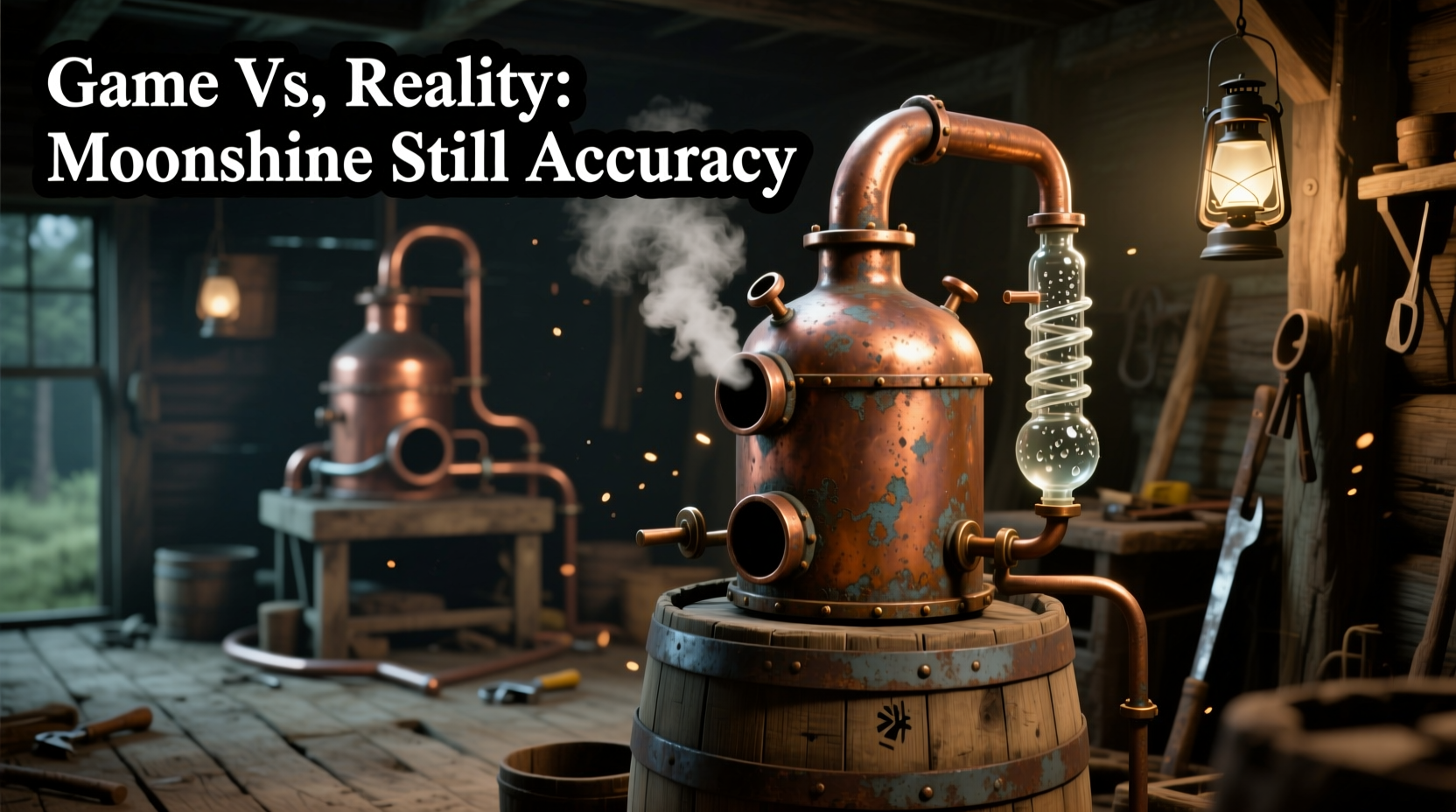
Most games that feature moonshine stills treat distillation as a resource-crafting loop: gather corn or sugar, ferment it into mash, heat it in a still, collect output. In Fallout 76, players assemble modular stills from scrap metal, adjust temperature dials, and monitor “purity” meters. In Red Dead Redemption 2, Arthur Morgan stirs mash vats, monitors fermentation time, and tends a pot still beside a roaring fire—complete with realistic condensation on copper tubing. Yet critical physical and chemical realities vanish behind the interface.
Real distillation hinges on precise temperature control within narrow bands: ethanol boils at 78.4°C (173.1°F), while water boils at 100°C (212°F) and methanol—a highly toxic byproduct of fermentation—boils at just 64.7°C (148.5°F). A real still operator must discard the first 5% of distillate (“foreshots”) to remove methanol and other volatiles. No major game implements this step. None require users to test for methanol using a copper wire flame test (which turns green if methanol is present) or use hydrometers to measure alcohol-by-volume (ABV). Instead, purity is abstracted into a slider or color-coded bar—functionally indistinguishable from upgrading a weapon’s damage stat.
Tip: Real moonshiners never skip the foreshots—discarding the first 30–50 mL per 5-gallon batch is non-negotiable for safety. Games omitting this step unintentionally normalize dangerous behavior.2. Material Accuracy: Copper, Stainless Steel, and the Myth of the “Classic Still”
Video games overwhelmingly favor copper for still construction—especially coil condensers and domes. This aligns with reality: copper reacts with sulfur compounds produced during fermentation, removing off-flavors and producing smoother spirit. But games rarely distinguish between functional copper and decorative copper. In Kingdom Come: Deliverance, players craft a “copper alembic” using medieval-era smithing mechanics—but historically, true copper alembics were rare in rural 15th-century Bohemia; most folk used clay, wood, or repurposed iron kettles. More critically, no game addresses copper’s reactivity with acidic mashes: prolonged contact with low-pH ferments can leach copper ions, causing nausea, liver strain, and blue-green discoloration of the final product.
Conversely, modern commercial and hobbyist distillers increasingly use food-grade stainless steel for boiler vessels—durable, non-reactive, and easy to clean. Yet stainless steel appears almost nowhere in game stills, sacrificed for visual shorthand: copper = authentic, rustic, “real.” This aesthetic choice flattens material science into folklore.
| Feature | Video Game Depiction | Real-World Standard |
|---|---|---|
| Boiler Material | Almost always copper or generic “metal” | Stainless steel (304/316 grade) or copper-lined steel; pure copper only for small-scale or traditional setups |
| Condenser Cooling | Passive “steam vents” or ambient animation; no coolant flow | Continuous cold-water circulation (counterflow or shell-and-tube); temperature differential critical for reflux |
| Temperature Control | Slider or “heat level” icon; no calibration or monitoring | Digital thermocouples at multiple points (pot, column, condenser outlet); manual or PID-controlled heating |
| Safety Features | None depicted—no pressure relief, no vapor leak detection, no grounding | Pressure-relief valves, explosion-proof wiring, static-grounding clamps, ventilation hoods (especially for indoor use) |
| Output Measurement | “Purity” % or “strength” meter; jars fill automatically | Hydrometer or refractometer readings; ABV calculated via proofing tables; legal limits enforced (e.g., US federal law prohibits >190 proof / 95% ABV without special licensing) |
3. Historical Context vs. Hollywood Stereotype
Game stills often double as narrative shorthand for rebellion, poverty, or frontier ingenuity—but they rarely reflect the socioeconomic complexity of real moonshining. During Prohibition, Appalachian stills weren’t just hidden in hollows; they were integrated into community economies, with families rotating guard duty, doctors prescribing “medicinal whiskey,” and sheriffs turning blind eyes—for a cut. In contrast, Red Dead Redemption 2 reduces still operation to a solo, transactional activity: pay $20, wait 12 in-game hours, collect profit. There’s no depiction of the labor-intensive grain grinding, the risk of spoilage in warm weather, or the constant threat of ATF raids (depicted in-game as generic “lawmen” who never inspect equipment).
A more nuanced portrayal appears in the indie title Still Life (2021), where players manage a Depression-era Tennessee family’s still across seasons. Frost cracks copper coils in winter, summer humidity causes yeast mutations, and neighbors trade labor for shares—not cash. Though fictionalized, it acknowledges distillation as ecology, not just chemistry.
“The biggest inaccuracy isn’t the copper or the coil—it’s the silence. Real stills hum, hiss, drip, and smell like wet grain and hot metal. They demand attention every 15 minutes. Games make them ‘set and forget.’ That’s not distilling—that’s wishful thinking.” — Dr. Lena Torres, Historian of American Craft Distilling, Appalachian State University
4. Safety Omissions: When Gameplay Ignores Life-Threatening Realities
This is where artistic license crosses into ethical concern. Real still operation carries three primary hazards: fire, explosion, and poisoning. Ethanol vapor is highly flammable (flash point: 13°C / 55°F); a spark from a faulty switch, static discharge, or pilot light can ignite an entire room. Methanol poisoning—caused by improper cuts or contaminated yeast—can cause permanent blindness or death. And pressurized stills without relief valves can rupture violently.
Yet games consistently erase these risks. Players place stills indoors next to torches (Minecraft mods), operate them inside wooden cabins (Red Dead Redemption 2), or leave them unattended for days (Fallout 76). None implement vapor detectors, grounding protocols, or mandatory outdoor placement—even though real-world codes (like the International Fire Code) require Class I, Division 1 hazardous location compliance for any still producing over 1 gallon per day.
The omission isn’t trivial. In 2022, the CDC reported 127 cases of methanol poisoning linked to illicitly distilled spirits in the U.S.—many involving homemade stills built from pressure cookers and tubing, echoing the crude designs seen in games. When entertainment normalizes unsafe setups without context, it risks shaping real-world behavior.
5. A Practical Reality Check: What You’d Actually Need to Build a Legal, Safe Still
For readers curious about real-world distillation—not as fantasy, but as craft—the gap between game logic and regulatory reality is stark. Here’s what a compliant, functional setup requires today:
- Licensing: A federal Distilled Spirits Plant (DSP) permit from the TTB (Alcohol and Tobacco Tax and Trade Bureau), plus state-level licenses. Cost: $5,000–$15,000+ in fees and bonding; processing time: 6–18 months.
- Facility Requirements: Dedicated, ventilated space with explosion-proof electrical, fire suppression, and vapor monitoring. No residential basements or garages permitted under federal code.
- Equipment Standards: ASME-certified pressure vessels, NSF-approved gaskets and seals, calibrated thermometers and hydrometers, and documented cleaning logs traceable to FDA Food Safety Modernization Act (FSMA) standards.
- Testing Protocols: Third-party lab analysis for congeners, heavy metals, and methanol before any product leaves the facility. Every batch requires a Certificate of Analysis.
- Waste Disposal: Spent grain (stillage) must be processed per EPA regulations—no dumping into streams or fields, as commonly implied in game environments.
This framework exists for good reason: distillation is industrial chemistry, not cooking. Games compress it into a 90-second minigame because simulating bureaucracy, liability insurance, and microbiological testing wouldn’t serve gameplay. But recognizing that compression—as design necessity, not educational failure—is key to understanding the medium’s limits.
Mini Case Study: The “Corn Whiskey” Incident in Appalachia, 2019
In spring 2019, a group of college students in West Virginia attempted to build a still inspired by Fallout 76. Using a pressure cooker, copper tubing, and a garden hose for cooling (a common YouTube tutorial setup), they fermented cracked corn for five days. Ignoring warnings about foreshots, they collected the first 200 mL of distillate—then drank it. Within hours, two experienced blurred vision and nausea; one required emergency treatment for metabolic acidosis. Lab analysis revealed methanol levels at 1,200 ppm—over 24 times the FDA’s safe limit of 50 ppm for spirits. The still lacked temperature control, used unannealed copper (releasing toxic oxides), and had no vapor containment. Crucially, the students told investigators they “just followed the game”—not realizing that Fallout’s still was designed to reward speed and yield, not safety or legality.
FAQ
Can playing distillation games teach real distilling skills?
No—not in any meaningful, transferable way. Games simulate input-output relationships, not thermodynamics, microbiology, or materials science. Recognizing a “good” fermentation smell, calibrating a reflux ratio, or troubleshooting a flooded column require sensory training and hands-on mentorship. Games may spark interest, but they provide zero procedural fidelity.
Why don’t games include methanol warnings or safety tutorials?
Because they’re not safety trainers—they’re entertainment products. Adding mandatory safety interlocks, lab reports, or regulatory paperwork would disrupt pacing, frustrate players, and dilute narrative focus. That said, some developers (like the team behind Still Life) embed educational tooltips explaining why certain steps exist—without forcing them as gameplay barriers.
Are there any games that get it *mostly* right?
Still Life (2021) and the mod Distillery Craft for Minecraft come closest. Both require multi-stage fermentation monitoring, enforce temperature-based cuts (with visual cues for foreshots/hearts/tails), and penalize unsafe practices—like running a still indoors (triggering smoke alarms and fire risk). Neither is perfect, but both treat distillation as a system, not a button.
Conclusion
Moonshine stills in video games are compelling fiction—not flawed instruction manuals. Their copper coils gleam with romanticism; their steam rises with cinematic rhythm; their output promises reward without reckoning. That’s their purpose: to evoke resilience, resourcefulness, and rebellion in ways that serve story and play. But when players mistake stylized simulation for technical guidance—or worse, treat game logic as real-world precedent—the consequences extend beyond broken immersion. They risk real harm.
So appreciate the artistry. Enjoy the lore. Let the stills in your games symbolize grit, ingenuity, or defiance. But if you ever consider building one in reality, set the controller aside. Read the TTB guidelines. Consult a licensed distiller. Test your foreshots. Ground your equipment. Respect the physics—and the people—behind the process. Authenticity isn’t found in copper tubing alone. It lives in rigor, responsibility, and respect for the line between legend and law.
💬 Have you spotted a particularly accurate—or dangerously misleading—still in a game? Share your observations, corrections, or experiences in the comments. Let’s separate folklore from fact, together.