
For decades, Monopoly has been a staple of family game nights—a sprawling board, stacks of cash, and hours of wheeling and dealing. But while the classic version holds nostalgic value, it often overstays its welcome. Enter Monopoly Deal: a fast-paced, compact card game that captures the essence of property trading without the marathon sessions. In today’s world of shorter attention spans and tighter schedules, Monopoly Deal emerges not just as an alternative, but as a superior option for those seeking quick, engaging, and genuinely fun gameplay.
The original Monopoly can take two to four hours—or longer—with extended turns, tedious dice rolls, and players slowly going bankrupt one property at a time. Monopoly Deal condenses that experience into 15–30 minutes, delivering the same thrill of building color groups and charging rent, but with streamlined mechanics, constant action, and no downtime. It’s not about replacing the classic; it’s about redefining what makes the Monopoly concept enjoyable in modern settings.
The Problem with Traditional Monopoly
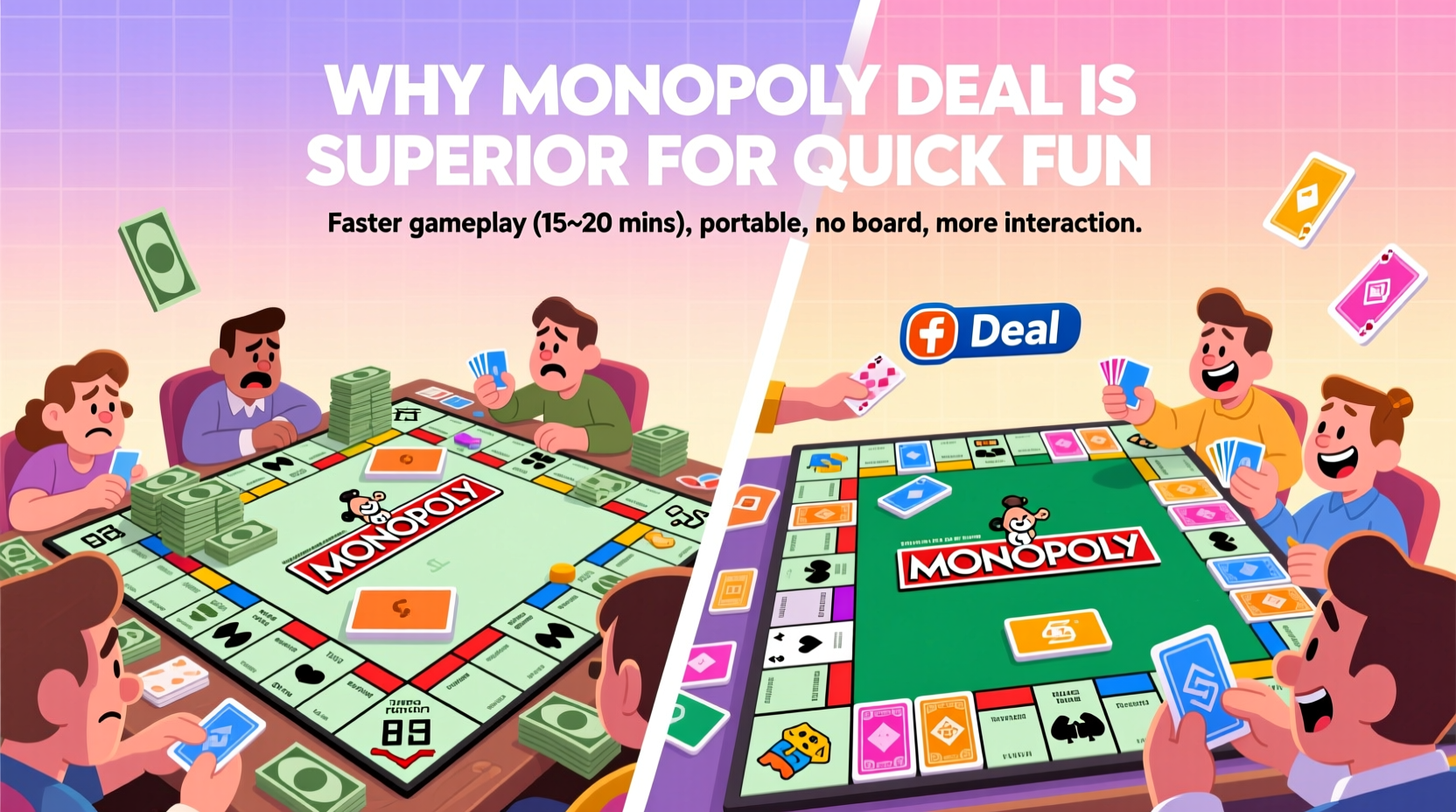
Despite its iconic status, traditional Monopoly suffers from several critical flaws that diminish its appeal for casual or time-limited play:
- Excessive length: Games routinely exceed two hours, making them impractical for weeknight gatherings or short breaks.
- Downtime: Players often sit idle between turns, especially as the game progresses and fewer properties remain available.
- Elimination: Once a player goes bankrupt, they’re out—forced to wait while others finish the game.
- Luck dependency: Dice rolls heavily influence outcomes, reducing strategic depth.
- Bulky setup: The large board, numerous tokens, paper money, and title deeds require significant table space and storage.
“Monopoly is less a game of strategy and more a test of endurance.” — Tom Vasel, Board Game Critic & Host of *The Dice Tower*
This isn’t to say Monopoly lacks merit. For families with time to spare or nostalgic adults revisiting childhood memories, it still has value. But when the goal is quick engagement, social interaction, and repeatable fun, it falls short. That’s where Monopoly Deal steps in as a refined, modern solution.
How Monopoly Deal Redefines the Experience
Monopoly Deal distills the core elements of Monopoly—property collection, rent collection, and financial maneuvering—into a dynamic card-based format. Each player starts with five cards and takes turns drawing, playing, and reacting until someone completes three full property sets. The entire game fits in a small box, plays in under half an hour, and keeps all players actively involved throughout.
Every card serves a purpose: property cards form sets, action cards allow stealing, rent collection, or protection, and money cards are used to pay dues or fund deals. The game encourages bluffing, timing, and tactical decision-making. Unlike the passive waiting in classic Monopoly, every turn in Monopoly Deal presents meaningful choices—and threats.
Tip: Always keep at least one “Just Say No” card in reserve if possible—it can block a devastating rent or property steal at a crucial moment.Key Advantages of Monopoly Deal Over Classic Monopoly
The superiority of Monopoly Deal isn’t subjective—it stems from tangible improvements in design, pacing, and accessibility. Below is a breakdown of the most compelling reasons why the card game outperforms its board-bound predecessor for quick entertainment.
1. Dramatically Shorter Playtime
Where Monopoly averages 120+ minutes, Monopoly Deal typically lasts 15–30 minutes. This brevity makes it ideal for coffee breaks, travel, or as a warm-up before a longer game. You can play multiple rounds in the time it takes to finish one game of traditional Monopoly.
2. Continuous Player Engagement
In Monopoly Deal, there’s no waiting around. Even on another player’s turn, you might be targeted by a rent card or forced to defend your properties. The hand-management mechanic ensures everyone remains mentally engaged, turning passive observers into active participants.
3. Portability and Setup Efficiency
The entire Monopoly Deal deck fits in a tuck box smaller than a standard paperback. No board, no tokens, no lengthy setup. Just shuffle and deal. This makes it perfect for picnics, flights, dorm rooms, or office lunches.
4. Balanced Mix of Strategy and Luck
While luck plays a role in card draws, Monopoly Deal rewards smart resource allocation. Do you use your money now or save it for rent? Do you build a third property group or hold back action cards for defense? These decisions create a deeper layer of engagement than rolling dice and hoping for Park Place.
5. No Player Elimination
Unlike classic Monopoly, where players drop out early and watch the rest of the game unfold, Monopoly Deal keeps everyone in until the very end. Even if you lose your properties, you can rebuild quickly with new draws. This inclusivity enhances social dynamics and prevents frustration.
Side-by-Side Comparison: Monopoly vs. Monopoly Deal
| Feature | Classic Monopoly | Monopoly Deal |
|---|---|---|
| Average Duration | 90–240 minutes | 15–30 minutes |
| Player Downtime | High (long waits between turns) | Minimal (constant interaction) |
| Setup Time | 5–10 minutes | Under 1 minute |
| Portability | Poor (large box, many components) | Excellent (fits in pocket) |
| Player Elimination | Yes (players go bankrupt and exit) | No (all stay until end) |
| Strategic Depth | Moderate (limited by dice rolls) | High (hand management, timing, bluffing) |
| Replayability | Low (same progression each game) | High (variable hands, tactics) |
Real-World Example: Game Night Transformation
Consider the Johnson family: parents in their 40s, two kids aged 10 and 13, and occasional visits from grandparents. They used to break out the classic Monopoly every holiday, but over time, enthusiasm waned. The youngest would lose interest after 45 minutes. One parent would get frustrated by bad luck. The game often ended abruptly due to exhaustion.
Then they tried Monopoly Deal. At their next gathering, they played three full games during the same timeframe they’d normally spend on one round of Monopoly. The kids loved the bright cards and fast pace. The parents appreciated the strategic choices and lack of downtime. Grandma, who usually avoided Monopoly due to complexity, picked up the rules quickly and won the second game. The energy stayed high, laughter flowed, and no one felt left out.
That night marked a shift. Monopoly Deal became their go-to opener—fun, fair, and fast. The classic version still comes out occasionally, but only when everyone agrees to dedicate an evening. For spontaneous fun, the card game reigns supreme.
Mastering Monopoly Deal: A Step-by-Step Guide to Winning
To truly appreciate Monopoly Deal’s superiority, it helps to understand how to play—and win—effectively. Here’s a concise guide to maximizing your advantage:
- Start with balanced draws: On your first turn, prioritize drawing two cards to expand your options. Avoid playing everything immediately.
- Build incomplete sets early: Begin collecting property cards, even if you don’t have a full set yet. This sets you up for quick completion later.
- Hold defensive cards: Keep at least one “Just Say No” or “House/Hotel” card in hand. These can block rent attacks or double your income.
- Time your rent cards wisely: Don’t waste a “Rent” card early. Wait until opponents have visible sets, then hit them when they least expect it.
- Use debt as a shield: If you're low on money, sometimes it's better to let someone charge you rent if it forces them to end their turn—giving you a chance to rebound.
- Bluff strategically: Hold action cards even when you can’t use them. Other players may hesitate to target you, thinking you’re protected.
- Complete sets decisively: Once you have two cards of a color group, prioritize getting the third. The game ends fast once someone gets close.
Essential Checklist for Getting the Most Out of Monopoly Deal
- ✅ Shuffle thoroughly before each game to avoid clumping of property types.
- ✅ Teach the rules using a sample hand—don’t start cold.
- ✅ Limit initial plays to one action per turn to prevent overwhelming new players.
- ✅ Encourage table talk and light trash-talking—it enhances the fun without harming strategy.
- ✅ Rotate dealers or shufflers to maintain fairness and engagement.
- ✅ Play best-of-three to even the odds and extend enjoyment.
- ✅ Store the deck in a protective sleeve to prolong card life.
Frequently Asked Questions
Can children play Monopoly Deal easily?
Yes. The rules are simple enough for children aged 8 and up to grasp quickly. The visual cards and short turns keep younger players engaged, making it an excellent introduction to strategy games.
Is Monopoly Deal just a simplified version, or does it offer real depth?
It offers genuine strategic depth. While easier to learn than classic Monopoly, Monopoly Deal introduces hand management, risk assessment, and psychological timing. Skilled players consistently outperform beginners through smarter card use and bluffing.
Can I combine Monopoly Deal with other card games or expansions?
Yes. Hasbro has released themed versions (like Monopoly Deal Disney or Pokémon), and fans have created house rules and combo variants. While official cross-compatibility is limited, creative players often mix decks for novelty and variety.
“The brilliance of Monopoly Deal is that it preserves the emotional highs of Monopoly—building empires, charging rent, pulling off last-minute steals—but removes the drudgery.” — Matt Thrower, Board Game Journalist, *GamesRadar+*
Why Monopoly Deal Fits Modern Lifestyles
In an age where time is scarce and attention is fragmented, games must adapt. Monopoly Deal succeeds because it respects its players’ time. It delivers satisfaction without demanding a commitment. Whether you’re unwinding after work, entertaining guests between courses, or killing time at the airport, it’s ready to go in seconds.
Moreover, its compact nature supports digital-era habits. People carry smartphones, not board games. Monopoly Deal bridges that gap—lightweight, self-contained, and instantly accessible. It’s the board game equivalent of a podcast episode versus a full-length documentary: both valuable, but one fits seamlessly into daily life.
And unlike apps or video games, it fosters face-to-face interaction. There’s no screen glare, no notifications, no solo mode. Just people, cards, and conversation. In a world increasingly mediated by technology, that human connection is more valuable than ever.
Conclusion: Make Room for Monopoly Deal in Your Game Rotation
Classic Monopoly will always have a place in gaming history. But for quick fun, consistent excitement, and broad appeal, Monopoly Deal is the clear winner. It retains the spirit of the original—property bartering, wealth accumulation, and playful sabotage—while eliminating the pain points that made the long version a chore.
Whether you’re a seasoned gamer looking for a lively filler, a parent wanting to engage kids in strategic thinking, or someone who just wants to laugh and compete without a time sink, Monopoly Deal delivers. It’s faster, smarter, and more inclusive. It turns game night from an obligation into a joy.
🚀 Ready to upgrade your game night? Grab a deck of Monopoly Deal, gather a few friends, and experience how a simple card game can outshine a board game legend. Share your favorite Monopoly Deal moments in the comments!