When people ask whether Apple is richer than Samsung, they're usually referring to market capitalization — the total value of a company’s outstanding shares. As of recent financial data, Apple consistently ranks among the most valuable companies in the world, often exceeding $2.5 trillion in market cap. Samsung, while massive in scale and influence, has a market capitalization hovering around $300–$400 billion. That means Apple is not just slightly richer — it's nearly seven times more valuable on paper.
But market cap isn’t everything. Samsung operates across far more industries than Apple: semiconductors, displays, home appliances, heavy construction, medical equipment, and more through its sprawling conglomerate structure. Apple remains focused primarily on consumer electronics, software, and services. So while Apple wins on stock market valuation, Samsung has broader operational reach and supply chain dominance. Understanding this distinction helps clarify why the “richer” label doesn't tell the whole story.
Market Capitalization vs. Revenue: What Really Matters?
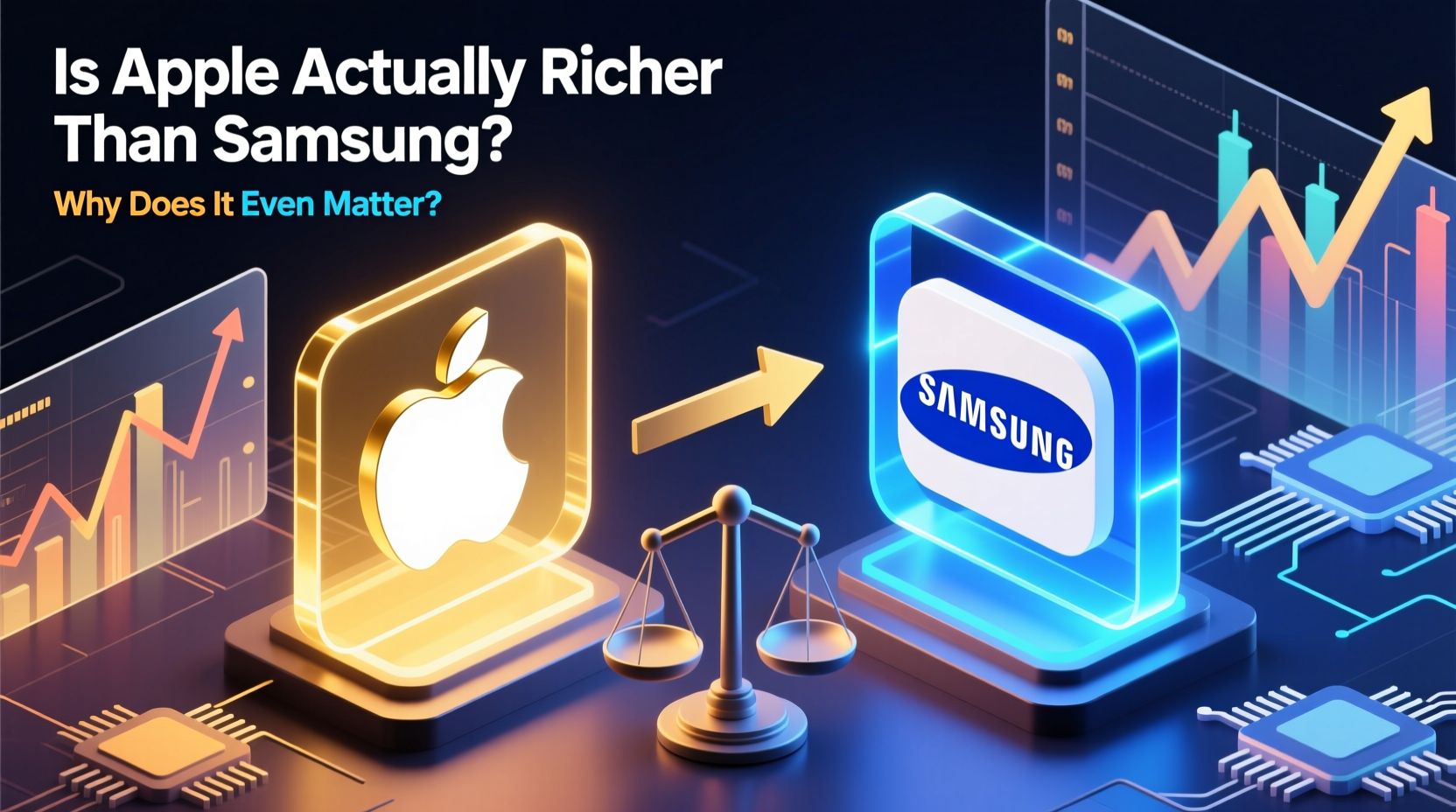
Market cap reflects investor confidence in future profitability, not just current earnings. Apple’s high valuation stems from consistent profit margins, brand loyalty, ecosystem lock-in (iPhone, iCloud, App Store), and recurring revenue from services like Apple Music and subscriptions. In contrast, Samsung Electronics — though generating comparable annual revenue (~$200 billion) — operates with thinner margins due to intense competition in sectors like memory chips and smartphones.
| Metric | Apple (2023) | Samsung Electronics (2023) |
|---|---|---|
| Market Cap | $2.5 trillion | $350 billion |
| Annual Revenue | $383 billion | $200 billion |
| Gross Profit Margin | ~44% | ~40% |
| Primary Revenue Drivers | iPhone, Services, Mac, Wearables | Memory Chips, Smartphones, Displays |
| Global Workforce (approx.) | 164,000 | 267,000 |
The table reveals a critical insight: Apple generates nearly double the revenue of Samsung Electronics despite having fewer employees and a narrower product range. More importantly, Apple converts that revenue into profit more efficiently. This efficiency fuels higher investor confidence, which directly impacts market capitalization.
Tip: When comparing tech giants, look beyond headlines about \"who’s bigger.\" Focus on profit margins, cash flow, and long-term innovation pipelines to understand true financial strength.Why Does This Comparison Even Matter?
To consumers, the Apple-Samsung rivalry shapes innovation in smartphones, wearables, and digital services. For investors, the disparity in market value signals where capital flows and which business models are deemed sustainable. But there’s a deeper layer: global economic influence.
Apple’s ability to command premium pricing and maintain customer retention gives it outsized leverage in app development, privacy standards, and even regulatory debates. Its App Store policies affect millions of developers worldwide. Samsung, meanwhile, dominates foundational technologies — producing the OLED screens and DRAM chips used in devices across brands, including Apple’s own iPhones.
“Samsung is the silent engine of the tech world. Without its components, even Apple couldn’t scale.” — Dr. Lee Hwan-seok, Semiconductor Industry Analyst at Seoul National University
This interdependence makes their relationship complex: fierce competitors in handsets, yet deeply intertwined in supply chains. The health of one affects the other, regardless of market cap rankings.
Mini Case Study: The iPhone Display Supply Chain
In 2023, Apple launched the iPhone 15 Pro with a next-generation titanium frame and brighter OLED display. While designed by Apple, the display was manufactured entirely by Samsung Display, a subsidiary of Samsung Electronics. Despite competing fiercely in the smartphone market, Apple relies on Samsung for some of its most advanced screen technology.
This arrangement highlights a paradox: Apple may be worth more, but it cannot fully operate without Samsung’s industrial capabilities. Conversely, Samsung earns billions annually from supplying Apple, making the U.S. giant one of its most important clients. This symbiosis shows that corporate wealth isn’t just about balance sheets — it’s also about strategic control over critical resources.
Key Factors Behind Apple’s Valuation Lead
- Ecosystem Lock-In: Once users invest in iPhones, AirPods, Apple Watch, and iCloud, switching costs rise significantly.
- Services Growth: Apple’s services segment (App Store, AppleCare, subscriptions) now generates over $78 billion annually with ~70% gross margins.
- Cash Reserves: Apple holds over $160 billion in cash, enabling aggressive buybacks and R&D investment without debt.
- Premium Branding: Apple maintains pricing power, selling phones at average prices above $900 globally.
Samsung, while innovative, struggles with brand perception outside South Korea. Its Galaxy phones compete directly with cheaper Chinese brands in Asia and Europe, forcing price cuts that erode profits. Meanwhile, Apple dominates the high-end segment, capturing over 80% of global smartphone profits despite holding only ~15% market share.
Actionable Checklist: How to Evaluate Tech Giants Beyond Headlines
- Check market cap trends over 5 years, not just current figures.
- Analyze gross and net profit margins — not just revenue.
- Review reliance on third-party suppliers or customers.
- Assess exposure to geopolitical risks (e.g., chip exports, trade wars).
- Examine R&D spending as a percentage of revenue.
- Consider environmental and labor practices — these increasingly affect investor sentiment.
FAQ
Does Samsung make money from Apple?
Yes. Samsung supplies key components like displays, memory chips, and image sensors to Apple. This inter-company trade generates billions annually and illustrates how competition and collaboration coexist in tech.
Can Samsung ever surpass Apple in market value?
It’s unlikely in the near term unless Samsung restructures to unlock value from its diverse divisions. Currently, investors undervalue conglomerates compared to focused, high-margin firms like Apple. A potential spin-off of Samsung’s semiconductor arm could change this dynamic.
Is Apple richer than entire countries?
In terms of market cap, yes — Apple’s valuation exceeds the GDP of most nations, including Switzerland and Saudi Arabia. However, GDP measures economic output, not corporate equity, so direct comparisons are misleading.
Conclusion: Wealth Isn’t Just About Numbers
The question of whether Apple is richer than Samsung matters because it reveals how value is created and perceived in the modern economy. Apple excels at turning hardware into recurring revenue through software and services. Samsung excels at manufacturing the invisible building blocks of technology. One commands higher investor trust; the other underpins global production.
For consumers, this competition drives better products. For investors, understanding the nuances behind market caps leads to smarter decisions. And for the tech industry, the Apple-Samsung dynamic exemplifies how innovation thrives at the intersection of rivalry and dependence.
💬 What do you think determines a company’s real strength — market value, innovation, or industrial control? Share your thoughts and help shape the conversation on what “rich” really means in the digital age.