There’s a quiet choreography in great cocktail making: the deliberate crush of mint, the brisk 12-second shake, the slow pour over a single large cube. Jazz—especially bebop, cool jazz, and modal improvisation—thrives on similar temporal intelligence: syncopated phrasing, variable swing ratios, and intentional pauses that breathe like a well-timed stir. Until recently, aligning these two rhythms required deep musical intuition and manual playlist curation. Now, generative AI bridges that gap—not by replacing human taste, but by extending it. This isn’t about algorithmic background noise. It’s about crafting bespoke sonic environments where every chord progression mirrors the kinetic arc of your craft: a walking bass line accelerating as you crack ice, a brushed snare softening as you garnish with citrus twist.
The Rhythm Logic Behind Cocktail-Aware Jazz
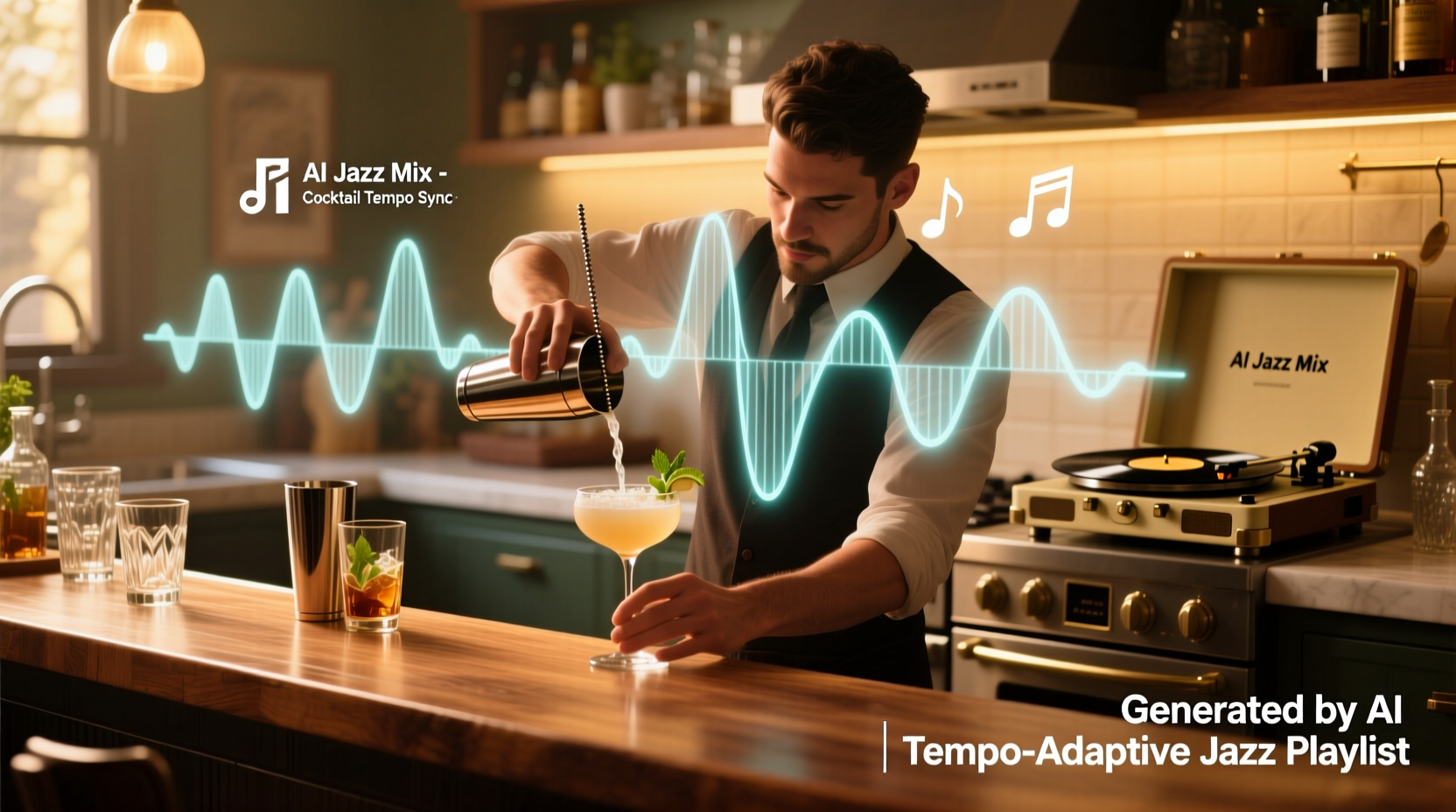
Cocktail preparation unfolds in measurable, repeatable phases—each with its own biomechanical tempo and emotional cadence. A classic Old Fashioned takes ~90 seconds: 15 seconds for muddling sugar and bitters, 20 for stirring with ice, 10 for straining, 30 for garnishing and presentation. A shaken Daiquiri compresses that into ~60 seconds, with peak physical intensity during the 10–12 second shake. These aren’t arbitrary numbers—they’re physiological anchors. Your heart rate rises slightly during agitation; your breath slows during precision pours. Jazz, at its most functional, responds to this. Think of Miles Davis’ “So What” not just as a modal masterpiece—but as a 96 BPM groove that holds space, invites focus, and never rushes the pour.
Generative AI doesn’t “hear” your shaker—but it *can* interpret structured tempo maps derived from professional bartending workflows. When trained or prompted with rhythmic metadata (e.g., “muddle phase: 72–80 BPM, sparse instrumentation, minor 7th chords; shake phase: 112–128 BPM, driving ride cymbal, staccato piano comping”), models like Google’s MusicLM, OpenAI’s Jukebox (in research mode), or fine-tuned LLMs paired with symbolic music generators (e.g., MuseNet, Magenta’s MusicVAE) output harmonic and rhythmic structures that obey those constraints—not as rigid loops, but as evolving, improvisational phrases.
Tip: Start with a 3-phase tempo map—Prep (70–85 BPM), Action (100–130 BPM), Finish (60–75 BPM)—before prompting any AI tool. This mimics the natural arc of cocktail making and yields more coherent musical narratives.Step-by-Step: Building Your First Synced Playlist
- Map Your Signature Cocktail Workflow: Choose one drink you make weekly. Time each discrete action with a stopwatch: muddling, measuring, shaking/stirring, straining, garnishing, plating. Note average duration and perceived intensity (low/medium/high).
- Translate to Musical Parameters: Assign BPM ranges and instrumentation cues:
- Muddling (15 sec, low intensity) → 74 BPM, upright bass + vibraphone, spacious reverb, whole-tone harmonies
- Shaking (12 sec, high intensity) → 122 BPM, brushed snare + walking bass + aggressive piano comping, tight stereo image
- Garnishing (20 sec, medium-low intensity) → 68 BPM, muted trumpet solo over pedal-point F#m7, vinyl crackle overlay
- Select & Configure Your AI Tool: Use platforms with controllable musical parameters. For beginners: Suno AI (v4.5+) supports BPM, genre, mood, and instrument prompts. For advanced users: MuseNet via Hugging Face Spaces allows custom MIDI seed input and tempo conditioning. Avoid tools that only accept vague descriptors like “jazzy” or “cool.”
- Prompt with Precision: Combine rhythmic, harmonic, and textural directives. Example prompt for Suno: “Original jazz composition, 74 BPM, 32-bar form, upright bass and vibraphone only, no drums, whole-tone scale harmony, spacious mix, subtle room reverb, 15-second duration, ambient but focused mood — for muddling mint and sugar in an Old Fashioned.”
- Refine Through Iteration: Generate 3–5 variants per phase. Listen critically—not for “jazziness,” but for whether the music’s internal pulse feels like a companion to your movement. Does the vibraphone decay linger just long enough for you to lift the muddler? Does the snare hit coincide with the first vigorous shake? Trim silence, crossfade transitions, and export as lossless WAV for maximum fidelity in your bar setup.
Do’s and Don’ts of AI-Generated Jazz for Mixology
| Do | Don’t |
|---|---|
| Use BPM-specific prompts—not just “jazz” but “modal jazz at 116 BPM with brushed snare” | Assume “jazz” means one thing—bebop, cool, hard bop, and fusion have radically different tempos and densities |
| Layer AI outputs with field recordings (ice cracking, citrus zest, glass clink) for spatial realism | Rely solely on AI for final mastering—always apply light EQ (cut sub-60Hz rumble, boost 2–4kHz for articulation) |
| Build a library of 10–15 short (10–25 sec), phase-specific stems for flexible assembly | Chain full 3-minute tracks—cocktail prep rarely needs extended solos; brevity is functional |
| Test audio latency: Bluetooth speakers add 150–300ms delay—use wired or aptX Low Latency codecs | Ignore acoustic context—reverb time in your space affects perceived tempo; dry rooms need tighter rhythms |
| Label files clearly: “Stir_108BPM_BassPiano_Walking_22sec.wav” | Use copyrighted jazz samples as seeds—AI tools may generate derivative work risking takedowns |
Real-World Application: The Midnight Hour Bar in Portland
At The Midnight Hour, a 24-seat craft cocktail bar known for its silent service ethos, bartender Lena Chen integrated AI-synced jazz into her nightly ritual. She began by filming herself making her signature “Smoke & Mirrors” cocktail—a mezcal-forward drink requiring precise 8-second smoke infusion under a cloche. Using a metronome app and frame-by-frame video analysis, she mapped three distinct auditory zones: the 5-second cloche placement (ambient drone), the 8-second smoke infusion (evolving modal harmony with rising pitch), and the 12-second pour and serve (light bossa nova rhythm). She used Suno AI to generate 12 unique 8-second drone fragments, then fed them into Ableton Live with Max for Live’s “Tempo Follower” device to trigger the next phase’s rhythm track precisely when her hand lifted the cloche. Patrons didn’t hear “music”—they felt a seamless, almost imperceptible shift in atmosphere that mirrored the drink’s transformation. As Lena notes: “The AI didn’t replace my intuition—it gave me vocabulary I didn’t know I was missing. Now the drink tells its own story, and the music is its punctuation.”
“Jazz has always been about real-time response—the way a drummer leans into a bassist’s phrase, or how a pianist answers a vocalist’s pause. Generative AI, when used with intention, extends that conversation beyond human players into the very gestures of craft.” — Dr. Aris Thorne, Ethnomusicologist & Author of Jazz and the Rhythms of Labor
Expert Prompt Engineering for Jazz Authenticity
Generic prompts yield generic results. To evoke genuine jazz language, embed structural and idiomatic cues. Avoid vague adjectives (“smooth,” “classy”) and prioritize actionable musical grammar:
- For swing feel: Specify “medium swing, eighth-note triplet subdivision, ride cymbal ‘ting-ting-ting’ pattern” instead of “swung rhythm.”
- For harmonic color: Use jazz-standard terminology: “ii–V–I in Bb major,” “Coltrane changes on G7,” “Herbie Hancock-style altered dominant voicings.”
- For instrumentation: Name specific timbres: “Wurlitzer electric piano (not Rhodes), dry and punchy,” “tenor sax with slight overblow, no vibrato,” “brushed snare with minimal sustain.”
- For phrasing: Indicate space and breath: “two-bar rests after every four-bar phrase,” “call-and-response between bass and piano left hand,” “melody enters on beat 3 of bar 1.”
This level of specificity trains the model to prioritize authentic jazz syntax over surface-level tropes. It also prevents clichés—no gratuitous “saxophone wail” unless your garnish involves flaming orange peel.
FAQ
Can I use free AI tools for this, or do I need paid subscriptions?
You can start with free tiers—Suno AI offers 10 free generations weekly, and Magenta’s open-source models run locally on capable hardware. However, commercial-grade control (precise BPM locking, stem separation, low-latency export) typically requires Pro plans ($8–$24/month). Prioritize tools with transparent tempo handling over “free but fuzzy” options.
Won’t AI-generated jazz sound sterile or mechanical?
It will—if you treat it as a black box. The sterility comes from ignoring jazz’s core principle: intentional imperfection. Counteract this by adding analog texture: layer in subtle tape hiss, apply gentle saturation to bass lines, or manually nudge MIDI note timing by ±12ms to break quantization. One barista in Brooklyn runs all AI outputs through a vintage Roland Space Echo emulator before final export—“it’s not about fixing the AI,” she says, “it’s about reminding it it’s playing in a room, not a server.”
How do I handle transitions between cocktail phases without jarring jumps?
Avoid abrupt cuts. Use overlapping fades (1.5–2 seconds), shared tonal centers (e.g., keep the same root note across phases), or transitional “bridge” stems (e.g., a 5-second brushed snare roll that decays into vibraphone sustain). Some bartenders use a simple footswitch to trigger crossfades live—no software needed, just a $40 USB audio interface and free Audacity session playback.
Conclusion
Syncing jazz to cocktail preparation isn’t a gimmick—it’s a return to music’s oldest function: marking time, shaping attention, and elevating ritual. Generative AI removes the technical barrier to personalizing that relationship, but the artistry remains firmly human. You choose the drink. You define the tempo map. You decide whether that 12-second shake deserves a blistering Bud Powell-inspired piano line or the suspended tension of a Bill Evans rubato passage. The tools are now accessible, responsive, and deeply musical—not because they understand mixology, but because they’ve learned to listen to the patterns we embed in our instructions. Stop searching for “jazz playlists.” Start composing your next cocktail’s original score.
💬 Your turn. Try mapping one cocktail phase today—even just 10 seconds—and generate a single AI stem. Share your tempo map, prompt, and result in the comments. Let’s build the first open-source library of cocktail-synced jazz—not as files, but as shared rhythm.