
Getting paid early isn’t just a luxury—it’s a financial advantage. With Chase Early Direct Deposit, eligible customers can receive their paychecks up to two days before the official payday. This feature can help cover unexpected expenses, avoid overdraft fees, or simply give you more control over your cash flow. While not all Chase accounts automatically qualify, unlocking this benefit is straightforward if you know the requirements and steps.
Chase offers Early Direct Deposit as part of its broader digital banking enhancements, designed to improve customer experience and financial flexibility. However, many account holders remain unaware of how to activate it or assume it’s automatic. The truth is, while the service doesn’t require an application, certain conditions must be met for it to take effect.
How Early Direct Deposit Works at Chase
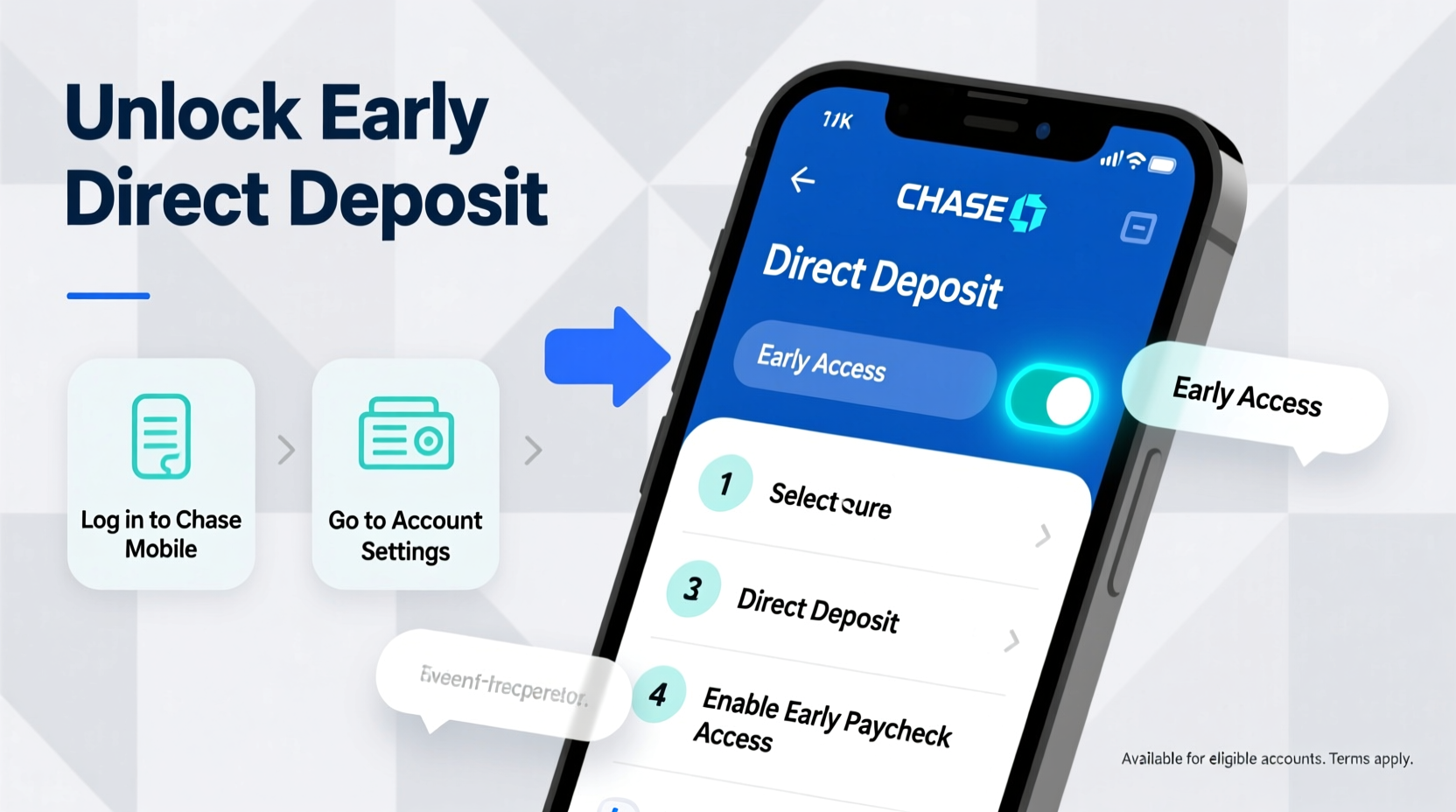
Early Direct Deposit allows Chase customers to access their direct deposits—such as paychecks, government benefits, or pension payments—as soon as the sender submits the funds, rather than waiting for the scheduled payment date. In practice, this often means receiving money one to two business days earlier than expected.
The timing depends on when the payer (like your employer or the IRS) transmits the deposit. Chase processes incoming direct deposits as soon as they’re received from the Automated Clearing House (ACH) network. If the deposit arrives early, and your account meets eligibility criteria, you’ll see the funds credited ahead of schedule.
It's important to note that Chase does not advertise Early Direct Deposit as a formal “feature” you turn on. Instead, it’s a conditional benefit tied to account activity and setup. There’s no toggle in the app labeled “Enable Early Deposit.” Rather, it activates automatically when specific conditions are satisfied.
Tip: Early access only applies to recurring, electronic direct deposits—not checks, cash deposits, or peer-to-peer transfers.Eligibility Requirements for Early Access
Not every Chase account will qualify for early deposit access. To increase your chances, ensure your account meets the following criteria:
- You have a personal checking account (e.g., Chase Total Checking® or Chase Secure Banking℠)
- Your direct deposit is set up for a regular income source (paycheck, Social Security, etc.)
- The deposit amount is at least $200 per posting cycle
- The deposit is electronic and recurring (not one-time or manual)
- You’ve had the account open for at least 30 days
While Chase doesn’t guarantee early availability, meeting these conditions significantly increases the likelihood. Temporary or promotional accounts, such as those opened for sign-up bonuses, may not qualify immediately.
“Early direct deposit isn’t a perk you request—it’s a result of consistent, qualifying direct deposit behavior.” — Lisa Tran, Consumer Banking Advisor at Chase
Step-by-Step Guide to Unlock Early Direct Deposit
Follow these steps to position your account for early deposit access:
- Open a qualifying Chase checking account – Choose Chase Total Checking® for full features or Chase Secure Banking℠ if you're rebuilding financial habits.
- Set up direct deposit with your employer – Request a direct deposit form from your HR department or payroll provider. Enter your Chase account number and routing number.
- Verify your deposit information – Double-check that the bank details match exactly what appears in your Chase app under 'Account & Routing Numbers'.
- Confirm receipt of first deposit – Monitor your account to ensure the deposit posts correctly. This establishes the pattern Chase uses to determine eligibility.
- Maintain consistency – Continue receiving recurring deposits of $200 or more. Avoid gaps in deposit timing.
After two consecutive qualifying deposits, most customers begin seeing funds arrive earlier. The system learns your deposit rhythm and adjusts availability accordingly.
Do’s and Don’ts When Setting Up for Early Access
| Do’s | Don’ts |
|---|---|
| Use the same account for all direct deposits | Split deposits across multiple banks frequently |
| Ensure deposits are recurring and automated | Rely on manual transfers or paper checks |
| Keep your contact and employment info updated | Ignore notifications from Chase about deposit issues |
| Monitor deposit timing in the app weekly | Assume early access is guaranteed forever |
Real Example: How Maria Gained Early Access in 4 Weeks
Maria, a medical assistant in Austin, switched to a Chase Secure Banking℠ account after years of using a credit union. She earned $3,200 monthly via direct deposit but often struggled with cash flow gaps between pay periods.
She followed the setup process carefully: provided her new Chase details to HR, confirmed the first deposit arrived correctly, and waited. By her second paycheck, she noticed the deposit posted on Thursday morning instead of Friday. Her next check arrived Wednesday evening—two full days early.
Over time, Maria used the extra day to pay rent early and avoid late fees. She also built a small buffer in her account, reducing stress during emergencies. Her success came from consistency—not from contacting customer service or enabling a special setting.
Tips to Maximize Your Chances of Early Deposit
- Use direct deposit exclusively – Avoid mixing check cashing with electronic deposits.
- Keep your account active – Make occasional debit card purchases or bill payments to show engagement.
- Link direct deposit to one primary account – Don’t rotate where your paycheck goes each month.
- Check deposit history regularly – Use the Chase mobile app to track when funds post compared to your expected date.
- Contact payroll if deposits are delayed – Sometimes the delay originates with the employer, not Chase.
Frequently Asked Questions
Does Chase offer early direct deposit on all accounts?
No. Early access primarily applies to personal checking accounts like Chase Total Checking® and Chase Secure Banking℠. Savings accounts, joint accounts, and business accounts typically do not qualify for accelerated availability.
How early will my paycheck arrive?
Most customers see deposits one to two business days early, depending on when the payer sends the funds. For example, if your payday is Friday, you might see the money on Wednesday or Thursday. There is no fixed schedule—it varies by employer and processing speed.
Can I lose early deposit access once I have it?
Possibly. If you stop receiving qualifying deposits for several months, change employers frequently, or close and reopen accounts often, Chase may revert to standard deposit timing. Consistency is key to maintaining the benefit.
Final Steps and Ongoing Monitoring
Once you’ve set up direct deposit and received two qualifying payments, continue monitoring your deposit timing through the Chase app. Look for patterns: Are funds arriving earlier than your official payday? Is the amount consistent? These signs indicate the system recognizes your deposit stream.
If you don’t see early access after three cycles, verify that your deposit meets the $200 minimum and is truly recurring. You can also call Chase customer service to confirm your deposit type, though they cannot manually enable early access.
Remember, Chase’s early deposit isn’t a promotion or upgrade—it’s a function of reliable financial behavior. The more predictable your income flow, the more likely the bank will make it available sooner.
💬 Ready to get paid sooner? Review your current direct deposit setup today. Ensure your employer has your correct Chase account details and start building the consistency that unlocks early access. Share your experience in the comments—your story could help others gain financial flexibility faster.