For the home bartender who’s moved beyond the basic Old Fashioned and begun riffing on classics—or even inventing from scratch—a digital cocktail journal isn’t just a record. It’s a living archive of your palate’s evolution, a troubleshooting log for failed experiments, and a quiet testament to craftsmanship built one stirred, shaken, or clarified drink at a time. Unlike social media posts that vanish into feeds or scribbled notes on napkins, a well-structured digital journal transforms fleeting moments behind the bar into cumulative knowledge. It answers questions you’ll ask yourself months later: *Why did that pineapple-ginger shrub work so well in July but fall flat in November? Was it the rum batch, the ambient humidity, or my technique?* This guide walks through building a journal that’s both deeply personal and rigorously useful—not as a vanity project, but as an essential tool for intentionality in drink-making.
Why a Digital Journal Beats Paper, Photos, or Memory Alone
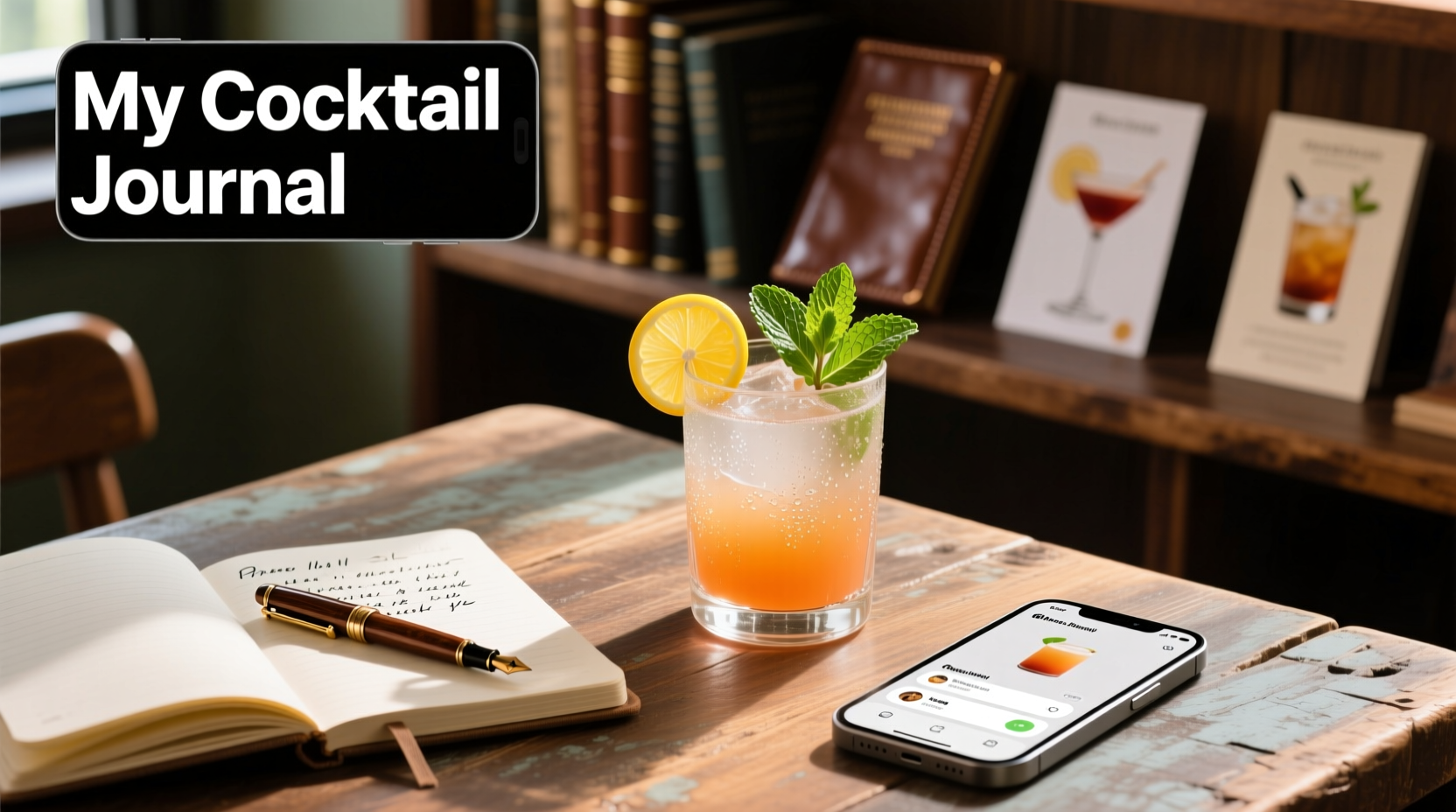
Handwritten notebooks gather dust or get misfiled. Phone photos lack context—no temperature, no stirring speed, no note about how the ice cracked. And memory is unreliable: by the third drink of an evening, even vivid sensory impressions blur. A digital journal solves these problems with structure, searchability, and scalability. You can filter entries by base spirit, season, occasion, or even mood. You can cross-reference ingredients across dozens of drinks to spot patterns—like noticing that three successful tiki variations all used demerara syrup aged 48 hours with toasted coconut. Digital tools also enable version control: if you tweak a recipe twice, you preserve the original and both iterations without rewriting pages.
More importantly, digital journals support reflection. When you return to an entry six months later, the act of rereading your own tasting notes—“bitter finish too abrupt; next time, add 3 drops of saline”—creates a feedback loop no photo or memory can replicate. That’s where real skill develops: not in repetition alone, but in documented, iterative learning.
Your Core Journal Framework: Five Essential Fields
A robust cocktail journal entry needs more than “what you mixed.” It needs the conditions under which it was made and perceived. Build every entry around these five non-negotiable fields:
- Base & Structure: Spirit(s), modifiers (vermouths, liqueurs), sweeteners, acids, bitters, and dilution method (stirred/shaken/dry shake/clarified).
- Technique Notes: Ice type (large cube, crushed, pebble), shaking duration (12 sec vs. 18 sec), stirring count (35 rotations), glassware, garnish method (expressed oil, flamed, floated).
- Sensory Log: Appearance (clarity, viscosity, hue), aroma (dominant top/mid/base notes), taste (sweet/sour/bitter/savory balance, texture, heat), finish (length, lingering notes, flaws).
- Context: Date, time, location, occasion (casual Tuesday, guest dinner, pre-shift test), ambient conditions (room temp, humidity if relevant), and your physical state (well-rested? fatigued? after a meal?).
- Reflection & Revision: What worked? What didn’t? Why? One concrete change to try next time—and whether you’ll revisit this drink.
This framework turns each entry into a mini case study. Without it, you’re collecting data points without a hypothesis.
Tip: Start simple—fill only the Base & Structure and Sensory Log fields for your first ten entries. Add Context and Reflection once the habit sticks. Perfectionism kills consistency.Choosing Your Platform: Pros, Cons, and Real-World Fit
Your tool must serve your workflow—not complicate it. Below is a comparison of four widely used options, evaluated on ease of entry, searchability, portability, and long-term reliability:
| Platform | Best For | Key Strength | Notable Limitation |
|---|---|---|---|
| Notion | Those who want customization + database power | Templates, relational databases (e.g., link “Rum” to all entries using it), mobile sync, free tier robust | Steeper learning curve; requires initial setup time |
| Obsidian | Deep thinkers who value linking ideas | Fully local storage (your data stays private), bidirectional links (“Gin Sour” → “Egg White Foam” → “Dry Shake Technique”), plain-text future-proofing | No native mobile app (requires community plugins); zero cloud sync unless self-hosted |
| Google Sheets | Beginners or spreadsheet-savvy users | Instantly familiar, powerful filtering (e.g., “show all drinks with aquavit AND caraway”), collaborative editing, free | Limited rich text; no visual hierarchy; hard to embed tasting notes with nuance |
| Dedicated Apps (e.g., Barkeep, Cocktail Flow) | Mobile-first users wanting quick logging | One-tap ingredient selection, barcode scanning, built-in recipe libraries, offline mode | Vendor lock-in; limited export options; subscriptions often required for full features |
Consider your priorities. If you value privacy and plan to write paragraphs about mouthfeel and terroir, Obsidian or Notion wins. If you want to scan a bottle label and log a drink in under 20 seconds while hosting friends, a dedicated app may suit better—even with its trade-offs.
A Real Example: How Maya Refined Her “Smoked Maple Manhattan”
Maya, a graphic designer and weekend bartender in Portland, began her digital journal in March 2023 after a disappointing “smoked maple Manhattan” served to guests. Her first entry read:
March 12, 2023 — 7:45 PM — Home bar
Base: Rittenhouse Rye (100 proof), Dolin Rouge, house-smoked maple syrup (cold-smoked over applewood, 2:1 ratio)
Technique: Stirred 40 sec w/ large cube, strained into Nick & Nora, orange twist expressed
Sensory: Deep amber, viscous. Nose: Smoke dominates, hides rye spice. Palate: Sweet upfront, then cloying; smoke overwhelms botanicals. Finish: Bitter wood ash, short.
Context: Humid evening (72°F, 68% RH), guests had just finished spicy Thai takeout.
Reflection: Syrup too intense. Next: Reduce smoke time by 50%, add 1 dash of black walnut bitters to bridge smoke and rye.
She logged three more versions over six weeks. By May, her fifth iteration used syrup smoked for only 12 minutes—not 30—and included the walnut bitters plus a rinse of Fernet-Branca in the glass. The final note reads: “Smoke now supportive, not dominant. Rye spice and cherry notes shine. Finish clean, herbal, 12-second length. Served to same guests—they asked for the recipe.” Her journal didn’t just fix one drink—it revealed how humidity affects syrup viscosity and how palate fatigue from spicy food reshapes perception of bitterness.
Step-by-Step: Building Your First 5 Entries in Under 30 Minutes
Don’t wait for the “perfect” system. Launch with actionable clarity:
- Choose your platform now. Pick one from the table above—no research beyond 5 minutes. (If unsure, start with Google Sheets using the five-field framework as column headers.)
- Create your first template. In Notion/Obsidian/Sheets, make columns or sections for: [Spirit(s)], [Modifiers], [Technique], [Sensory Notes], [Context], [Revision].
- Log yesterday’s drink—or the last one you remember clearly. Don’t reconstruct; use what’s accessible. Even “Vodka Soda, lime wedge, no ice” counts. Fill in what you recall honestly.
- Add one sensory detail you usually skip. Not “tasted good,” but “lime oil aroma cut through vodka heat,” or “bubbles faded in 90 seconds.”
- Write one revision sentence. “Next time: Use Topo Chico instead of generic soda for sharper effervescence.” No need to implement it yet—just capture the thought.
Repeat steps 3–5 for four more drinks within 24 hours. By entry #5, you’ll notice patterns: maybe you consistently over-stir stirred drinks, or your citrus notes fade when room temp exceeds 70°F. That’s your journal beginning to teach you.
“Taste is trainable—but only when you measure it. A journal is your calibration tool. Without it, you’re adjusting a watch blindfolded.” — David T. Smith, Certified Spirits Educator and author of The Palate’s Compass
Advanced Practices for Long-Term Value
Once your habit is stable, deepen impact with these intentional upgrades:
- Ingredient Provenance Tracking: Note batch numbers, distillery release dates, or harvest years (e.g., “Punt e Mes, Lot #PE2023-087”). Spirits evolve—your journal should reflect that.
- Seasonal Tagging: Add tags like #HighHumidity, #WinterCitrus, #SummerHerbs. Over time, correlate performance with climate data (a simple Weather.com screenshot saved as text works).
- Guest Feedback Integration: Record verbatim quotes: “Love the smokiness—but less sweet next time.” Avoid summarizing; raw language reveals nuance algorithms miss.
- Quarterly Review Ritual: Every 3 months, sort entries by “Revision” field. Identify your top three recurring adjustments (e.g., “reduce sweetener by 0.25 oz,” “always double-strain,” “use smaller ice for high-ABV drinks”). These become your personal mixing principles.
None of this requires extra time—just deliberate attention during the 90 seconds you spend cleaning your shaker.
FAQ
Do I need professional equipment to log meaningfully?
No. A $12 kitchen scale, a thermometer ($15), and a notebook app are sufficient. What matters is consistency in recording variables you control—like weight of spirits or water temperature for dilution—not lab-grade precision. Your journal gains value from pattern recognition over time, not milligram accuracy.
What if I don’t like writing? Can voice notes work?
Voice notes are acceptable for initial capture—but transcribe them within 24 hours. Spoken language lacks the discipline of written reflection: you’ll say “it was fine” aloud but write “the juniper was muted, likely due to over-dilution from small ice” when typing. Transcription forces precision.
How do I protect my journal if my device fails?
Back up daily. In Notion, enable automatic backups to Google Drive. In Obsidian, sync your vault folder to iCloud or Dropbox. For Sheets, download a CSV weekly. Treat your journal like irreplaceable research data—because it is.
Conclusion
Your cocktail journal isn’t about documenting perfection. It’s about honoring the labor behind every drink—the failed infusions, the over-shaken sours, the garnishes that slipped into the shaker. It’s where curiosity meets accountability, and where a hobby quietly becomes expertise. Every entry is a vote for intention over impulse, for craft over convenience. You won’t master balance in one night, but you will see, month after month, how your understanding of dilution deepens, how your nose distinguishes between two types of orange bitters, how your hands learn the exact pressure needed to express citrus oil without bitterness. That growth is real. It’s measurable. And it belongs entirely to you.
So open your chosen tool right now—not tomorrow, not after “one more drink.” Log the last cocktail you made. Then the one before that. Then pause, read back what you wrote, and ask: *What did this teach me?* That question, repeated over time, is where mastery begins.
💬 Your journal starts with one entry—not a perfect system. Share your first cocktail log in the comments below. What surprised you about revisiting it? We’re building this craft together.