
Social Security is one of the most significant sources of retirement income for millions of Americans. Yet, many claim their benefits without fully understanding how timing, work history, and filing strategies impact their monthly payments. A well-planned approach can mean the difference between receiving $1,500 or $2,800 per month in benefits—adding up to hundreds of thousands of dollars over a lifetime. This guide walks you through every critical phase of securing and optimizing your Social Security benefits with clarity and precision.
Understanding Eligibility and Earning Credits
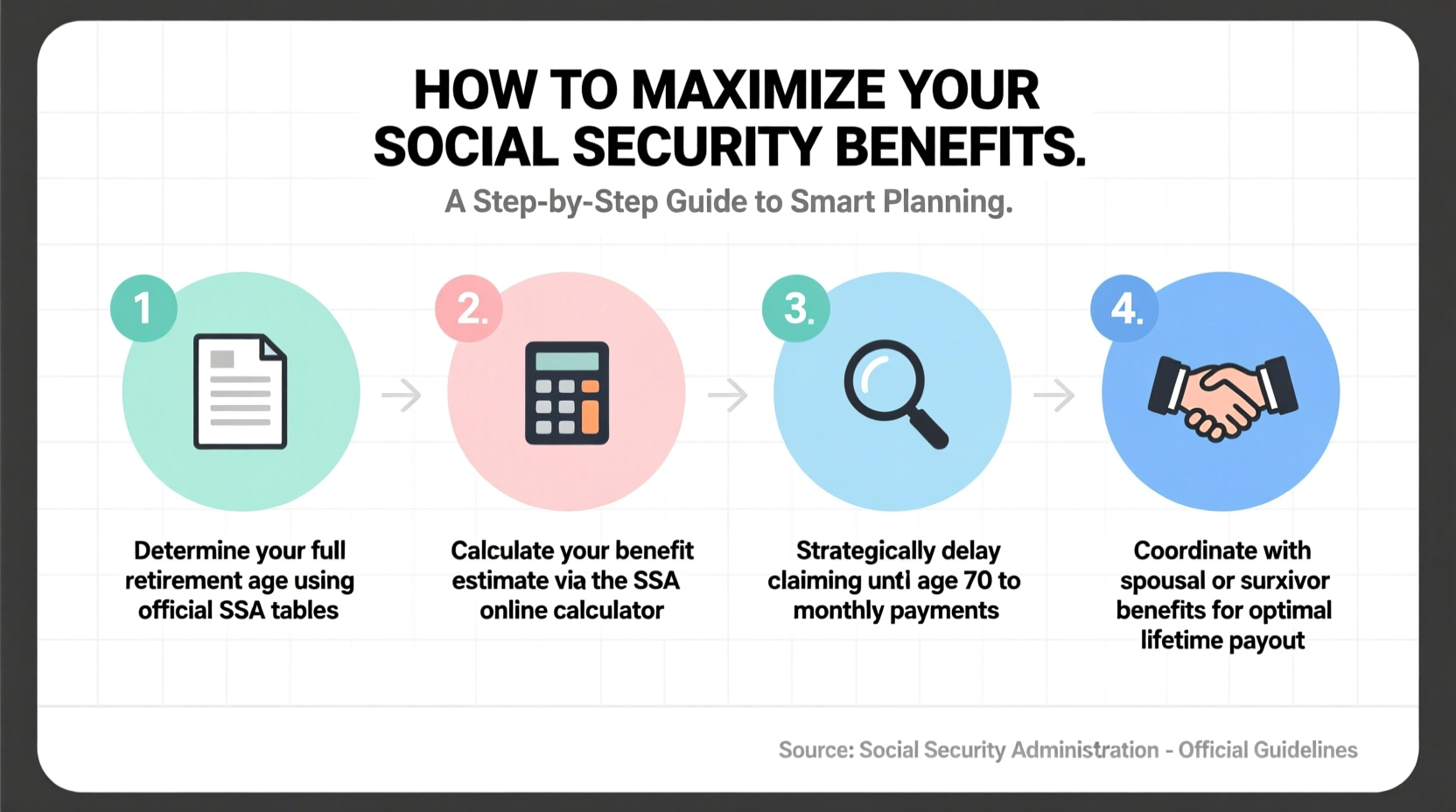
To qualify for Social Security retirement benefits, you must earn at least 40 credits—roughly equivalent to 10 years of work. Each year, you can earn up to four credits depending on your earnings. In 2024, you earn one credit for every $1,730 in wages or self-employment income, meaning $6,920 in earnings secures all four credits for the year.
These credits remain on your record even if you change jobs or take time off. However, they do not accrue interest or increase in value over time. The Social Security Administration (SSA) tracks your earnings history automatically through your W-2s and tax filings, but it’s wise to verify your record regularly via a free account at ssa.gov/myaccount.
Tip: Review your Social Security statement annually to ensure your reported earnings are accurate. Errors now can reduce your future benefits.The Impact of Claiming Age on Monthly Benefits
Your age when you file directly affects how much you receive each month. While you can begin claiming as early as age 62, doing so permanently reduces your benefit. Conversely, delaying beyond your Full Retirement Age (FRA) increases your monthly payout through Delayed Retirement Credits (DRCs), up to age 70.
Full Retirement Age varies based on birth year:
| Birth Year | Full Retirement Age (FRA) | Early Claim Reduction (Age 62) | Maximum Increase (Age 70) |
|---|---|---|---|
| 1943–1954 | 66 | ~25% reduction | ~32% increase |
| 1955 | 66 + 2 months | ~25.8% reduction | ~29.3% increase |
| 1960 or later | 67 | ~30% reduction | ~24% increase |
If your Primary Insurance Amount (PIA)—the benefit you’re entitled to at FRA—is $2,000, claiming at 62 would reduce it to about $1,400. Waiting until 70 would raise it to approximately $2,480. That extra $1,080 per month adds up to more than $12,900 annually.
“Delaying benefits is often the single most effective way to boost retirement income, especially for higher earners and those in good health.” — Alicia Munnell, Director, Center for Retirement Research at Boston College
Step-by-Step Guide to Maximizing Your Benefits
Optimizing your Social Security requires planning well before retirement. Follow this timeline to make informed decisions:
- Age 50–59: Build an Accurate Earnings Record
Ensure all income is correctly reported. If you're self-employed or had cash jobs, confirm entries with the SSA. High earners may want to maximize contributions during peak earning years to improve the 35-year average used in benefit calculations. - Age 60: Begin Strategic Planning
Request a detailed Social Security statement. Use online tools like the SSA’s Retirement Estimator or third-party calculators (e.g., Maximize My SS) to model different claiming scenarios. - Age 62: Evaluate Early Claiming Needs
Only claim early if you face serious health issues, job loss, or financial hardship. Understand that reductions are permanent and affect spousal benefits too. - Approaching Full Retirement Age: Coordinate with Your Spouse
Married couples have unique options. Consider whether a “file and suspend” or “restricted application” strategy applies—though rules changed in 2016, some legacy options remain available for those born before January 2, 1954. - Age 70: Claim If You Haven’t Already
By law, Delayed Retirement Credits stop accruing at 70. Even if you’re still working, file by this age to avoid leaving money on the table.
Special Strategies for Married, Divorced, and Survivor Beneficiaries
Marriage and divorce open additional pathways to benefits. Many people overlook these opportunities:
- Spousal Benefits: You can claim up to 50% of your spouse’s PIA if you’re at FRA. This does not reduce their benefit.
- Divorced Spousal Benefits: If your marriage lasted at least 10 years and you’re unmarried, you may qualify on your ex-spouse’s record—even if they haven’t filed yet, as long as they’re eligible.
- Survivor Benefits: Widows and widowers can claim reduced benefits as early as age 60 or full benefits at FRA. These replace your own benefit if higher.
A common mistake is claiming personal benefits early and missing out on larger survivor benefits later. Instead, consider taking your own reduced benefit first and switching to an unreduced survivor benefit at FRA.
Real Example: The Johnsons’ Strategy
John and Mary Johnson, both 65, had planned to file together. John earned significantly more, giving him a PIA of $2,800 versus Mary’s $1,600. After consulting a financial advisor, they implemented a coordinated strategy:
Mary claimed her own benefit at 66. John filed a “restricted application” for spousal benefits only (allowed because he was born before 1954), collecting 50% of Mary’s PIA ($800) while letting his own benefit grow until 70. At 70, he switched to his maximized benefit of $3,696. Their total household income increased by over $100,000 in expected lifetime benefits due to this delay and coordination.
Common Mistakes and How to Avoid Them
Even small errors can cost thousands. Here’s what to watch for:
| Mistake | Consequence | How to Avoid |
|---|---|---|
| Claiming too early without considering longevity | Permanent reduction in income | Use break-even analysis: if you live past 78–80, waiting usually pays off |
| Failing to coordinate with spouse | Lost opportunity for higher combined benefits | Model dual-claiming strategies using SSA tools or professional software |
| Not checking earnings record accuracy | Lower calculated PIA | Review your statement annually at ssa.gov |
Frequently Asked Questions
Can I work while collecting Social Security?
Yes, but if you’re under FRA, the SSA withholds $1 of benefits for every $2 you earn above $21,240 in 2024. In the year you reach FRA, it’s $1 for every $3 earned above $56,520, up to the month you hit FRA. After that, there’s no limit. Withheld benefits are recalculated later to increase your monthly amount.
What happens to my benefits when I die?
Your spouse may be eligible for survivor benefits, which can equal 100% of your benefit if they’ve reached FRA. No benefits are paid for the month of death, so any check received must be returned. A one-time $255 death benefit may be payable to a surviving spouse or child under certain conditions.
Can I change my mind after filing?
You can withdraw your application within 12 months of filing, but only once in your lifetime. You must repay all benefits received, including any dependent benefits. After withdrawal, you can reapply later—ideally at a higher age for increased payments.
Take Control of Your Financial Future
Maximizing Social Security isn’t about gaming the system—it’s about making informed choices that align with your life expectancy, health, marital status, and financial needs. The decisions you make today will shape your standard of living for decades. Whether you’re five years from retirement or already collecting, review your strategy, consult reliable resources, and consider speaking with a fee-only financial planner who specializes in retirement income.
💬 Ready to optimize your claim? Visit ssa.gov to review your statement, use their calculators, and schedule an appointment. Share this guide with someone who might benefit—it could change their retirement trajectory.