
Understanding the true value of your time is essential for making informed financial decisions. While salaried positions offer stability, they often obscure the real cost or reward per hour worked. Converting your annual salary into an accurate hourly rate empowers you to compare job offers, evaluate freelance opportunities, assess overtime pay, and even decide whether a raise is truly worthwhile. But many people make oversimplified calculations that ignore key variables like unpaid time off, benefits, and actual hours worked. A precise conversion requires more than just dividing by 2,080—it demands context, accuracy, and awareness.
Why Hourly Conversion Matters Beyond the Math
At first glance, converting salary to hourly pay seems straightforward. However, this calculation plays a critical role in personal finance strategy. When you know your effective hourly rate, you gain insight into:
- How much your free time is worth
- Whether a side gig pays enough to justify the effort
- If a higher-paying job actually improves your quality of life
- How benefits like health insurance or retirement contributions affect take-home value
For example, two jobs may offer similar salaries, but one requires 50-hour weeks while the other maintains a strict 40-hour schedule. The shorter workweek effectively increases the hourly wage—even if the annual figure is lower.
“Knowing your real hourly rate transforms abstract income into tangible time value. It’s one of the most empowering tools in personal finance.” — Dr. Lena Torres, Behavioral Economist & Financial Literacy Advocate
The Standard Formula—and Its Limitations
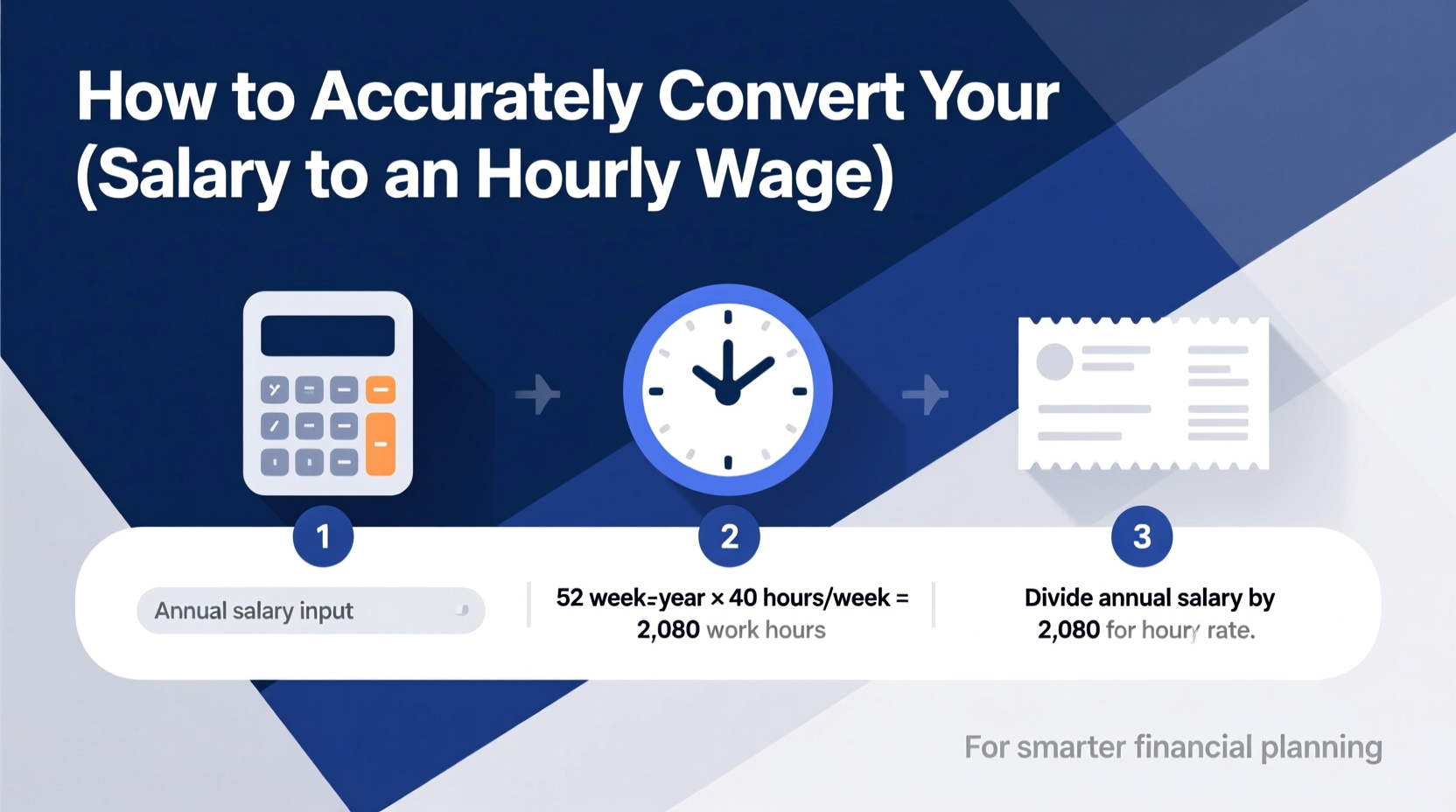
The conventional method for converting salary to hourly wage assumes a full-time schedule of 40 hours per week over 52 weeks a year:
Hourly Rate = Annual Salary ÷ 2,080
This number—2,080—is derived from 40 hours × 52 weeks. For instance, someone earning $52,000 annually would calculate:
$52,000 ÷ 2,080 = $25/hour
While simple, this formula has significant flaws. It doesn’t account for:
- Paid or unpaid vacation days
- Holidays
- Sick leave
- Overtime or irregular hours
- Commute time or unpaid tasks outside work hours
As a result, the calculated rate can be misleading. If you only work 46 weeks due to vacation and holidays, your actual working hours drop to about 1,840 (40 × 46), pushing your effective hourly rate up to $28.26—an 13% difference.
Tip: Always adjust your annual workdays based on your actual paid time off. This gives a more realistic picture of your hourly earnings.Step-by-Step Guide to Accurate Hourly Conversion
To determine your true hourly wage, follow these steps using personalized data:
- Determine your total annual compensation. Include base salary, bonuses, commissions, and stipends.
- Calculate your actual working days per year. Start with 260 business days (52 weeks × 5 days) and subtract vacation, holidays, sick days, and any unpaid leave.
- Multiply working days by daily hours. Most full-time roles are 8 hours/day, so if you work 230 days, that’s 1,840 hours/year.
- Divide total compensation by total hours worked. This yields your true hourly rate.
- Add non-monetary benefits (optional). To get a holistic view, estimate the value of health insurance, retirement matches, or transit passes and include them proportionally.
Let’s walk through an example:
A marketing manager earns $60,000 annually, receives three weeks of paid vacation, observes eight company holidays, and takes five sick days. They work 8 hours per day.
- Total business days: 260
- Subtract: 15 vacation + 8 holidays + 5 sick = 28 days off
- Working days: 232
- Total hours: 232 × 8 = 1,856
- Hourly rate: $60,000 ÷ 1,856 ≈ $32.33/hour
This is nearly 24% higher than the standard $28.85 derived from 2,080 hours—highlighting how ignoring time off inflates perceived workload and deflates hourly value.
Comparing Scenarios: Salaried vs. Hourly vs. Freelance
Accurate hourly conversion becomes especially useful when comparing employment types. Below is a comparison table illustrating how different roles stack up when adjusted for real hours and benefits.
| Role Type | Annual Pay | Work Hours/Year | Effective Hourly Rate | Key Considerations |
|---|---|---|---|---|
| Salaried (40 hrs/wk) | $55,000 | 1,840 | $29.89 | No overtime pay; includes PTO and benefits |
| Hourly (45 hrs/wk) | $27/hr × 2,340 hrs | 2,340 | $27.00 | Overtime included; no guaranteed PTO |
| Freelancer | $60,000 net | 1,500 | $40.00 | No employer benefits; variable income |
The freelancer earns the highest effective hourly rate but lacks stability and benefits. The hourly worker logs significantly more time, reducing their effective rate despite a high base wage. Meanwhile, the salaried employee enjoys balance and predictability—even if the raw math appears less favorable.
Mini Case Study: Evaluating a Job Offer
Sophia, a graphic designer, received two offers:
- Company A: $65,000 salary, 40-hour weeks, 15 days PTO, 6 holidays
- Company B: $30/hour, expected 50-hour weeks, minimal PTO
She calculated her effective hourly rates:
Company A:
260 business days − (15 vacation + 6 holidays) = 239 working days
239 × 8 = 1,912 hours
$65,000 ÷ 1,912 ≈ $33.99/hour
Company B:
50 hours/week × 52 weeks = 2,600 hours
$30 × 2,600 = $78,000 gross
But factoring burnout risk and lack of downtime, her effective rate drops when valuing rest and sustainability.
Sophia chose Company A—not because it paid more on paper, but because it offered a healthier work-life balance and a higher quality-adjusted hourly rate.
Common Pitfalls to Avoid
Even well-intentioned calculations can go wrong. Here are common mistakes and how to avoid them:
- Using 2,080 hours without adjustment. Always factor in actual workdays.
- Ignoring unpaid labor. Time spent answering emails after hours should count toward total hours if it's routine.
- Overlooking benefits. A $5,000 employer 401(k) match adds real value—treat it as part of income.
- Assuming all hours are equal. High-stress or cognitively demanding work may warrant a premium rate.
Checklist: Calculate Your True Hourly Wage
- ☐ Gather your annual salary and any bonuses or commissions
- ☐ Count your total paid workdays in a year (260 minus PTO and holidays)
- ☐ Multiply days by daily hours to get total annual hours worked
- ☐ Divide total compensation by total hours
- ☐ Adjust for unpaid overtime or remote work creep
- ☐ Factor in the monetary value of key benefits (e.g., health insurance, retirement match)
- ☐ Compare results across job options or side hustles
FAQ
Does unpaid overtime affect my hourly rate?
Yes. If you regularly work 45–50 hours per week on a fixed salary, your effective hourly rate decreases. For example, a $50,000 salary over 2,200 hours equals $22.73/hour—significantly less than the $24.04 at 2,080 hours.
Should I include benefits in my hourly calculation?
Including benefits provides a fuller financial picture. Estimate their value: a $10,000 employer contribution adds directly to your compensation. Whether you treat it as cash equivalent depends on your goals—strict budgeting vs. long-term wealth planning.
Can this method help freelancers set rates?
Absolutely. Freelancers should reverse-engineer their desired salary. If you want $60,000 after taxes and expect to bill 1,200 hours annually, divide to find your minimum rate. Then add overhead (software, taxes, insurance) to land at a competitive market price—likely $75–$100/hour depending on location and niche.
Take Control of Your Financial Clarity
Converting salary to an accurate hourly wage isn’t just arithmetic—it’s a mindset shift. It turns abstract income into measurable units of time and effort, revealing which opportunities truly respect your life and labor. By refining your calculation beyond the default 2,080-hour model, you gain leverage in negotiations, clarity in decision-making, and confidence in your financial path. Whether you're weighing job offers, starting a side hustle, or simply reevaluating your current role, knowing your real hourly rate puts you in control. Start tracking, start calculating, and start valuing your time like the finite, powerful resource it is.
🚀 Ready to take charge of your financial future? Download a free hourly wage calculator template or share your experience in the comments below—help others see the true value of their time.