
The internet has birthed countless viral moments, but few have captured pop culture’s imagination quite like fictional character rap battles. Among them, the face-off between Godzilla and King Kong stands out—not just for its absurd premise, but for the surprisingly sharp lyrics and thematic depth each monster brings to the mic. While both titans are known for smashing cities, not sonnets, their lyrical clash reveals more than brute force: it exposes storytelling nuance, rhythmic precision, and symbolic weight. So when the dust settles and the beats fade, who actually wins—not in strength, but in lyrical supremacy?
The Context Behind the Battle
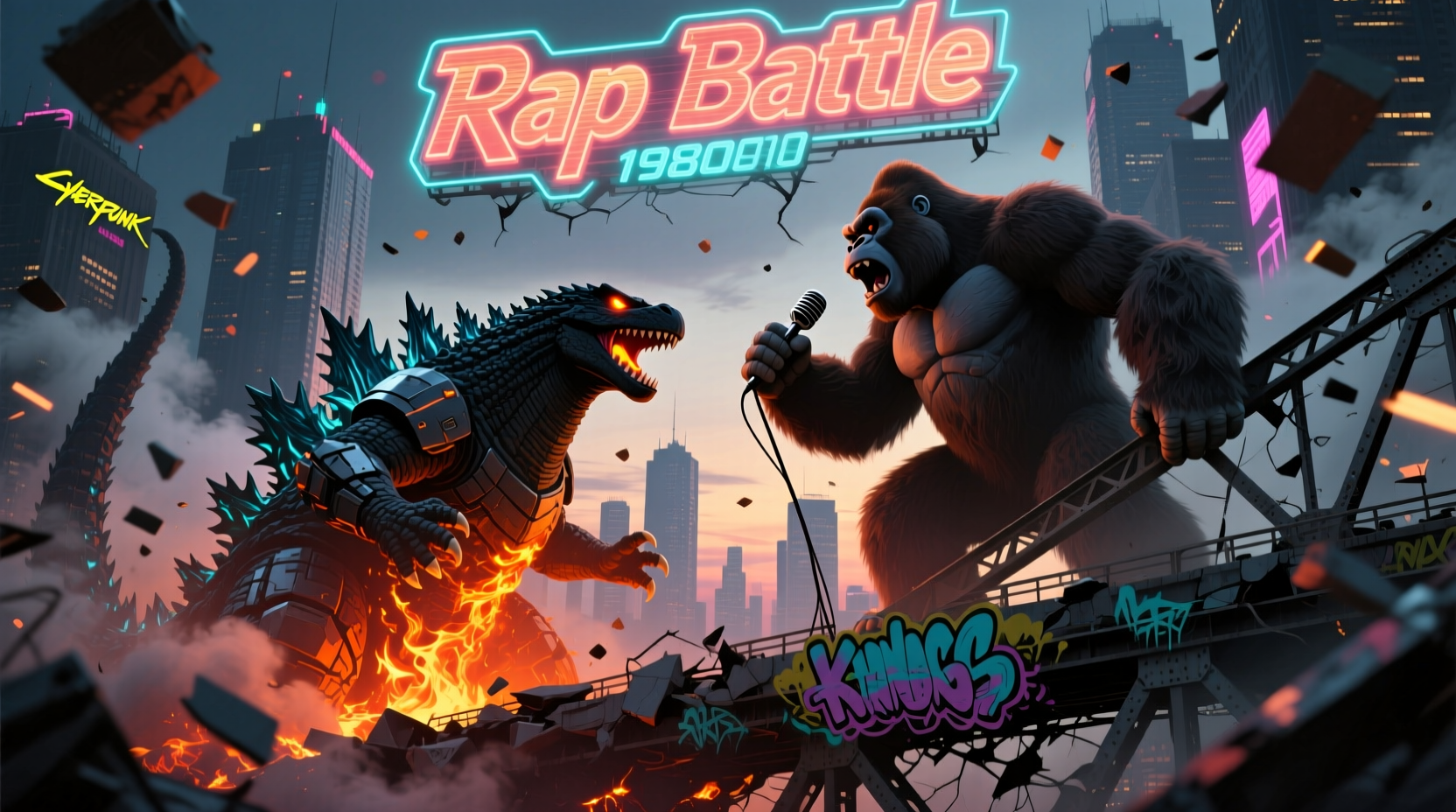
This isn’t a real-world concert or a track released by major labels. The \"Godzilla vs King Kong\" rap battle exists primarily in fan-made videos, animated skits, and parody content—most notably inspired by the style of *Epic Rap Battles of History*. In these stylized duels, characters are pitted against each other with custom-written bars that blend historical references, pop culture jabs, and clever wordplay.
In this particular matchup, the writers had to personify two creatures defined by silence on screen—neither speaks in films, yet both carry mythic status. That makes the challenge greater: how do you give voice to beings whose power lies in destruction, not dialogue? The answer comes through metaphor, allusion, and persona projection.
“Giving voice to silent icons requires understanding their symbolism—not just their size.” — Dr. Lena Torres, Pop Culture Rhetoric Scholar
Lyrical Breakdown: Godzilla’s Approach
Godzilla enters the ring as the embodiment of nuclear consequence and ancient wrath. His verses typically lean into apocalyptic imagery, environmental critique, and superiority rooted in elemental dominance. A sample line might go:
“I’m the pulse in the fault line, the glow in the fallout / You swing from trees while I level Tokyo downtown.”
What stands out is his use of internal rhyme (“pulse/fault,” “glow/fallout”) and multisyllabic patterns that mimic seismic rhythm. He often references real-world anxieties—climate change, atomic energy, human hubris—elevating his lyrics beyond mere bragging. His flow tends to be slow, deliberate, and heavy, matching his cinematic presence.
- Strengths: Thematic consistency, rich metaphors, cultural commentary
- Weaknesses: Less punchline-driven; can feel overly serious
- Rhyme density: High, especially in mid-to-late verses
King Kong’s Counterattack
King Kong, in contrast, often adopts a more emotional and tragic tone. His lyrics frequently explore themes of isolation, exploitation, and misunderstood strength. Lines like:
“You call me beast, but I climbed skyscrapers for love / While you burn cities ‘cause your heart’s made of mud.”
demonstrate narrative depth and vulnerability rarely seen in monster-on-monster conflicts. Stylistically, Kong’s verses tend to be faster, more agile—mirroring his physical dexterity—and packed with emotional resonance. He uses contrast effectively: beauty vs. beast, nature vs. industry, instinct vs. intelligence.
Where Godzilla weaponizes fear, Kong humanizes rage. This gives him an edge in relatability, even if he lacks the same geopolitical weight in his references.
Key Lyrical Devices Used by Kong
- Anaphora: Repetition for emphasis (“I’ve been caged… I’ve been chained…”)
- Juxtaposition: Contrasting his actions with Godzilla’s (“I protect my home—you destroy yours.”)
- Alliteration: “Fists forged in the forest,” “ape ascending, no assistant”
Head-to-Head Comparison: Who Wins Lyrically?
To determine the true victor, we need a framework. Below is a breakdown across five critical categories in lyrical evaluation.
| Category | Godzilla | King Kong |
|---|---|---|
| Rhyme Complexity | ★★★★�� | ★★★☆☆ |
| Flow & Cadence | ★★★☆☆ | ★★★★☆ |
| Thematic Depth | ★★★★★ | ★★★★☆ |
| Wordplay & Punchlines | ★★★☆☆ | ★★★★★ |
| Originality of Voice | ★★★★☆ | ★★★★★ |
Godzilla scores highest in thematic depth, using his platform to comment on humanity’s self-destructive tendencies. His lines resonate with allegorical power, making his performance intellectually satisfying. However, he sometimes sacrifices humor and agility for gravitas.
Kong, meanwhile, shines in originality and wordplay. By reframing himself as a tragic hero rather than a mindless brute, he subverts expectations. His punchlines land harder, and his flow adapts better to rapid-fire exchanges. While he doesn’t dive as deep into global issues, his personal narrative arc adds emotional stakes missing from Godzilla’s cold fury.
A Mini Case Study: The Final Verse Showdown
In one popular version of the battle, the final round shifts dramatically. Godzilla unleashes a barrage of geological metaphors:
“I’m tectonic, prophetic, volcanic rhetoric / My breath is napalm, my legacy is ballistic.”
Strong imagery, yes—but predictable in theme. Then Kong responds:
“You’re loud, but empty—just radiation noise / I’m the king of the jungle, and you’re just a lizard with toys.”
This couplet works on multiple levels. “Lizard” undermines Godzilla’s godlike image (despite being a mutated dinosaur, he’s often mistaken for a giant iguana). “Toys” suggests childish destruction, contrasting Kong’s purposeful climbs. The rhyme is tight, the insult layered, and the delivery implies control over chaos.
This moment exemplifies why many fans consider Kong the lyrical winner: he doesn’t just match Godzilla’s power—he redefines the battlefield.
Common Mistakes in Evaluating Fictional Rap Battles
Many viewers judge these clashes based on fandom loyalty or visual presentation, not lyrical merit. To avoid bias, here’s a checklist for fair analysis:
Checklist: How to Judge a Rap Battle Fairly- Separate character popularity from lyrical quality
- Evaluate rhyme schemes, not just end rhymes
- Assess thematic coherence across verses
- Note originality—does the writer avoid clichés?
- Consider emotional impact alongside technical skill
Frequently Asked Questions
Was there ever an official Godzilla vs King Kong rap battle?
No, there is no officially licensed rap battle between Godzilla and King Kong produced by Toho or Legendary. All versions are fan-made tributes, often modeled after shows like *Epic Rap Battles of History*.
Do the monsters actually rap in any movies?
No. Neither Godzilla nor King Kong speaks in any canonical film. The rap battle concept is purely imaginative, allowing writers to explore their personas through lyrical interpretation.
Why does King Kong sometimes win despite being smaller?
In lyrical terms, size doesn’t matter—substance does. Kong’s ability to convey emotion, irony, and narrative complexity gives him an artistic advantage, even if Godzilla dominates in raw power and thematic scale.
Conclusion: The Verdict
After dissecting rhyme schemes, thematic layers, flow dynamics, and emotional resonance, one conclusion emerges: **King Kong wins the rap battle lyrically**. Not because he’s more powerful, but because he’s more poetic. He transforms his image from a primal ape into a symbol of resistance, dignity, and misunderstood strength. Godzilla remains a force of nature—impressive, inevitable, and intellectually potent—but ultimately less adaptable in a format that rewards wit, rhythm, and surprise.
Lyricism isn’t about volume; it’s about vision. And in that arena, the ape ascends higher than the atom-powered leviathan.
💬 Who do you think delivered the better bars? Share your favorite lines from fan-made battles or write your own verse—then challenge a friend to a rematch!