Bill O'Reilly is widely recognized not only as a political commentator but also as a compelling historical storyteller whose books bring complex events to life with narrative intensity and accessible prose. His collaborations—particularly with historian Martin Dugard—have produced a series of bestsellers that combine rigorous research with the pacing of a thriller. These works appeal to readers who want more than dry facts: they seek drama, human conflict, and moral clarity in the retelling of history. Whether it's wartime decisions, presidential assassinations, or epic battles, O'Reilly’s books transform historical turning points into immersive experiences.
The Killing Series: A Narrative Revolution in Popular History
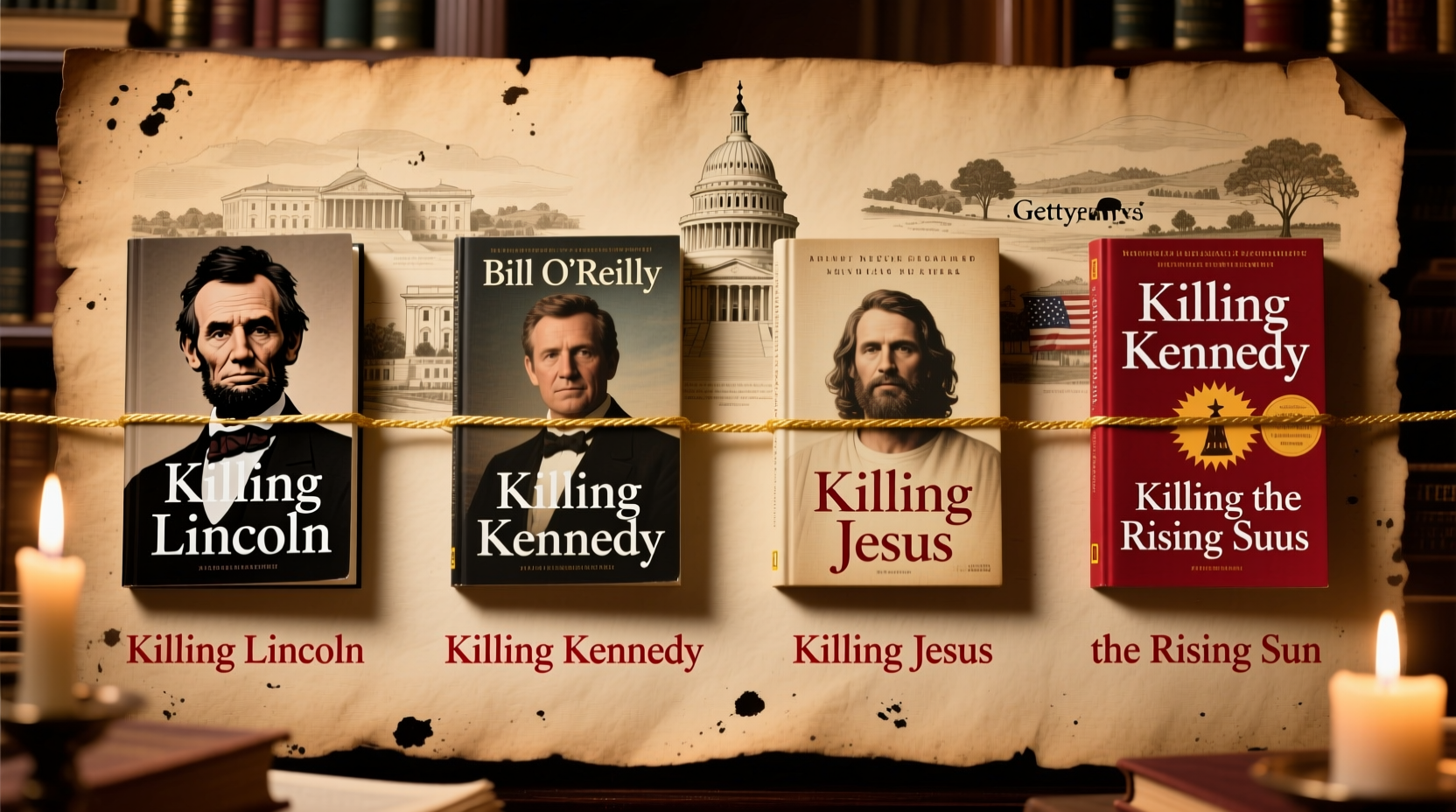
O'Reilly’s most influential contribution to popular history is undoubtedly his “Killing” series. Beginning with Killing Lincoln in 2011, this collection reframes major historical events through a cinematic lens, focusing on key figures, behind-the-scenes maneuvers, and the emotional weight of their choices. Each book reads like a suspense novel while maintaining factual accuracy, making them ideal for both casual readers and history enthusiasts looking for an entry point into deeper subjects.
The series stands out for its dual authorship model: O'Reilly provides the narrative voice and thematic focus, while Dugard handles much of the archival research and structural development. This partnership has proven highly effective, resulting in over a dozen titles that have sold millions of copies worldwide.
Tip: Start with Killing Lincoln or Killing Kennedy if you're new to O'Reilly’s style—they are the most accessible and set the tone for the rest of the series.Why the \"Killing\" Format Works
The brilliance of the series lies in its structure. Rather than presenting history chronologically from start to finish, each book zeroes in on the final days leading up to a pivotal event—the assassination of a leader, the end of a war, or the climax of a trial. This narrow focus builds tension and allows readers to feel the immediacy of historical moments.
For example, Killing Lincoln doesn’t attempt to cover Abraham Lincoln’s entire presidency. Instead, it narrows its scope to the last months of his life, interweaving the perspectives of Lincoln, John Wilkes Booth, and Union generals. The result is a story that feels personal and urgent, even though the outcome is already known.
Top 5 Bill O'Reilly Books for History and Storytelling Excellence
| Book Title | Historical Focus | Key Strength | Best For Readers Interested In |
|---|---|---|---|
| Killing Lincoln | Assassination of Abraham Lincoln | Narrative pacing, character depth | American Civil War, presidential leadership |
| Killing Kennedy | JFK’s presidency and assassination | Political intrigue, Cold War context | 1960s America, CIA operations |
| Killing Patton | General George S. Patton’s final days | Military strategy, conspiracy theories | World War II command dynamics |
| Killing Reagan | Ronald Reagan’s life and attempted assassination | Personal resilience, Cold War diplomacy | Modern conservatism, mental health policy |
| Killing the Rising Sun | U.S.-Japan conflict in WWII | Epic scale, moral complexity | Pacific Theater, nuclear warfare ethics |
These titles represent the peak of O'Reilly and Dugard’s collaborative storytelling. Each one balances dramatic tension with educational value, often including maps, timelines, and photographs (in print editions) to enhance understanding.
Storytelling Techniques That Make History Come Alive
What separates O'Reilly’s books from traditional historical accounts is his use of literary devices typically found in fiction. He employs short chapters, cliffhanger endings, and multiple third-person viewpoints to maintain momentum. This approach mirrors television storytelling—unsurprising given O'Reilly’s background in broadcast journalism.
“We wanted to write history the way people experience it—not as a lecture, but as a race toward an inevitable conclusion.” — Martin Dugard, co-author of the Killing series
This quote reveals the core philosophy behind the series: history should be felt, not just studied. By emphasizing personal motivations, fears, and ambitions, O'Reilly humanizes historical figures. Readers don’t just learn what happened—they understand why it mattered.
Another hallmark is the use of real-time narration. Events unfold hour by hour, especially during critical sequences like D-Day in Killing the SS or the Cuban Missile Crisis in Killing Kennedy. This technique creates urgency and draws readers into the decision-making process at the highest levels of power.
Real Example: How Killing the Bismarck Turns Naval Warfare Into Drama
In Killing the Bismarck, O'Reilly and Dugard recount the 1941 British pursuit of the German battleship Bismarck across the North Atlantic. While naval engagements might seem distant or technical to some readers, the authors frame the story around individual courage and national survival.
One chapter follows a young Royal Navy pilot flying a torpedo bomber from an aircraft carrier in stormy weather. His plane is damaged, visibility is near zero, and he knows a hit could sink the Bismarck—but also that failure means prolonging the war. This human-scale perspective makes abstract military strategy deeply personal.
This mini case study illustrates how O'Reilly’s method transforms data—tonnage, speed, coordinates—into stakes. It’s not just about sinking a ship; it’s about breaking Nazi morale and proving Britain could strike back.
Beyond the Killing Series: Other Notable Works
While the “Killing” books dominate O'Reilly’s bibliography, other titles offer valuable insights into American values and identity:
- A Bold Fresh Piece of Humanity: O'Reilly’s memoir detailing his early career in journalism, including time spent reporting from war zones. Offers rare insight into how he developed his no-nonsense communication style.
- Legends and Lies: A companion series to his Fox Nation show, covering figures like Billy the Kid, Ulysses S. Grant, and the Founding Fathers. More opinionated than the Killing books, but still rich in anecdote and visual storytelling.
- History Lessons: A critique of modern education, arguing that schools fail to teach foundational American history. Best read as a polemic rather than a textbook.
How to Read Bill O'Reilly’s Books Critically and Effectively
While O'Reilly’s storytelling is engaging, readers should approach his work with a discerning eye. His narratives often reflect a conservative worldview, emphasizing patriotism, strong leadership, and moral absolutes. Some historians have critiqued the series for oversimplifying complex events or downplaying systemic issues like racism or imperialism.
To get the most out of these books, consider the following checklist:
- Read the footnotes and sources section to identify where information comes from.
- Cross-reference controversial claims with academic histories.
- Notice which voices are centered—and which are missing (e.g., civilian perspectives in war narratives).
- Reflect on the language used: Does it evoke emotion? Is it persuasive?
- Use the books as a starting point for deeper exploration, not a final authority.
“Popular history has a responsibility to inform as well as entertain. O’Reilly succeeds in grabbing attention—but readers must do their part to verify.” — Dr. Linda Chen, Professor of Historical Communication, University of Chicago
FAQ
Are Bill O'Reilly’s books historically accurate?
Yes, in terms of verifiable facts and timelines. However, interpretation and emphasis reflect a particular ideological lens. They are best used as introductory texts, supplemented with scholarly works for balance.
Do I need to read the Killing series in order?
No. Each book is self-contained and focuses on a different event. However, reading them in publication order can help you appreciate the evolution of the writing style and thematic concerns.
Are these books appropriate for high school students?
Many educators use Killing Lincoln and Killing Kennedy in classrooms due to their readability and engagement. However, parental or teacher guidance is recommended for titles involving graphic violence, such as Killing the Rising Sun.
Final Thoughts: Why These Books Still Matter
In an age of fragmented attention and declining interest in history, Bill O'Reilly’s books serve a vital role: they make the past exciting. At their best, they inspire curiosity, prompt discussion, and encourage readers to look beyond headlines and soundbites. Whether you agree with every interpretation or not, the power of these stories to ignite interest in history is undeniable.
If you’ve ever wondered what it was like to be in the Situation Room during the Cuban Missile Crisis, or on the deck of the HMS Hood facing the Bismarck, O'Reilly’s books deliver that experience with unmatched intensity.
💬 Ready to dive into history with a pulse-pounding narrative? Pick up Killing Lincoln today and discover how one night in April changed America forever. Share your thoughts with others—what moment in history would you want told like a thriller?