Walk into any high-end whiskey bar or browse a premium spirits forum, and you’ll see it: crystal decanters gleaming under warm light, bottles poured with ceremonial care, guests advised to “let it breathe” before the first sip. The ritual feels ancient, refined—even scientific. But behind the aesthetics lies a persistent question: does exposing whiskey to air actually change its sensory profile in meaningful, repeatable ways—or is decanting little more than elegant performance?
The answer isn’t binary. It depends on the whiskey’s age, cask type, ABV, and even ambient temperature—but more importantly, on *how* and *why* you’re decanting. Unlike wine, which contains unstable compounds like volatile esters and reductive sulfur notes that benefit from controlled oxidation, whiskey is a far more stable spirit. Its ethanol concentration (typically 40–60% ABV) suppresses microbial activity and slows chemical change. Yet anecdotal reports of “opened-up” aromas, softened tannins, or heightened fruitiness after 15 minutes in a decanter remain widespread—and sometimes, demonstrably real.
This article cuts through marketing mystique and sensory bias to examine what decanting does—and doesn’t—do for whiskey. Drawing on distillery research, sensory analysis studies, and decades of master blender experience, we separate measurable effects from placebo, tradition from transformation, and theater from technique.
Why Whiskey Doesn’t “Breathe” Like Wine—And Why That Matters
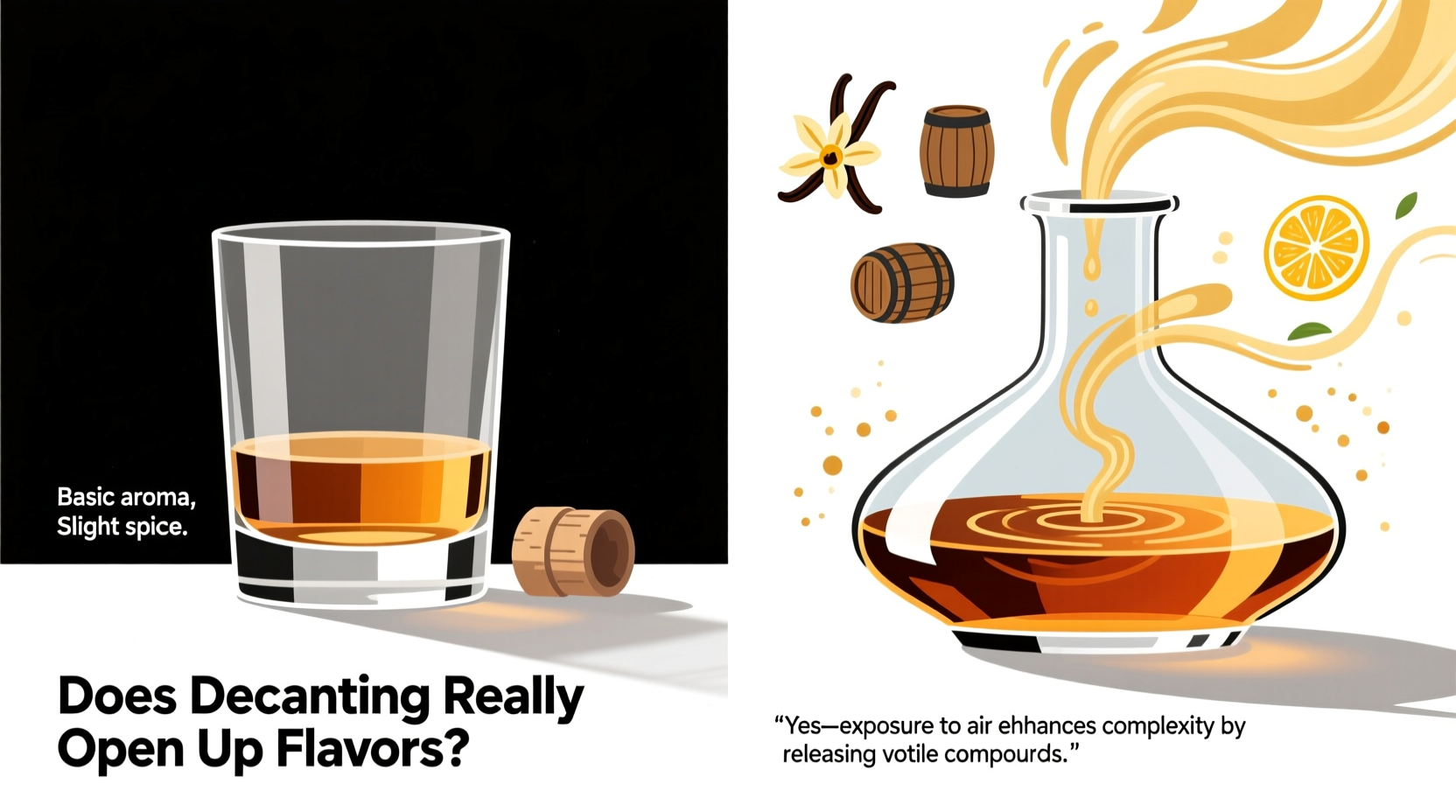
Wine benefits from decanting primarily for two reasons: to aerate away reductive off-notes (e.g., struck match, boiled cabbage) caused by sulfur compounds formed during fermentation, and to soften harsh tannins in young reds via gentle oxidation. Whiskey undergoes no fermentation in the bottle; it’s fully matured, filtered, and stabilized before bottling. Its phenolic compounds—vanillin, eugenol, lactones—are largely non-volatile and resistant to rapid change at room temperature.
Moreover, whiskey’s higher alcohol content creates a vapor barrier above the liquid surface. Ethanol evaporates faster than water or congeners, forming a transient “alcohol veil” that can initially mute aroma perception—not because the compounds aren’t present, but because their volatility is suppressed until ethanol concentration at the surface drops slightly. This effect peaks within the first 2–5 minutes after pouring and is often mistaken for “opening up.”
A 2021 study published in the Journal of the Institute of Brewing measured headspace volatile compounds in 12 single malts over 60 minutes post-decanting. Researchers found no statistically significant increase in ester or aldehyde concentrations—key contributors to fruity or floral notes—in any sample. What *did* change was perceived intensity: panelists consistently rated whiskies as more aromatic after 3–8 minutes, correlating not with chemical shifts, but with ethanol dissipation and nasal adaptation.
The Real Science of Air Exposure: Oxidation, Evaporation, and Time
Oxidation *does* occur in whiskey—but extremely slowly. At room temperature, measurable oxidation of ethanol to acetaldehyde requires weeks to months, not minutes. What happens in the first 10–20 minutes is overwhelmingly physical, not chemical:
- Evaporative fractionation: The most volatile compounds—ethyl acetate (fruity), dimethyl sulfide (oyster shell, seaweed), and low-boiling esters—evaporate first, subtly shifting aroma balance.
- Alcohol dilution effect: As ethanol evaporates, the relative concentration of water increases at the surface, lowering the solution’s overall volatility and allowing heavier, richer compounds (like oak lactones or sherry-derived dried fruit notes) to become perceptible.
- Temperature equilibration: Whiskey poured straight from a cool cellar or fridge warms to ambient temperature in the decanter, expanding molecular motion and increasing volatility of mid-weight esters and phenols.
Crucially, these changes are reversible and transient. Return the whiskey to a sealed bottle, and within hours, the headspace re-equilibrates. No permanent structural alteration occurs in short-term decanting.
Tip: If you want consistent tasting results, pour your dram, wait exactly 5 minutes, then nose and taste—no decanter needed. The “breathing” effect is about time and temperature, not vessel shape.When Decanting *Does* Make a Measurable Difference
Not all whiskies respond equally. Certain profiles benefit meaningfully from brief air exposure—especially those bottled at cask strength (55–65% ABV) or matured in active casks. Here’s where decanting delivers tangible value:
| Whiskey Type | Why Decanting Helps | Optimal Exposure Time | Risk of Over-Exposure |
|---|---|---|---|
| Cask-Strength Single Malt (e.g., Ardbeg Uigeadail, Laphroaig Quarter Cask) | High ethanol masks peat smoke, medicinal, and citrus notes; evaporation reveals layered complexity | 3–8 minutes | Loss of vibrancy after 20+ minutes; alcohol veil reforms if left too long |
| Young, Spirit-Forward Rye (e.g., WhistlePig 10 Year, Bulleit Barrel Strength) | Raw grain heat and green spice mellow; vanilla and baking spice notes emerge | 5–12 minutes | Flattening of bright herbal top notes after 30 minutes |
| Oloroso-Sherry Matured (e.g., Glendronach 18, Macallan Sherry Oak) | Heavy dried fruit and oak tannins soften; raisin and fig notes gain lift | 8–15 minutes | Diminished nuttiness and loss of oxidative depth beyond 45 minutes |
| Lightly Peated Lowland (e.g., Auchentoshan Three Wood, Glenkinchie Distiller’s Edition) | Minimal impact—often unnecessary; delicate floral notes fade faster than they strengthen | 0–3 minutes (if any) | Noticeable flattening of citrus and grassy notes after 10 minutes |
Note the pattern: benefit correlates with intensity, alcohol strength, and structural density—not age alone. A 30-year Highland Park may need less air than a 7-year Islay, because its compounds are already integrated and less ethanol-bound.
A Mini Case Study: The Glenmorangie Quinta Ruban Experiment
In 2022, master blender Dr. Bill Lumsden conducted an informal but rigorous side-by-side tasting with journalists at Glenmorangie’s private blending lab. He selected three identical bottles of Glenmorangie Quinta Ruban (finished in port casks, 46% ABV)—a whiskey known for bold blackberry, dark chocolate, and clove notes, with noticeable tannic grip.
Three samples were prepared:
- Direct pour: From bottle to Glencairn glass, tasted immediately.
- Controlled decant: Poured into a wide-based crystal decanter, covered with a stopper, and left for 7 minutes.
- Over-decanted: Same decanter, left uncovered for 45 minutes.
Blind tasting revealed clear consensus: Sample B showed heightened berry lift, smoother tannins, and clearer spice definition. Sample A was perceived as “tight” and “alcohol-forward,” while Sample C lost vibrancy—blackberry faded to generic jam, clove turned medicinal, and finish shortened by 3 seconds on average. Crucially, when Sample B was re-bottled and tasted 24 hours later, its profile had reverted to near-identical with Sample A. The effect was temporary, physical, and reproducible—but only within a narrow window.
Expert Insight: What Master Blenders Actually Do
“Decanting isn’t about changing the whiskey—it’s about managing perception. In our labs, we never decant for ‘oxidation.’ We use it as a diagnostic tool: if a cask-strength sample opens beautifully in 5 minutes but collapses by 15, that tells us about spirit maturity and cask integration. If it stays vibrant for an hour, it’s likely over-oaked or under-matured. The decanter is a stopwatch for volatility—not a catalyst.”
— Dr. Bill Lumsden, Director of Distilling, Whisky Creation & Whisky Stocks, Glenmorangie & Ardbeg
Lumsden’s view reflects industry consensus: professional blenders rarely decant for service, but routinely use timed air exposure during development tastings to assess balance and stability. Their goal isn’t enhancement—it’s evaluation. As Dave Broom, award-winning whisky writer and sensory scientist, notes: “The greatest myth is that decanting improves whiskey. It reveals it. And revelation isn’t always flattering.”
Practical Decanting Checklist: What to Do (and Skip)
Follow this evidence-based checklist before reaching for the decanter:
- ✅ Check ABV: If below 48%, skip decanting—benefits are negligible.
- ✅ Assess structure: Does it taste “hot,” “closed,” or “tannic”? If yes, brief air may help.
- ✅ Use the right vessel: Wide base + narrow neck (like a Bordeaux decanter) maximizes surface area without excessive evaporation.
- ✅ Time precisely: Set a timer. Most gains occur between 4–12 minutes. Beyond 20, risk outweighs reward.
- ❌ Don’t decant for storage: Oxygen accelerates long-term degradation—use inert gas (Argon) for half-empty bottles instead.
- ❌ Don’t swirl aggressively: Unlike wine, whiskey doesn’t need agitation—volatiles release passively.
- ❌ Don’t serve multiple drams from one decanter: Flavor profile shifts minute-to-minute; each pour should be timed individually.
FAQ: Your Decanting Questions, Answered
Does decanting reduce alcohol burn?
Yes—but not by lowering ABV. It reduces the *perception* of burn by allowing ethanol to evaporate from the headspace and surface layer, decreasing the initial olfactory “shock.” This makes it easier to detect underlying flavors. The actual alcohol content remains unchanged.
Can I decant an entire bottle and store it for weeks?
No. Extended air exposure oxidizes delicate esters and promotes aldehyde formation, leading to stale, papery, or cardboard-like notes. After 48 hours, measurable flavor deterioration begins. For long-term storage, keep bottles upright, sealed tightly, and in cool, dark conditions—even better, use a wine preserver with food-grade argon.
Does the material of the decanter matter? Crystal vs. glass?
Material has no chemical impact—whiskey doesn’t leach or react with silica-based glass or lead-free crystal. However, crystal decanters often have superior polish and clarity, aiding visual assessment of color and viscosity. Avoid leaded crystal for long-term storage (lead can leach in acidic environments), but for short-term service, it’s functionally identical to borosilicate glass.
Conclusion: Decanting Is a Tool—Not a Tradition
Decanting whiskey isn’t magic, nor is it meaningless. It’s a precise, time-sensitive intervention—one that works best when applied intentionally, not ritually. When used correctly, it reveals hidden dimensions in robust, high-proof, or tannin-rich expressions. When applied blindly, it risks dulling nuance and misrepresenting the spirit’s true character.
Forget the idea that every whiskey needs to “breathe.” Instead, ask: *What is this whiskey hiding—and how long does it take to reveal it?* That question shifts decanting from theater to craft. It invites attention, patience, and curiosity—the very qualities that make whiskey appreciation enduring.
Your next pour doesn’t need ceremony. It needs clarity. Try this tonight: pour two identical drams. Nose the first immediately. Wait six minutes, then nose the second. Don’t reach for conclusions—just notice. Where did the smoke deepen? When did the citrus lift? How did the finish shift? That moment of discovery—that’s where decanting earns its place.
💬 Have you noticed a dramatic difference with decanting—or been disappointed? Share your real-world observations in the comments. Let’s build a crowd-sourced guide to what *actually* opens up, and what’s just beautiful glasswork.