Walk into a bustling neighborhood bar on a sunny Saturday afternoon and you might spot a golden retriever curled beside a leather banquette, a French bulldog sharing a stool with its owner, or a well-groomed terrier sipping from a stainless-steel water bowl near the patio entrance. Pet-friendly bars have surged in popularity across urban centers—from Portland to Berlin to Melbourne—driven by shifting cultural norms, rising pet ownership (nearly 70% of U.S. households include at least one companion animal), and a growing demand for inclusive, experiential hospitality. Yet skepticism lingers: Can a space designed for human conviviality—where craft cocktails are stirred with precision, ambient lighting sets mood, and surfaces gleam under rigorous sanitation protocols—truly welcome dogs, cats, and occasionally even rabbits, without diluting its character or standards?
The answer isn’t binary. It’s not “yes” or “no”—it’s *how*. The most successful pet-inclusive venues don’t treat pets as an afterthought or a marketing gimmick. They integrate thoughtful design, operational discipline, and hospitality philosophy so that canine companions enhance rather than interrupt the experience—for everyone present.
What “Pet-Friendly” Really Means—Beyond the Sign on the Door
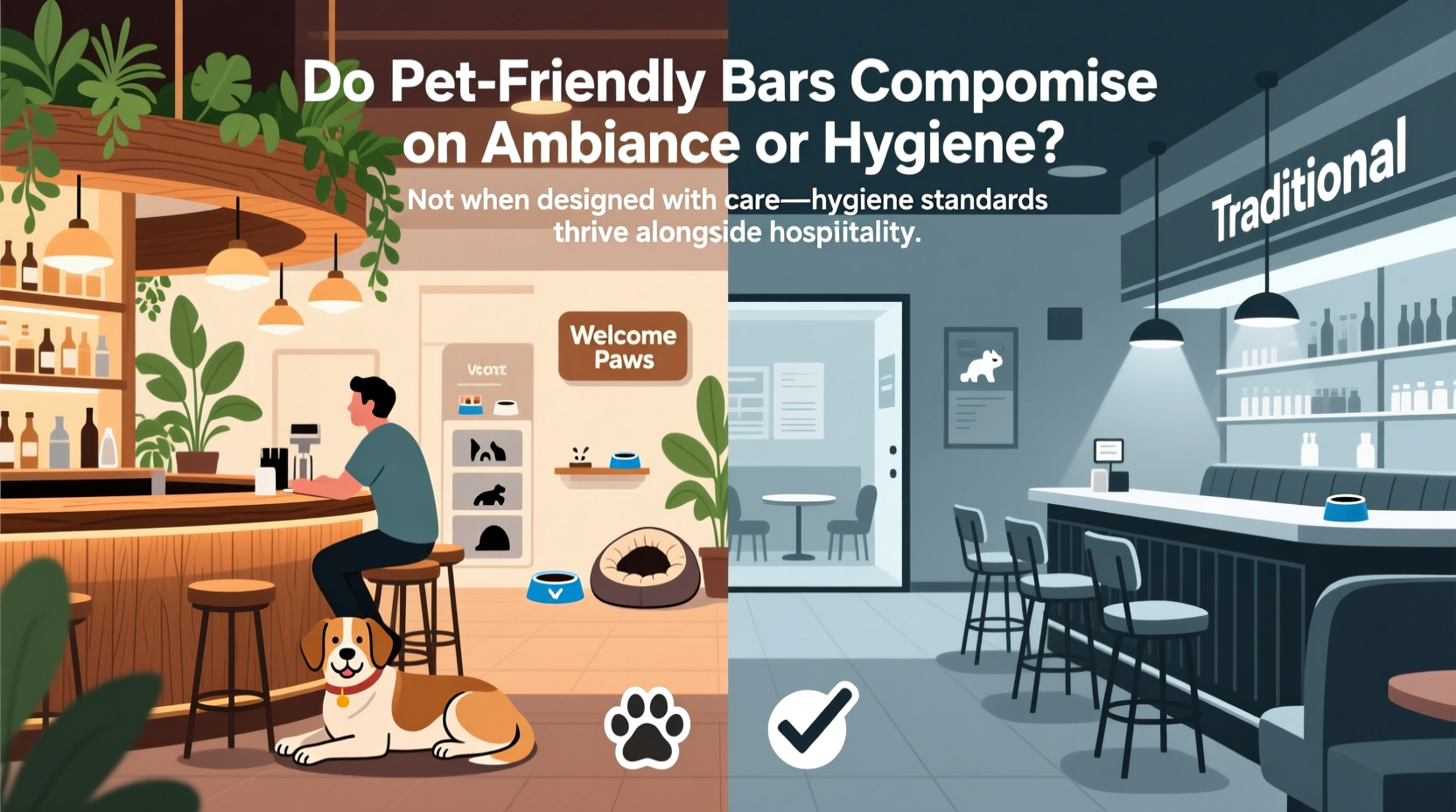
“Pet-friendly” is widely misused. A venue may allow leashed dogs on outdoor patios but prohibit them indoors—or permit pets only during off-peak hours. Others claim inclusivity while enforcing vague, inconsistently applied rules (“Well-behaved pets only”) that leave staff untrained and guests uncertain. True pet-friendliness requires intentionality: clear policies, staff training, physical infrastructure, and hygiene accountability.
Consider the distinction between *pet-tolerant* and *pet-integrated*. A pet-tolerant bar lets animals in—but doesn’t adapt. A pet-integrated bar designs for coexistence: non-porous flooring that resists odor absorption, dedicated hand-washing stations near entry points, elevated water bowls placed away from food prep zones, and seating layouts that preserve personal space for patrons who prefer distance from animals.
Tip: When evaluating a bar’s pet policy, look beyond the website banner. Check for specifics: Are pets allowed indoors? Is there a weight or breed restriction? Do they provide waste bags and disposal stations? Vague language often signals inconsistent execution.The Ambiance Equation: Atmosphere, Not Exclusivity
Ambiance isn’t diminished by presence—it’s shaped by intention. A dimly lit speakeasy with velvet booths and jazz on vinyl can remain deeply atmospheric with pets present—if those pets are calm, well-socialized, and their owners are attentive. What erodes ambiance is disruption: unchecked barking, unattended animals under tables, or owners ignoring behavioral cues. The burden lies not with the animal, but with the venue’s ability to curate behavior through design and expectation.
Leading pet-integrated bars use spatial intelligence to preserve mood. At The Hound & Hearth in Austin, acoustic panels line the ceiling to dampen high-frequency sounds—including whines and sudden barks—while warm pendant lighting focuses light downward onto tabletops, keeping floor-level activity visually soft. Seating is zoned: quiet corners reserved for low-stimulus interaction; central communal tables where social energy (and occasional tail wags) are welcomed; and a dedicated “paw lounge” with washable wool rugs and sound-absorbing walls for higher-energy pups needing brief decompression.
Crucially, ambiance also includes human comfort. A 2023 National Restaurant Association survey found that 62% of diners who *don’t* own pets still support pet-inclusive spaces—if those spaces maintain cleanliness, noise control, and respectful boundaries. That means ambiance isn’t just about aesthetics—it’s psychological safety, sensory balance, and perceived order.
Hygiene: Rigor, Not Ritual
Hygiene concerns are legitimate—and often the most cited objection. But they’re rarely about biological risk (dogs carry fewer zoonotic pathogens than raw chicken or unwashed produce) and more about visible maintenance: fur on banquettes, muddy paws on hardwood, or lingering odors near restrooms. The solution isn’t banning pets—it’s implementing evidence-based sanitation protocols that exceed standard industry practice.
Here’s how top-tier venues operate:
- Daily deep-cleaning cycles timed between service windows—not just nightly, but mid-afternoon when foot traffic dips.
- Non-toxic, enzyme-based cleaners deployed on all high-contact surfaces (bar rails, booth edges, floor seams) to break down organic matter without harsh fumes.
- Flooring materials selected for function: polished concrete with micro-textured sealant (resists scratches, easy to mop), commercial-grade luxury vinyl plank (LVP) with antimicrobial coating, or sealed terrazzo—never carpet or unsealed wood.
- Staff hygiene mandates: mandatory handwashing after any pet contact, gloves for waste handling, and separate cleaning carts designated solely for pet-adjacent zones.
“The moment a venue treats pet hygiene as ‘extra’ instead of foundational, it fails both its animals and its people. Cleanliness isn’t compromised by inclusion—it’s redefined by it.” — Dr. Lena Torres, Veterinary Public Health Consultant and former CDC Environmental Health Officer
Do’s and Don’ts: A Practical Operational Checklist
For bar owners considering pet integration—or patrons seeking genuinely well-run spaces—here’s a concise, actionable checklist grounded in real-world operations:
| Action | Do | Don’t |
|---|---|---|
| Policy Clarity | Post written rules at entrances: leash requirements, prohibited areas (e.g., kitchen, restrooms), vaccination expectations, and behavioral standards (e.g., “No mounting, growling, or unsupervised roaming”) | Rely on verbal explanations or vague signage like “Pets Welcome!” with no further detail |
| Staff Training | Train all front-of-house staff in canine body language, de-escalation techniques, and proper waste response (including disposal logs) | Assign pet-related duties only to one “animal person” without cross-training the full team |
| Sanitation Protocol | Maintain a documented cleaning log: time-stamped entries for floor mopping, surface disinfection, and water bowl replacement | Clean pet zones only during overnight shifts—leaving daytime residue unaddressed |
| Guest Experience | Offer complimentary pet amenities: biodegradable waste bags, pH-balanced paw wipes, and ceramic water bowls (not plastic) | Provide generic “dog treats” made with artificial dyes or xylitol—a known toxin for canines |
| Space Design | Use wipeable, non-porous upholstery (e.g., Crypton fabric or marine-grade vinyl) and install discreet floor drains near high-traffic pet entry points | Install plush, light-colored carpeting in high-pet zones or upholster booths in untreated linen |
Mini Case Study: The Oak & Tether, Portland, OR
When The Oak & Tether opened in 2021, it positioned itself as Portland’s first “full-spectrum pet-inclusive” bar—welcoming dogs indoors year-round, with cats and rabbits permitted by prior arrangement. Skeptics predicted chaos: fur in the draft lines, barking over live jazz, hygiene complaints flooding Yelp.
Instead, within six months, it earned a 4.7-star average (with 82% of reviews mentioning pets positively) and was featured in Food & Wine’s “Most Thoughtful Hospitality Spaces of 2023.” How?
First, they redesigned the layout around flow: a wide, L-shaped entryway with a dedicated “transition zone”—a 6-foot mat area with industrial-grade vacuum suction, a paw-rinse station fed by filtered water, and wall-mounted hooks for leashes. Second, they implemented a reservation add-on: patrons could pre-select “pet-friendly seating,” which assigned them to booths with built-in under-seat storage for leashes and a discreet, removable tray for water bowls. Third, they trained staff using certified canine behaviorist modules—teaching recognition of stress signals (lip licking, whale eye, stiff tail) and gentle redirection techniques.
Most telling? Their indoor air quality tests showed *lower* particulate counts during peak pet hours than on quiet weekday mornings—attributed to increased ventilation cycling triggered by motion sensors near pet zones and daily electrostatic dusting of overhead ducts. Ambiance wasn’t diluted; it was deepened by intention.
Step-by-Step: How to Assess a Pet-Friendly Bar’s Integrity (In Under 90 Seconds)
You don’t need a clipboard or lab coat to gauge whether a pet-friendly bar takes its standards seriously. Use this field-tested sequence during your first visit:
- Observe the entry point (0–15 sec): Is there a clearly marked waste bag dispenser with a covered bin nearby? Are floor mats present and visibly clean—not just decorative?
- Scan the floor (15–30 sec): Look for fur accumulation along baseboards, under tables, or near HVAC vents. Minimal visible fur—even in high-traffic zones—signals consistent vacuuming and electrostatic treatment.
- Check water access (30–45 sec): Are water bowls ceramic or stainless steel (not disposable plastic)? Are they elevated (reducing neck strain) and placed away from food pathways and high-heel traffic?
- Listen and watch (45–75 sec): Note the volume and frequency of dog vocalizations. One soft bark every few minutes suggests calm energy; overlapping, sustained barking indicates poor behavioral screening or inadequate space planning.
- Smell and feel (75–90 sec): Does the air carry neutral or faintly herbal notes (from natural cleaners), or does it smell faintly ammoniac or musty? Run a finger along a booth armrest—does it feel dry and smooth, or tacky or dusty?
If four of five indicators meet the “integrated” standard, the venue is likely succeeding—not compromising.
FAQ
Do pet-friendly bars increase liability or insurance costs?
Yes—but not uniformly. General liability premiums typically rise 12–18% for venues permitting indoor pets, according to the National Association of Insurance Brokers. However, bars that implement documented training, behavioral screening (e.g., requiring proof of basic obedience certification for indoor access), and third-party hygiene audits often qualify for risk-mitigation discounts that offset 60–75% of the increase. The greater financial risk lies in *unmanaged* pet access—not pet access itself.
Can cats or small mammals be accommodated safely alongside dogs?
Yes—with strict zoning and advance coordination. Cats require elevated, enclosed perches away from foot traffic; small mammals (rabbits, guinea pigs) need ventilated carriers placed on stable, non-vibrating surfaces. Crucially, these animals must never share space with dogs unless under direct, continuous supervision—and even then, only if the dog has documented, reliable recall and zero prey drive. Most high-performing venues limit non-canine species to private bookings or off-peak hours.
Does allowing pets affect food safety compliance during health inspections?
No—if protocols are followed. The FDA Food Code explicitly permits service animals (and by extension, well-managed companion animals in non-food-prep areas) provided they don’t enter kitchens, dishwashing areas, or food storage zones. Inspectors assess *control*, not presence. Bars with documented cleaning logs, staff training records, and physical barriers (e.g., gates at kitchen doors) consistently pass with no pet-related citations.
Conclusion
Pet-friendly bars don’t inherently compromise ambiance or hygiene. What they reveal—sometimes uncomfortably—is our assumptions about what “quality” requires. We’ve long conflated exclusivity with excellence: the idea that refinement demands separation, silence, and sterility. But the most resonant hospitality experiences of our time aren’t built on exclusion—they’re built on intelligent inclusion. On recognizing that a well-placed water bowl, a thoughtfully textured floor, and a staff member who knows when a dog needs quiet time aren’t concessions. They’re commitments—to care, consistency, and the quiet dignity of shared space.
Whether you’re a bar owner weighing policy changes, a pet owner seeking spaces that respect both your companion and your palate, or simply someone who values environments where humanity and empathy extend beyond the human species—the standard is no longer “Can we allow pets?” It’s “How rigorously, respectfully, and beautifully can we coexist?”
💬 Your experience matters. Have you visited a pet-friendly bar that got it right—or missed the mark? Share what made the difference: Was it the lighting? The staff’s calm authority? The way fur vanished between pours? Your insight helps raise the bar—for everyone.