For students, journalers, and creative professionals, the tools used to capture ideas matter. Among the most popular stationery items in recent years are Disney-themed gel pens—colorful, whimsical, and often marketed as both functional and collectible. But when it comes to actual note-taking performance, how do they stack up against traditional highlighters? While aesthetics play a role, functionality is key: legibility, ink flow, longevity, and compatibility with different paper types all influence real-world usability. This article dives deep into the practical differences between Disney gel pens and standard highlighters, helping you decide which tool serves your academic or organizational needs best.
Ink Type and Writing Experience
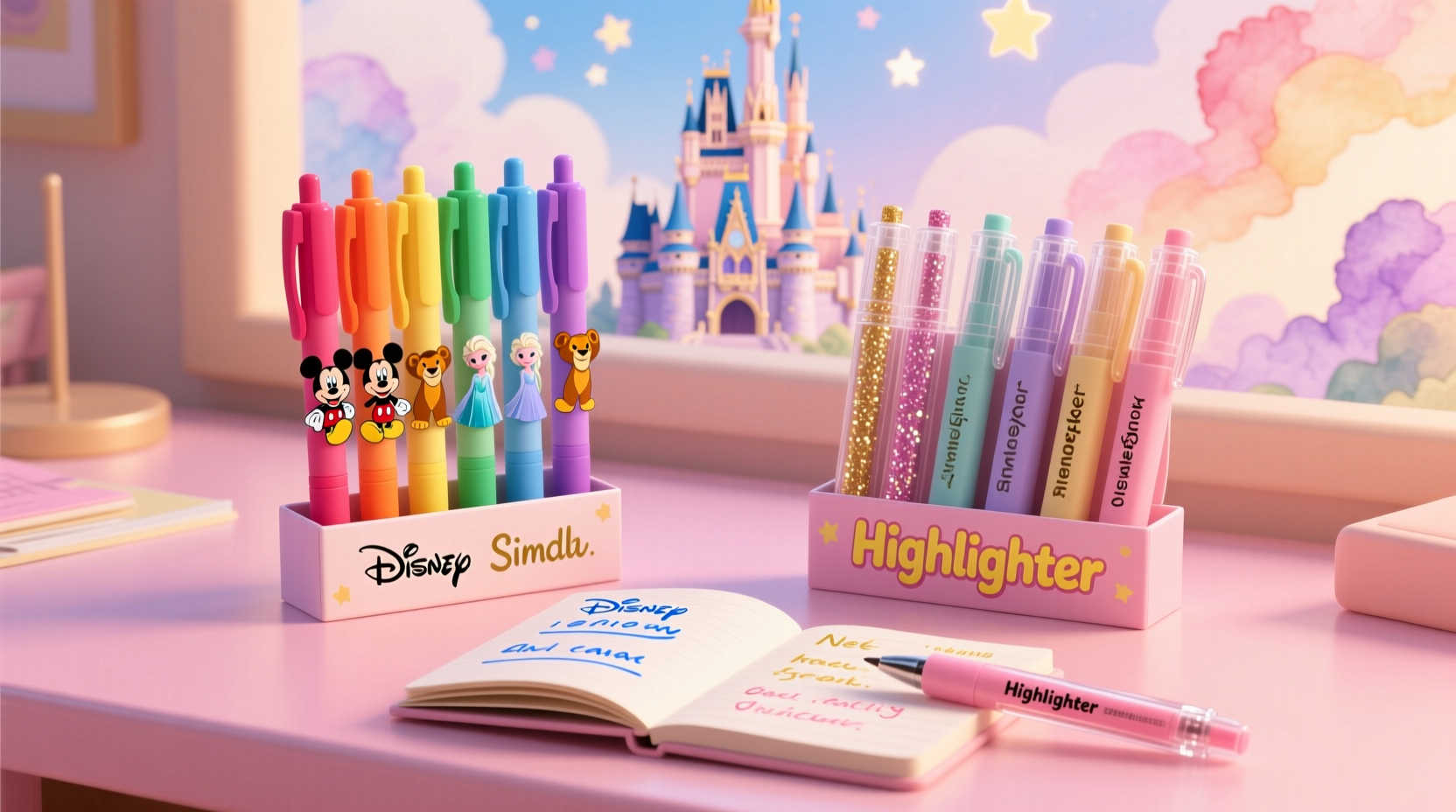
Gel pens and highlighters use fundamentally different ink formulations, which directly affect their performance. Disney gel pens typically use water-based gel ink, known for its smooth glide, vibrant colors, and precision tip (usually 0.5mm to 0.7mm). This makes them ideal for writing full sentences, underlining, or adding decorative touches to notes. The ink dries quickly on most paper and resists smudging better than ballpoint or rollerball alternatives.
Highlighters, by contrast, rely on alcohol-based or water-based fluorescent inks designed to sit on top of the page rather than absorb deeply. Their broad chisel tips (3–5mm) allow users to cover large blocks of text rapidly, but they’re not meant for writing words. Because the ink remains wet longer and can bleed through thin paper, using a highlighter for detailed note-taking is impractical and often messy.
Tip: Gel pens like Disney’s offer superior control for bullet journaling or margin annotations, while highlighters excel at calling out key phrases without disrupting readability.Comparative Performance: A Side-by-Side Analysis
| Feature | Disney Gel Pens | Standard Highlighters |
|---|---|---|
| Ink Type | Water-based gel | Alcohol or water-based fluorescent |
| Tip Size | 0.5–0.7mm fine point | 3–5mm chisel tip |
| Bleed-Through Risk | Low (on medium-thickness paper) | Moderate to high |
| Drying Time | Fast (2–4 seconds) | Slow (5–10 seconds) |
| Use Case | Writing, underlining, doodling | Text highlighting only |
| Color Opacity | Opaque, vivid pigments | Semi-transparent, see-through |
| Paper Compatibility | Most notebook papers | Thicker paper recommended |
The table underscores a critical distinction: gel pens are writing instruments first, while highlighters are annotation tools. Attempting to write full paragraphs with a highlighter leads to fatigue and inconsistent line thickness. Conversely, Disney gel pens enable crisp, readable handwriting with minimal pressure, making them more versatile in layered note-taking systems.
Real-World Use: A Student’s Perspective
Consider Maya, a college sophomore majoring in psychology. She uses a combination of Cornell notes and color-coded revision cues. Initially, she relied solely on yellow highlighters to mark definitions and theories in her textbooks. Over time, she noticed that excessive highlighting made pages look cluttered and reduced retention. After switching to a set of Disney gel pens in pastel blue, coral, mint, and lavender, she began actively rewriting key points in margins and connecting concepts with small arrows and symbols.
“I stopped just passively marking text and started engaging with it,” Maya explained. “The gel pens made my notes feel personal and organized. I could underline in one color, define terms in another, and even sketch quick diagrams. With highlighters, I was just coloring—I wasn’t learning.”
This shift reflects cognitive research suggesting that active note-taking—rewriting, summarizing, and organizing information—is more effective than passive highlighting. Gel pens support this process by enabling precise, expressive writing, whereas highlighters often encourage surface-level engagement.
“Students who annotate with purpose—not just color for color’s sake—show deeper comprehension. Tools that allow for variation in line weight and color coding enhance metacognitive processing.” — Dr. Linda Chen, Educational Psychologist, University of Oregon
Practical Tips for Maximizing Note-Taking Efficiency
Whether you choose gel pens or stick with highlighters, strategy matters. Here’s how to get the most out of either tool:
- Limit color use: Assign specific meanings to each color (e.g., blue for definitions, pink for questions) to avoid visual noise.
- Avoid over-marking: Research shows that highlighting more than 25% of a text reduces recall effectiveness.
- Combine tools wisely: Use a highlighter to flag sections, then annotate with a gel pen for summaries or connections.
- Test on paper first: Some gel inks may feather on low-quality notebooks. Always trial new pens before committing to a full set.
- Store properly: Keep gel pens capped and away from heat to prevent drying; store highlighters horizontally to maintain tip saturation.
Step-by-Step Guide: Building a Color-Coded System
Follow this sequence to integrate Disney gel pens effectively into your study routine:
- Choose 3–4 core colors based on frequency of use (e.g., black for main notes, blue for examples, green for reminders).
- Label each pen with its designated purpose using tape or a pen sleeve.
- Begin reading and highlight broad sections with a pale yellow highlighter if needed.
- Rephrase key ideas in the margins using your gel pen—this reinforces memory.
- Add symbols (→ for cause/effect, ! for important, ? for unclear points) to increase interactivity.
- Review weekly and recolor outdated entries or update with new insights.
This method transforms passive review into an active learning loop, where the physical act of writing with a smooth, enjoyable pen increases focus and retention.
Frequently Asked Questions
Can Disney gel pens replace highlighters entirely?
Not completely. While gel pens are excellent for underlining and light shading, they don’t provide the same visual pop as a fluorescent highlighter for quickly scanning pages. For optimal results, use both: highlighters to identify, gel pens to explain.
Do Disney gel pens smudge easily?
Most high-quality Disney-branded gel pens (especially those made by brands like Stabilo or Pilot under license) use quick-drying ink and resist smudging on standard notebook paper. However, left-handed writers may want to allow a few extra seconds for drying or use a blotting sheet.
Are these pens worth the price for serious studying?
If the design motivates consistent note-taking, yes. While functionally similar to non-branded gel pens, the aesthetic appeal of Disney themes can increase user engagement—especially for younger students or creative learners. Function meets fun.
Final Verdict: Function Meets Fun, But Purpose Matters
Disney gel pens are not just novelty items—they are fully functional writing tools with advantages over traditional highlighters in precision, comfort, and versatility. They allow for expressive, structured note-taking that supports active learning. Highlighters still have a place in fast-review scenarios, but they lack the finesse required for detailed work.
The real question isn’t whether Disney gel pens are “better” across the board, but whether they align with your learning style. If you value clarity, customization, and a touch of joy in your daily workflow, these pens offer tangible benefits beyond their charming designs.
🚀 Ready to upgrade your note-taking game? Try a three-color Disney gel pen system this week and track how it affects your focus and recall. Share your experience in the comments—what works for you?