When you pour a measure of fine brandy into a tulip glass, warm it gently in your palms, and inhale—what rises isn’t just ethanol and esters. It’s limestone dust from a sun-baked slope in Charente, the damp clay of a Gascon vineyard after autumn rain, the whisper of Atlantic winds that shaped centuries of viticulture. For connoisseurs who sip brandy neat—not as a cocktail base or digestif prop, but as a contemplative, sensory dialogue with place—the question isn’t merely “Which is smoother?” or “Which is older?” It’s sharper, more philosophical: Which spirit tells truer soil-to-spirit stories? Cognac and Armagnac are both AOC-protected French grape brandies, yet they diverge not just in production methods, but in their fundamental relationship to land. This divergence fuels quiet but fierce debates among distillers, blenders, and appellation guardians—debates rooted in geology, history, and philosophy as much as chemistry.
The Terroir Imperative: Why Brandy Isn’t Just Distilled Wine
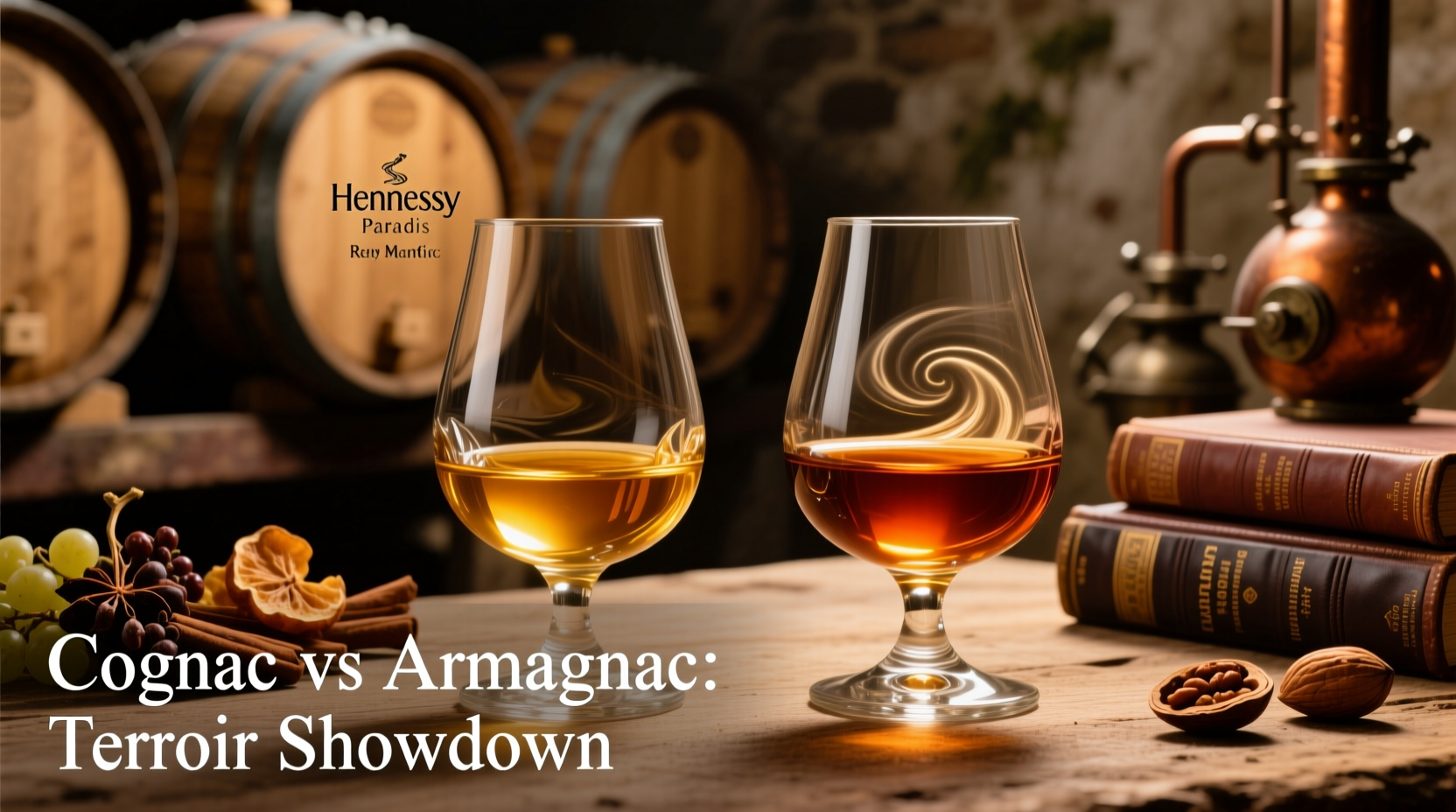
Terroir—often reduced to “taste of place”—isn’t a marketing buzzword in French brandy regions. It’s a legal, technical, and cultural covenant. Both Cognac and Armagnac are bound by strict AOC (Appellation d’Origine Contrôlée) regulations governing grape varieties, yields, distillation equipment, aging vessels, and geographic boundaries. But unlike wine, where terroir expresses itself directly through fermentation and minimal intervention, brandy layers distillation and aging atop the vineyard’s voice—potentially amplifying or obscuring it. The key lies in how much raw material survives that transformation.
Cognac relies on double distillation in copper pot stills—a process that concentrates alcohol and volatile aromatics while stripping away heavier, less volatile compounds tied to soil minerals and microclimate nuances. Armagnac, by contrast, traditionally uses single continuous distillation in column stills (though some producers now use hybrid or pot stills), yielding a lower-alcohol, higher-congener spirit—richer in fatty acids, esters, and phenolic compounds that carry vineyard-specific signatures. As Jean-Luc Bordes, fourth-generation distiller at Domaine d’Espérance in Bas-Armagnac, puts it: “Cognac polishes the vineyard’s face. Armagnac lets it sweat, breathe, show its pores.”
“Cognac seeks elegance through refinement; Armagnac seeks authenticity through retention. One asks, ‘What should this taste like?’ The other asks, ‘What does this *actually* taste like?’” — Marie Lurton, Master Blender, House of Delamain (Cognac)
Geology in Glass: How Soil and Climate Shape Flavor Expression
Both regions sit on ancient sedimentary basins—but their soils tell different stories. Cognac’s heartland—Grande and Petite Champagne—is dominated by chalky, limestone-rich terre blanche, formed from fossilized marine organisms. This soil drains rapidly, stresses vines, and imparts high acidity and floral-mineral lift to Ugni Blanc grapes. Armagnac’s core zone—Bas-Armagnac—is defined by sandy, iron-rich boulbène soil over clay-limestone subsoil. Less draining than Cognac’s chalk, it retains moisture and fosters deeper root systems, yielding grapes with riper fruit, earthier depth, and pronounced nutty, waxy, and dried-fruit notes.
Climate adds another layer. Cognac lies 100 km inland from the Atlantic but benefits from maritime moderation—cool springs, mild winters, and reliable summer rains. Armagnac sits further south and east, with greater continental influence: hotter summers, colder winters, and more pronounced diurnal shifts. These differences aren’t abstract. They manifest in the glass:
- Cognac neat often presents polished citrus peel, white flowers (acacia, hawthorn), toasted brioche, and a saline, almost flinty finish—refined, linear, and precise.
- Armagnac neat tends toward baked quince, prune, walnut oil, leather, damp forest floor, and a distinctive saline-umami savoriness—broader, more textured, and layered with mineral weight.
Distillation Philosophy: Copper Pot vs Column Still—A Battle of Priorities
The distillation method is where ideology meets alchemy. Cognac’s double pot distillation is labor-intensive, batch-based, and highly selective. Each distillation removes “heads” (volatile, harsh alcohols) and “tails” (heavy, oily residues), capturing only the “heart”—a narrow, clean fraction (~70% ABV). This ensures consistency across millions of liters but inherently sacrifices complexity for purity.
Armagnac’s traditional continuous column still operates at lower temperatures and pressures, producing a broader cut—typically 52–60% ABV—with far more congeners: higher levels of ethyl acetate (fruity), isoamyl alcohol (banana, malt), and volatile fatty acids (rancio, cheese, umami). Crucially, these compounds bind tightly to oak tannins during aging, evolving into the deep, savory, oxidative notes Armagnac is famed for. That rancio—the hallmark of mature Armagnac—isn’t just oxidation; it’s the slow conversation between soil-derived precursors and wood.
This difference explains why distillers argue. Cognac houses emphasize reproducibility, longevity, and global appeal. Their blenders spend decades mastering the art of harmonizing hundreds of eaux-de-vie to achieve house style—a triumph of human curation over nature. Armagnac producers, especially small estates, view blending as dilution. “If I blend my Bas-Armagnac sand-grown Folle Blanche with a Ténarèze clay plot, I lose the sand,” says Claire Dubois of Château de Laubade. “I’d rather bottle them separately and let the land speak alone.”
Terroir Transparency: A Comparative Framework
So which reveals more terroir? The answer depends on how you define “reveal.” Cognac reveals terroir through precision: its chalky soils yield unmistakable acidity and minerality, even in complex blends. Armagnac reveals terroir through presence: its sandy soils deliver visceral texture, weight, and umami depth that feels undeniably geological. The table below outlines key comparative dimensions:
| Dimension | Cognac | Armagnac |
|---|---|---|
| Vineyard Expression | High in single-cru bottlings (e.g., Borderies’ violet/flint, Fins Bois’ fruit-forwardness); muted in large XO blends. | Consistently strong—even in blends—due to lower-distillation retention of varietal & soil compounds. |
| Soil Signature | Chalky minerality, saline lift, crisp acidity (esp. Grande Champagne). | Sandy-iron savoriness, earthy weight, walnut-oil richness (esp. Bas-Armagnac). |
| Aging Influence | Oak dominates early; terroir re-emerges subtly after 20+ years as tannins soften. | Terroir and oak co-evolve; rancio amplifies soil-derived umami, not masks it. |
| Typical Neat Profile | Refined, elegant, floral-citrus, linear structure, dry finish. | Robust, textured, nutty-dried fruit, savory depth, lingering umami finish. |
| Terroir Accessibility | Requires focus: seek single-cru, vintage, or small-batch bottlings to hear the land clearly. | More immediately apparent—even in younger expressions—due to congeners’ persistence. |
Real Palate, Real Place: A Mini Case Study from Bas-Armagnac
In 2021, Olivier Castel, vigneron at Domaine Tariquet in Bas-Armagnac, conducted an informal tasting with six sommeliers. He poured three 2003 Armagnacs, all from the same estate, same grape (Ugni Blanc), same vintage, same aging period (18 years in 350L Limousin oak), but from three distinct plots:
- Plot A: Pure boulbène sand over clay—yielded a spirit with dominant notes of roasted walnuts, iodine, and wet stone.
- Plot B: Sand mixed with iron-rich gravel—showed pronounced black olive tapenade, dried fig, and a saline, mouth-coating texture.
- Plot C: Sandy topsoil over limestone bedrock—revealed brighter quince paste, chamomile, and a chalky, almost Burgundian finish.
No blending occurred. No manipulation. Just soil, vine, still, and time. All six sommeliers identified Plot A’s “walnut-stone” profile as uniquely Bas-Armagnac—distinct from any Cognac they’d tasted. “It wasn’t just flavor,” noted one participant. “It was *weight*. Like holding a handful of that sand in your mouth.” This isn’t anecdote—it’s empirical evidence that Armagnac’s production chain preserves more direct soil-to-spirit vectors. Yet Cognac counters with its own rigor: a 2022 study by the Bureau National Interprofessionnel du Cognac confirmed that Grande Champagne eaux-de-vie consistently showed higher concentrations of tartaric acid derivatives linked to chalk dissolution��proof that even refined distillation cannot erase geology.
Your Sipping Protocol: A Step-by-Step Guide to Terroir Detection
Terroir isn’t passive—it demands attention. Follow this sequence to maximize perception when sipping either brandy neat:
- Choose the right glass: Use a tulip-shaped nosing glass (not a snifter) to concentrate aromas without overwhelming ethanol.
- Observe temperature: Serve at 18–20°C (64–68°F). Too cold suppresses nuance; too warm volatilizes delicate notes.
- First nosing (cold): Hold the glass still. Note primary fruit and floral notes—these reflect grape variety and fermentation.
- Second nosing (warmed): Cup the bowl gently for 30 seconds. Now seek secondary notes: nuts, spice, earth, minerals—these signal terroir and distillation choices.
- Third nosing (post-sip): After tasting, return to the glass. The empty bowl reveals oxidative, rancio, and mineral traces—the deepest terroir signatures, especially in Armagnac.
- Compare side-by-side: Try a Bas-Armagnac and a Grande Champagne Cognac of similar age. Focus on mouthfeel: Is it lean and saline (Cognac) or viscous and savory (Armagnac)? That contrast is terroir speaking.
Frequently Asked Questions
Does aging in different oak types affect terroir expression?
Yes—but differently. Cognac’s lighter, more neutral Limousin oak allows subtle terroir notes to emerge slowly over decades. Armagnac’s denser, more tannic Monlezun oak interacts aggressively with congeners, accelerating rancio development and amplifying soil-derived savoriness. Over-oaking can mask terroir in both, but Armagnac’s richer base withstands it better.
Can I taste terroir in VS or VSOP brandies?
Rarely. VS and VSOP are young (minimum 2–4 years) and heavily blended. Terroir requires time and concentration to surface. Focus on XO, Hors d’Age, or vintage-dated bottlings—especially those labeled with cru names (e.g., “Bas-Armagnac,” “Borderies”).
Why don’t more Cognac producers adopt single-cru or single-estate bottlings?
Tradition and scale. Cognac’s model is built on blending vast stocks for consistent house style. Single-cru bottlings exist (e.g., Rémy Martin’s “Cuvée Paradis” from Grande Champagne), but they’re exceptions. Armagnac’s smaller scale and estate-centric culture makes single-plot releases the norm—not the novelty.
Conclusion: Choose Your Conversation With the Land
There is no objective “winner” in the Cognac vs Armagnac terroir debate—only two profound, legitimate philosophies of place. Cognac offers terroir as a distilled haiku: precise, evocative, refined to its essential mineral and floral truth. Armagnac offers terroir as a long-form novel: rich, textured, unfiltered, revealing the full spectrum of soil, climate, and vine in visceral, savory detail. French distillers argue because they care—not about superiority, but about fidelity. They argue because terroir isn’t static; it’s a living contract between human stewardship and geological time.
If you value clarity, structure, and the elegance of restraint, begin with a single-cru Cognac—let its chalky precision recalibrate your palate. If you crave depth, texture, and the unvarnished voice of the land, reach for a 20-year Bas-Armagnac—feel its weight, its umami, its unmistakable sense of origin. Neither is a substitute for the other. Both are masterclasses in how geography becomes taste.
💬 Your turn: Have you tasted a Cognac or Armagnac that made you feel the soil beneath your feet? Share your most terroir-revealing sip—and which region spoke loudest—in the comments. Let’s keep this vital conversation alive.