Aging whiskey at home is one of the most frequently misunderstood topics in craft spirits. Many enthusiasts imagine setting up a mini distillery in their garage—only to discover that federal law prohibits distilling alcohol without a permit. But here’s the crucial distinction: while *distilling* whiskey is illegal for individuals in the U.S., *aging* legally purchased, unaged spirit (commonly called “white dog” or new make) in small barrels is not only permitted—it’s practiced by thousands of home enthusiasts, hobbyists, and even professional bartenders refining custom blends.
The reality is nuanced. Aging isn’t magic; it’s chemistry accelerated by wood contact, oxygen exchange, temperature fluctuation, and time. At home, you won’t replicate decades in a Kentucky rickhouse—but with intention, precision, and the right tools, you can produce nuanced, balanced, oak-influenced whiskey in as little as 3–12 months. This article cuts through the marketing hype and regulatory fog to deliver grounded, actionable guidance—from legality and safety to barrel selection, monitoring protocols, and bottling decisions.
Legal Boundaries: What You Can and Cannot Do
In the United States, the Alcohol and Tobacco Tax and Trade Bureau (TTB) strictly regulates alcohol production. Distillation—the process of heating fermented mash to separate and concentrate ethanol—is classified as manufacturing. Doing so without a federal distilled spirits plant permit (and corresponding state licenses) is a felony punishable by fines and imprisonment.
However, the TTB explicitly permits consumers to age, blend, and bottle lawfully acquired spirits. That includes purchasing unaged corn, rye, or wheat whiskey from licensed distilleries (often sold as “moonshine,” “white dog,” or “new make”) and aging it yourself. You may not label your product as “whiskey” for sale—nor may you use terms like “bourbon” or “rye” unless it meets all legal definitions (e.g., bourbon must be aged in new charred oak barrels). But for personal consumption? Yes—you own the spirit and control its maturation environment.
Important caveats apply internationally. In the UK, Canada, Australia, and most EU countries, aging purchased spirit is similarly legal for personal use—but always verify local excise regulations before proceeding.
Tip: Always buy unaged whiskey from a licensed, bonded distillery—not a private seller or unregulated source. Verify batch numbers and proof on the label. Never attempt to distill fermented wash using improvised stills—this poses serious fire, explosion, and methanol poisoning risks.Core Equipment: Minimalist Setup vs. Precision System
Home aging doesn’t require industrial infrastructure—but skipping fundamentals leads to inconsistent results or spoilage. Below is a tiered breakdown of essential equipment, ranked by impact on quality and reliability.
| Equipment | Why It Matters | Minimum Recommendation | Avoid |
|---|---|---|---|
| Barrel | Wood species, char level, and size dictate extraction rate and flavor profile. | 5–15L American white oak, medium char (#3), air-dried (not kiln-dried) | Small plastic “aging sticks,” uncharred wine barrels, or barrels previously used for vinegar or fish sauce |
| Hydrometer & Thermometer | Tracking proof drop and temperature helps diagnose evaporation (angel’s share), oxidation, and potential contamination. | Digital proof hydrometer (0–100% ABV range) + calibrated digital thermometer (±0.2°C) | Generic kitchen thermometers, uncalibrated glass hydrometers |
| Aging Vessel Stand | Prevents barrel leakage, allows rotation, and ensures consistent wood contact. | Sturdy hardwood cradle or stainless steel barrel stand with rubberized feet | Placing barrel directly on concrete, carpet, or uneven surfaces |
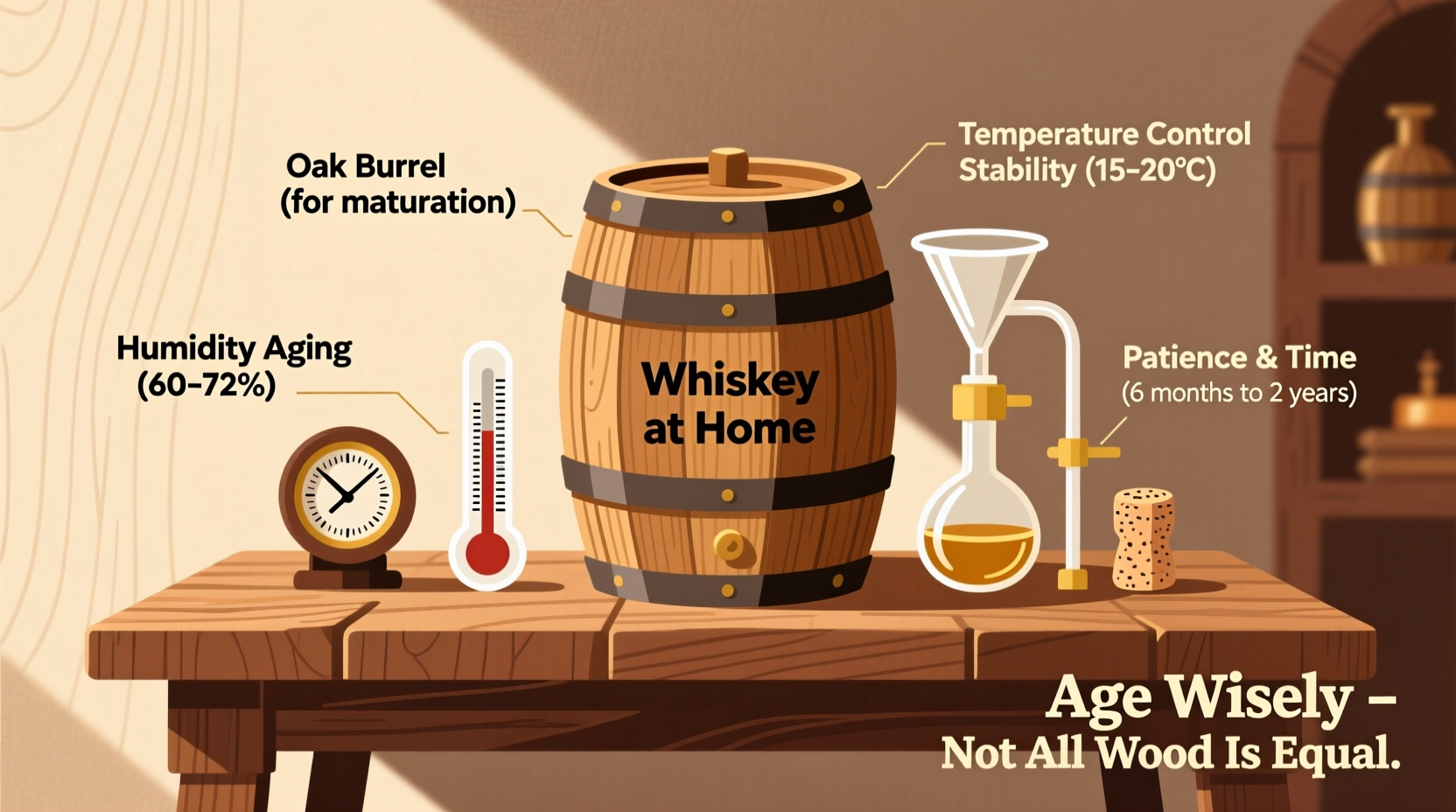
| Storage Environment | Temperature swings drive expansion/contraction, pulling spirit into and out of wood pores—critical for flavor development. | Consistent 12–24°C (54–75°F) range; 55–70% relative humidity; no direct sunlight | Garages with extreme summer heat (>35°C) or unheated sheds below 5°C |
| Bottling Gear | Prevents oxidation and contamination during transfer. | Food-grade stainless steel funnel, 0.5-micron filter, inert gas (nitrogen or argon) canister for purging bottles | Pouring directly from barrel into open bottles, using coffee filters or cheesecloth |
Unlike commercial operations, home agers lack climate-controlled rickhouses. That means environmental management becomes your most critical variable. A basement corner with stable temperature and moderate humidity often outperforms a sunlit kitchen cabinet—even if the latter looks more “artisanal.”
The Science of Small-Barrel Aging: Why Time ≠ Flavor
Small barrels (under 30 liters) accelerate aging dramatically—not because time speeds up, but because surface-area-to-volume ratio increases exponentially. A standard 200L bourbon barrel has ~0.02 m² of wood per liter of spirit. A 5L barrel offers ~0.12 m²/L—six times more wood contact. That means faster tannin, lignin, and vanillin extraction… but also faster over-extraction of bitter compounds and excessive oak dominance if left too long.
Research from the University of Louisville’s Spirits Research Center confirms: spirits aged in 5L barrels reach peak complexity between 3–6 months. Beyond 8 months, oak saturation and ethanol burn often outweigh aromatic benefits—unless the spirit starts at lower proof (45–52% ABV) and is diluted gradually.
“The ‘barrel effect’ dominates early aging—wood sugars and lactones appear fast. But the subtler esterification and oxidative notes that define mature whiskey take longer to develop, even in small barrels. Rushing past 6 months without tasting is gambling, not aging.” — Dr. Sarah Lin, Senior Flavor Chemist, Kentucky Bourbon Institute
This explains why many successful home agers adopt a “fractional aging” approach: splitting one 5L batch across three 1.5L barrels, rotating tasting samples every 2 weeks, and recombining only the most balanced fractions at bottling. It adds labor—but eliminates guesswork.
Step-by-Step Home Aging Protocol (3–6 Month Cycle)
- Select and sanitize your barrel: Rinse new oak barrel with hot water (no soap), then fill with hot water for 48 hours to swell staves and seal micro-gaps. Drain completely—no standing water allowed.
- Fill at optimal proof: Use spirit between 55–62% ABV. Higher proof extracts more aggressively; lower proof yields softer, rounder profiles but extends timeline.
- Initial conditioning: Store upright for first 72 hours to saturate end-grain. Then rotate to horizontal position and gently roll barrel end-over-end once daily for first week.
- Monitor biweekly: Record temperature, ambient humidity, and proof (using hydrometer corrected for temperature). Taste a 10mL sample each time—note oak intensity, sweetness, bitterness, and heat.
- Adjust as needed: If tannins dominate at 4 weeks, reduce proof to 50% ABV by adding distilled water (pre-chilled to barrel temp). If flatness develops after 10 weeks, introduce controlled oxidation: briefly uncork for 30 seconds every 5 days.
- Bottle with intent: When balance peaks (typically 3–5 months), chill spirit to 4°C for 48 hours to precipitate fatty acids, then filter through 0.5-micron membrane under nitrogen blanket. Bottle at final desired proof (43–48% ABV is ideal for sipping).
Real-World Example: The Portland Bartender’s 4-Month Rye Experiment
In early 2023, Maya Rodriguez—a bar manager in Portland, Oregon—began aging 5L batches of unaged 100% rye whiskey (63% ABV) in toasted French oak barrels. Her goal was a cocktail-ready rye with pronounced baking spice and restrained oak. She maintained her basement at 18°C ± 2°C and rotated barrels manually every other day.
At week 3, she detected aggressive clove and raw wood. Rather than dump the batch, she reduced proof to 54% ABV and added two 10g chunks of air-dried cherry wood (food-safe, untreated). By week 10, the spirit had mellowed significantly—vanilla and dried fig emerged, with rye’s peppery backbone intact. She blended the batch with 10% of a separate 5L American oak batch aged 6 weeks at 58% ABV, achieving layered complexity without cloying sweetness.
She now serves it as “The Hawthorne Reserve” on her menu—clearly labeled as “home-aged for personal use,” with full transparency about provenance and process. Customers consistently describe it as “more integrated than most 2-year commercial ryes.”
Frequently Asked Questions
Can I reuse a barrel for multiple aging cycles?
Yes—but effectiveness declines sharply after the first use. A second cycle extracts roughly 30–40% of the original compounds; a third yields minimal oak influence. For consistency, treat each barrel as single-use for primary aging. Reused barrels work well for finishing (e.g., adding 2 weeks of sherry cask influence), but never for full maturation unless heavily toasted again (a complex, risky process).
Do I need to top off the barrel like winemakers do?
No—and topping off is actively discouraged. Unlike wine, whiskey benefits from controlled oxidation via the “angel’s share” (natural evaporation through wood pores). Topping introduces fresh spirit that hasn’t undergone the same chemical evolution, diluting complexity and risking microbial imbalance. Let volume decrease naturally; most 5L barrels lose 8–15% over 4 months—this concentration enhances mouthfeel and aroma.
What happens if my whiskey tastes sour or vinegary?
This signals acetic acid bacteria contamination—usually from inadequate sanitation, excessive headspace, or temperatures above 28°C. Discard immediately. Do not attempt to “fix” it with filtration or blending. Clean the barrel with boiling water and ozone-treated steam (if available), or retire it. Prevention is non-negotiable: always sanitize tools with 70% food-grade ethanol, minimize air exposure during sampling, and keep barrels sealed except during scheduled tastings.
Conclusion: Aging Is Stewardship, Not Alchemy
Aging whiskey at home isn’t about shortcuts or replicating industrial output. It’s an exercise in patience, observation, and responsive craftsmanship. You’re not commanding time—you’re negotiating with it. Every temperature shift, every subtle shift in oak tannin, every fractional drop in proof tells a story you learn to read through disciplined tasting and recordkeeping.
You don’t need a warehouse or a master distiller’s pedigree. You need a sound barrel, calibrated tools, environmental awareness, and the humility to taste honestly—even when the result is harsh, green, or unbalanced. Those “failures” teach more than flawless batches ever will.
Start small: one 5L barrel, one reliable hydrometer, one notebook dedicated solely to dates, temps, proofs, and sensory notes. Age your first batch for 4 months—not because a calendar says so, but because your palate says it’s ready. Then share what you learn—not just the whiskey, but the process, the missteps, the quiet moments of discovery when vanilla emerges from raw grain, or smoke softens into caramel.
💬 Your experience matters. Did a temperature swing surprise you? Did a particular char level transform your spirit? Share your real-world insights in the comments—help build a smarter, safer, more thoughtful home aging community.