Magnetic stirrers—those compact lab devices with rotating magnetic fields that spin a Teflon-coated stir bar inside a vessel—are staples in chemistry labs, pharmaceutical R&D, and microbiology incubators. But in the last five years, they’ve quietly migrated into high-end home bars and experimental cocktail studios. Some bartenders swear by them for achieving “perfect dilution control.” Others dismiss them as theatrical gadgetry masquerading as technique. The truth lies between those extremes—and it hinges on understanding *what precision means* in cocktail making, not just how fast or uniformly a liquid moves.
Cocktail precision isn’t solely about temperature or dilution consistency. It’s about repeatability across variables: ice melt rate, agitation intensity, thermal mass of glassware, ambient humidity, and even the ethanol concentration of the base spirit. A magnetic stirrer controls exactly one variable—mechanical agitation—while introducing new constraints: container geometry, volume limitations, and material compatibility. To assess its utility, we must move beyond novelty and examine real-world performance against established benchmarks: hand stirring, shaking, and modern alternatives like centrifugal chillers or vacuum infusion systems.
How Magnetic Stirrers Actually Work in a Bar Context
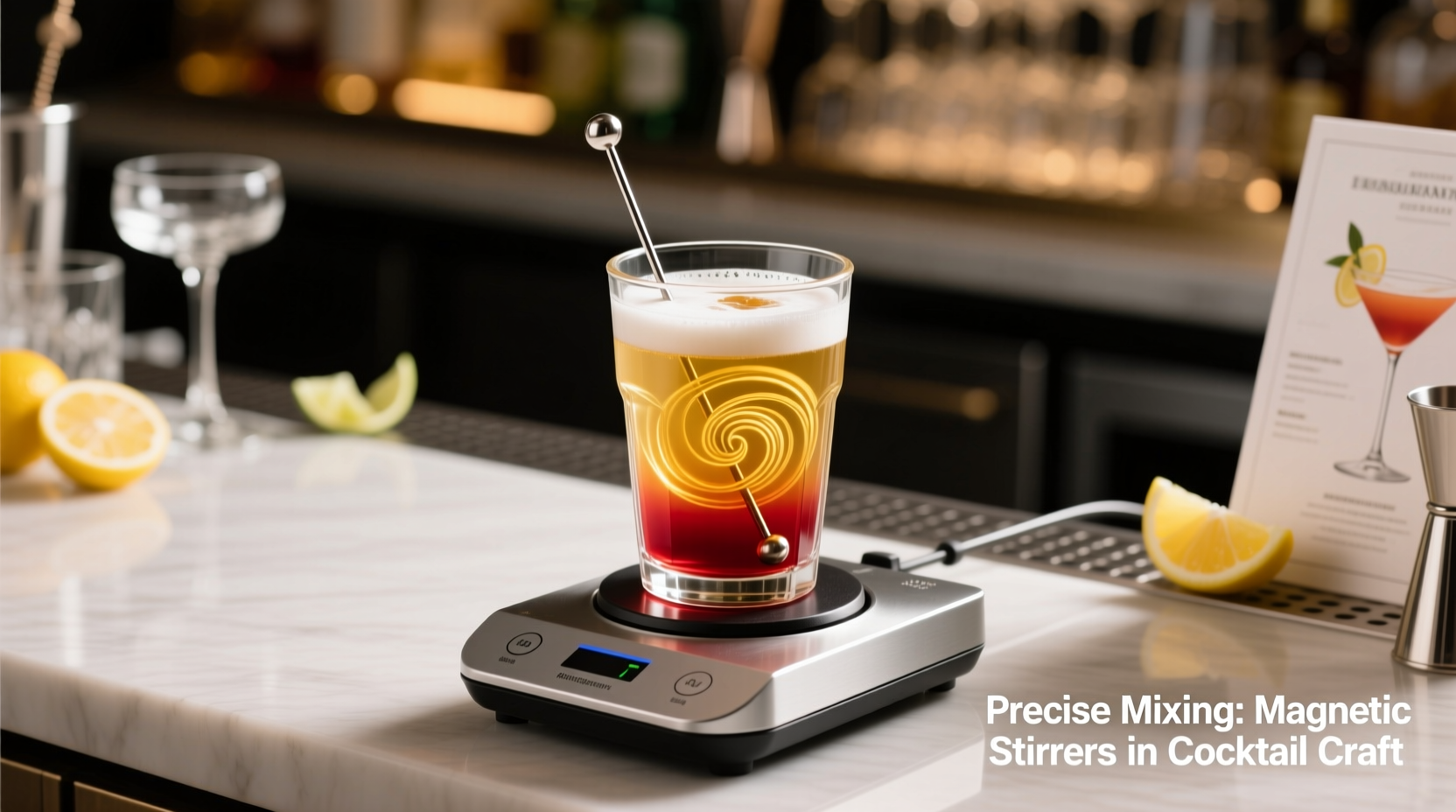
A magnetic stirrer consists of a motor-driven rotating magnet beneath a non-magnetic plate (usually ceramic or stainless steel). When placed beneath a compatible vessel—typically a beaker, Erlenmeyer flask, or custom-designed stainless steel mixing cup—a magnetic stir bar (a small, sealed, cylindrical magnet coated in chemically inert PTFE) spins in synchrony with the field. Speed is adjustable, usually from 0–1,200 RPM, and many units include heating plates for simultaneous temperature control.
In practice, bartenders use them for three primary applications:
- Dilution-controlled chilling: Chilling spirits or fortified wines without ice contact—e.g., bringing vermouth to precisely 4°C before combining with gin to preserve volatile aromatics.
- Emulsion stabilization: Maintaining homogeneity in fat-washed or oil-infused cocktails during service (e.g., keeping clarified butter evenly suspended in a Brown Derby variation).
- Infusion acceleration: Speeding up cold infusions—like citrus peels in neutral grain spirit—by increasing solvent-solute interaction without heat degradation.
Crucially, magnetic stirrers do not replicate the physics of traditional stirring. Hand stirring relies on convection currents generated by a bar spoon moving through liquid and ice—creating turbulent flow that simultaneously chills, dilutes, and aerates. A magnetic stirrer creates laminar, rotational flow in a static vessel—no ice, no temperature drop unless paired with a chilled bath or Peltier cooling unit. That distinction defines its niche: it excels where thermal stability and mechanical consistency matter more than rapid chilling.
When They Deliver Real Precision (and When They Don’t)
Precision in cocktail mixing has two dimensions: repeatability (can you reproduce the exact same result 50 times?) and intentionality (does the method serve the drink’s structural and sensory goals?). Magnetic stirrers score highly on repeatability for low-volume, temperature-sensitive preparations—but fail where dynamic thermal exchange is essential.
Tip: Never use a magnetic stirrer for ice-based dilution. Its value lies in ice-free preparation—chilling pre-chilled liquids, stabilizing emulsions, or accelerating infusions. If your goal is classic dilution control (e.g., 22% ABV reduction in a Martini), hand stirring remains faster, more responsive, and sensorially richer.Consider the Martini—a benchmark for precision. A skilled bartender achieves consistent dilution (typically 20–25%) and temperature (−2°C to 0°C) in 25–35 seconds using a chilled mixing glass, dense ice, and deliberate spoon rotation. A magnetic stirrer cannot replicate this because it lacks the thermal sink of melting ice. Even with a pre-chilled spirit and chilled vessel, the final temperature will plateau above freezing—and dilution won’t occur at all without added water or ice melt. In contrast, for a clarified milk punch—where clarity, stability, and exact acid-to-fat ratios are critical—a magnetic stirrer ensures uniform coagulation during the curdling phase, preventing localized overheating or uneven separation that hand stirring might cause.
Comparative Performance: Magnetic Stirring vs. Traditional Methods
| Application | Magnetic Stirrer | Hand Stirring | Shaking |
|---|---|---|---|
| Dilution Control | None (no ice contact) | High (adjustable via time/ice density) | Moderate (variable due to aeration & ice fracture) |
| Temperature Consistency | Excellent (±0.3°C with external cooling) | Good (±1.2°C, dependent on ice quality) | Poor (±3°C, rapid fluctuation) |
| Emulsion Stability | Exceptional (laminar, continuous shear) | Fair (intermittent, manual fatigue affects consistency) | Poor (violent aeration breaks most emulsions) |
| Infusion Speed (Cold) | 2–4× faster than static infusion | No benefit over static | Not applicable |
| Sensory Impact | Neutral (no aeration, no oxidation) | Subtle aeration enhances aromatic lift | Significant aeration & micro-oxidation alter mouthfeel |
The table reveals a clear pattern: magnetic stirrers aren’t replacements—they’re specialized tools for specific phases of cocktail development. Their strength is in *preparation*, not *final assembly*. They shine in R&D, batch production, or service of technically demanding formats (e.g., bottled cocktails, nitro-infused serves, or layered clarified presentations), but add little value to the standard service pour.
Mini Case Study: The Clarified Gin Sour at Atelier Mixologie
At Atelier Mixologie in Portland, head bartender Lena Ruiz faced a recurring issue with her signature Clarified Gin Sour: inconsistent protein coagulation during the egg white–lemon juice clarification step. Using traditional hand stirring, some batches yielded brilliant clarity; others retained faint haze due to uneven pH adjustment and localized heat spikes from friction. After testing multiple methods—including immersion blenders (too aggressive) and orbital shakers (too slow)—Ruiz adopted a dual-vessel magnetic stirring setup.
She uses two 500 mL borosilicate beakers: one holds the acidified gin mixture (gin, lemon juice, gum arabic), the other contains chilled calcium lactate solution. Both stir at 320 RPM. After 90 seconds, she combines them slowly while both vessels remain under agitation. The result? 99.7% batch-to-batch clarity consistency, verified via spectrophotometer measurements at 620 nm. More importantly, service speed increased by 40%—no more waiting for gravity filtration. “It’s not about being flashy,” Ruiz explains. “It’s about removing human variability from a chemical process so I can focus my attention on the guest’s palate—not the cloudiness of my sour.”
“Magnetic stirring doesn’t make better drinks—it makes *more reliable* drinks. And reliability, especially at scale, is the foundation of hospitality.” — Lena Ruiz, Head Bartender & Beverage Director, Atelier Mixologie
Practical Implementation: A Step-by-Step Guide for Professionals
If you’re considering integrating magnetic stirring into your workflow, skip the lab surplus market and invest in food-grade equipment designed for beverage use. Here’s how to implement it effectively:
- Select the right hardware: Choose a stirrer with PTFE-coated plate, RPM range of 50–800, and optional cooling jacket compatibility. Avoid units with exposed wiring or non-food-grade plastics.
- Choose compatible vessels: Use borosilicate glass (e.g., Pyrex beakers) or 304 stainless steel cups with flat, smooth bottoms. Avoid tapered or curved containers—the stir bar will “climb” and destabilize.
- Size your stir bar correctly: For volumes under 100 mL, use a 15 mm bar; 100–500 mL requires 25–30 mm; above 500 mL, use dual bars or upgrade to a larger unit. Always verify PTFE coating integrity—scratches expose nickel, which leaches into acidic solutions.
- Validate temperature control: Pair with a calibrated digital probe thermometer. Never rely on the unit’s built-in readout. Place the probe near the vessel’s center—not against the wall—to measure actual liquid temp.
- Sanitize rigorously: Soak stir bars in 70% ethanol for 5 minutes between uses. Rinse with distilled water to prevent mineral deposits. Store in sealed, dry containers—not loose in drawers where coatings chip.
What Experts and Industry Leaders Say
While magnetic stirrers remain rare behind most bars, their adoption is growing among educators and innovators focused on reproducibility. Dave Arnold, founder of Booker & Dax and author of Liquid Intelligence, has long advocated for instrument-assisted techniques—but with caveats.
“The stirrer isn’t magic. It’s a torque delivery system. What matters is knowing *why* you need constant torque at a fixed RPM—and whether that serves the drink’s architecture. If you’re chasing ‘precision’ just to say you have it, you’ll waste time and money. But if you’re developing a shelf-stable, clarified, low-ABV aperitif that must taste identical after six months of storage? Then yes—controlled agitation becomes non-negotiable.” — Dave Arnold, Food Scientist & Cocktail Innovator
Similarly, Dr. Sarah Chen, a food chemist who consults for premium spirit brands, emphasizes material science over mechanics: “Most failures I see aren’t from wrong speed or time—they’re from using cheap stir bars in high-acid environments like shrubs or vinegar-based tinctures. Nickel leaching alters flavor perception at parts-per-trillion levels. Spend $20 on certified food-grade bars. Your palate—and your customers’—will notice.”
FAQ: Addressing Common Misconceptions
Can I use a magnetic stirrer to chill a cocktail like a freezer?
No. Magnetic stirrers generate negligible cooling effect. Any temperature change comes from ambient conditions or external cooling (e.g., placing the vessel in an ice bath). Stirring alone raises temperature slightly due to viscous dissipation—especially with viscous modifiers like xanthan gum or glycerin.
Do I need a heated stirrer for cocktail work?
Rarely. Heating is useful only for accelerated infusions (e.g., botanicals in warm neutral spirit) or controlled denaturation (e.g., clarifying dairy). For most applications, room-temp or chilled operation suffices. If you do heat, never exceed 40°C—higher temps degrade delicate terpenes in citrus oils and herbs.
Are magnetic stirrers FDA-approved for food use?
There is no FDA “approval” for equipment—only compliance with 21 CFR Part 177 (indirect food additives). Ensure stir bars carry NSF/ANSI 51 certification for food equipment, and verify the PTFE coating meets FDA 21 CFR 177.1550 standards. Lab-grade bars often lack this documentation.
Conclusion: Precision Is a Choice, Not a Gadget
Magnetic stirrers are neither revolutionary nor frivolous. They are precision instruments borrowed from another discipline—and like any borrowed tool, their value depends entirely on alignment with intent. They deliver measurable advantages in repeatability, thermal stability, and emulsion integrity for specific technical applications. But they cannot replace the intuition of a seasoned bartender reading a guest’s mood, adjusting dilution based on ambient heat, or sensing the exact moment a stirred Martini reaches its aromatic apex. Precision in cocktails isn’t monolithic. It’s contextual. It’s sensory. It’s human.
So ask yourself: Are you building a single-batch, bottle-conditioned amaro that must age identically across 200 units? Yes—reach for the stirrer. Are you crafting a Negroni for someone celebrating a promotion, wanting brightness, balance, and warmth? Reach for the spoon, the ice, and your full attention. The most precise cocktail isn’t the one made with the most advanced gear—it’s the one made with the clearest purpose.
💬 Have you used magnetic stirrers in your bar program—or rejected them for good reason? Share your experience, successes, and hard-won lessons in the comments. Let’s build a practical, unvarnished knowledge base for the next generation of precise, intentional mixology.