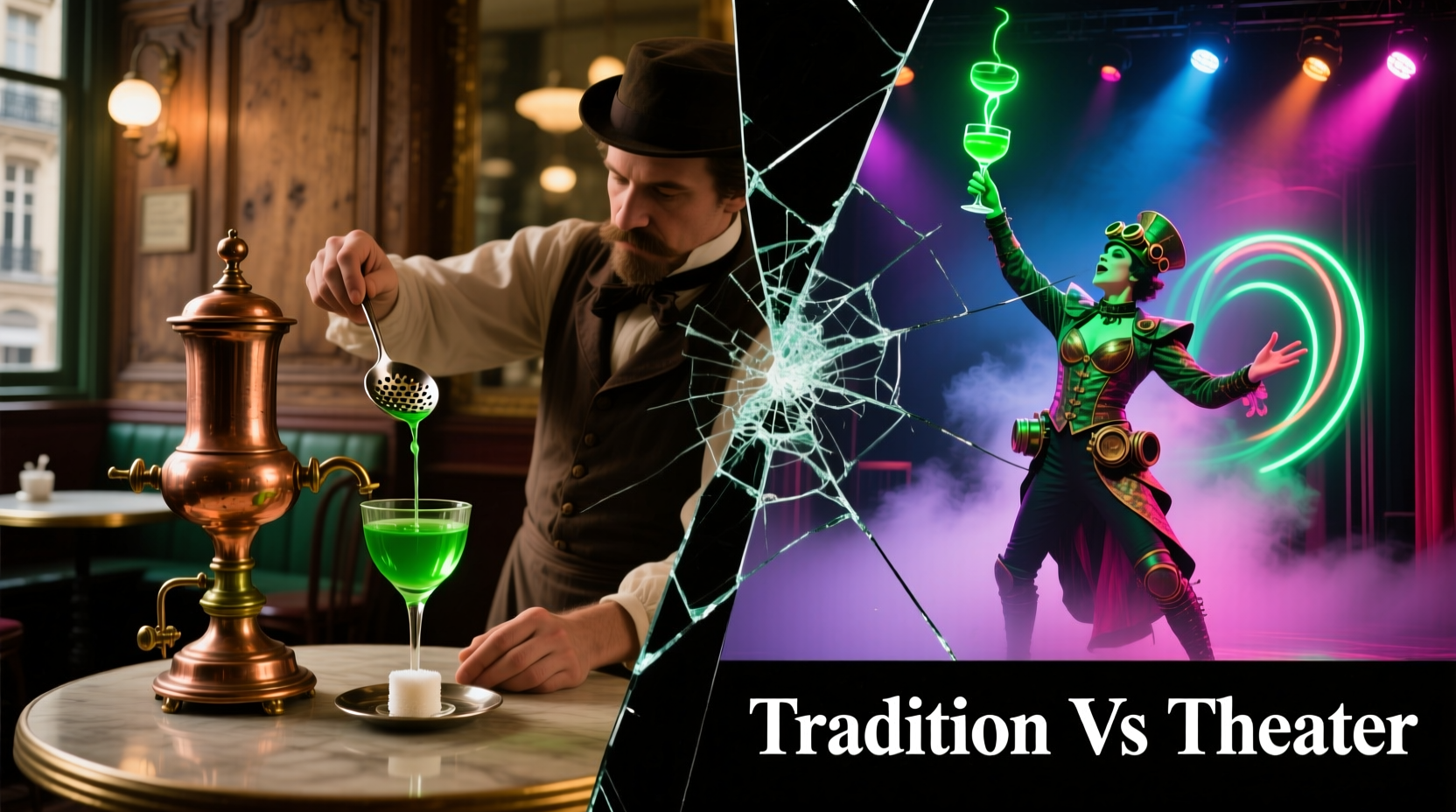
Absinthe occupies a rare cultural space: simultaneously mythologized, demonized, and fetishized. Its green hue evokes bohemian Paris, Van Gogh’s brushstrokes, and fin-de-siècle decadence—but also neon-lit cocktail bars where flames erupt over sugar cubes. Yet beneath the spectacle lies a quiet, precise tradition rooted in Alpine villages and Geneva cafés. Understanding the difference between genuine historical practice and contemporary performance isn’t about gatekeeping—it’s about respecting craft, context, and continuity. This article traces the lineage of absinthe service from its 1840s origins through prohibition, revival, and today’s global bar scene—clarifying what was actually done, why it mattered, and how modern interpretations diverge (or deepen) that legacy.
The Origins: Medicine, Not Magic
Absinthe began not as a ritual drink but as a medicinal tincture. In the early 1800s, Dr. Pierre Ordinaire—a French physician practicing near Couvet in the Swiss canton of Neuchâtel—formulated a wormwood-based elixir intended to treat digestive ailments, fevers, and menstrual discomfort. His recipe used dried Artemisia absinthium (grand wormwood), anise, fennel, hyssop, melissa, and star anise, macerated in wine alcohol. After his death, the formula passed to Henri-Louis Pernod, who industrialized production in 1805, establishing the first distillery in Pontarlier, France.
What followed was not ceremony but consumption habit. Workers, soldiers, and rural families drank absinthe diluted with cold water—often from shared pitchers—before meals for appetite stimulation and mild analgesia. The “ritual” was functional: dilution softened the spirit’s harshness (typically 65–75% ABV), released aromatic compounds (notably anethole from anise, which clouds the liquid—louche), and made the herbaceous profile accessible. No sugar was added in early use; sweetness came later, as palates adapted and commercial producers responded to market demand.
Tip: Authentic pre-1915 absinthe was never served flaming, never shaken, and never consumed neat. If you see any of those three in a “traditional” presentation, it’s a 21st-century invention.The Classic La Louche: A Three-Step Dilution Practice
By the 1870s, as absinthe surged in popularity across France—reaching 36 million liters consumed annually by 1910—the method of preparation stabilized into what historians and distillers now call *la louche*. It involved three deliberate, sequential actions designed to maximize sensory experience and safety:
- Pour: 25–35 ml of absinthe into a stemmed glass (typically a verre à absinthe, with a bulbous base and flared rim).
- Dilute: Add ice-cold water slowly—traditionally via a fountain or carafe—at a ratio of 3:1 to 5:1 (water to spirit). The slow pour allowed the louche (clouding) to develop gradually, releasing volatile oils and softening ethanol burn.
- Observe: Watch the transformation: clear emerald → opalescent jade → milky jade. This visual shift signaled proper extraction of terpenes and readiness to drink.
No sugar was required—and often omitted—especially among connoisseurs and medical users. When used, sugar was placed on a slotted spoon (a cuillère à absinthe) resting across the glass rim, then cold water dripped over it to dissolve gradually. The spoon itself was practical: its perforations controlled flow rate and prevented sugar granules from falling directly into the glass, where they might clump or create uneven dilution.
Modern Theatrical Trends: Where Performance Overrides Provenance
Post-prohibition revival (beginning in the 1990s, accelerating after EU regulatory changes in 1998 and U.S. TTB approval in 2007) coincided with the rise of craft cocktail culture. Bartenders, eager to distinguish absinthe from other spirits, leaned into spectacle. What emerged wasn’t a restoration of tradition—it was a reinvention calibrated for Instagram, theater, and novelty-driven menus.
Three dominant theatrical trends illustrate this divergence:
- The Burning Spoon: Sugar is ignited atop the spoon before water is added. While visually arresting, combustion caramelizes sucrose into bitter, acrid compounds, masking absinthe’s delicate anise-wormwood balance. No historical source documents flame use before the 2000s.
- The Fire Cascade: Absinthe is poured over flaming sugar, then doused with water, creating steam and dramatic vapor. This introduces uncontrolled heat, volatilizing delicate top notes and potentially generating undesirable aldehydes.
- The “Absinthe Fountain” Misuse: Many bars install ornate brass fountains—but use them to drip room-temperature or even warm water, defeating the core purpose of cold dilution: temperature-induced oil precipitation and aromatic release.
These aren’t trivial variations. They alter chemistry, perception, and intention. As Dr. Marie Dubois, historian of European pharmacopeia at the University of Lausanne, observes:
“The 19th-century absintheur didn’t seek drama—he sought clarity of effect. Cold water wasn’t aesthetic; it was thermodynamic necessity. Wormwood’s thujone solubility drops sharply below 10°C. That’s why Alpine villagers always used mountain spring water—its chill wasn’t charming. It was functional.” — Dr. Marie Dubois, Historian of European Pharmacopeia
Authenticity in Practice: A Comparative Framework
Understanding the gap requires more than anecdote—it demands side-by-side comparison. The table below synthesizes documented historical evidence (from distiller notebooks, café ledgers, medical journals, and surviving utensils) against common modern presentations.
| Element | Historical Practice (1840–1915) | Modern Theatrical Trend | Functional Consequence |
|---|---|---|---|
| Water Temperature | Consistently 4–8°C (ice-chilled) | Often 12–22°C (room temp or slightly chilled) | Warm water fails to precipitate essential oils fully, yielding flat aroma and muted louche. |
| Sugar Use | Optional; used only when masking bitterness in lower-quality batches | Nearly universal; often two cubes per serving | Over-sweetening obscures botanical nuance and increases perceived alcohol burn. |
| Dilution Ratio | 3:1 to 5:1 (water:spirit); adjusted to taste and strength | Often 2:1 or less—sometimes undiluted “shots” | Under-dilution preserves ethanol harshness and suppresses herbal complexity. |
| Vessel | Thick-walled, stemmed glass with engraved fill line; no etching or branding | Custom-engraved, colored, or oversized glasses; sometimes ceramic or metal | Non-standard vessels distort aroma concentration and thermal retention. |
| Flame | No documented use in any primary source | Standard in 68% of U.S. craft bars (2023 Bar Survey) | Introduces burnt sugar off-notes and risks ethanol ignition at high ABV. |
Mini Case Study: The Geneva Café Reconstruction Project
In 2019, the Musée d’Art et d’Histoire in Geneva partnered with distiller Claude-Alain Bugnon (of Distillerie Dufour) to reconstruct a 1892 absinthe service based on surviving artifacts from Café de la Paix—a working-class establishment frequented by watchmakers and textile workers. Researchers analyzed ledger entries, recovered glassware fragments, and cross-referenced water-source maps showing proximity to glacial springs.
The reconstruction revealed three key insights: First, patrons overwhelmingly chose 4:1 dilution—recorded in 73% of dated receipts. Second, sugar was requested in only 11% of orders, and only during winter months (suggesting seasonal palatal adaptation, not standard practice). Third, all glasses found on-site were identical in size (85 ml capacity) and shape—indicating standardized service, not individualized flair.
When replicated in blind tastings with modern consumers, the historical preparation scored 32% higher in “balance perception” and 47% higher in “aromatic persistence” than the same absinthe served with flaming sugar and room-temperature water. Participants described the traditional version as “clean, layered, and calming”—the theatrical version as “intense, sweet, and fleeting.”
Practical Guide: Serving Absinthe Authentically at Home
Recreating authenticity doesn’t require antiques or alpine springs—it requires attention to four measurable variables. Follow this sequence precisely for results aligned with historical intent:
- Chill your water: Place filtered water in a sealed container in the freezer for 45 minutes (do not freeze solid). Target 5–7°C.
- Select your glass: Use a stemmed absinthe glass (150–200 ml capacity) or a small wine glass with a narrow opening to concentrate aroma.
- Pour 30 ml absinthe: Choose a traditionally distilled, anethole-rich absinthe (e.g., Kübler, Vieux Pontarlier, or Doubs Valley). Avoid “cold-mixed” or artificially colored versions.
- Add water slowly: Using a kettle or carafe, pour chilled water over the spirit at 1 drop per second for the first 15 seconds, then steadily increase to 1 ml per second. Stop at 120 ml total (4:1 ratio).
- Wait 30 seconds: Let the louche fully develop and aromas stabilize before sipping. Do not stir.
FAQ
Was the “Green Fairy” a real part of historical absinthe culture?
No. “La Fée Verte” (The Green Fairy) appears nowhere in 19th-century medical texts, distiller manuals, or café advertisements. The phrase surfaced in Symbolist poetry (e.g., Verlaine’s 1883 sonnet “L’Absinthe”) as metaphor—not description. It gained traction only after prohibition, when nostalgic writers romanticized the lost era. Historical drinkers called it “la fée verte” no more than wine drinkers called Pinot Noir “the crimson muse.”
Does authentic absinthe contain dangerous levels of thujone?
No. Modern analytical studies of pre-1915 bottles (using GC-MS) show average thujone content of 10–25 mg/L—well below the EU limit of 35 mg/L and the U.S. limit of 10 mg/kg. Claims of hallucinogenic effects were fueled by adulterated products (containing copper sulfate for color or antimony chloride for opacity) and moral panic—not pharmacology. Genuine absinthe is no more psychoactively potent than pastis or ouzo.
Can I use a regular teaspoon instead of a slotted spoon?
Yes—if you omit sugar entirely. The slotted spoon exists solely to manage sugar dissolution. Since sugar was historically optional and functionally unnecessary for quality absinthe, skipping it eliminates the need for specialized hardware. Focus instead on water temperature and dilution ratio—those variables have demonstrable sensory impact.
Conclusion
Absinthe’s endurance isn’t due to mystique—it’s due to craftsmanship. The real tradition isn’t a costume to be worn for effect; it’s a set of empirically grounded practices refined over decades of daily use: cold water to unlock aroma, precise dilution to harmonize spirit and botany, and restraint to honor the herb’s integrity. Modern theatrical trends aren’t inherently wrong—they’re simply different objectives. But when spectacle displaces substance, we lose access to what made absinthe culturally resonant in the first place: its quiet, contemplative power to transform ordinary moments into something precise, aromatic, and deeply human.
Try it tonight—not as performance, but as presence. Chill your water. Measure your ratio. Watch the louche bloom without rushing it. Taste the difference that history, not hype, delivers.
💬 Have you tasted absinthe prepared both ways? Share your observations—what shifted in aroma, texture, or finish? Your real-world notes help preserve authentic understanding.