
That sharp, acrid scent—like hot plastic or singed insulation—wafting from your pre-lit Christmas tree isn’t just unpleasant. It’s your home’s earliest warning system. Unlike the warm aroma of pine needles or cinnamon candles, a burnt wire smell signals electrical stress, insulation breakdown, or component failure. And while many consumers dismiss it as “just new lights” or “part of the holiday setup,” this odor is rarely benign. In fact, according to the U.S. Consumer Product Safety Commission (CPSC), over 170 home fires annually are linked to decorative lighting—including pre-lit trees—with faulty wiring cited as the leading cause in nearly 40% of those incidents.
This isn’t about alarmism—it’s about precision. A faint, fleeting whiff during the first 10 minutes of operation may reflect harmless thermal settling in low-voltage LED circuitry. But persistent, intensifying, or localized burning smells demand immediate action. This article cuts through marketing claims and seasonal complacency. We’ll walk you through the physics behind the odor, differentiate between tolerable manufacturing residue and genuine hazard, outline a field-tested diagnostic protocol, and give you clear, unambiguous thresholds for when to stop troubleshooting and start unplugging.
What Causes That Smell? The Science Behind the Scent
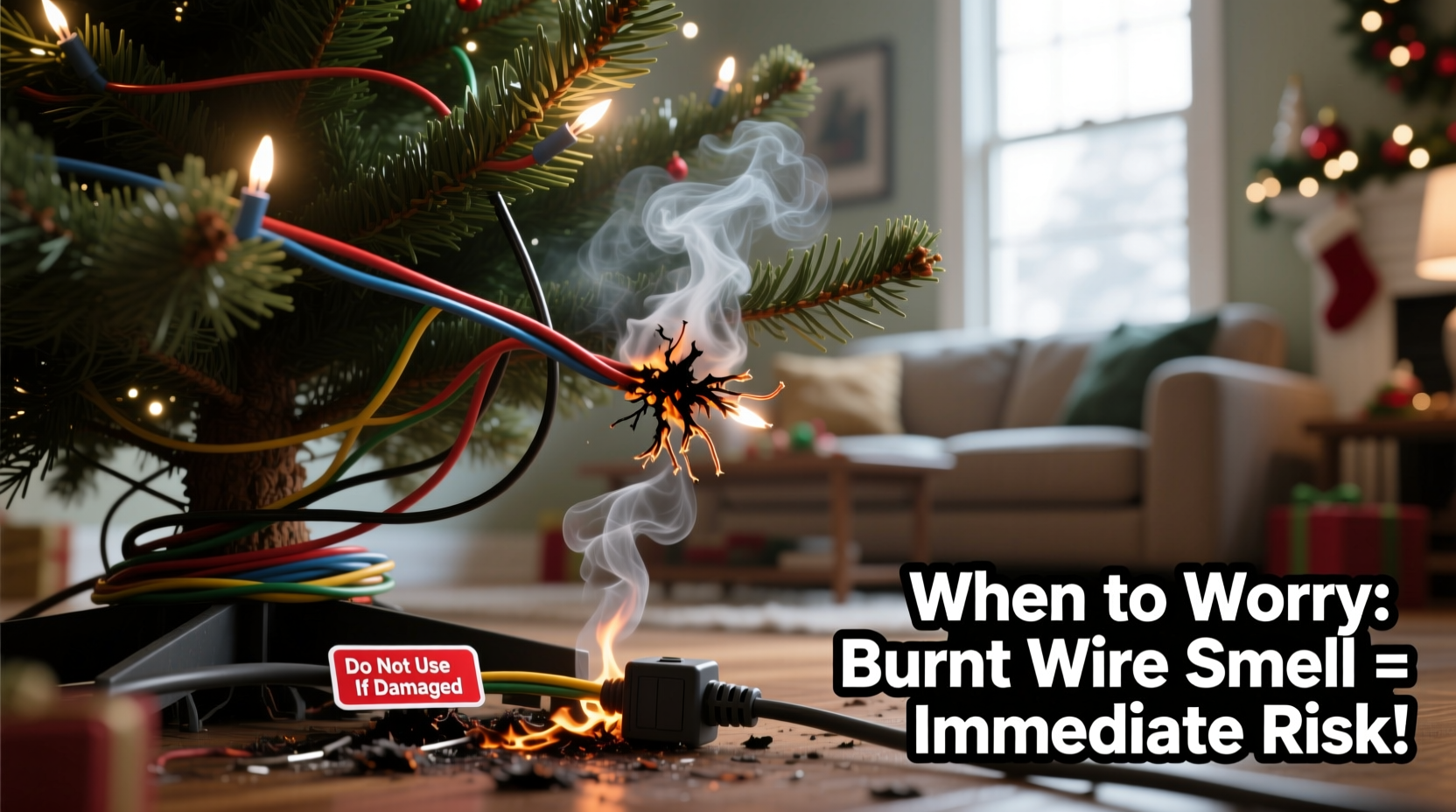
A burnt wire smell originates from thermal degradation of materials surrounding electrical conductors: insulation (typically PVC or polyethylene), solder flux residues, conformal coatings on circuit boards, or even dust and lint baked onto warm components. When current flows through resistance—even tiny, unintended resistance—the resulting heat can exceed the material’s thermal tolerance. At around 150°C (302°F), PVC insulation begins to decompose, releasing hydrogen chloride gas and aromatic hydrocarbons that register to our olfactory receptors as sharp, acrid, or “electrical.”
In pre-lit trees, several design realities compound risk:
- High-density wiring: Hundreds of miniature bulbs, often wired in series or hybrid configurations, create long, thin current paths with cumulative resistance.
- Enclosed heat traps: Branches and foliage restrict airflow, causing localized hotspots—especially near plug-in bases, junction boxes, or dimmer modules.
- Manufacturing variances: Budget models may use thinner-gauge wire, underspec’d transformers, or non-UL-listed components prone to early thermal stress.
- Dust accumulation: Stored trees collect dust, pet hair, and cobwebs. When energized, these combustible layers bake onto warm wires, producing smoke and odor before actual flame ignition.
Crucially, the smell itself is not the hazard—it’s the symptom. By the time you detect it, insulation may already be compromised, increasing risk of short circuits, arcing, or ground faults. Ignoring it doesn’t make the problem disappear; it accelerates degradation.
When Is It *Probably* Safe—and When It’s Definitely Not
Not all burnt odors carry equal weight. Context matters: timing, location, intensity, and behavior determine whether you’re dealing with a transient quirk or an active fire precursor.
| Smell Characteristic | Typical Cause | Risk Level | Action Required |
|---|---|---|---|
| Faint, brief (≤90 seconds), only at startup; dissipates fully within 5 minutes | Residual solder flux or conformal coating off-gassing under initial thermal load | Low | Monitor closely next 2–3 uses. If odor recurs beyond Day 1 or intensifies, discontinue use. |
| Sharp, chemical, or “hot plastic” smell localized near the base plug or control box | Overheating transformer, failing rectifier, or loose terminal connection | High | Unplug immediately. Do not reuse until professionally inspected—or better, replaced. |
| Intermittent smell coinciding with flickering lights or sections going dark | Intermittent short circuit, damaged wire insulation, or failing bulb socket | Critical | Unplug and inspect wiring visually. If any wire shows discoloration, brittleness, or exposed copper, discard tree. |
| Smell accompanied by visible smoke, charring, or melting plastic | Active thermal runaway—insulation failure progressing to conductor exposure | Emergency | Unplug using insulated tool (e.g., dry wooden spoon). Evacuate area if smoke thickens. Call fire department if odor persists after power removal. |
| Odor returns every year, stronger than last, especially after extended use (>4 hours) | Progressive insulation degradation from repeated thermal cycling and aging | High | Retire tree. Pre-lit trees older than 6–8 years exceed safe operational lifespan per UL 588 standards. |
A Step-by-Step Diagnostic Protocol (Do This Before Plugging In Again)
If you’ve detected a burnt wire smell, follow this sequence methodically—no skipping steps. This isn’t troubleshooting; it’s forensic safety verification.
- Unplug and cool down: Disconnect from power and wait at least 2 hours for all components to return to ambient temperature.
- Visual inspection (base & trunk): Examine the plug, cord, and base housing. Look for discoloration (yellow/brown streaks), warping, melted plastic, or charred areas. Check for loose or corroded prongs.
- Inspect the control box: If your tree has a built-in timer, dimmer, or adapter, open its access panel (if designed for user access). Look for bulging capacitors, brown residue on circuit board traces, or cracked solder joints.
- Trace branch wiring: Starting at the base, follow the main harness upward. Gently separate branches and inspect where wires pass through branch joints. Look for pinched, frayed, or kinked sections—especially near tight bends or metal branch supports.
- Test individual light sections: Plug in only the bottom section (if modular). Wait 5 minutes. Smell again. Repeat upward section-by-section. If odor appears only with one segment, isolate and discard that section—or the entire tree if non-modular.
- Check environment: Ensure tree is on a level, non-flammable surface, away from heaters, vents, or direct sunlight. Confirm outlet isn’t overloaded (max 80% capacity—e.g., ≤12A on a 15A circuit).
This process takes 20–30 minutes but eliminates guesswork. If any step reveals physical damage—or if the smell returns during testing—do not proceed. Your tree has failed its safety audit.
Mini Case Study: The “Just One More Year” Tree
Janice, 58, of Portland, OR, used her 9-year-old pre-lit Fraser fir every holiday season. For three years, she noticed a “plastic-y” smell on Day 1—but it always faded by evening, so she assumed it was normal. Last December, the odor returned earlier, lingered longer, and concentrated near the base. She ignored it until Day 3, when her daughter spotted black specks on the white cord near the plug. Janice unplugged it, examined closely, and found a 2-inch section where the PVC jacket had turned brittle and gray, revealing dull copper beneath. She contacted the manufacturer. Their response? “The tree exceeded its recommended service life. Not covered under warranty.”
Janice replaced it with a UL-certified, modular LED tree featuring independent circuit protection and a 3-year warranty. Her electrician confirmed the old tree’s transformer was outputting 18V instead of rated 12V—a classic sign of internal capacitor failure accelerating insulation breakdown. The black specks weren’t dirt—they were carbonized polymer residue, evidence of micro-arcing. Had she waited one more day, the risk of ignition would have spiked exponentially.
“Any burnt odor from electrical decor should trigger the same response as smoke from a stove: immediate power removal and visual assessment. There is no ‘safe threshold’ for degraded insulation.” — David R. Mendoza, P.E., Electrical Safety Consultant, NFPA 101 Committee Member
FAQ: Your Most Urgent Questions Answered
Can I fix a burnt-smelling tree myself?
No. Splicing wires, replacing transformers, or re-insulating damaged sections requires certified electrical training and UL-listed replacement parts. DIY repairs void safety certifications and introduce new failure points. Pre-lit trees are integrated systems—not modular electronics. If components fail, the entire assembly is compromised.
Why do newer LED trees still smell? Aren’t they safer?
LEDs run cooler than incandescents, but safety depends on the entire system—not just the bulbs. Cheap LED trees often use undersized wiring, non-fire-retardant plastics, and unregulated power supplies. A 2023 CPSC lab analysis found 22% of budget LED trees failed basic thermal stress tests, with 60% emitting detectable off-gassing before reaching 100 hours of operation. UL 588 certification—not “LED” labeling—is your real safety indicator.
How long should a pre-lit tree last before retirement?
UL recommends maximum 6–8 years of seasonal use for pre-lit trees, assuming proper storage (cool, dry, vertical, no compression). After 6 years, insulation embrittlement accelerates—even without visible damage. If your tree is older than 8 years, retire it regardless of appearance or performance. Thermal cycling degrades polymers at a molecular level; odor is often the first observable symptom of that decay.
When to Worry: Your Unambiguous Decision Tree
Use this flow to cut through uncertainty. Answer each question honestly:
- Is the smell present before plugging in? → Stop. Discard tree. (Indicates off-gassing from severe prior damage or chemical contamination.)
- Did the smell appear only once, fade completely within 90 seconds, and never return in 3 subsequent uses? → Monitor, but consider retirement if tree is >6 years old.
- Does the smell return every time you plug it in—even faintly? → Unplug permanently. Replace tree.
- Is the smell strongest near the plug, base, or control box? → Unplug. Do not reuse.
- Do you see any discoloration, melting, or exposed wire? → Discard immediately. Do not attempt repair.
If you answered “yes” to any of the last three questions, your decision is made. No further testing needed. Electrical safety isn’t probabilistic—it’s binary: functional or failed.
Conclusion: Safety Isn’t Seasonal—It’s Structural
Your pre-lit tree isn’t just decor. It’s a low-voltage electrical appliance operating in close proximity to flammable materials, children, pets, and sleeping adults. A burnt wire smell isn’t a quirk to endure—it’s evidence that the safety margins engineered into your tree have been breached. Modern UL 588–certified trees include thermal fuses, flame-retardant wiring jackets, and redundant circuit protection precisely because manufacturers know how easily those margins erode with age, storage conditions, and usage patterns.
Replacing a tree feels like an inconvenience—until you consider the alternative: a fire starting in your living room at 2 a.m., fueled by synthetic foliage and decades-old wiring. Don’t wait for smoke alarms to scream. Trust your nose. Respect the odor. Act decisively. Choose a tree with verifiable UL certification, modular design for easier troubleshooting, and a clear manufacturer warranty—not just the lowest price tag.
This holiday season, let your tree sparkle—not smolder. Prioritize peace of mind over nostalgia. Inspect, assess, and invest in safety that lasts beyond December 26th.
💬 Have you encountered a burnt wire smell? Share your experience—what you did, what you learned, and which tree model you now trust. Your story could help another family avoid a dangerous mistake.








