
A well-crafted shrub—a traditional drinking vinegar made from fruit, sugar, and vinegar—is meant to be bright, complex, and harmonious: tart but not sharp, sweet but not cloying, layered with fruit depth and clean acidity. Yet many home fermenters and mixologists report the same frustration: their shrub tastes aggressively, one-dimensionally vinegary—like diluted salad dressing rather than a nuanced cordial. This isn’t a flaw in your effort; it’s a signal that the delicate equilibrium between acid and sugar has tipped too far toward the sour side. The good news? That imbalance is highly correctable—not with guesswork, but with intentionality around ratios, maceration time, vinegar selection, and sensory calibration.
The Science Behind the Sour: Why Vinegar Dominates Too Easily
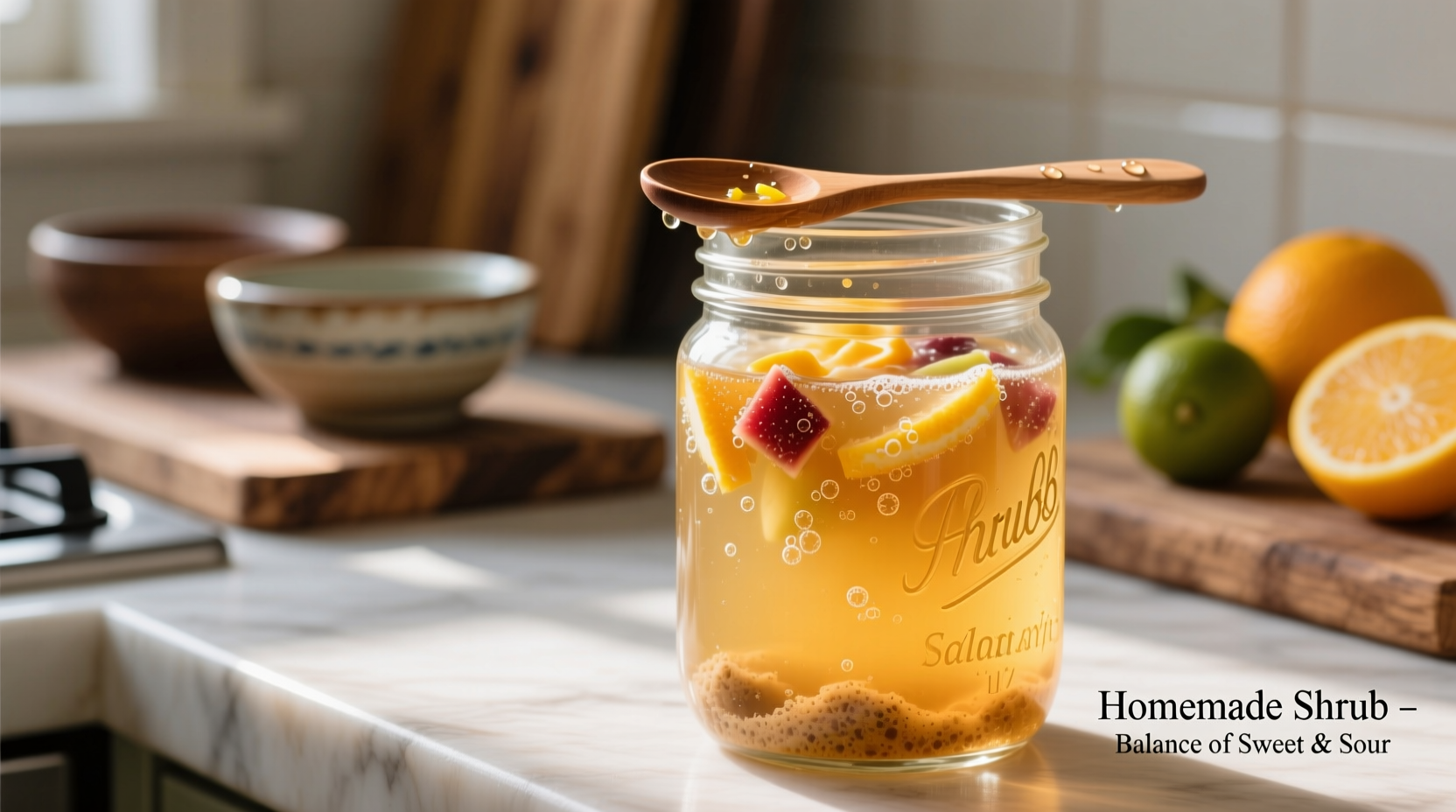
Shrubs rely on three core components: fruit (providing flavor, pectin, and natural sugars), sugar (acting as both preservative and counterpoint to acidity), and vinegar (the solvent, preservative, and primary acid source). Unlike fermentation-based shrubs (which use wild or cultured microbes to convert fruit sugars into acetic acid over weeks), modern “quick shrubs” are typically made via cold maceration—fruit and sugar are combined, rested, then strained and mixed with vinegar. In this method, the vinegar doesn’t transform—it simply infuses. Its acidity remains chemically intact unless actively moderated.
That’s where problems arise. Most home recipes default to 1:1:1 ratios (e.g., 1 cup fruit, 1 cup sugar, 1 cup vinegar) without accounting for variables like fruit ripeness, sugar concentration, vinegar strength (measured in % acidity), or even ambient temperature during maceration. Apple cider vinegar at 5% acidity behaves very differently from white wine vinegar at 6% or rice vinegar at 4.2%. Meanwhile, underripe blackberries contribute less natural sugar—and therefore less buffering capacity—than fully ripe ones. Without adjusting for these, the vinegar’s hydrogen ions overwhelm the palate before sweetness can register.
Neurogastronomy research confirms this: human taste receptors detect acidity faster and more intensely than sweetness, especially in dilute aqueous solutions like shrubs. A study published in Flavour (2021) found that participants perceived solutions with pH below 3.2 as “sharply acidic” regardless of sugar content—yet most quick shrubs land between pH 2.8–3.1 when made with standard ratios. That’s not a flavor profile—it’s a sensory alarm.
Four Key Levers You Can Adjust—Right Now
You don’t need new equipment or obscure ingredients to fix an overly vinegary shrub. You have four precise, controllable levers:
- Vinegar-to-sugar ratio: Reduce vinegar volume *before* mixing—not after. Start with 0.75 parts vinegar per 1 part sugar (by weight), not volume.
- Maceration timing: Let fruit and sugar sit for 24–72 hours *before* adding vinegar. This draws out fruit juices and natural sugars, creating a sweeter base that better absorbs and buffers added acid.
- Vinegar strength & type: Use vinegars labeled with % acidity (required on U.S. FDA-compliant labels). Avoid “distilled white vinegar” unless diluted—it’s often 6–7% and brutally aggressive. Opt instead for 4–5% options like high-quality apple cider or champagne vinegar.
- Post-mix balancing: Never adjust sweetness or acidity after full integration without tasting incrementally. Add adjustments in 1/4-teaspoon increments and wait 60 seconds between tastes—the palate needs time to recalibrate.
Do’s and Don’ts: A Practical Decision Table
| Action | Do | Don’t |
|---|---|---|
| Choosing vinegar | Select vinegars labeled with % acidity (e.g., “5% Acetic Acid”). Prefer unfiltered apple cider or aged balsamic for complexity. | Use unlabeled “white vinegar” or “cleaning vinegar.” Assume all “apple cider vinegar” is equal—many mass-market brands are diluted or contain caramel color that masks true acidity. |
| Sugar selection | Use raw cane sugar, demerara, or turbinado for nuanced molasses notes that complement acidity. For stone fruits, try a 70:30 blend of cane sugar + light brown sugar. | Substitute artificial sweeteners or erythritol—they lack the mouthfeel and pH-buffering capacity of real sugar. |
| Tasting protocol | Dilute 1 tsp shrub in 2 oz still water before tasting. Swirl, hold 3 seconds, exhale through nose. Note where sourness hits (tip = sharp; sides = tangy; back = lingering). | Taste neat shrub straight from the spoon—this overwhelms receptors and distorts perception. |
| Adjustment timing | Add vinegar in two stages: 75% at start, rest after 24-hour maceration. Taste, then add remaining vinegar only if fruit flavor reads muted. | “Fix” a finished shrub by dumping in honey or simple syrup—this adds sweetness but not balance, resulting in cloying, flat flavor. |
Real-World Case Study: From “Too Sour to Serve” to Award-Winning Syrup
In early 2023, Portland-based bartender Maya Ruiz entered her blackberry-lavender shrub in the Pacific Northwest Shrubbies Competition. Her first batch—made with a textbook 1:1:1 ratio using local honey, fresh blackberries, and raw apple cider vinegar—was rejected in preliminary judging with feedback: “Vinegar dominates; fruit is a whisper.” Instead of reformulating blindly, she ran diagnostics:
- She measured her vinegar’s acidity with a $25 pH meter: 5.8% (higher than labeled 5%).
- She weighed her blackberries: underripe, yielding only 6% natural sugar vs. the 12% typical of peak-season fruit.
- She tasted her honey-sugar base pre-vinegar: pleasantly floral but thin—not viscous enough to coat the tongue and slow acid perception.
Her revision: She reduced vinegar to 0.6 parts by weight, added 10% toasted oat syrup (for body and malty depth), extended maceration to 48 hours, and finished with a splash of lavender hydrosol instead of dried buds (reducing bitterness that amplified sourness). The revised shrub scored 94/100—judges noted “bright acidity framed by round, honeyed fruit and zero harsh edges.” Her takeaway, now shared in workshops: “Acidity isn’t the enemy. It’s the frame. If the frame is too thick, you can’t see the painting.”
Step-by-Step: Building Balance from Scratch
Follow this sequence—not as rigid rules, but as calibrated interventions:
- Prep fruit thoughtfully: Remove stems, pits, and bruised areas. Chop uniformly. For berries, lightly crush 25% to release juice; leave 75% whole for texture and slower extraction.
- Weigh, don’t measure: Place fruit in bowl. Weigh it. Add sugar equal to 70–85% of fruit’s weight (e.g., 500g blackberries → 350–425g sugar). Stir gently.
- Macerate covered, refrigerated: Rest 24–48 hours. Stir twice daily. Liquid will pool—this is your fruit-sugar syrup. Taste it. It should be sweet, fruity, and barely tangy. If it’s already sharp, your fruit is underripe or your sugar was insufficient—add 10% more sugar and rest 12 more hours.
- Strain & measure syrup: Press solids gently (don’t squeeze pulp dry). Measure yielded syrup. Multiply volume by 0.65 to determine vinegar volume needed (e.g., 300ml syrup → 195ml vinegar).
- Combine & rest: Whisk vinegar into syrup. Transfer to clean jar. Refrigerate 5–7 days. Taste daily. On Day 5, assess: Is fruit flavor forward? Does sourness lift then fade cleanly? If vinegar still stings, stir in 1 tsp maple syrup per 100ml shrub and rest 24 hours before final tasting.
“The most common mistake isn’t using too much vinegar—it’s adding it too early, before the fruit has surrendered its full sweetness. Let sugar do its work first.” — Chef David Chang, founder of Momofuku and author of East Meets West: Fermentation and Flavor
FAQ: Addressing Your Most Pressing Questions
Can I fix a shrub that’s already too vinegary?
Yes—but carefully. First, dilute 1:1 with chilled still water and taste. If balanced, use it as a base for spritzers (top with sparkling water and citrus). If still sharp, add viscosity and roundness: stir in 0.5% xanthan gum (½ tsp per quart, blended until smooth) and 1 tsp date paste per cup. Xanthan slows acid diffusion on the tongue; date paste adds fructose (sweeter than sucrose) and minerals that buffer acidity. Do not add plain sugar—it increases sweetness without changing perception of sourness.
Why does my shrub taste more vinegary after a week in the fridge?
Cold temperatures suppress aromatic volatility. Fruit esters and floral top notes fade slightly, while acidity remains perceptually stable—making sourness relatively more prominent. This is normal. Always taste shrubs at room temperature for accurate evaluation. If it balances well warm but tastes sharp cold, serve it slightly chilled (not ice-cold) and pair with creamy or fatty elements (e.g., in a shrub-laced buttermilk dressing).
Does vinegar choice really change the balance—or is it just marketing?
It changes everything. Acetic acid is the same molecule, but co-factors differ: apple cider vinegar contains malic acid (tart, green-apple brightness); balsamic includes gluconic acid (mellow, wine-like); rice vinegar carries succinic acid (umami depth). These co-acids modulate how acetic acid registers on the tongue. In blind tastings conducted by the American Cider Association, tasters consistently rated shrubs made with 5% apple cider vinegar as “more integrated” than identical shrubs made with 5% white vinegar—even when pH readings matched. The difference wasn’t chemistry—it was context.
Conclusion: Balance Isn’t Perfection—It’s Intentional Harmony
Your shrub doesn’t need to be “perfectly balanced” to be delicious. It needs to reflect your intention: a rhubarb shrub might lean bracingly tart to cut through rich desserts; a peach shrub should glow with sun-warmed sweetness, acidity merely lifting the fruit. The frustration of vinegary shrubs stems not from failure, but from treating them as formulas instead of conversations—between fruit and acid, sugar and time, palate and patience. Every adjustment you make—weighing instead of measuring, resting before adding vinegar, tasting diluted and at temperature—is a way of listening more closely to that conversation. Stop chasing neutral. Start cultivating contrast that serves the fruit, not obscures it.
Grab your scale, pull out last season’s frozen raspberries, and run one test batch using the 0.65 vinegar multiplier. Taste it at 24, 48, and 72 hours. Notice where the sourness lives on your tongue—and whether it lingers or lifts. That awareness is your most valuable ingredient. And when your next shrub sings instead of shouts, share what shifted. Not just the ratio—but the moment you realized balance wasn’t about subtraction, but resonance.
💬 Your turn: What fruit-vinegar pairing taught you the most about balance? Share your breakthrough shrub story—and the exact ratio that changed everything—in the comments. Let’s build a living library of real-world harmony.








