Cocktail foam isn’t just visual flair—it’s texture, aroma delivery, mouthfeel, and balance in miniature. When a carefully shaken Ramos Gin Fizz or a silky Pisco Sour collapses within seconds, it’s more than disappointing: it signals a breakdown in technique, ingredient synergy, or molecular stability. Foam failure isn’t random. It’s physics—and chemistry—working against you. Understanding *why* foam vanishes reveals exactly *what* to adjust: temperature, acidity, fat content, protein quality, agitation method, and, crucially, which stabilizers deliver real-world reliability behind the bar.
The Science Behind Foam Collapse (It’s Not Just “Shake Harder”)
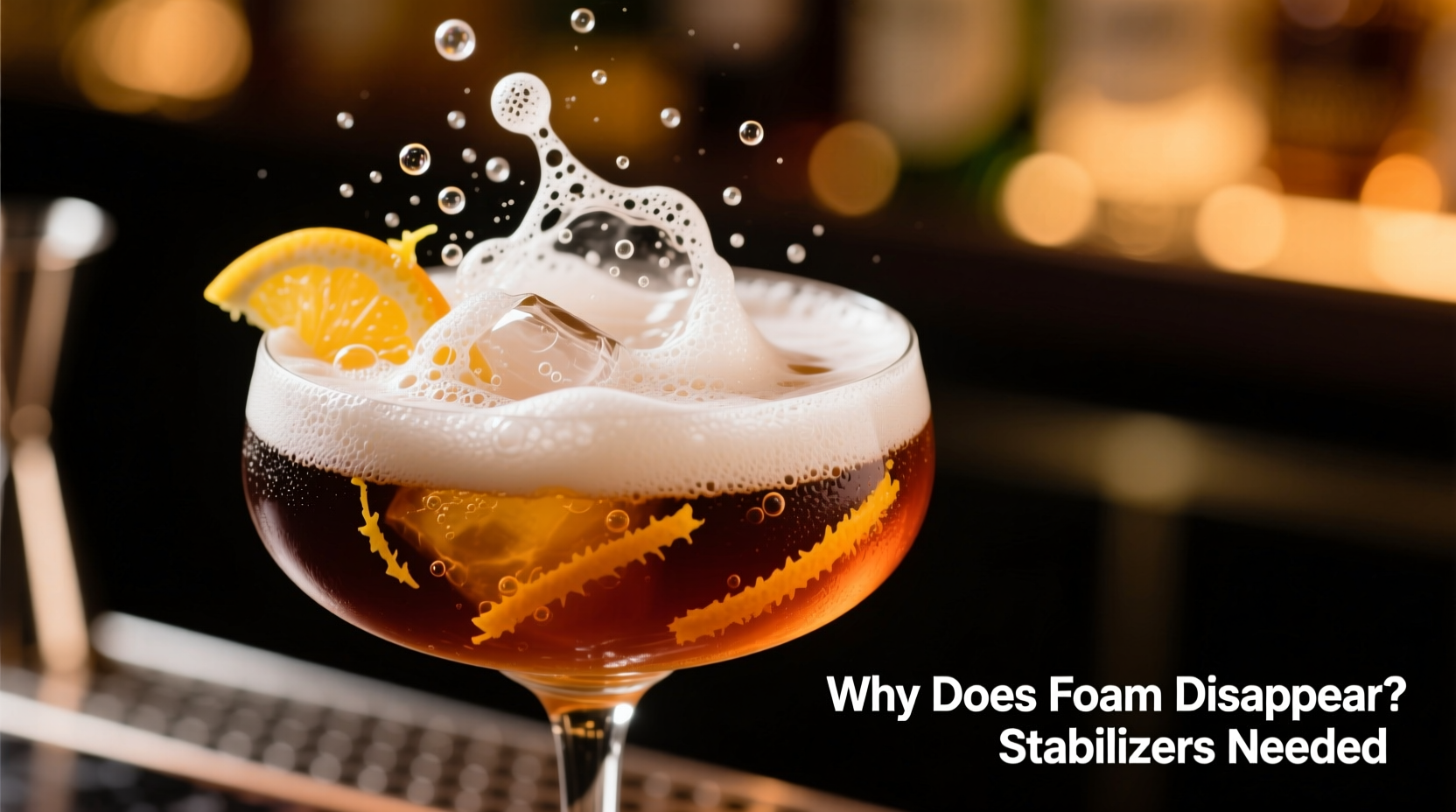
Cocktail foam forms when air is trapped in liquid by surface-active molecules—surfactants—that reduce surface tension and create elastic films around bubbles. In cocktails, these surfactants come primarily from egg white, aquafaba, dairy proteins, or plant-based gums. But foam stability depends on three interdependent factors: bubble size distribution, film elasticity, and drainage resistance.
Small, uniform bubbles resist coalescence better than large, irregular ones. Elastic films (like those formed by ovalbumin in egg white) stretch without rupturing when neighboring bubbles press together. And slow drainage—where liquid doesn’t rapidly drain from the film between bubbles—keeps the structure hydrated and intact.
Foam fails when one or more of these elements breaks down:
- pH imbalance: Acids like lemon or lime juice denature egg proteins too aggressively if not properly balanced—especially at room temperature—leading to weak, brittle films.
- Temperature shock: Warm ingredients destabilize protein unfolding; cold liquids (below 4°C) slow denaturation but also reduce solubility of some stabilizers.
- Fat interference: Even trace fats—like those clinging to shaker tins, spoons, or citrus oils—disrupt surfactant alignment at air-liquid interfaces.
- Over-dilution: Excessive shaking introduces too much water, thinning the foam matrix and accelerating drainage.
- Insufficient hydration time: Egg whites need 10–30 seconds of dry shake (no ice) to fully unfold and form stable micelles before chilling and aerating.
Without intervention, even a perfectly executed dry shake yields foam that lasts 60–90 seconds under ideal conditions. For service consistency—especially in high-volume bars—relying solely on raw egg white isn’t enough.
Stabilizer Tier System: What Works, When, and Why
Not all stabilizers are equal. Some reinforce protein networks. Others increase viscosity to slow drainage. A few do both. The most effective bars use tiered combinations—not single “magic bullets.” Below is a practical, field-tested hierarchy based on efficacy, scalability, flavor neutrality, and regulatory compliance (FDA GRAS status).
| Stabilizer | Primary Mechanism | Best For | Usage Range (per 100ml base) | Flavor/Texture Notes |
|---|---|---|---|---|
| Egg white (pasteurized) | Protein film formation + foam nucleation | Classic foams (Ramos, Whiskey Sour) | 15–25g (½–¾ oz) | Neutral; adds subtle richness |
| Aquafaba (canned chickpea brine) | Plant protein + saponins + soluble fiber | Vegan cocktails; high-acid drinks | 20–30ml (⅔–1 oz) | Faint bean note; best with strong citrus or spice |
| Xanthan gum | Viscosity control + drainage inhibition | All foams; especially low-protein or dairy-based | 0.05–0.15g (tiny pinch ~1/32 tsp) | Neutral; overuse causes sliminess |
| Guar gum | Thickening + mild protein synergy | Long-service drinks (e.g., batched sours) | 0.08–0.2g | Neutral; slightly more forgiving than xanthan |
| Hydrolyzed whey protein isolate | Enhanced film elasticity + pH buffering | High-acid, low-sugar cocktails (e.g., shrub-based) | 0.5–1.2g | Clean, milky; no chalkiness |
Note: Gums must be pre-hydrated in a small amount of room-temp liquid (e.g., simple syrup or citrus juice) and whisked until fully dispersed—never added directly to dry shakers. Clumping creates uneven stabilization and gritty texture.
Tip: Always add gums to your liquid phase *before* adding egg white or aquafaba. This ensures even dispersion and prevents localized over-concentration that can inhibit protein unfolding.Real-World Bar Failure: How “The Marble” Fixed Its Fizz Collapse
At The Marble, a 32-seat craft cocktail bar in Portland, the signature “Cascade Fizz”—a gin, yuzu, honey, and black tea sour—was losing its head within 45 seconds of service. Guests complained the drink tasted “flat” before finishing. Owner and head bartender Lena Ruiz tracked variables for two weeks: same pasteurized egg whites, same shaker tins (sanitized daily), same 12-second dry shake, same 18-second wet shake over ice.
Testing revealed the culprit wasn’t technique—it was the yuzu juice. Sourced fresh from a local supplier, its pH averaged 2.8 (lower than lemon’s typical 2.0–2.6), due to higher citric and malic acid concentration. That extra acidity caused rapid, irreversible denaturation of ovalbumin during the dry shake, yielding fragile, large-bubble foam.
Ruiz trialed solutions: increasing dry shake time (made foam drier, less creamy); reducing yuzu (compromised flavor); adding baking soda (raised pH but muted brightness). The breakthrough came with hydrolyzed whey protein isolate (0.8g per 100ml base), added to the yuzu-honey mixture before shaking. The whey’s buffered amino acids protected egg proteins from acid shock while enhancing film elasticity. Result: foam held shape for 3+ minutes, retained delicate citrus aroma, and earned consistent guest praise for “silky lift.” They now batch the stabilized base weekly—no loss of integrity.
Step-by-Step: Building a 3-Minute Stable Foam (Bar-Ready Protocol)
This protocol prioritizes repeatability, speed, and sensory integrity. It assumes standard bar equipment and pasteurized egg white or aquafaba.
- Pre-chill all components: Store egg white, citrus juice, and base spirits at 2–4°C. Cold liquids slow unwanted protein aggregation and improve bubble nucleation.
- Hydrate gums first: In a small cup, combine xanthan gum (0.1g) with 5ml room-temp simple syrup. Whisk 30 seconds until fully dissolved and glossy—no grit, no strings.
- Mix wet ingredients: In your mixing glass, combine chilled citrus juice, spirit, sweetener, and the hydrated gum mixture. Stir gently to integrate.
- Add protein source: Pour in egg white (20g) or aquafaba (25ml). Do *not* stir—gentle swirling only.
- Dry shake with intention: Seal shaker tightly. Shake *vigorously* for 20 seconds—not just to aerate, but to fully unfold proteins. Use a consistent up-down motion (not circular) for optimal shear force.
- Wet shake for chill & dilution: Add ice. Shake hard for 12–14 seconds—just enough to chill to ~−2°C and dilute ~22%. Over-shaking adds excess water, thinning foam.
- Double-strain & serve immediately: Use a fine mesh strainer over a chilled coupe or Nick & Nora glass. Serve within 10 seconds of pouring—foam begins stabilizing post-pour as surface tension reorganizes.
This sequence delivers predictable, restaurant-grade foam without specialized tools or lengthy prep.
Expert Insight: The Protein-PH-Stability Triangle
“Foam isn’t about maximum air—it’s about *controlled* air retention. Egg white alone gives you volume, but not longevity. You need pH buffering to protect the protein, viscosity to slow drainage, and proper hydration timing to let the network form. Skip any one leg, and the triangle collapses.” — Dr. Arjun Mehta, Food Scientist & Beverage Consultant, former lead researcher at the American Institute of Food Chemistry
Dr. Mehta’s team tested 47 stabilizer combinations across 12 cocktail formats. Their key finding: xanthan gum at 0.1% w/v increased foam half-life (time for 50% collapse) by 210% in high-acid sours—but only when paired with a 20-second dry shake and pH > 3.0. Below pH 2.9, hydrolyzed whey outperformed all alternatives. Context determines chemistry.
Do’s and Don’ts: Foam Longevity Checklist
Checklist:- ✅ Chill all liquids below 5°C before shaking
- ✅ Sanitize shaker tins and strainers with vinegar rinse (removes residual fat)
- ✅ Use pasteurized egg white—raw carries risk and inconsistent protein structure
- ✅ Pre-hydrate gums in non-acidic liquid (simple syrup > citrus juice)
- ✅ Dry shake for full 20 seconds—count aloud if needed
- ❌ Don’t add salt or high-mineral water (disrupts protein folding)
- ❌ Don’t use aged citrus juice—oxidation degrades pectin and increases free fatty acids
- ❌ Don’t store pre-mixed foaming bases longer than 48 hours refrigerated (proteins degrade)
- ❌ Don’t substitute corn syrup for simple syrup—its glucose-fructose ratio interferes with foam matrix
FAQ
Can I stabilize foam without using eggs or gums?
Yes—but with trade-offs. Coconut cream adds richness and medium-term stability (90–120 sec) due to lauric acid and emulsified fat, but imparts distinct coconut flavor and reduces aromatic lift. Silken tofu blended into a slurry works in savory or umami-forward cocktails (e.g., miso-gin fizz), though texture remains heavier. Neither matches the clean, airy lift of properly stabilized egg or aquafaba.
Why does my foam look great in the shaker but collapse instantly when poured?
This points to insufficient drainage resistance—not lack of air. The foam has volume but poor film integrity. Likely causes: gum underuse, warm ingredients, or fat contamination. Try adding 0.05g xanthan to your next batch and ensure your strainer isn’t clogged with old citrus oil residue.
Is aquafaba truly as stable as egg white?
In high-acid, high-sugar environments (e.g., classic sours), aquafaba often outperforms egg white—its saponins and soluble fibers resist acid denaturation better than ovalbumin. However, it lacks the same mouth-coating richness and can develop a faint vegetal note if overused or paired with delicate spirits like elderflower liqueur.
Conclusion
Foam isn’t decoration. It’s functional architecture—a dynamic interface where aroma meets texture, where acidity meets richness, where science meets service. When your cocktail foam disappears too fast, it’s not a flaw in your skill—it’s feedback from the molecules you’re working with. The right stabilizer isn’t a shortcut; it’s precision calibration. Whether you choose xanthan for its unobtrusive reliability, hydrolyzed whey for its protective buffering, or aquafaba for its vegan resilience, each choice reflects intention—not compromise. Start with one variable: chill your ingredients, hydrate your gum, extend your dry shake. Measure the difference—not in seconds saved, but in the sustained lift of citrus, the lingering creaminess of spirit, the quiet confidence of a pour that holds its shape, breathes its scent, and delivers exactly what the drink promises. Your guests won’t name the stabilizer—but they’ll taste the care.
💬 Have you cracked the foam code with an unexpected stabilizer or technique? Share your real-world fix in the comments—your insight could save another bartender’s service tonight.








