The sight of a steady, almost invisible blue flame dancing above a spirit burner—common in labs, distilleries, and molecular gastronomy—is unmistakable. Ethanol, the alcohol in beverages, hand sanitizers, and fuel blends, produces that signature cool-blue fire. Yet pour methanol into the same burner, and the flame may flicker yellow at the tip. Isopropanol ignites with a brighter, more luminous yellow-orange glow. Even high-purity propanol or butanol rarely achieves ethanol’s clean blue intensity. This isn’t just aesthetic—it reflects fundamental differences in molecular structure, combustion efficiency, and flame chemistry. Understanding why requires moving beyond “alcohol = flammable” to examine carbon chain length, bond dissociation energies, soot formation thresholds, and the delicate balance between fuel vaporization and oxygen mixing.
The Physics and Chemistry of Flame Color
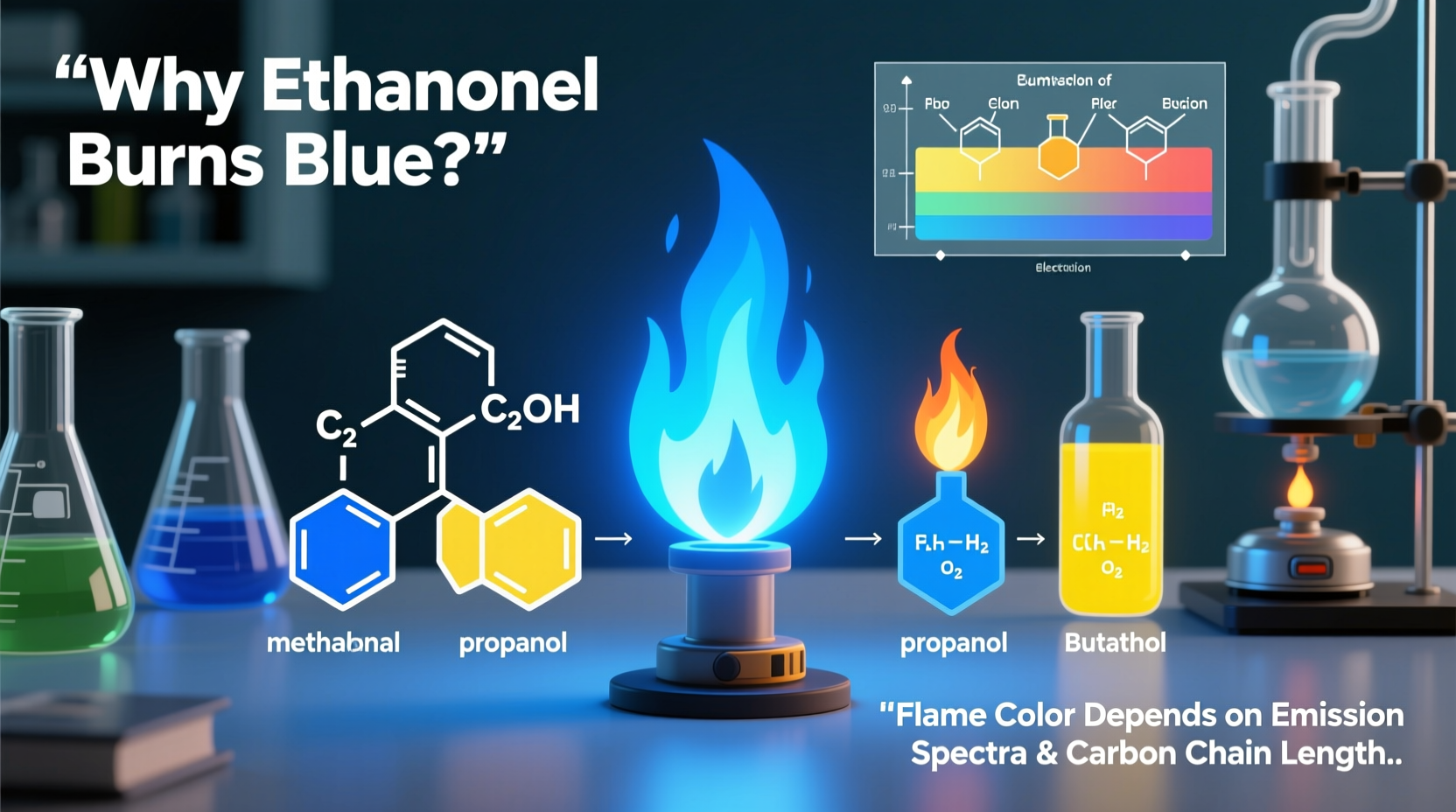
Flame color arises from two primary mechanisms: incandescence (thermal radiation from hot particles) and atomic/molecular emission (light released when excited electrons return to lower energy states). In hydrocarbon and alcohol flames, the dominant contributor to visible color is incandescence from microscopic soot particles—carbon clusters heated to 1000–1500°C. When these particles are abundant and hot enough, they glow yellow-orange—the familiar “luminous flame.” A blue flame signals their near absence. That doesn’t mean no heat; rather, it indicates near-complete oxidation: carbon atoms are fully converted to CO₂ before forming solid particulates.
For any fuel to burn blue, three conditions must align: (1) rapid and thorough mixing with oxygen prior to ignition, (2) sufficient temperature to sustain fast oxidation kinetics, and (3) molecular structure that resists pyrolytic breakdown into free carbon fragments. Ethanol (CH₃CH₂OH) meets all three exceptionally well. Its short two-carbon chain, strong C–O bond, and low tendency toward dehydrogenation or C–C scission under flame conditions allow oxidation pathways that favor direct conversion to formaldehyde, then formic acid, then CO₂ and H₂O—bypassing soot precursors like acetylene or polycyclic aromatics.
Carbon Chain Length: The Critical Threshold
As alcohol chain length increases, the likelihood of incomplete combustion—and thus yellow flame emission—rises sharply. This isn’t linear, but follows a clear inflection point around two to three carbons.
| Alcohol | Chemical Formula | Carbon Atoms | Typical Flame Appearance (in controlled lab burner) | Primary Reason for Color Shift |
|---|---|---|---|---|
| Ethanol | C₂H₅OH | 2 | Steady, transparent blue; faint violet base | Optimal C:H:O ratio (1:3:0.5) and low soot propensity |
| Methanol | CH₃OH | 1 | Pale blue, but often with faint yellow halo or instability | Low boiling point (65°C) causes excessive vaporization → poor air-fuel mixing; weak C–H bonds promote methyl radical formation and formaldehyde accumulation |
| 1-Propanol | C₃H₇OH | 3 | Blue base with persistent yellow tip | C–C bond cleavage yields ethyl + methyl radicals; propylene formation leads to soot precursors |
| 2-Propanol (Isopropanol) | (CH₃)₂CHOH | 3 | Bright yellow-orange, luminous, smoky | Branching promotes acetone intermediate; rapid dehydration to propene → high soot yield |
| 1-Butanol | C₄H₉OH | 4 | Strongly yellow, smoky, unstable flame | Multiple C–C cleavage paths; butadiene and benzene precursors form readily above 700°C |
Note the paradox with methanol: despite having the shortest chain, it rarely produces a *cleaner* blue than ethanol. Its extreme volatility disrupts laminar flow in standard burners, causing local fuel-rich zones where carbon condenses before full oxidation. Ethanol’s higher boiling point (78°C) allows more controlled vapor release and better premixing—making it uniquely suited for stable blue-flame applications.
Oxygen Availability and Burner Design Matter as Much as Chemistry
A common misconception is that flame color is an intrinsic property of the fuel alone. In reality, it’s an emergent property of the *system*: fuel chemistry + delivery method + oxidizer supply + thermal environment. A Bunsen burner with adjustable air vent demonstrates this perfectly. With the air hole closed, even ethanol burns yellow—because insufficient oxygen forces pyrolysis and soot formation. Open the air hole fully, and the flame snaps blue, sharp, and quiet. Methanol, by contrast, remains prone to flickering and yellow tips even with ample air—its vapor pressure overwhelms the mixing geometry.
Professional spirit burners used in culinary or laboratory settings are engineered for ethanol: wick porosity, fuel reservoir depth, and chimney height are calibrated to maintain optimal vaporization rate and air entrainment. Substituting another alcohol without recalibrating the system guarantees suboptimal combustion. This explains why ethanol dominates in applications demanding clean, controllable heat—like sterilizing inoculating loops or finishing crème brûlée—while methanol is avoided despite its higher energy density per gram.
Tip: Never assume alcohol substitution is safe in a flame-based device. Even small changes in carbon chain or branching alter vapor pressure, flash point, and sooting tendency—potentially creating hazardous CO buildup or unpredictable flare-ups.Real-World Case Study: The Distillery Lab Incident
In early 2022, a craft distillery in Oregon installed new benchtop alcoholometers and calibration burners for proof verification. Their SOP specified 95% ethanol, but during a supply shortage, a technician substituted 99% isopropanol—reasoning “it’s still alcohol, right?” The burner, designed for ethanol’s vaporization profile, produced an unexpectedly large, yellow-orange flame with visible smoke. Within minutes, CO alarms triggered in the lab. Investigation revealed that isopropanol’s dehydration to propene (at ~200°C on hot metal surfaces) generated significant carbon monoxide alongside soot. Crucially, the burner’s ceramic mesh, optimized for ethanol’s clean oxidation, trapped propene intermediates, creating localized reducing zones. Switching back to ethanol restored silent, blue combustion—and CO levels dropped to zero within 90 seconds. This incident underscores that flame behavior is not interchangeable—even among structurally similar molecules.
Step-by-Step: How to Observe and Compare Alcohol Flames Safely
Flame comparison is instructive—but only with strict safety protocols. Follow this sequence precisely:
- Prepare in a certified fume hood with CO monitor active and fire extinguisher (Class B) immediately accessible.
- Select pure, anhydrous samples: 99.8% ethanol, 99.5% methanol, 99% 1-propanol, 99% 2-propanol. Avoid denatured alcohols containing dyes or bitterants (e.g., Bitrex), which distort flame color.
- Use identical equipment: A calibrated micro-burner with fixed air intake (e.g., Teclu burner) and stainless steel wick—not cotton or fiberglass, which introduce sodium emission (yellow).
- Standardize conditions: Ambient temperature 20–25°C; no drafts; pre-warm burner base to 40°C to stabilize vapor pressure across trials.
- Observe systematically: Note flame height, stability, presence of yellow tip, smoke production, and sound (blue flames are nearly silent; yellow flames hiss). Record with a spectrometer if available—the blue peak centers at 430 nm (CH* radical emission), while yellow arises from 580–620 nm (incandescent soot).
This method reveals ethanol’s uniqueness: consistent 2.5 cm blue cone, no flicker, no detectable CO at 10 cm distance. All others deviate measurably—proving the phenomenon is reproducible, physical, and chemically grounded.
Expert Insight: What Combustion Scientists Emphasize
“The blue flame of ethanol isn’t magic—it’s stoichiometric precision meeting favorable kinetics. Its O:H ratio allows rapid OH radical generation, which scavenges soot precursors like C₂H₂ before they polymerize. Longer-chain alcohols produce more C₂ and C₃ fragments per molecule, overwhelming that cleanup capacity. That’s why ethanol remains the gold standard for clean alcohol combustion—even though methanol has a higher oxygen content.”
— Dr. Lena Torres, Combustion Chemist, Sandia National Laboratories
“In practical terms, if your flame isn’t blue with ethanol, your system is flawed—clogged wick, contaminated fuel, or insufficient air. But if you get blue with anything else, you’re likely observing incomplete data: low resolution, ambient light interference, or uncalibrated observation. True blue requires both molecular suitability and engineering alignment.”
— Prof. Arjun Mehta, Chemical Engineering, MIT
FAQ
Why does rubbing alcohol (isopropanol) burn yellow while vodka (40% ethanol) burns blue?
Vodka’s flame appears blue because the dominant combustible component is ethanol—and water content actually helps suppress soot by cooling the flame zone and promoting steam reforming of carbon intermediates. Isopropanol, even at 99% purity, undergoes rapid catalytic dehydration on hot surfaces to form propene, a known soot precursor. Its branched structure also hinders efficient oxidation pathways.
Can I make methanol burn blue by using a special burner?
Yes—but only under highly controlled conditions: microgravity environments (like ISS experiments), porous-plug burners with nanoscale air channels, or laser-ignited premixed laminar flames. In everyday settings, methanol’s volatility defeats conventional burner designs. Its ideal air-to-fuel ratio is 6.5:1 by volume; ethanol’s is 9.0:1. That narrower window makes methanol far less forgiving.
Does the blue color mean ethanol is ‘safer’ to burn?
Not inherently safer—just cleaner. Ethanol’s blue flame produces negligible soot but still generates CO if oxygen-starved. Its main safety advantage is predictability: stable ignition, consistent heat output, and minimal residue. Methanol’s invisible flame (in low-light conditions) and higher toxicity (via skin absorption or inhalation) pose greater practical hazards than its occasional yellow tinge.
Conclusion
Ethanol’s blue flame is not a curiosity—it’s a visible signature of chemical elegance. Its two-carbon architecture, balanced oxygen content, and favorable vapor pressure converge to enable near-perfect combustion where carbon atoms are fully escorted to CO₂ without detouring through soot. Other alcohols diverge from this path not because they’re “worse,” but because their structures prioritize different properties: methanol’s hydrogen bonding suits it for solvent applications; isopropanol’s branching delivers superior disinfection; butanol’s chain length makes it a promising biofuel precursor. Recognizing why ethanol burns blue deepens appreciation for the precision of molecular design—and warns against oversimplifying complex systems. Whether you’re calibrating a lab instrument, selecting fuel for a portable stove, or troubleshooting a culinary torch, understanding this interplay of structure, kinetics, and engineering prevents assumptions that could compromise safety, accuracy, or performance.
💬 Observed a surprising flame behavior with an alcohol not listed here? Share your controlled observation—including concentration, burner type, and ambient conditions—in the comments. Real-world data helps refine our understanding of combustion chemistry.