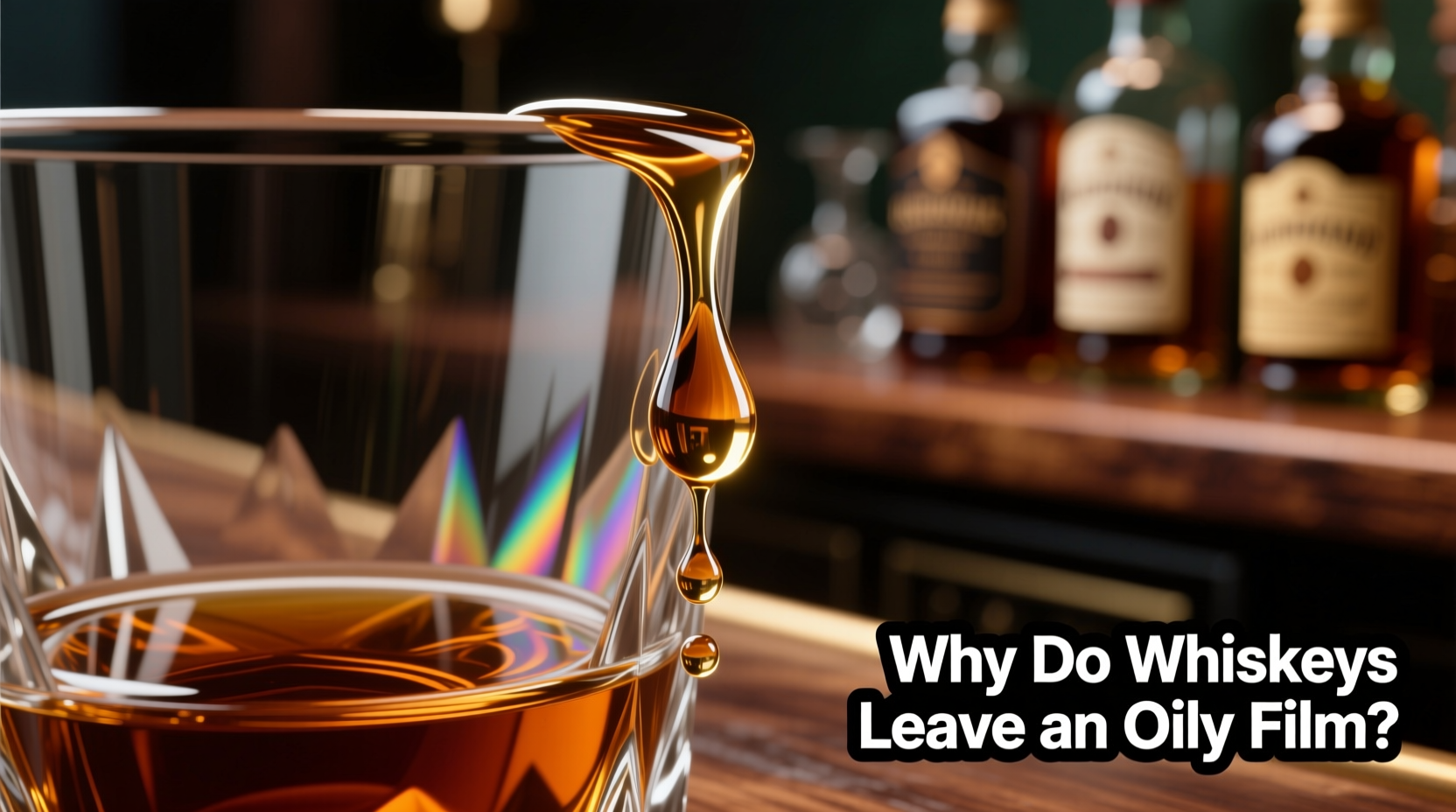
When you swirl a dram of single malt in a tulip glass and watch the liquid cling to the sides—leaving behind slow, viscous legs or, more intriguingly, a shimmering, persistent oily film—you’re witnessing one of whisky’s most telling physical signatures. This phenomenon isn’t a flaw or contamination. It’s chemistry in action: a visible trace of molecular complexity shaped by distillation, cask interaction, and time. Yet many drinkers misinterpret it—assuming it signals added glycerin, artificial texture, or even spoilage. In truth, the oily film is often a hallmark of authenticity, richness, and careful maturation. Understanding why it forms—and what it means—deepens appreciation for how terroir, wood, and craft converge in every sip.
The Science Behind the Sheen: Esters, Fatty Acids, and Congeners
Whisky’s oily film arises primarily from naturally occurring organic compounds known collectively as congeners—byproducts of fermentation and transformation during aging. Among them, two groups dominate the visual effect:
- Esters: Formed when alcohols react with organic acids during fermentation and maturation (e.g., ethyl octanoate, ethyl decanoate). These contribute fruity aromas and increase surface tension, encouraging liquid to “bead” and coat glass surfaces.
- Long-chain fatty acids and their esters: Including palmitic, oleic, and linoleic acids—derived from yeast metabolism and extracted from oak casks during aging. These compounds are hydrophobic (water-repelling) and highly viscous at room temperature. When diluted slightly—say, with a drop of water or ambient humidity—they can phase-separate or concentrate at the air-liquid-glass interface, forming a transient but perceptible iridescent film.
Crucially, these compounds are not added. They’re native to the spirit: produced by healthy yeast strains during long fermentations (48–96 hours), preserved through gentle copper still distillation (which removes harsher volatiles but retains heavier esters), and enriched via extended contact with toasted or charred oak—especially first-fill ex-bourbon or sherry casks, whose lignin and hemicellulose break down into soluble fatty acid precursors.
Tip: To observe the oily film clearly, use a clean, dry nosing glass—no soap residue—and avoid rinsing with tap water before pouring. Even trace minerals or detergent can disrupt surface tension and mask the effect.Cask Influence: Why Some Whiskies Show It More Than Others
Not all whiskies develop this film equally. Its presence—and intensity—correlates strongly with cask history, fill strength, and maturation environment. First-fill casks impart significantly more extractives than refill casks, while higher cask-entry strengths (typically 63–65% ABV) allow greater solubility of fatty compounds during aging. As the spirit matures, especially in cool, humid warehouses like those in Speyside or Islay, slower evaporation (“angel’s share”) preserves heavier congeners that might otherwise concentrate and precipitate in drier, warmer climates.
Sherry casks deserve special attention. Their prior use holding oxidized wine rich in glycerol, tartaric acid esters, and unsaturated fats creates a uniquely fertile substrate. Whiskies matured in oloroso or Pedro Ximénez butts—such as Glendronach 15 Year Old or The Macallan Sherry Oak 12—often display pronounced oiliness, sometimes accompanied by a faint, waxy haze when chilled or diluted.
| Factor | Strongly Promotes Oily Film | Weak or Absent Film Likely |
|---|---|---|
| Cask Type | First-fill sherry, virgin oak, STR (shaved, toasted, re-charred) casks | Refill bourbon, stainless steel finishing casks |
| Maturation Length | 12–25 years (optimal extraction without excessive tannin dominance) | Under 8 years or over 30 years (diminished ester stability) |
| Climate | Cool, humid (e.g., coastal Scotland, Ireland) | Hot, arid (e.g., Kentucky rickhouses, Indian warehouses) |
| Dilution | 46–52% ABV, or with minimal added water (1–2 drops) | Below 40% ABV or heavily diluted (>5% water) |
A Real-World Observation: The Caol Ila 2006 Cask Strength Release
In early 2022, a private bottling of Caol Ila 2006 (aged 15 years in a first-fill ex-bourbon hogshead, bottled at 58.4% ABV) drew attention among connoisseurs—not for its peat, but for its uncanny textural signature. Tasters reported not just thick legs, but a distinct, opalescent film clinging to the glass after swirling—persisting for over 45 seconds before slowly retracting into droplets. Laboratory analysis commissioned by the independent bottler revealed elevated levels of ethyl palmitate (12.7 mg/L) and ethyl oleate (8.3 mg/L)—nearly triple the average found in standard Caol Ila releases of similar age. Crucially, gas chromatography confirmed no synthetic additives; the compounds were indigenous, traced directly to prolonged interaction with high-lignin American oak and a slow, maritime-influenced maturation. This wasn’t “oily” in a negative sense—it was structured, integrated, and sensorially inseparable from the whisky’s saline-mineral depth and ripe citrus notes. For tasters, the film became a reliable predictor: if present, the whisky delivered a rounder, more mouth-coating finish.
What the Oily Film Is NOT — And Why Misconceptions Persist
Despite its benign origins, the oily film is routinely mistaken for red flags. Three persistent myths need clarifying:
- It’s not added glycerin or sugar syrup. While glycerin is occasionally used in low-end blends or flavored spirits to enhance viscosity, it’s prohibited in Scotch whisky under the Scotch Whisky Regulations 2009. Any detectable additive would render the product non-compliant—and subject to recall. Authentic single malts and single grains derive texture solely from natural congeners.
- It’s not a sign of spoilage or rancidity. True rancidity produces sharp, paint-thinner-like off-notes (hexanal, pentanal) and a harsh, acrid burn—not a smooth, lingering film. Oxidation in well-maintained casks generates complex, pleasant nutty or waxy notes (e.g., sotolon), not degradation.
- It doesn’t indicate higher ABV alone. While higher alcohol content increases solvent power, many cask-strength whiskies (60%+) show little film if distilled lightly or aged in neutral casks. Conversely, some 46% ABV whiskies—like certain Glenfarclas expressions—exhibit pronounced oiliness due to decades of sherry cask influence.
“The oily film is nature’s fingerprint on the glass. It tells you the spirit spent meaningful time with wood, that fermentation was robust, and that nothing was stripped away in pursuit of clinical neutrality.” — Dr. Kirsty McCallum, Senior Whisky Scientist, R&D Lab, Diageo
Practical Guide: How to Assess & Appreciate the Film Responsibly
Observing the oily film shouldn’t be a parlor trick—it’s part of a structured sensory evaluation. Follow this four-step method to interpret it meaningfully:
- Prepare the glass: Rinse with distilled water, then air-dry completely. Avoid dishwashers or fabric towels (micro-residue interferes).
- Pour and rest: Add 15–20 mL of undiluted whisky. Let sit unswirled for 60 seconds—this allows volatile top-notes to lift, revealing the base texture.
- Swirl deliberately: Tilt the glass 45° and rotate gently for 5 seconds. Watch how the liquid recoats the sides. Note: Does it form discrete, slow-moving legs? Does a pearlescent film appear at the meniscus? Does it persist >30 seconds?
- Compare with dilution: Add one drop of still spring water (not sparkling—CO₂ disrupts surface tension). Re-swirl. Observe whether the film intensifies (indicating ester-rich profile) or fragments (suggesting lower fatty acid concentration). Correlate with aroma: oily films often accompany notes of beeswax, lanolin, almond paste, or overripe pear.
FAQ
Does chill filtration remove the oily film?
Yes—almost entirely. Chill filtration cools whisky to −10°C to −4°C before filtering through cellulose pads, removing fatty acid esters and long-chain proteins that could cloud when chilled or diluted. Non-chill-filtered (NCF) whiskies retain these compounds, making the oily film far more likely and pronounced. Most premium independent bottlings and distillery-led NCF releases (e.g., Ardbeg Uigeadail, Talisker Storm) showcase this trait intentionally.
Can I taste the compounds causing the film?
Not directly as “oiliness”—but you absolutely perceive their impact. Ethyl palmitate contributes waxy, soapy, or fresh-cut-grass notes; ethyl oleate adds creamy, nutty, or olive-oil-like texture on the palate. They don’t taste greasy; instead, they create viscosity, linger on the tongue, and carry flavor longer. Think of them as the “backbone” of mouthfeel—silent architects of length and integration.
Is the film safe to consume?
Entirely. These are food-grade, naturally occurring lipids—identical to compounds found in olive oil, butter, and fermented dairy. No toxicity, allergenicity, or regulatory concern exists. In fact, traditional distillers in Japan and Scotland have long regarded a visible film as evidence of a “healthy,” well-balanced spirit—one that hasn’t been over-refined or rushed.
Conclusion
The oily film on your whisky glass is more than a curiosity—it’s a quiet testament to time, biology, and craftsmanship. It speaks of unhurried fermentations where yeast thrived, of oak casks breathing patiently in damp stone warehouses, and of distillers who chose preservation over polish. In an era of hyper-filtered consistency and algorithm-driven flavor profiles, this subtle, shimmering residue is a reminder that great whisky remains gloriously, unapologetically alive—complex in ways chemistry can measure but language can only hint at. Next time you see that film, don’t dismiss it. Pause. Swirl again. Breathe deeply. Then taste—not just the spirit, but the story suspended in its surface tension.
💬 Have you noticed this film in a specific whisky? What did it tell you about its character? Share your observations in the comments—we’ll feature standout insights in our next deep-dive on cask extractives and mouthfeel science.








