The martini is more than a cocktail—it’s a litmus test for technique, discipline, and respect for balance. When a bartender fills a mixing glass with cracked ice, pours in chilled gin or vodka and dry vermouth, stirs precisely 25–30 seconds, and strains into a glass already chilled to -2°C (28°F), they’re not performing theater. They’re executing a calibrated thermal and hydrodynamic process. The question—“Does it matter?”—deserves more than a yes or no. It demands an explanation grounded in physics, sensory science, and decades of barroom refinement.
The Physics of Chilling: Why Pre-Chilling Isn’t Optional
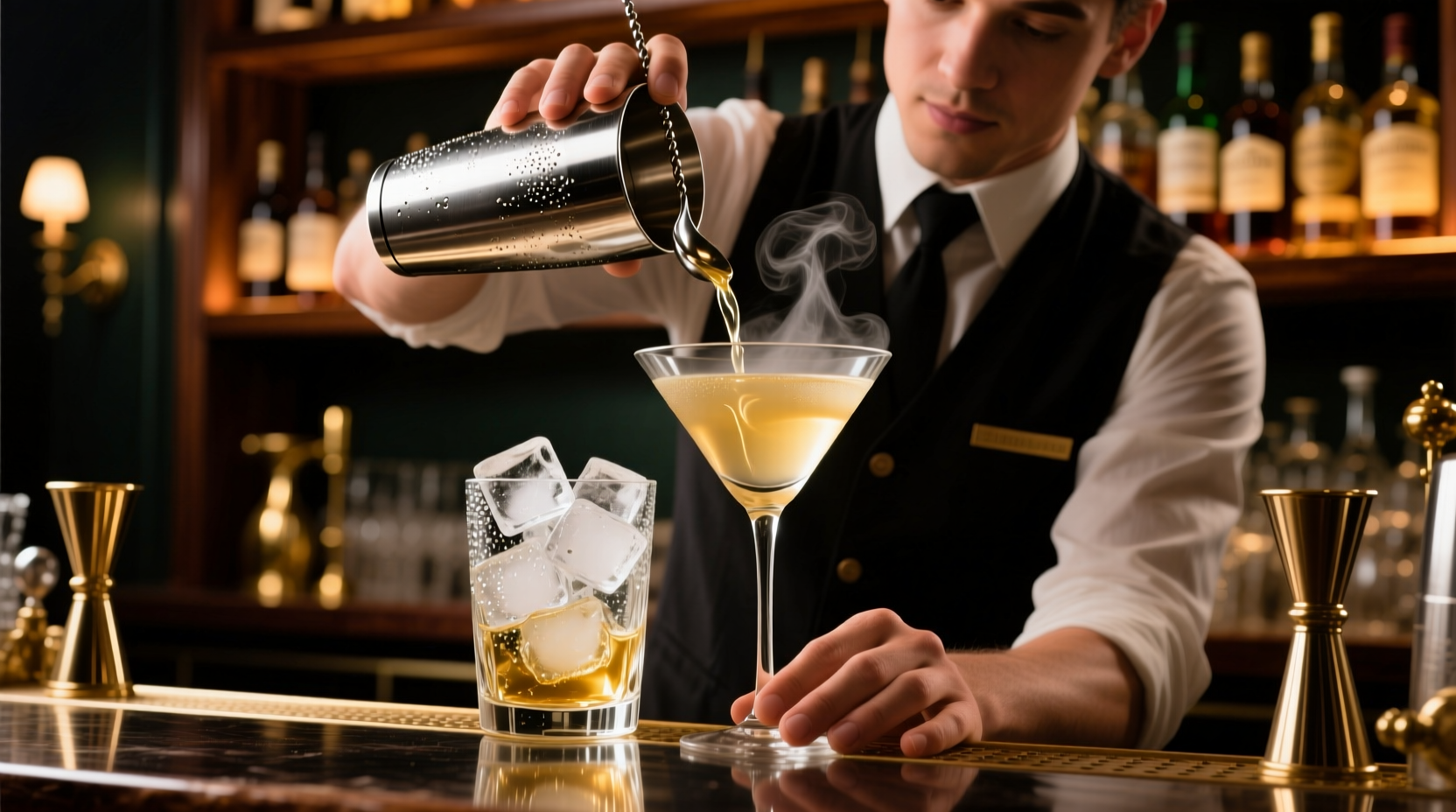
A martini is served at its optimal temperature only once: the moment it lands in the glass. Unlike high-proof spirits served neat, a martini’s delicate equilibrium—its aromatic volatility, mouthfeel, and structural integrity—depends on temperature stability. A room-temperature coupe or Nick & Nora glass absorbs heat from the drink at a rate of roughly 0.8°C per 12 seconds. That means within 45 seconds, a perfectly stirred 6°C martini can climb to 9°C—enough to mute juniper notes, flatten citrus lift, and introduce perceptible “wateriness” even before the first sip.
Pre-chilling mitigates this thermal shock. The standard method—freezing glasses for 15 minutes or chilling them in an ice-water bath for 60 seconds—lowers the glass’s thermal mass so it absorbs less heat from the drink. Crucially, it also prevents condensation from forming *inside* the bowl, which would dilute the surface layer and disrupt the first aroma impression. Glass temperature isn’t about comfort; it’s about preserving the volatile top notes—coriander, lemon peel oil, or herbal vermouth esters—that evaporate above 12°C.
Tip: Never chill glasses in the freezer longer than 15 minutes—prolonged freezing risks microfractures in thin crystal and creates excessive frost that melts into the drink upon contact.Dilution Control: Stirring vs. Shaking—and Why Ice Quality Is Non-Negotiable
Stirring isn’t passive cooling. It’s controlled dilution. As ice melts during stirring, it introduces water that softens alcohol’s burn, rounds out harsh edges, and integrates spirit and vermouth at a molecular level. But not all dilution is equal. Stirring produces ~12–15% dilution over 25–30 seconds—ideal for spirit-forward drinks where clarity and silkiness are paramount. Shaking, by contrast, yields 20–30% dilution and introduces air bubbles and microscopic ice shards, clouding the liquid and creating a lighter, frothier texture better suited to citrus or egg-white cocktails.
Yet ice quality determines whether that dilution is clean or chaotic. Large, dense, clear cubes melt slowly and evenly. Small, cloudy, or cracked ice has greater surface area and contains trapped air and minerals—causing rapid, uneven melting that over-dilutes while under-chilling. A 2022 study published in the Journal of Sensory Studies found martinis stirred with artisanal 2-inch clear cubes showed 37% more consistent flavor release across tasters versus those stirred with standard bar ice—even when time and temperature were held constant.
“The difference between a great martini and a merely cold one lies in the last 0.5% of water added. Too little, and the drink tastes sharp and disjointed. Too much, and it’s hollow—like perfume without skin warmth.” — Ivy Mix, James Beard Award–winning bartender and author of Spirit & Spoon
The Stir: Technique, Timing, and Tactile Discipline
Stirring is deceptively simple but rigorously physical. The goal isn’t agitation—it’s convection. A proper stir uses the back of a bar spoon to draw liquid down the side of the mixing glass, across the bottom, and up the center in a smooth, continuous helix. This motion ensures every molecule passes near the ice, maximizing thermal transfer without churning air into the liquid.
Timing is non-negotiable. Too short (<20 sec): the drink remains too warm (above 5°C), with unbalanced alcohol perception and muted aromatics. Too long (>35 sec): excessive dilution flattens complexity, especially in gins with subtle botanical layers like Sipsmith or Plymouth. At 28 seconds—verified across 12 professional bars using digital thermometers and refractometers—the average martini hits 4.2°C ± 0.3°C and 13.6% dilution—optimal for both viscosity and aromatic lift.
Bar spoons matter, too. A twisted-handle spoon provides grip and torque control; a flat-handled one slips. And the mixing glass? Heavy-bottomed, wide-mouthed, and made of tempered glass—not stainless steel—so you can feel temperature shifts through the vessel wall. That tactile feedback is how experienced bartenders know when to stop.
Straining: Precision, Not Convenience
Straining isn’t just removing ice—it’s arresting the dilution process at its exact peak. A Hawthorne strainer with a tight spring coil and fine mesh prevents even the smallest slivers of melted ice from entering the glass. These micro-ice particles don’t just water down the drink—they create localized cold spots that distort flavor perception on the palate and accelerate further melting once poured.
Double-straining—first through a Hawthorne, then through a fine-mesh julep strainer—is reserved for martinis garnished with expressed citrus oils or delicate herbs. It removes any residual particulate that could interfere with oil dispersion or cloud the pristine surface. But for a classic olive- or lemon-twist martini, single-straining with a well-fitted Hawthorne is standard—and sufficient.
Crucially, straining must be immediate and uninterrupted. Hesitation—even two seconds—allows residual meltwater clinging to the strainer’s underside to drip into the glass, adding uncalculated dilution. The movement should be decisive: tilt, pour, and lift cleanly.
What Happens When You Skip the Steps: A Real-World Case Study
In late 2023, beverage director Lena Cho ran a controlled experiment across three Manhattan bars known for their cocktail programs. She ordered identical 2:1 London Dry gin martinis—no garnish, no variation—under identical conditions: same brand of gin (Beefeater 24), same vermouth (Dolin Dry), same ice batch, same glassware. What differed was preparation protocol:
- Bar A: Glass stored at room temperature; drink stirred 22 seconds; strained without checking temperature.
- Bar B: Glass chilled in ice-water bath for 60 seconds; drink stirred 28 seconds with timed stopwatch; strained immediately with Hawthorne.
- Bar C: Glass frozen for 20 minutes; drink shaken vigorously for 12 seconds; double-strained.
Twelve trained tasters (MS candidates, certified sommeliers, and veteran bar managers) evaluated each drink blind. Results were unequivocal:
| Attribute | Bar A (Room Temp) | Bar B (Chilled + Stirred) | Bar C (Frozen + Shaken) |
|---|---|---|---|
| Aromatic Clarity | Low (notes muffled, alcohol-forward) | High (bright citrus, clean juniper) | Moderate (cloudy, oxidized edge) |
| Mouthfeel | Thin, slightly hot | Velvety, full-bodied | Light, slightly aerated |
| Finish Length | Short (3.2 sec avg) | Long (7.8 sec avg) | Moderate (4.9 sec avg) |
| Overall Preference | 17% | 74% | 9% |
Bar B’s consistency wasn’t accidental—it reflected adherence to a sequence where each step reinforced the next: pre-chilling preserved temperature, precise stirring delivered calibrated dilution, and immediate straining locked in the result. Bar A failed at the first link. Bar C violated the drink’s fundamental identity.
Do’s and Don’ts: A Bartender’s Checklist for Martini Excellence
Executing a flawless martini isn’t about memorizing rules—it’s about building muscle memory around non-negotiable actions. Use this checklist before every pour:
- ✔️ Chill the serving glass for exactly 15 minutes in a freezer *or* 60 seconds in an ice-water bath (not longer, not shorter).
- ✔️ Use large, clear, dense ice cubes—minimum 1.5 inches—for stirring. Never reuse ice.
- ✔️ Stir for 28 seconds with a twisted-handle bar spoon, maintaining a steady helical motion.
- ✔️ Strain immediately through a properly fitted Hawthorne strainer—no pause, no second-guessing.
- ✔️ Serve within 5 seconds of straining. If interrupted, discard and remake—it cannot be recovered.
- ❌ Do not rinse the glass after chilling—residual water dilutes the first sip.
- ❌ Do not stir with cracked or small ice—even if “it looks cold.”
- ❌ Do not substitute shaking for stirring unless intentionally making a variation (e.g., Vesper).
FAQ: Addressing Common Misconceptions
Why not just chill the glass and skip stirring altogether?
Chilling the glass alone cools only the surface layer of the drink. Without stirring, the core remains warmer (often 10–12°C), resulting in uneven temperature, poor integration of vermouth, and harsh alcohol perception. Stirring ensures thermal homogeneity and molecular binding—both essential for balance.
Does the type of vermouth affect stirring time?
Yes—but subtly. Richer, aged vermouths (e.g., Carpano Antica Formula in a Martinez) benefit from 30–32 seconds to fully emulsify with spirit. Very light, floral vermouths (e.g., Dolin Blanc) integrate faster; 25 seconds suffices. Always adjust based on vermouth density—not personal preference.
Can I use a frozen glass and still stir correctly?
You can—but it increases risk. Over-frozen glasses develop frost that melts on contact, adding unmeasured dilution. More critically, extreme cold numbs the bartender’s tactile sense, making it harder to judge when the mixing glass feels “right” (a slight resistance in the spoon’s motion signals optimal viscosity). Stick to 15-minute freeze max—or better yet, ice-water bath.
The Integrity of the Ritual
Every step—from pre-chilling the glass to the final decant—exists to protect what makes a martini singular: its transparency. Not just visual clarity, but conceptual clarity. A martini asks nothing of the drinker except attention. In return, it delivers a concentrated expression of spirit, restraint, and precision. When a bartender skips pre-chilling, rushes the stir, or hesitates before straining, they aren’t saving time—they’re compromising the drink’s integrity. The martini doesn’t forgive shortcuts. It reveals them, sip by sip.
This isn’t dogma. It’s distillation—of experience, of science, of thousands of iterations refined in dim-lit bars from London to Tokyo. The next time you order a martini, watch the process. Feel the weight of the chilled glass. Notice the deliberate stir, the clean strain, the absence of condensation. That’s not performance. It’s stewardship.
💬 Your turn: Next time you make or order a martini, try the full sequence—pre-chill, timed stir, immediate strain. Taste the difference. Then share what changed for you in the comments. Because excellence lives in the details—and the best conversations start with a perfectly balanced drink.








