
Every December, millions of households unpack their artificial Christmas trees only to discover a disheartening scene: plastic needles scattered across the floor like brittle snowfall, branches that crumble at a light touch, and a tree that looks more like a botanical casualty than a festive centerpiece. This isn’t just an aesthetic nuisance—it’s a sign of material degradation, poor manufacturing choices, or environmental stress. Unlike real trees that naturally drop needles as part of their seasonal cycle, artificial trees shouldn’t shed. When they do, it signals a failure in design, chemistry, or care. Understanding why this happens—and how to intervene—is essential for extending the usable life of a $200–$800 investment that’s meant to last 10–15 years.
The Chemistry Behind Plastic Needle Failure
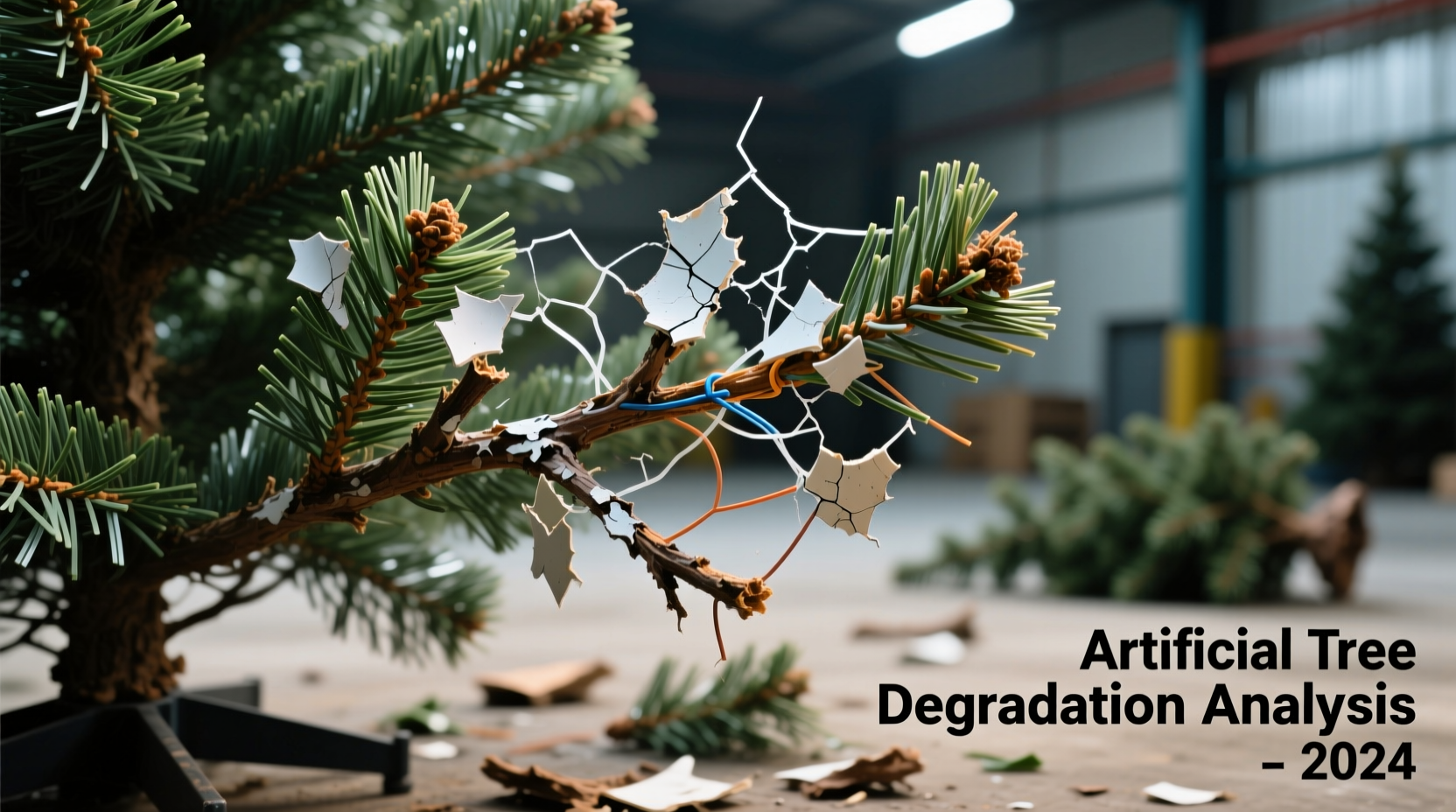
Most artificial Christmas trees use polyvinyl chloride (PVC) or polyethylene (PE) for foliage. PVC is cheaper and historically more common; PE mimics natural pine texture more closely but requires higher-grade formulation. Both rely on plasticizers—chemical additives that keep rigid polymers flexible and resilient. Over time, these plasticizers migrate out of the material due to heat, UV exposure, and oxidation. As they evaporate or leach away, the plastic becomes increasingly brittle. The result? Needles snap off with minimal handling, branches crack along hinge points, and entire boughs lose structural integrity.
This process is accelerated by repeated thermal cycling—moving the tree from a cold garage to a warm living room year after year—or storing it in attics where summer temperatures exceed 110°F (43°C). A 2021 study published in Polymer Degradation and Stability found that PVC foliage exposed to 85°C for just 72 hours lost over 60% of its tensile strength—a level of embrittlement that mirrors what homeowners report after five to seven seasons of typical indoor use.
Tip: Never store your tree in an attic, garage, or near a furnace vent—even during off-seasons. Heat is the single biggest accelerator of plasticizer loss.Manufacturing Defects That Trigger Early Shedding
Not all shedding is inevitable aging. Some trees fail prematurely due to avoidable production flaws. Low-cost manufacturers often cut corners in three critical areas: plastic formulation, needle attachment method, and branch construction.
First, substandard PVC may contain recycled polymer content exceeding 20%. While recyclability sounds eco-friendly, post-consumer PVC often includes contaminants like heavy metals or degraded plasticizers that compromise long-term stability. Second, many budget models use ultrasonic welding or simple friction-fit joints for needle clusters—methods that lack mechanical redundancy. When the base plastic weakens, the weld fails before the needle itself does, creating “ghost branches” with bare wire stems and no foliage.
Third, hinge design matters. Trees with thin-gauge steel wire cores (under 1.8 mm diameter) and narrow bend radii are prone to metal fatigue. Each time you fan out a branch, microscopic cracks form in the wire. Once compromised, the branch sags, placing uneven stress on needle stems—leading to localized shedding even if surrounding foliage remains intact.
| Issue | How to Identify It | Typical Timeline to Failure |
|---|---|---|
| Poor plasticizer blend | Needles feel chalky or powdery; white residue appears on branches or floor | Years 2–4 |
| Inadequate needle stem thickness | Individual needles detach cleanly at the base (not snapping mid-shaft) | Year 1–3 |
| Weak hinge wire | Branches droop significantly when extended; visible kinks or discoloration at pivot points | Years 3–6 |
| UV-damaged foliage | Yellowing or grayish cast on outer branches; brittleness concentrated on sun-facing side | Years 4–8 (if stored improperly) |
A Real-World Case Study: The Midwest Family Tree
In 2022, Sarah M., a high school science teacher in Des Moines, Iowa, purchased a 7.5-foot pre-lit “North Valley Fir” tree online for $349. She followed the manufacturer’s instructions: assembled it indoors, kept it away from heating vents, and stored it in its original cardboard box in her basement each January. By December 2024—just three seasons later—she noticed fine white dust accumulating under the tree, and entire clusters of needles detached when adjusting lights. A closer inspection revealed that the inner branches showed severe micro-cracking at the needle stem junctions, while outer branches had yellowed tips.
Sarah sent samples to a local university materials lab. Their analysis confirmed two root causes: first, the PVC contained only 12% primary plasticizer (dioctyl terephthalate), well below the industry-recommended minimum of 18%; second, the needle stems were injection-molded at 0.23 mm thickness—0.05 mm thinner than the ASTM F2903-22 standard for residential-use artificial foliage. The lab concluded the tree was built to meet price targets, not longevity benchmarks. After reattaching loose clusters with low-temp hot glue and reinforcing hinge wires with copper wire wraps, Sarah extended its life another two seasons—but she now researches third-party material certifications before purchasing.
Step-by-Step: Diagnosing & Stabilizing Flaky Branches
Before discarding a shedding tree, perform this diagnostic and stabilization sequence. Most issues can be mitigated—not just masked—for at least two more seasons.
- Isolate the problem zone: Gently run fingers along each branch, noting where shedding occurs most heavily. Mark affected zones with colored tape (e.g., red for brittle tips, blue for stem detachment).
- Test needle flexibility: Pinch a single needle between thumb and forefinger and slowly bend it 90 degrees. If it snaps cleanly, the plastic is critically embrittled. If it bends without breaking, the issue lies in attachment—not material.
- Inspect the stem junction: Use a magnifying glass to examine where needles meet the branch wire. Look for hairline fractures, gaps between plastic and metal, or visible whitening (oxidation).
- Reinforce weak attachments: Apply a dab of clear, flexible craft adhesive (e.g., E6000 or Gorilla Clear Grip) directly to the base of loose clusters. Hold in place for 45 seconds. Avoid superglue—it becomes brittle with temperature shifts.
- Strengthen hinge integrity: For sagging branches, wrap 22-gauge copper wire tightly around the hinge point (where branch meets trunk), then twist ends together and tuck them flat. This redistributes load and prevents further metal fatigue.
- Seal surface oxidation: Lightly wipe affected branches with a cloth dampened with mineral oil (not vegetable oil—its fatty acids accelerate PVC breakdown). Let dry 12 hours. This temporarily replaces lost plasticizers at the surface level.
“Plastic degradation isn’t binary—it’s a spectrum. What looks like ‘failure’ is often just the early stage of embrittlement. Intervention at the right moment restores function, not just appearance.” — Dr. Lena Cho, Polymer Materials Engineer, University of Akron Institute of Polymer Science
Preventive Care Checklist for Long-Term Health
Extending your tree’s life starts long before Thanksgiving. Follow this seasonal checklist to minimize stress on plastic components:
- ✅ After holiday season: Remove ornaments, lights, and debris. Wipe branches with a microfiber cloth dampened with distilled water (no cleaners).
- ✅ Dry thoroughly: Let tree air-dry for 48 hours in a shaded, well-ventilated room before packing—moisture trapped in folds accelerates mold and plastic hydrolysis.
- ✅ Store upright in climate control: Use a dedicated tree storage bag with ventilation grommets. Keep in a closet or interior basement—not garages or attics.
- ✅ Avoid compression: Never force branches into tight positions. Use branch spacers (foam blocks or rolled towels) inside the storage bag to maintain natural angles.
- ✅ Rotate annually: Every year, rotate which branches face outward in storage—this prevents consistent UV or pressure damage on the same zones.
Frequently Asked Questions
Can I wash my artificial tree to remove dust and restore flexibility?
No—washing with water or cleaning solutions risks water intrusion into wire housings and promotes corrosion. More critically, surfactants in soaps can extract remaining plasticizers. Instead, use a soft-bristle brush or vacuum with a brush attachment on low suction. For stubborn grime, lightly wipe with a lint-free cloth and a 1:10 solution of isopropyl alcohol and distilled water—test on one branch first.
Are newer “flame-retardant” trees less likely to shed?
Not necessarily. Flame retardants like antimony trioxide or aluminum hydroxide are added to meet UL 94 V-0 standards, but they don’t improve plastic longevity. In fact, some halogenated flame retardants can catalyze PVC degradation under heat. Look instead for trees labeled “UV-stabilized” or those using non-halogenated, phosphorus-based stabilizers—which actively inhibit photo-oxidation.
Will sealing needles with spray-on acrylic help?
No. Acrylic sprays create a rigid film that contracts and expands at different rates than PVC, leading to micro-cracking and eventual peeling. This worsens shedding over time. Flexible, solvent-free adhesives designed for plastics are the only safe surface treatments.
Conclusion: Treating Your Tree as Engineered Infrastructure
An artificial Christmas tree is not disposable decor—it’s engineered infrastructure. Its plastic needles are precision-calibrated polymer composites; its branches are load-bearing mechanical systems; its wiring harnesses are rated for seasonal thermal cycling. When shedding occurs, it’s rarely random. It’s data: telling you about storage conditions, material quality, or usage patterns. Addressing it thoughtfully—through diagnosis, targeted reinforcement, and preventive habits—transforms maintenance from a chore into stewardship. You’re not just preserving a holiday symbol—you’re honoring the intention behind its design and extending the value of a thoughtful purchase across years, not seasons.
Start this year by auditing your current tree: inspect one branch closely, note where stress concentrates, and apply one stabilization technique from the step-by-step guide. Then share what you learn—whether it’s a brand that held up exceptionally well, a storage hack that eliminated shedding, or a material flaw you wish you’d known before buying. Real-world experience is the most reliable source of longevity intelligence. Your next tree doesn’t have to shed. And neither should your standards.
💬 Have you fixed a flaky artificial tree? Share your repair method, brand insights, or storage solution in the comments—help others build smarter, longer-lasting traditions.








