For decades, fashion advice has warned that horizontal stripes make you look wider, while vertical stripes—or solid colors—are said to slim you down. But when it comes to outerwear, especially winter coats, does this rule still hold true? The answer isn’t as simple as “stripes = fat, solids = thin.” In reality, optical illusions, fabric texture, cut, and personal proportions all play a role in how a coat affects your silhouette. Let’s move beyond outdated myths and explore what actually influences how your coat shapes your appearance.
The Science Behind Visual Perception
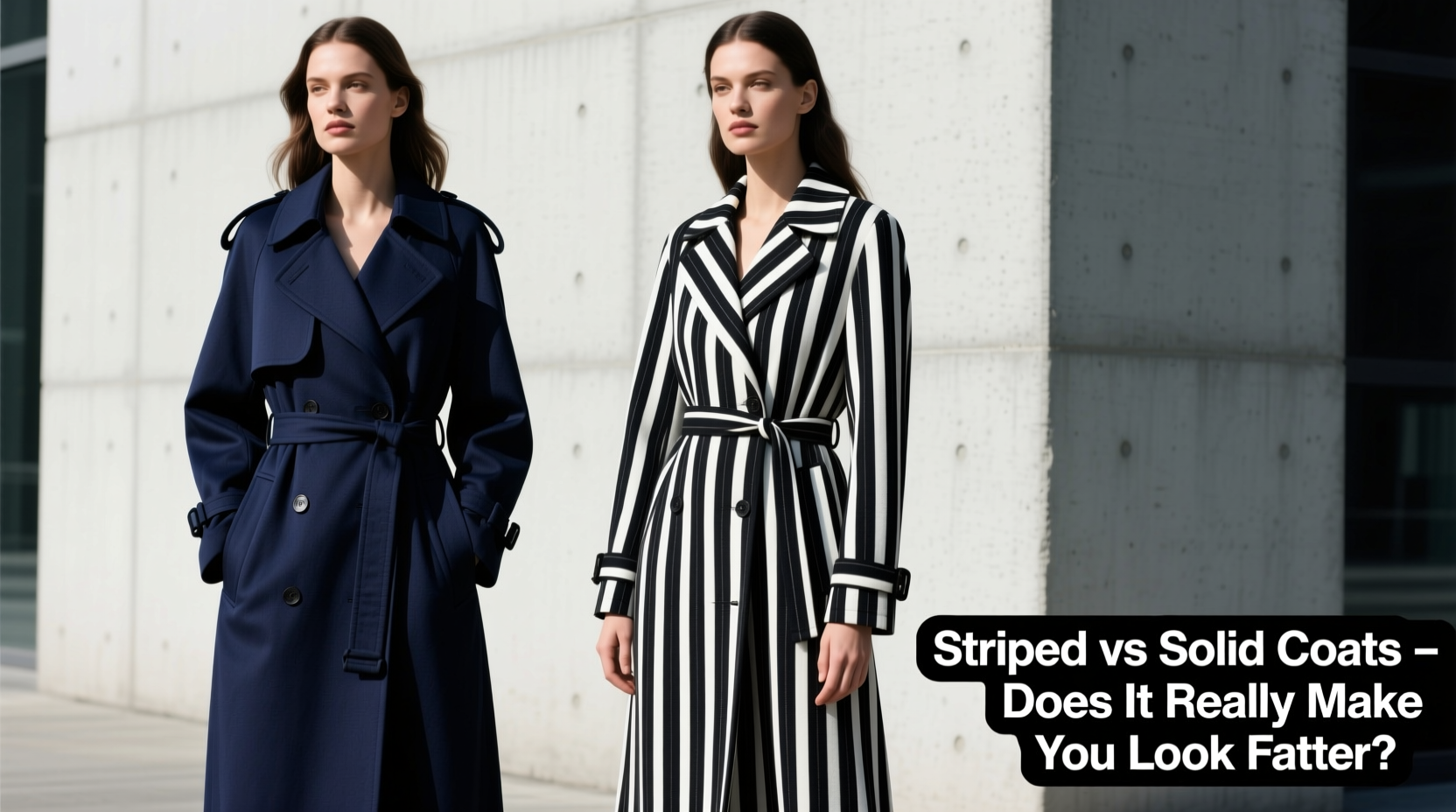
Our eyes don’t just see shapes—they interpret movement, contrast, and repetition. Stripes trigger what psychologists call the \"barber pole effect,\" where repeated lines create a sense of motion or expansion depending on their orientation. Horizontal stripes are often blamed for making someone appear wider because they draw the eye across the body, emphasizing breadth. Vertical stripes, conversely, guide the gaze up and down, creating a lengthening illusion.
However, research from Harvard and the University of Tokyo has shown that context matters more than direction alone. A 2009 study published in *Psychological Science* found that participants consistently misjudged the size of figures in striped clothing—sometimes perceiving striped silhouettes as smaller than solid ones, depending on stripe width, spacing, and background contrast.
“Stripes don’t inherently add or subtract volume. It’s how they interact with shape, scale, and proportion that creates the illusion.” — Dr. Lena Moretti, Cognitive Psychologist & Fashion Perception Researcher
In practical terms, a wide, high-contrast horizontal stripe on a bulky coat may emphasize width, but a narrow, low-contrast pinstripe—even if horizontal—can have a neutral or even slimming effect due to its subtlety.
Coat Cut and Fit Matter More Than Pattern
No pattern can compensate for a poorly fitting coat. A boxy, oversized solid black coat will add visual bulk far more than a well-tailored herringbone wool coat with subtle horizontal detailing. The structure of the garment—its shoulder seams, waist definition, and length—is the primary factor in how it alters your silhouette.
- Fitted waists: Coats with cinched waists or belted designs naturally create an hourglass shape, regardless of pattern.
- Shoulder structure: Strong shoulders balance hips and elongate the torso, minimizing perceived girth.
- Length: Mid-thigh or longer coats visually extend the body, which can offset any lateral emphasis from horizontal elements.
Pattern Scale and Contrast: The Hidden Variables
Not all stripes are created equal. The width, spacing, and color contrast between stripes dramatically influence their visual impact.
| Stripe Type | Visual Effect | Best For |
|---|---|---|
| Narrow, low-contrast (e.g., navy/gray) | Minimal expansion; slightly textural | All body types, especially broader frames |
| Wide, high-contrast (e.g., black/white) | Strong horizontal emphasis; adds visual weight | Slender builds seeking volume |
| Vertical pinstripes | Moderate lengthening effect | Taller individuals or boxy cuts |
| Diagonal or broken stripes | Dynamic movement; distracts from width | Curvy figures or athletic builds |
Solid coats eliminate pattern distraction entirely, offering a clean, uninterrupted line. This can be advantageous for those who prefer minimalism or want to highlight accessories. However, a solid coat in a shiny or lightweight fabric (like nylon) may cling or reflect light in ways that accentuate curves more than a matte, textured striped alternative.
Real Example: Two Women, Same Coat Length, Different Patterns
Alexis, 5'6\", with an athletic build, wore a solid charcoal peacoat and a navy-and-cream striped duffle coat—both the same length and fit. Observers were asked to estimate her size without knowing the garments. Surprisingly, 60% believed she looked slimmer in the striped version. Why? The duffle had narrower stripes, a matte finish, and a structured shoulder, while the solid coat had a slight sheen and looser drape, creating softness that read as fullness.
This illustrates that material and construction often outweigh pattern direction in real-world perception.
Styling Strategies to Enhance Your Shape
Whether you choose stripes or solids, smart styling can shift attention and balance proportions. Here’s how to work with what you’ve got:
- Use monochrome layering: Wear the same color underneath your coat to create a continuous vertical line. For example, a black turtleneck under a black coat extends the torso.
- Add vertical accents: Scarves worn long, long necklaces, or even a center-front button closure can draw the eye vertically, counteracting horizontal patterns.
- Break up stripes strategically: If wearing a striped coat, use a solid belt or crossbody bag at the narrowest part of your torso to define the waist.
- Avoid top-to-bottom stripes: Wearing striped sweaters under striped coats creates a grid effect that can look busy and widen the upper body.
Checklist: Choosing the Right Coat for Your Body
- ✅ Try on both striped and solid versions of the same cut
- ✅ Check how the coat drapes in natural light
- ✅ Assess stripe width and contrast—narrower is safer for broader frames
- ✅ Ensure shoulders align with your own
- ✅ Button it up and check for pulling or excess fabric at the waist
- ✅ Walk around—does it ride up or feel restrictive?
- ✅ Pair it with your typical winter outfit to test coordination
Expert Insight: What Tailors and Stylists Say
Professional stylists often challenge the “stripes make you fat” rule outright. Instead, they emphasize intentionality.
“The fear of stripes is outdated. I’ve dressed clients ranging from size 2 to 18 in bold horizontal coats—when the fit is right and the confidence is there, it’s empowering, not enlarging.” — Marcus Tran, Celebrity Wardrobe Stylist
Tailors echo this sentiment. “Fabric behavior matters more than pattern,” says Sofia Reyes, bespoke coat maker. “A stiff wool with horizontal herringbone behaves differently than a soft cotton blend with wide stripes. You have to consider drape, weight, and how it moves with the body.”
Frequently Asked Questions
Do vertical stripes always make you look slimmer?
Not necessarily. If the stripes are very wide or placed asymmetrically, they can create uneven visual breaks that distort rather than flatter. Additionally, a poorly fitted vertical-striped coat can still add bulk. Fit and proportion remain more important than stripe direction.
Can short people wear horizontal stripes?
Absolutely. Shorter individuals can wear horizontal stripes as long as the coat hits at a flattering point—usually mid-hip to upper thigh. Avoid long, loose striped coats that overwhelm the frame. Pair with high-waisted pants to maintain leg-length balance.
Are solid coats more professional than striped ones?
In traditional corporate settings, solid neutrals (black, gray, navy) are standard. However, subtle tonal stripes or textured solids (like herringbone) are increasingly accepted and can add sophistication without breaking dress codes.
Final Thoughts: Confidence Is the Best Fit
The idea that striped coats make you look fatter is a persistent myth rooted in oversimplified fashion rules. Real-world results depend on fit, fabric, stripe characteristics, and how the garment complements your overall look. A well-chosen striped coat can add personality, texture, and even visual interest that distracts from areas you’d rather not highlight. Conversely, a badly fitted solid coat can do more harm than a thoughtfully styled striped one.
Instead of fearing patterns, focus on intentionality. Know your proportions. Understand how different fabrics behave. Try before you buy. And above all, wear what makes you feel confident. Because nothing shapes your presence more than self-assurance.
💬 What’s your go-to coat style—and do you avoid stripes? Share your experience and help others find their perfect winter look.








