When choosing a timepiece, one of the most fundamental decisions is between quartz and automatic movements. While aesthetics, heritage, and craftsmanship often sway buyers toward automatic watches, the question of long-term accuracy remains pivotal—especially for those who rely on their watch as a precise instrument. Over years of wear, environmental exposure, and mechanical stress, how do these two technologies compare in maintaining consistent timekeeping? The answer isn’t always intuitive, but it hinges on physics, engineering, and practical usage patterns.
At its core, the debate isn't just about ticking precision—it's about reliability over time, resistance to external influences, and the cost of upkeep. Understanding the science behind each movement type reveals why quartz consistently outperforms automatics in long-term accuracy, even if the latter wins in emotional appeal.
The Science Behind Timekeeping: Quartz vs Automatic
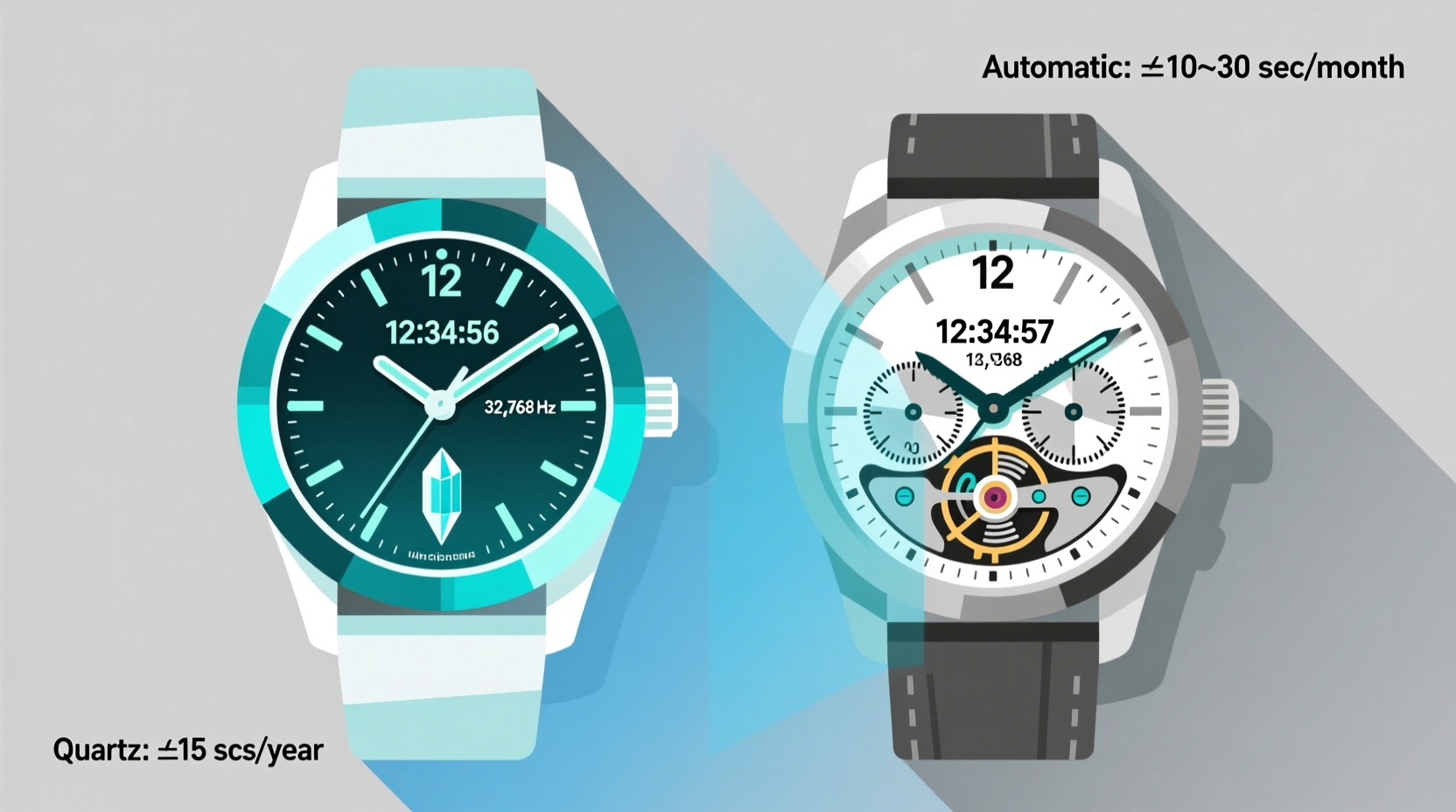
Quartz and automatic watches operate on entirely different principles. An automatic (or self-winding mechanical) watch uses a complex system of gears, springs, and a balance wheel regulated by a hairspring. As the wearer moves their wrist, a rotor spins and winds the mainspring, storing energy that powers the movement. The oscillation of the balance wheel—typically at 28,000 vibrations per hour—controls the release of energy in measured increments.
In contrast, a quartz watch relies on a battery-powered electronic circuit. This sends an electric current through a tiny quartz crystal, causing it to vibrate at a highly stable frequency of 32,768 times per second. These vibrations are counted by a microchip, which translates them into one pulse per second—driving the motor that advances the hands.
This fundamental difference in operation leads to vastly different performance outcomes. Because quartz crystals oscillate with near-perfect consistency, they are inherently less susceptible to variation caused by temperature, position, or motion than a mechanical balance wheel.
Tip: If your priority is precision without daily adjustment, choose quartz—its accuracy is built into its design, not dependent on winding or servicing.Long-Term Accuracy: How Each Movement Ages
Over time, all watches experience some degree of deviation. However, the rate and predictability of this drift differ significantly between quartz and automatic movements.
Quartz watches typically maintain accuracy within ±15 seconds per month (±0.5 seconds per day). High-end models, such as those from Citizen’s Chronomaster line or certain Casio G-Shocks, can achieve ±10 seconds per year. This level of precision remains stable for years, provided the battery is replaced regularly and the circuitry isn’t damaged by moisture or impact.
Automatic watches, even high-grade ones like Rolex or Omega, generally perform within -10 to +30 seconds per day under ideal conditions. After several years, wear on internal components—such as lubricant degradation, gear misalignment, or magnetization—can increase this deviation unless the watch undergoes regular servicing every 5–7 years.
A study conducted by the Swiss Official Chronometer Testing Institute (COSC) found that while chronometer-certified automatic movements meet strict initial standards (average -4/+6 seconds per day), long-term field data shows a measurable decline in accuracy after three years without service. In contrast, quartz watches tested over five-year periods showed negligible change in performance when maintained properly.
“Quartz doesn’t age the way mechanical movements do. There’s no mainspring fatigue, no oil drying out—just consistent frequency output until the battery weakens.” — Dr. Laurent Morel, Horological Engineer, EPFL Lausanne
Comparison Table: Key Performance Metrics
| Metric | Quartz Watch | Automatic Watch |
|---|---|---|
| Average Accuracy (per day) | ±0.5 seconds | -10 to +30 seconds |
| Long-Term Drift (5+ years, un-serviced) | Minimal (battery-dependent) | Increases significantly (+/- minutes per month) |
| Service Interval | Every 5–10 years (battery & seals) | Every 5–7 years (full overhaul) |
| Impact of Position/Gravity | Negligible | Significant (varies by orientation) |
| Temperature Sensitivity | Low (compensated in premium models) | Moderate to High |
| Power Source Reliability | Stable until battery depletion | Declines with incomplete winding |
| Cost of Ownership (10-year estimate) | $20–$50 (batteries, gaskets) | $300–$800 (servicing, adjustments) |
Real-World Example: Two Watches, Ten Years Later
Consider two individuals: Sarah owns a mid-range quartz Seiko, while James wears a respected automatic Tissot PRX. Both buy their watches new and wear them daily. Neither seeks frequent calibration.
After ten years:
- Sarah’s quartz watch receives a new battery every three years and a fresh gasket during each replacement. She resets the time twice a year during daylight saving changes. At the decade mark, her watch still runs within ±10 seconds per month. No internal cleaning was needed.
- James’s automatic watch was serviced once after six years due to noticeable gain (over +45 seconds/day). Prior to servicing, it had drifted nearly five minutes ahead over six months. Post-service, accuracy improved, but required biannual regulation to stay within acceptable range. Total servicing cost: $420.
This scenario illustrates a common trend: quartz maintains passive accuracy, while automatics demand active maintenance to preserve performance. For users seeking “set and forget” reliability, quartz clearly holds the advantage.
Maintenance and Environmental Factors
Environmental exposure affects both types, but differently. Automatic watches are sensitive to magnetism, shocks, and positional variance. A watch worn only during desk work may not wind fully, leading to underperformance. Temperature swings cause metal components to expand or contract, altering the balance spring’s elasticity.
Quartz movements are not immune to issues. Extreme cold can temporarily slow crystal oscillation; moisture infiltration can corrode circuits. However, modern quartz designs include temperature compensation and robust sealing. Additionally, many feature anti-magnetic shielding and shock-resistant construction.
Battery longevity also plays a role. Most quartz batteries last 2–5 years. Delaying replacement risks leakage, which can destroy the movement. Regular pressure testing of case seals ensures water resistance remains intact—a critical factor in preventing internal damage that could affect timing circuits.
Tip: Replace your quartz watch battery promptly and have the case seal checked annually to prevent corrosion and moisture damage.Step-by-Step Guide to Maximizing Long-Term Accuracy
Whether you own a quartz or automatic watch, these steps help preserve accuracy over time:
- For Quartz Watches:
- Replace the battery every 2–3 years, even if it hasn’t died.
- Have the case back gasket inspected and replaced during battery changes.
- Avoid exposing the watch to strong magnetic fields (e.g., speakers, MRI machines).
- If the watch has a reset function, recalibrate it annually using an atomic clock signal or GPS time source.
- For Automatic Watches:
- Wear the watch for at least 8–10 hours daily to ensure full winding.
- Service the movement every 5–7 years with a certified technician.
- Store in a winder if not worn regularly to maintain tension and lubrication flow.
- Demagnetize the movement if you notice sudden time gains.
Expert Insight: Why Precision Matters Beyond the Second Hand
Accuracy isn’t just about telling the correct time—it impacts functionality in professional settings, travel coordination, and even personal discipline. Pilots, medical professionals, and field researchers depend on exact timekeeping where even a minute’s deviation can have consequences.
“In high-stakes environments, we recommend quartz or radio-synced movements. Mechanical watches are beautiful, but beauty doesn’t replace precision under stress.” — Captain Elena Rodriguez, Aviation Safety Consultant
This sentiment echoes across industries where timing is mission-critical. While automatic watches symbolize tradition and artistry, quartz offers the kind of dependable performance that aligns with modern expectations of technology.
Frequently Asked Questions
Do automatic watches become less accurate over time?
Yes. Without regular servicing, internal friction, dried lubricants, and minor misalignments accumulate, leading to increased time deviation. Even well-made automatics can lose or gain several minutes per month after five years of use without maintenance.
Can a quartz watch be as prestigious as an automatic?
Traditionally, mechanical watches dominate luxury markets due to craftsmanship. However, brands like Grand Seiko (with its 9F quartz line) and Breitling (Exospace B55) have elevated quartz to haute horlogerie status, combining extreme precision with premium finishes. Prestige is evolving beyond mechanics alone.
Is there a quartz watch that never needs a battery?
Yes. Solar-powered quartz watches (e.g., Citizen Eco-Drive, Seiko Solar) convert light into electrical energy, storing it in a rechargeable cell. These can run for decades with minimal intervention and offer the same high accuracy as battery-powered quartz.
Final Verdict: Which Movement Wins for Long-Term Accuracy?
The evidence is clear: quartz watches are significantly more accurate than automatics over the long term. Their reliance on stable crystal oscillation eliminates the mechanical variables that degrade performance in automatic movements. They require less maintenance, suffer fewer environmental setbacks, and deliver consistent results year after year.
That said, automatic watches offer intangible value—craftsmanship, heritage, and the romance of miniature engineering. But if your primary goal is precision, especially without ongoing investment in servicing, quartz is objectively superior.
Ultimately, the choice depends on priorities. For those who value accuracy above all, quartz isn’t just a practical option—it’s the definitive standard.
🚀 Ready to make an informed decision? Reassess your timekeeping needs and consider switching to a high-accuracy quartz model—or commit to disciplined servicing if you prefer the mechanical tradition. Share your thoughts or experiences in the comments below.








