When choosing between a quartz and an automatic watch, one of the most practical considerations is long-term maintenance. While aesthetics, brand prestige, and craftsmanship play major roles in decision-making, the reality of upkeep often determines how enjoyable a timepiece remains over years of ownership. Quartz and automatic movements operate on fundamentally different principles—one powered by a battery and electronics, the other by mechanical energy stored through motion. These differences directly influence how often they need service, what kind of care they require, and ultimately, how much effort and cost are involved in keeping them running accurately.
For many buyers, especially those new to horology, the idea of “watch maintenance” can seem daunting. But understanding the real-world demands of each movement type simplifies the choice. This article breaks down the maintenance needs of quartz and automatic watches, compares their long-term costs, and provides actionable insights to help you choose based on lifestyle, budget, and convenience.
How Quartz Watches Work and Their Maintenance Needs
Quartz watches use a small electronic oscillator regulated by a quartz crystal to keep time. When a battery sends current through the crystal, it vibrates at a precise frequency—32,768 times per second—which an integrated circuit counts and converts into one-second pulses that drive the motor moving the hands.
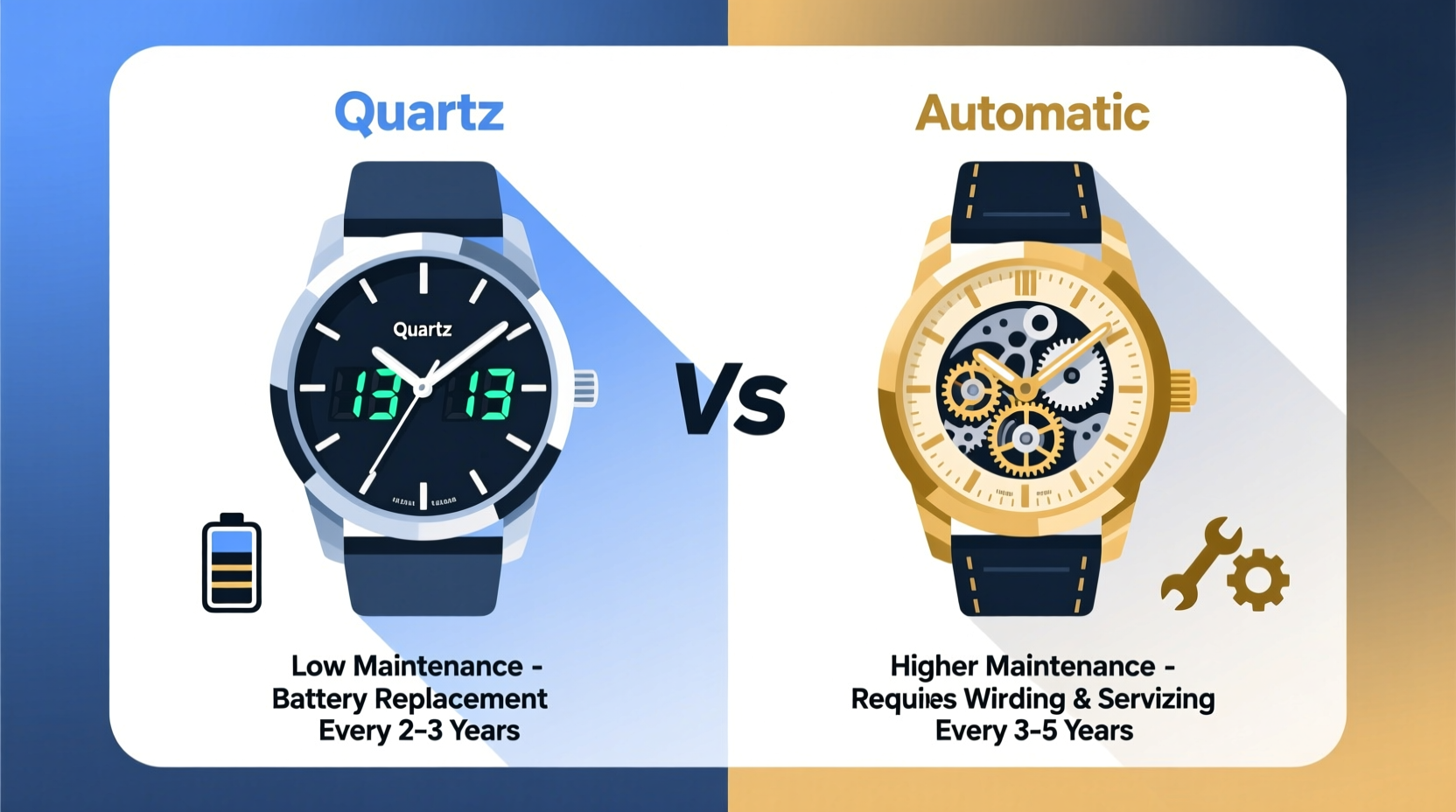
This system is highly accurate, typically losing or gaining no more than 15 seconds per month. Because the mechanism has very few moving parts, there’s less friction and wear compared to mechanical systems. The primary maintenance requirement for a quartz watch is battery replacement, usually every 1–3 years depending on the model and functions (e.g., chronographs or backlights drain power faster).
Beyond battery changes, quartz watches may occasionally need seals replaced to maintain water resistance, especially if worn frequently in wet environments. Over decades, minor electrical components like circuits or coils can degrade, but failures are rare. Most issues arise from moisture intrusion due to worn gaskets or improper crown operation—not inherent flaws in the movement itself.
Tip: After any battery replacement, ensure the case back is properly sealed and tested for water resistance if you plan to expose the watch to moisture.Automatic Watch Mechanics and Long-Term Servicing Demands
Automatic watches, also known as self-winding mechanical watches, rely on a rotor that spins with the motion of the wearer’s wrist. This rotor winds the mainspring, storing energy that powers the gear train and escapement regulating timekeeping. Unlike quartz watches, these have hundreds of tiny moving parts operating under constant tension and friction.
Because of this complexity, automatic watches require periodic servicing to remain accurate and reliable. Over time, lubricants inside the movement dry out, metal components wear, and dust can infiltrate even well-sealed cases. Without proper care, performance degrades—accuracy drops, power reserve shortens, and eventually, the watch stops altogether.
Watchmakers generally recommend a full service every 5–7 years. This involves disassembling the entire movement, cleaning each component, re-lubricating gears and pivots, inspecting for wear, and reassembling with adjusted timing. Such services typically cost between $200 and $600, depending on brand, complexity, and location.
“An automatic watch is like a classic car—it performs beautifully when maintained, but neglect leads to costly repairs.” — Daniel Reyes, Master Watchmaker at Geneva Timeworks
Comparative Analysis: Maintenance Frequency and Effort
To understand which type demands less maintenance, consider three key factors: frequency of intervention, complexity of care, and total cost over time.
| Maintenance Factor | Quartz Watch | Automatic Watch |
|---|---|---|
| Service Interval | Every 1–3 years (battery) | Every 5–7 years (full service) |
| Cost Per Service | $10–$30 (battery + pressure test) | $200–$600+ |
| Moving Parts | Few (low wear) | Over 100 (high wear) |
| Accuracy Drift Between Services | Negligible | Potential increase over time |
| Daily Wearing Requirement | None (runs on battery) | Ideal: daily wear; otherwise needs winder |
| Risk of Long-Term Damage if Neglected | Low (mainly battery leakage) | High (oil gumming, corrosion, part failure) |
The data shows that while automatic watches go longer between major services, the depth and expense of those services far exceed the routine upkeep of a quartz model. Additionally, quartz watches do not require regular wearing to function—ideal for collectors who rotate timepieces. In contrast, an automatic watch left unworn for weeks will stop and must be manually wound or placed on a watch winder to maintain readiness.
Real-World Example: Two Owners, Two Lifestyles
Consider two professionals: Sarah, a nurse who wears her watch daily in a hospital environment, and James, a consultant who owns several luxury watches and wears them rotationally.
Sarah owns a Seiko 5 Automatic. She wears it every day, so it stays wound. However, after six years without servicing, she notices it gains 10 minutes weekly. She takes it in for a service costing $350. The technician explains that dried oils caused increased friction, affecting accuracy. Now, she plans to service it every six years.
James owns a Casio Edifice Quartz. He alternates between four watches. His quartz model runs reliably despite sitting unused for months. Every two years, he replaces the battery for $20 and has the seal checked. Over 10 years, his total maintenance cost: $100. No accuracy issues. No unexpected repairs.
In terms of sheer maintenance burden, James’s experience reflects the low-effort advantage of quartz. Sarah enjoys the craftsmanship of her automatic piece but accepts higher upkeep as part of ownership.
Longevity and Durability Beyond Routine Care
While quartz watches win in ease of maintenance, longevity isn’t solely about service intervals. Some vintage quartz models from the 1970s still function perfectly today, thanks to replaceable batteries and robust design. Brands like Citizen, Seiko, and Longines have produced quartz movements engineered for decades of use.
Conversely, high-end automatic watches, particularly Swiss-made ones, are built to last generations—with proper servicing. A well-maintained Rolex or Omega from the 1960s can perform as intended today. However, this longevity assumes consistent investment in care. An automatic watch neglected for 20 years may require extensive restoration, potentially exceeding its market value.
Quartz watches face fewer mechanical risks, but older models may suffer from capacitor failure or obsolete circuitry. Finding replacements for discontinued movements can be difficult. Still, modern quartz movements are standardized and widely supported.
Tip: For long-term ownership, choose quartz models from reputable brands with global service networks to ensure parts availability decades later.Step-by-Step Guide to Minimizing Watch Maintenance Burden
Whether you own a quartz or automatic watch, smart habits reduce long-term maintenance needs. Follow this timeline to maximize reliability and minimize cost:
- Year 0 – Purchase: Choose a model with a proven track record of durability. Research common issues in user forums and repair shops.
- Every 1–3 Years (Quartz): Replace the battery promptly. Delaying increases the risk of leakage, which can corrode the movement.
- Every 1–2 Years (All Watches): Have water resistance tested, especially if exposed to sweat, rain, or swimming.
- Every 5–7 Years (Automatic): Schedule a full service even if the watch seems accurate. Preventive care avoids internal damage.
- Monthly (Automatic): If not worn daily, use a watch winder to keep the movement active and lubricants distributed.
- Ongoing: Avoid extreme temperatures, magnetic fields, and shocks. These affect both movement types, though quartz is generally more resistant.
- Before Storage: For automatics, wind and set to correct time. For quartz, consider removing the battery if storing for over a year.
Checklist: Choosing Based on Maintenance Priorities
- ✅ Do you want a “set and forget” timepiece? → Choose quartz
- ✅ Will you wear the watch infrequently? → Quartz is more forgiving
- ✅ Are you willing to budget $300+ every 6 years for servicing? → Automatic viable
- ✅ Do you value precision over tradition? → Quartz offers superior accuracy
- ✅ Is your lifestyle active or exposed to moisture? → Ensure strong seals regardless of type
- ✅ Do you enjoy the ritual of winding and maintaining a mechanical device? → Automatic suits your mindset
Frequently Asked Questions
Can a quartz watch last a lifetime?
Yes, provided it receives basic care like timely battery changes and occasional seal replacements. Many quartz watches from the 1980s are still operational today. While electronic components may eventually fail, most are repairable or replaceable if the manufacturer supports them.
What happens if I don’t service my automatic watch?
Over time, the lubricants in the movement dry up, increasing friction. This leads to accelerated wear, inaccurate timekeeping, and potential damage to delicate parts like the escapement or mainspring. In extreme cases, rust or seized components can render the watch unreparable without costly restoration.
Is it cheaper to repair a quartz or automatic movement?
Minor repairs favor quartz. Replacing a battery or circuit board is inexpensive. However, if a rare quartz movement is discontinued, sourcing parts may be impossible. Automatic movements, while expensive to service, are often repairable because many components are machined and adjustable by skilled watchmakers—even decades later.
Conclusion: Which Requires Less Maintenance Overall?
The evidence is clear: quartz watches require significantly less maintenance than automatic ones. They demand only periodic battery changes, minimal servicing, and no special wearing habits. Their accuracy remains consistent, and their resilience to neglect makes them ideal for everyday users, travelers, or those who prefer functionality over ceremony.
Automatic watches offer emotional appeal—the sweep of the second hand, the craftsmanship, the connection to horological heritage. But that comes at the cost of higher long-term maintenance. They require financial commitment, regular attention, and either consistent wear or a watch winder to stay functional.
If your priority is simplicity, reliability, and low ownership cost, quartz wins decisively. If you value tradition, engineering artistry, and don’t mind investing time and money into upkeep, an automatic watch can be deeply rewarding.
🚀 Ready to make an informed decision? Assess your lifestyle, budget, and expectations—then choose the movement that aligns with how you want to experience time.








