For decades, the debate between mechanical and quartz watches has divided enthusiasts, collectors, and everyday wearers. While both types serve the fundamental purpose of telling time, their differences in accuracy, cost, craftsmanship, and long-term value create distinct paths for different lifestyles. Whether you're investing in your first luxury timepiece or building a collection meant to last generations, understanding these contrasts is essential. This article breaks down the real-world implications of choosing mechanical over quartz — not just in how they keep time, but in how they age, appreciate, and reflect personal values.
Accuracy: Quartz Reigns Supreme
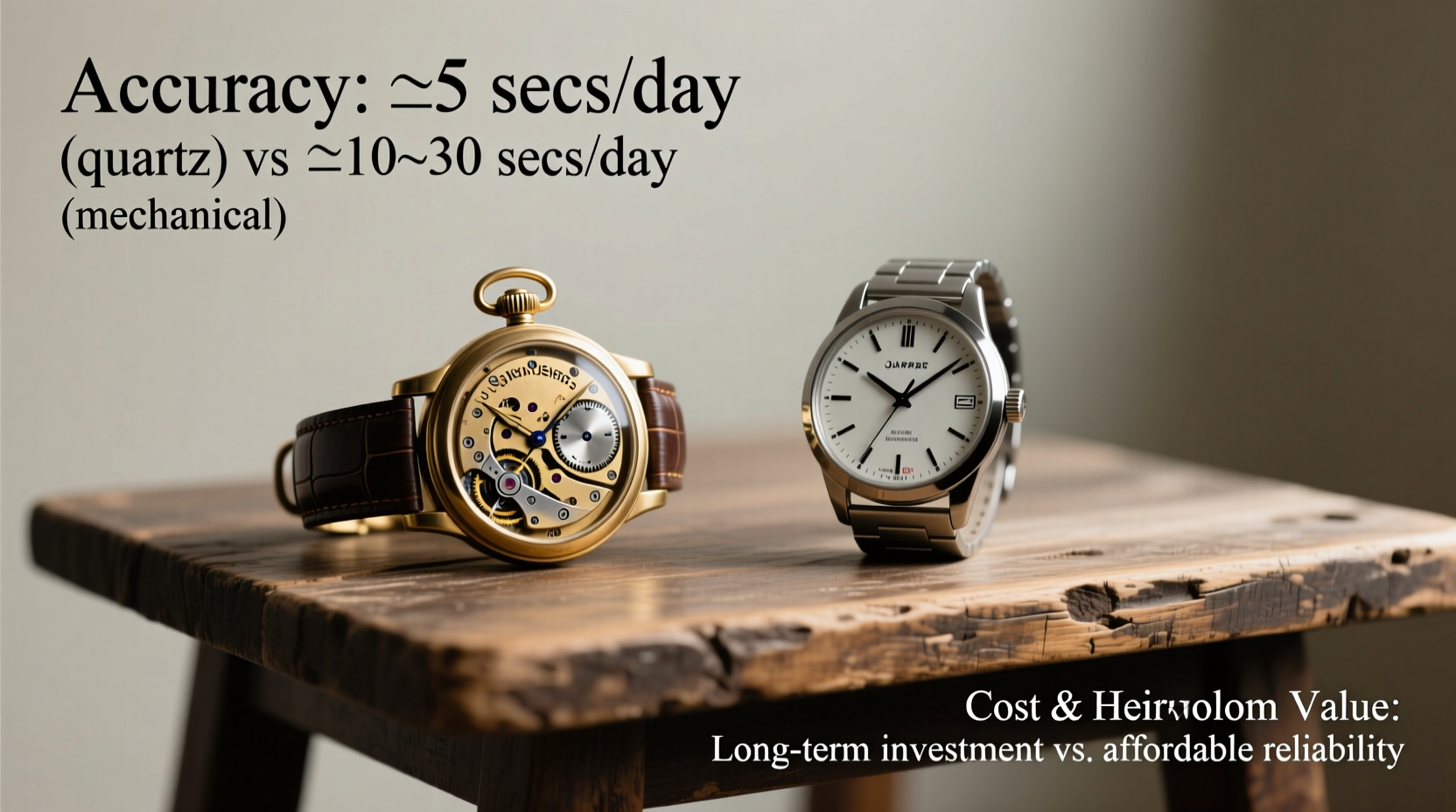
When it comes to precision, quartz watches are objectively superior. Powered by a battery and regulated by a tiny quartz crystal that vibrates at a precise frequency (32,768 times per second), these watches typically lose or gain only about 15 seconds per month. Some high-end quartz movements, like those from brands such as Citizen (in their Chronomaster line) or Longines (VHP models), achieve accuracy within ±10 seconds per year.
In contrast, even the most finely tuned mechanical watches — whether manually wound or automatic — are subject to physical variables: gravity, temperature, position, and wear patterns. A certified chronometer, such as one bearing the COSC (Contrôle Officiel Suisse des Chronomètres) label, is permitted a deviation of -4 to +6 seconds per day. That’s up to two minutes off per month — a significant gap compared to quartz.
Tip: If you rely on split-second precision for work or sports, quartz is the clear choice. For daily life, even mechanical deviations are negligible.Cost Comparison: Entry Points and Escalation
The price spectrum for both types varies widely, but the starting points differ dramatically. You can purchase a reliable quartz watch — accurate, durable, and stylish — for under $50. Brands like Casio, Timex, and Seiko offer quartz models that deliver excellent value with minimal maintenance.
Mechanical watches, however, begin at a higher threshold. A basic automatic movement from a reputable brand usually starts around $300–$500. The reason? Mechanical movements contain dozens — sometimes hundreds — of tiny parts hand-assembled and adjusted by skilled watchmakers. Even entry-level automatics involve more labor, materials, and quality control than mass-produced quartz equivalents.
At the high end, mechanical watches escalate rapidly in price due to complications (chronographs, moon phases, tourbillons), precious metals, and brand prestige. A Patek Philippe or Rolex can command tens or even hundreds of thousands of dollars. Meanwhile, premium quartz watches rarely exceed $2,000 unless they include luxury branding or exotic materials.
| Type | Entry-Level Price | Premium Tier | Maintenance Cost (Annual) |
|---|---|---|---|
| Quartz | $20 – $200 | $300 – $2,000 | $10 – $50 (battery + seal check) |
| Mechanical | $300 – $800 | $5,000 – $500,000+ | $100 – $500 (service every 5–7 years) |
This table highlights not just upfront costs but also long-term ownership expenses. While quartz batteries are cheap and simple to replace, mechanical watches require periodic servicing to clean oils, replace worn components, and recalibrate timing — an investment many owners accept as part of the tradition.
Heirloom Potential: Legacy Beyond Functionality
If you're considering a watch as a family heirloom — something to pass down through generations — mechanical watches hold a distinct emotional and cultural advantage. Their intricate mechanics, craftsmanship, and connection to centuries-old horological traditions make them more than tools; they become artifacts.
A well-maintained mechanical watch can last 50, 100, or even 200 years. Many vintage Rolexes, Jaegers, and Omega Speedmasters from the mid-20th century remain fully functional today, often increasing in value. These pieces carry stories: worn during historic events, gifted across generations, or purchased to mark milestones.
Quartz watches, while durable in their own right, face obsolescence challenges. Batteries may no longer be produced, circuits degrade, and replacement movements are often unavailable. Unlike mechanical parts, which can frequently be recreated or repaired by hand, quartz integrated circuits are proprietary and non-standardized. As a result, most quartz watches have a finite lifespan of 20–30 years before becoming relics rather than working instruments.
“Timepieces are not just measured in seconds, but in memories. A mechanical watch carries the heartbeat of its era — winding it each morning connects the wearer to history.” — Antoine Morel, Master Horologist & Curator, Geneva Watch Museum
Real Example: Two Watches, Two Legacies
Consider two scenarios involving a father passing down a watch to his son.
In the first, he hands over a 1972 Omega Seamaster, originally purchased by his grandfather. Though it hasn’t been worn in years, a local watchmaker cleans the movement, replaces the mainspring, and adjusts the balance wheel. After three weeks of work and $350 in service fees, the watch runs within COSC specifications again. The son wears it proudly, feeling connected to a lineage of craftsmanship and care.
In the second, the father gives a 1995 quartz dress watch from a now-defunct Japanese brand. He replaces the battery, but the second hand stutters. A specialist confirms the IC board has failed — no replacements exist. The watch is retired to a display box. It holds sentimental value, but not functionality.
Both gestures are meaningful, but only one continues to *work* — and that function becomes part of the legacy.
Choosing Based on Lifestyle and Values
Your decision should align with how you use and value time.
- Choose quartz if: You prioritize accuracy, low maintenance, affordability, and reliability. Ideal for travelers, professionals, athletes, or anyone who wants a “set it and forget it” experience.
- Choose mechanical if: You appreciate engineering artistry, ritual (like hand-winding), and long-term ownership. Best for collectors, those marking life milestones, or individuals seeking a tangible legacy.
There’s also a growing hybrid category — “smart quartz” watches with analog faces and Bluetooth syncing (e.g., Breitling SuperQuartz™ or Garmin’s hybrid series). These offer high accuracy and modern features but lack the soul of mechanical timepieces and still face electronic obsolescence.
Tip: Test both types in person. Feel the weight, listen to the tick (or silence), and consider how each fits your wrist and routine. Ownership is as much tactile as technical.Step-by-Step Guide: How to Decide Which Type Is Right for You
- Define your primary need: Is it telling time precisely, or expressing identity and heritage?
- Set a realistic budget: Include not just purchase price, but long-term upkeep.
- Assess your lifestyle: Do you swim, travel, or work in rugged environments? Quartz excels here. Do you attend formal events or collect fine objects? Mechanical adds gravitas.
- Think long-term: Will this watch be worn daily for 10 years? Passed to a child? Or replaced every few years?
- Try before you buy: Visit authorized dealers, handle models, ask about service networks.
- Research resale and serviceability: Check forums like WatchUSeek or Reddit’s r/Watches for brand-specific longevity reports.
Frequently Asked Questions
Can a quartz watch become a family heirloom?
Possibly, but with limitations. While some premium quartz watches (e.g., Grand Seiko 9F, Breitling SuperQuartz) are built to high standards, their electronic components may fail irreparably over time. Sentimental value remains, but functional longevity is uncertain.
Do mechanical watches require daily winding?
Manual-wind mechanical watches do require daily winding, typically taking 20–40 turns of the crown. Automatic (self-winding) models harness motion from your wrist and only need winding if left idle for 1–2 days, depending on power reserve.
Are quartz watches considered “lesser” in the luxury market?
In traditional watch circles, yes — but perceptions are shifting. High-accuracy quartz movements in luxury cases (e.g., Cartier, Tudor, Longines) are gaining respect for their precision and understated excellence. However, they generally do not command the same prestige or resale value as mechanical counterparts.
Checklist: What to Evaluate Before Buying
- ✅ Accuracy requirements (± seconds per month vs. day)
- ✅ Budget including future servicing
- ✅ Intended use (daily wear, formal events, sports)
- ✅ Brand reputation for durability and support
- ✅ Resale value and collector demand
- ✅ Emotional connection to craftsmanship or technology
- ✅ Longevity expectations (will it work in 30 years?)
Final Thoughts: Time as a Reflection of Values
The choice between mechanical and quartz isn’t merely technical — it’s philosophical. A quartz watch reflects efficiency, modernity, and practicality. A mechanical watch embodies patience, tradition, and human ingenuity. One measures time with flawless precision; the other reminds us that time is also felt.
Neither is inherently better. But if you seek a piece that ages with character, tells a story beyond its dial, and might one day rest on your child’s wrist with the same heartbeat it had decades prior, mechanical offers something quartz cannot replicate: continuity.
Ultimately, the best watch is the one that resonates with how you live, what you value, and how you wish to be remembered.
💬 What does your watch mean to you? Share your story in the comments — whether it’s a $20 quartz or a family heirloom mechanical. Let’s celebrate the many ways we measure time.








