
A well-crafted whitepaper is more than just an informational document—it’s a strategic tool that builds trust, demonstrates expertise, and influences decision-making. Whether you're in tech, finance, healthcare, or consulting, the ability to write a compelling whitepaper can position your organization as a thought leader and generate qualified leads. Unlike marketing brochures or sales pitches, whitepapers rely on data, logic, and structured argumentation to present solutions to complex problems.
Yet, many professionals struggle with where to begin, how to structure their argument, or how to maintain credibility while still being persuasive. This guide walks through the essential steps of writing a whitepaper that not only informs but also converts—offering clarity, authority, and value at every stage.
Understanding the Purpose and Audience
Before writing a single sentence, define why the whitepaper exists and who it’s for. A whitepaper should address a specific problem faced by a target audience and propose a well-reasoned solution. Is the goal to educate prospects about a new technology? To compare methodologies? To advocate for policy change?
The intended readers will shape both tone and depth. A technical whitepaper for engineers demands precision, data, and jargon appropriate to the field. One aimed at executives should emphasize ROI, risk mitigation, and strategic implications, using accessible language.
Tip: Create a reader persona: give your ideal reader a name, job title, pain points, and goals. Refer to them throughout the writing process to stay focused.Step-by-Step Guide to Writing a Whitepaper
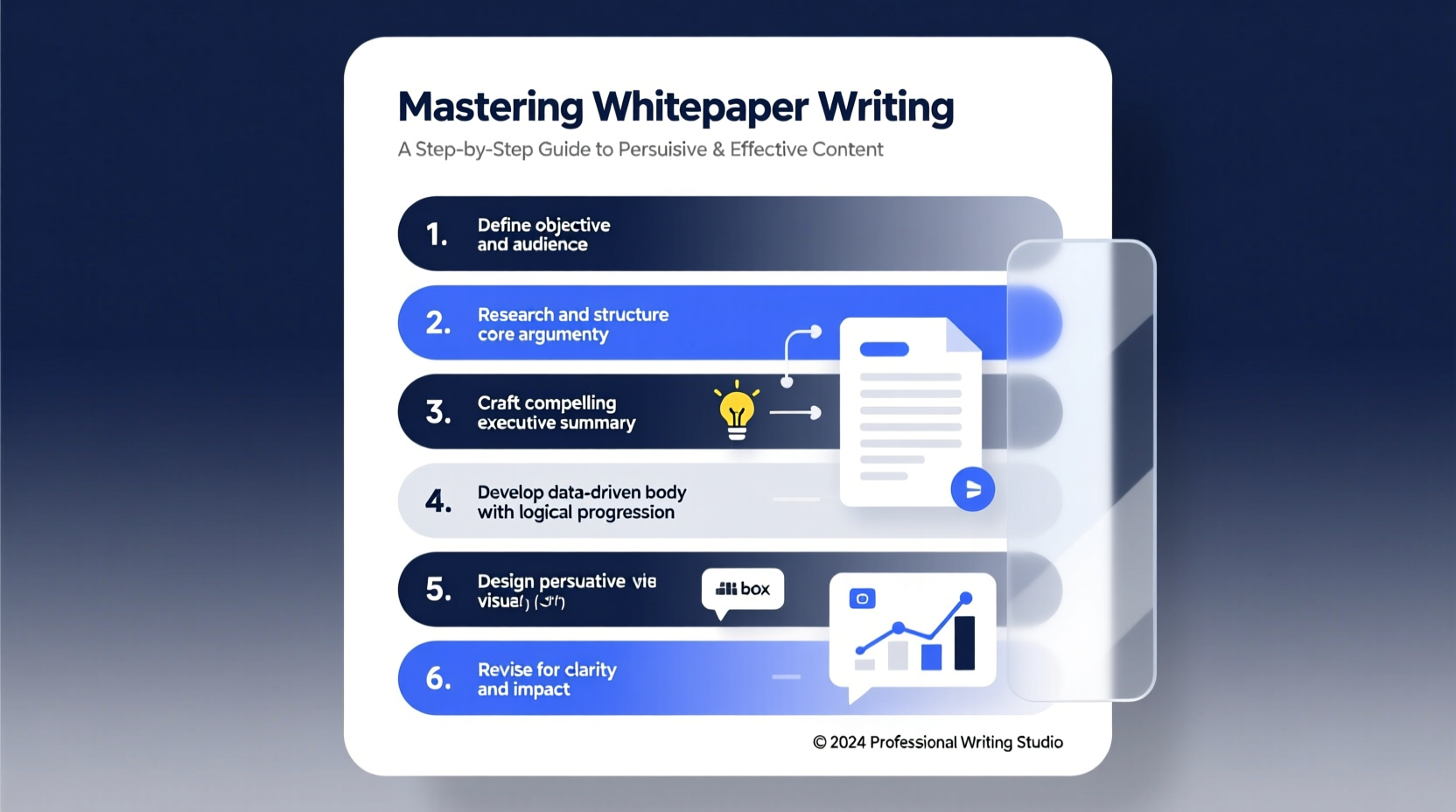
Writing a whitepaper isn’t about inspiration—it’s about discipline and structure. Follow these seven phases to produce a polished, authoritative document.
- Research Thoroughly: Gather peer-reviewed studies, industry reports, internal data, and expert interviews. The strength of your argument depends on the quality of your sources.
- Define the Core Problem: Frame the issue clearly. Use statistics or real-world examples to show its impact.
- Propose a Solution: Introduce your approach, product, or methodology as a viable answer. Avoid overt promotion; focus on logic and evidence.
- Outline the Structure: Use a standard format (problem → causes → consequences → solution → benefits) to ensure flow.
- Draft with Clarity: Write in active voice, avoid fluff, and use subheadings liberally. Each section should advance the central argument.
- Edit Ruthlessly: Cut redundant phrases, clarify ambiguous statements, and verify all claims. Have a colleague review for logic gaps.
- Design for Readability: While this guide focuses on content, remember that layout matters. Use numbered sections, bullet points, charts, and ample white space.
Structuring Your Whitepaper for Maximum Impact
A typical whitepaper follows a logical progression that guides the reader from awareness to conviction. Below is a proven structure:
| Section | Purpose | Key Elements |
|---|---|---|
| Executive Summary | Provide a snapshot of the problem and solution | 1–2 paragraphs; written last but placed first |
| Introduction | Establish context and urgency | Hook, background, scope, objectives |
| Problem Statement | Detail the challenge with supporting data | Statistics, case references, cost of inaction |
| Analysis / Causes | Break down contributing factors | Diagrams, root-cause analysis, expert input |
| Solution Overview | Present your recommended approach | How it works, differentiation, implementation steps |
| Evidence & Case Studies | Prove effectiveness | Data tables, testimonials, before/after scenarios |
| Conclusion & Call to Action | Summarize and prompt next steps | Reiterate value, suggest consultation, demo, or download |
Common Pitfalls and How to Avoid Them
Even experienced writers fall into traps that weaken a whitepaper’s impact. Recognizing these early helps preserve credibility and engagement.
- Overpromising: Claiming your solution “revolutionizes” an industry without proof damages trust.
- Ignoring Counterarguments: Failing to acknowledge limitations or competing approaches makes the paper seem biased.
- Using Excessive Jargon: Technical terms are necessary but should be defined when introduced.
- Lack of Data Integrity: Citing outdated or questionable sources undermines authority.
- Weak Flow: Jumping between ideas without transitions confuses readers.
“Credibility in a whitepaper comes not from bold claims, but from transparent reasoning and verifiable evidence.” — Dr. Lena Patel, Senior Research Strategist, TechInsight Group
Real-World Example: From Concept to Conversion
A fintech startup wanted to introduce blockchain-based invoice financing to mid-sized banks. Instead of launching a sales campaign, they produced a 12-page whitepaper titled *Reducing SME Lending Risk with Transparent Ledger Systems*.
The document opened with data showing that 38% of loan defaults stemmed from inaccurate financial reporting. It then explained how immutable transaction records could reduce fraud, followed by a pilot study with three regional banks that saw default rates drop by 22% over six months.
The whitepaper was shared via LinkedIn, email newsletters, and industry webinars. Within three months, it generated over 450 qualified leads and led to two enterprise partnerships. The success wasn’t due to flashy design—but to clear logic, credible sourcing, and relevance to executive concerns.
Essential Checklist Before Publishing
Use this checklist to ensure your whitepaper meets professional standards:
- ✅ Problem is clearly defined and relevant to the audience
- ✅ Solution is presented objectively, not as an advertisement
- ✅ All data sources are cited and up-to-date
- ✅ Technical terms are explained where necessary
- ✅ Logical flow from problem to solution is maintained
- ✅ Executive summary captures key takeaways
- ✅ Grammar, spelling, and formatting have been reviewed
- ✅ Call to action is clear and appropriate (e.g., contact sales, request a demo)
Frequently Asked Questions
How long should a whitepaper be?
Most effective whitepapers range from 6 to 12 pages (approximately 2,500–5,000 words). The length should match the complexity of the topic—long enough to cover the issue thoroughly, but concise enough to hold attention.
Can I include my company’s product in the solution section?
Yes, but frame it as one example of how the proposed solution works—not the only option. Focus on principles first, then show how your offering aligns. Readers respond better to education than promotion.
Do whitepapers still work in the age of short-form content?
Absolutely. While social media favors brevity, high-value decisions still require deep research. B2B buyers, investors, and policymakers often seek detailed resources before committing. A strong whitepaper fills that need and stands out in a sea of superficial content.
Crafting Authority Through Content
Writing a whitepaper is an investment—one that pays dividends in reputation, lead generation, and stakeholder confidence. It forces you to think critically about your domain, articulate insights clearly, and back claims with evidence. These skills don’t just improve documents; they sharpen strategic thinking across your organization.
The most impactful whitepapers aren’t those with the flashiest graphics, but those that solve a real problem for a real person. They’re referenced in boardrooms, shared among experts, and used to justify important decisions. That kind of influence doesn’t come from luck—it comes from careful planning, rigorous research, and disciplined writing.
🚀 Ready to make your expertise count? Start drafting your whitepaper today using this guide, and turn your insights into a powerful tool for change. Share your draft with a peer, refine it, and publish it where your audience will find it.








