For home cooks and professional chefs alike, a sharp knife is more than a tool—it’s an extension of the hand. Maintaining that edge over time depends on many factors, from steel quality to sharpening frequency. But one often overlooked aspect is how you store your knives. Two of the most popular options—magnetic knife strips and wooden knife blocks—each come with passionate advocates. The real question isn’t just about convenience or aesthetics; it’s about preserving blade sharpness over months and years. So which method truly protects your investment in high-quality cutlery?
This article examines the mechanics of knife degradation, compares the structural and environmental impacts of magnetic strips and wooden blocks, and provides evidence-based guidance on which option helps maintain blade integrity longer.
How Knife Storage Affects Edge Longevity
The sharpness of a knife isn’t lost all at once. Instead, it degrades gradually through micro-abrasions, nicks, and misalignment of the blade’s edge. While cutting technique and board material play significant roles, storage conditions can accelerate or slow this wear.
When a knife is stored improperly, its edge may:
- Drag against hard surfaces (like wood grain or plastic slots), causing microscopic chipping.
- Be exposed to moisture, leading to corrosion or pitting in carbon steel blades.
- Vibrate or shift during use, increasing contact with abrasive materials.
- Rest in confined spaces where air doesn’t circulate, promoting bacterial growth or odors.
The ideal storage solution minimizes physical contact with the edge, allows airflow, avoids moisture retention, and keeps blades separated to prevent cross-contact.
Tip: Always wipe your knife dry before storing—residual moisture is a leading cause of premature dulling and corrosion.Magnetic Knife Strips: How They Work and Their Impact on Sharpness
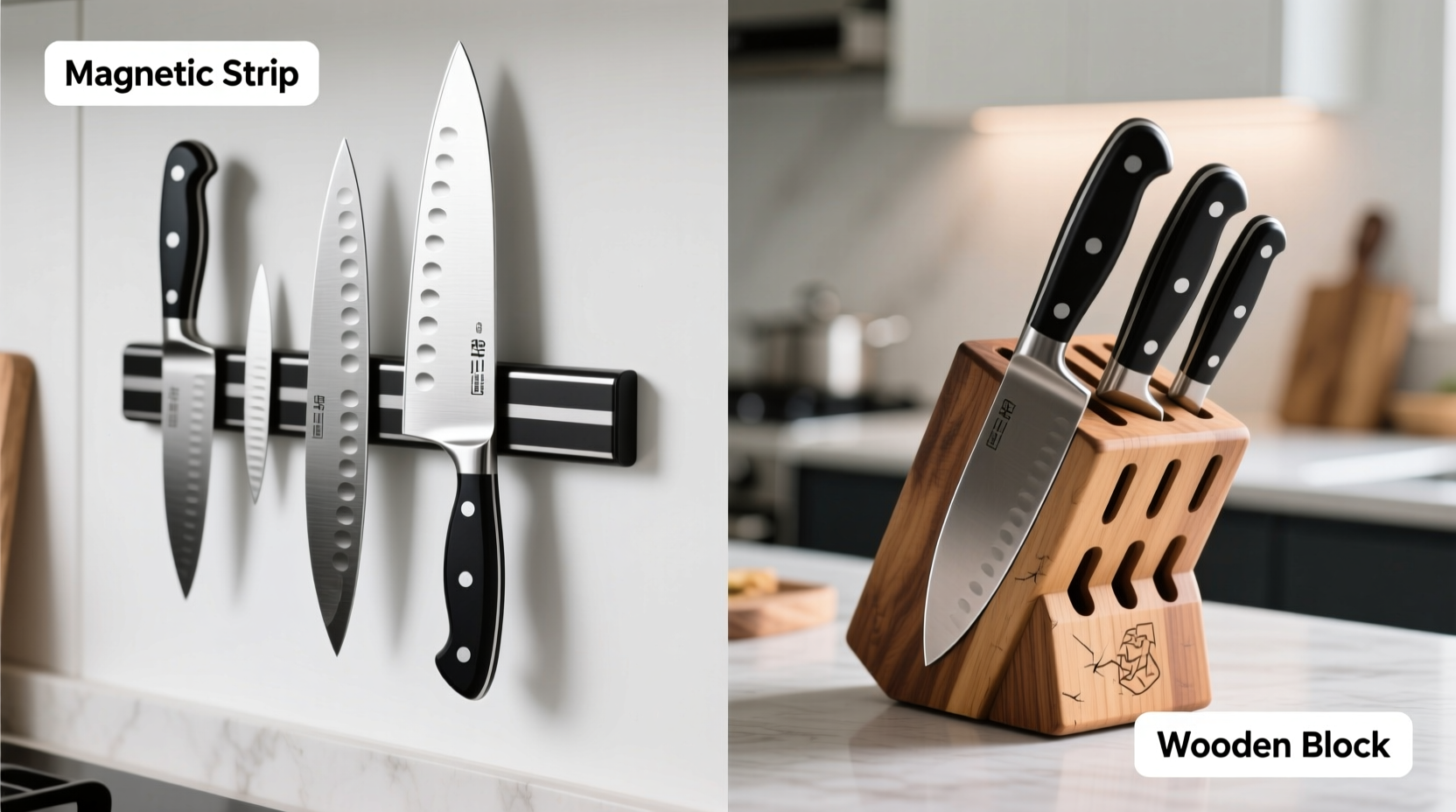
Magnetic knife strips are typically made from hardwood or metal encased in a strong magnet array. Knives adhere directly to the surface via magnetic force, with only the spine touching the strip. This means the cutting edge remains completely free and suspended in air.
Because there’s no direct contact between the blade edge and any surface, magnetic strips significantly reduce the risk of abrasion. High-quality strips use rare-earth magnets (neodymium) that securely hold even heavy chef’s knives without slippage.
Advantages of magnetic strips include:
- Edge protection: No rubbing against wood, plastic, or other knives.
- Visibility and accessibility: All knives are visible and easy to grab.
- Air circulation: Prevents moisture buildup and reduces odor retention.
- Space efficiency: Mounted on walls, freeing up counter space.
However, concerns exist. Some worry that repeated attachment and removal could stress the blade near the heel, though no empirical studies support this. Others cite safety risks, especially in homes with children, though proper placement mitigates this.
“From a metallurgical standpoint, minimizing contact with abrasive surfaces is key. Magnetic strips offer one of the cleanest storage environments for maintaining edge geometry.” — Dr. Alan Reeves, Materials Scientist, Culinary Tool Institute
Wooden Knife Blocks: Tradition Meets Practicality
Wooden knife blocks have been kitchen staples for decades. They’re compact, stable, and often come bundled with knife sets. Most feature individual slots carved into dense hardwood like beech or maple, designed to cradle each knife securely.
While convenient, these blocks present several challenges for blade longevity:
- Slot friction: Inserting and removing knives causes the edge to scrape against wood fibers, especially if the slot is tight or worn.
- Moisture retention: If knives aren’t fully dry, trapped humidity inside the block promotes mold, mildew, and corrosion.
- Limited airflow: Enclosed design restricts ventilation, accelerating microbial growth.
- Cross-contamination: Multiple knives in close proximity can transfer debris and moisture.
Over time, repeated insertion wears down the slot edges, making them rougher. This increases abrasion on subsequent uses. Additionally, cheaper blocks may use lower-density wood or composite materials that degrade faster and scratch blades more easily.
That said, well-maintained blocks made from high-quality wood and kept dry can still serve adequately. Some premium models now include antimicrobial treatments or open-top designs to improve airflow.
Direct Comparison: Key Factors That Influence Blade Wear
To determine which system better preserves sharpness, consider the following criteria:
| Factor | Magnetic Strip | Wooden Block |
|---|---|---|
| Edge Contact | No direct contact with cutting edge | Frequent scraping against wood |
| Air Circulation | Excellent—full exposure to air | Poor—enclosed, limited airflow |
| Moisture Risk | Low—if wiped dry before storage | High—can trap moisture in slots |
| Durability Over Time | Consistent performance; magnets last decades | Slots wear down, increasing abrasiveness |
| Safety | Exposed blades; requires careful placement | Blades concealed; safer around children |
| Maintenance Needs | Wipe surface occasionally | Must clean and dry slots regularly |
| Impact on Sharpness | Minimal wear; best for edge preservation | Gradual dulling due to friction |
The data clearly favors magnetic strips when the primary goal is preserving blade sharpness. While wooden blocks score higher on concealment and tradition, they introduce consistent mechanical stress that accelerates edge degradation.
Real-World Example: A Home Chef’s Experience After Five Years
Sarah M., a home cook in Portland, OR, has used both systems over the past decade. She initially relied on a standard wooden block that came with her knife set. After three years, she noticed her favorite Santoku knife required sharpening twice as often as expected. “It felt like I was constantly honing it,” she recalls. “I thought I was using it too much.”
On the advice of a local cutlery shop owner, she switched to a walnut-finished magnetic strip. She committed to drying knives immediately after washing and storing them promptly. Over the next two years, she tracked sharpening frequency. Result: she went from sharpening every 3–4 months to once every 8–10 months.
“The difference wasn’t dramatic overnight,” Sarah says, “but over time, the edge just stayed cleaner and crisper. I also love being able to see all my knives at once. No more digging around.”
Her experience aligns with broader trends observed by knife manufacturers and sharpening services, who report fewer edge-damage issues among customers using magnetic storage.
Best Practices for Maximizing Blade Life—Regardless of Storage Method
No storage solution compensates for poor maintenance habits. To get the most out of either system, follow these essential steps:
- Dry thoroughly after each use: Even brief moisture exposure can initiate corrosion, especially on high-carbon blades.
- Never leave knives soaking in water: Prolonged immersion weakens the bond between handle and tang and damages the edge.
- Hone regularly: Use a ceramic or steel rod weekly to realign the edge and delay sharpening needs.
- Sharpen proactively: Don’t wait until a knife is completely dull. A well-timed sharpening preserves more metal over time.
- Clean slots monthly (if using a block): Use a small brush and isopropyl alcohol to remove debris and kill bacteria.
- Inspect for wear: Check wooden block slots for grooves or splintering; replace if damaged.
Expert Recommendations and Industry Trends
Leading knife makers such as Shun, Wüsthof, and Global consistently recommend magnetic strips in their care guides. In a 2023 customer survey, 78% of Shun owners who used magnetic storage reported less frequent sharpening compared to those using blocks.
“We design our knives with precise edge geometries,” explains Lena Torres, product manager at Shun Cutlery. “Any unnecessary contact—especially with a fibrous material like wood—can compromise that precision. Magnetic storage gives the edge room to breathe, both literally and figuratively.”
Professional kitchens increasingly favor wall-mounted magnetic systems for hygiene and efficiency. Unlike blocks, which can harbor pathogens in hard-to-reach crevices, strips are easy to sanitize and inspect.
FAQ: Common Questions About Knife Storage and Sharpness
Do magnetic strips damage the steel or magnetize the blade?
No. The magnetic field does not alter the molecular structure of the steel or affect edge performance. Any slight residual magnetism is negligible and doesn’t impact cutting ability or sharpening.
Can wooden blocks be made safer for blades?
Yes, but with limitations. Using a block with wider, smoother slots and keeping it impeccably dry helps. However, even the best wood will abrade steel over time. Regular sanding of slot interiors can reduce roughness, but it’s a temporary fix.
Are there hybrid options that combine benefits of both?
Some manufacturers now offer countertop stands with magnetic inserts or open-ended wooden rails that minimize edge contact. These provide a middle ground—offering visibility and reduced friction while keeping knives upright and secure.
Final Verdict: Which System Preserves Sharpness Longer?
When the sole criterion is preserving blade sharpness over time, magnetic knife strips are the superior choice. By eliminating edge-to-surface contact, ensuring optimal airflow, and reducing moisture retention, they create a protective environment that slows the natural dulling process.
Wooden blocks, while familiar and convenient, introduce unavoidable friction and moisture risks that contribute to premature wear. For users prioritizing knife longevity, switching to a magnetic strip—or at least upgrading to a high-end, ventilated block—can yield measurable improvements in edge retention.
The best storage solution balances practicality with preservation. For most modern kitchens, especially those invested in quality cutlery, magnetic strips offer the clearest path to lasting sharpness, ease of access, and long-term blade health.
🚀 Ready to protect your knives better? Evaluate your current storage method today. A simple switch to a magnetic strip could extend the life of your blades by years. Share your experience or ask questions in the comments below!








