For decades, diamonds have symbolized enduring love, luxury, and status. But as technology advances, a new kind of diamond has entered the market—lab grown diamonds. These stones are chemically identical to natural diamonds but created in controlled environments over weeks instead of billions of years. As their popularity grows, so does the question: Can jewelers actually tell the difference?
The short answer is yes—but not always with the naked eye. The ability to distinguish between lab grown and natural diamonds depends on training, equipment, and sometimes even the specific characteristics of the stone. Understanding how this works reveals more than just gemology; it speaks to transparency, consumer awareness, and the evolving landscape of fine jewelry.
The Science Behind Diamond Formation
Diamonds are made of pure carbon atoms arranged in a cubic crystal structure. Whether formed deep within the Earth’s mantle under intense heat and pressure or synthesized in a laboratory using advanced techniques, the end result shares the same physical, chemical, and optical properties.
Natural diamonds typically take between 1 billion and 3.5 billion years to form at depths of about 90 to 120 miles below the surface. They’re brought closer to the surface through volcanic eruptions and mined from kimberlite pipes.
In contrast, lab grown diamonds are produced using two primary methods:
- High Pressure High Temperature (HPHT): This method replicates the Earth’s natural conditions by subjecting carbon to extreme pressures and temperatures, allowing crystals to grow around a small seed diamond.
- Chemical Vapor Deposition (CVD): A thin slice of diamond seed is placed in a vacuum chamber filled with carbon-rich gas. When heated, the gas breaks down and deposits carbon layer by layer onto the seed, forming a larger diamond crystal.
Both processes produce real diamonds—just without the geological timeline.
Tip: Not all \"synthetic\" means fake. Lab grown diamonds are real diamonds—just man-made. The term “synthetic” in gemology refers to origin, not authenticity.Visual Similarities and Why the Naked Eye Fails
To the untrained observer—and even many experienced jewelers—lab grown and natural diamonds appear indistinguishable when set in jewelry. Both exhibit fire, brilliance, scintillation, and hardness (a perfect 10 on the Mohs scale). Colorless grades, clarity levels, and cut quality can be nearly identical across both types.
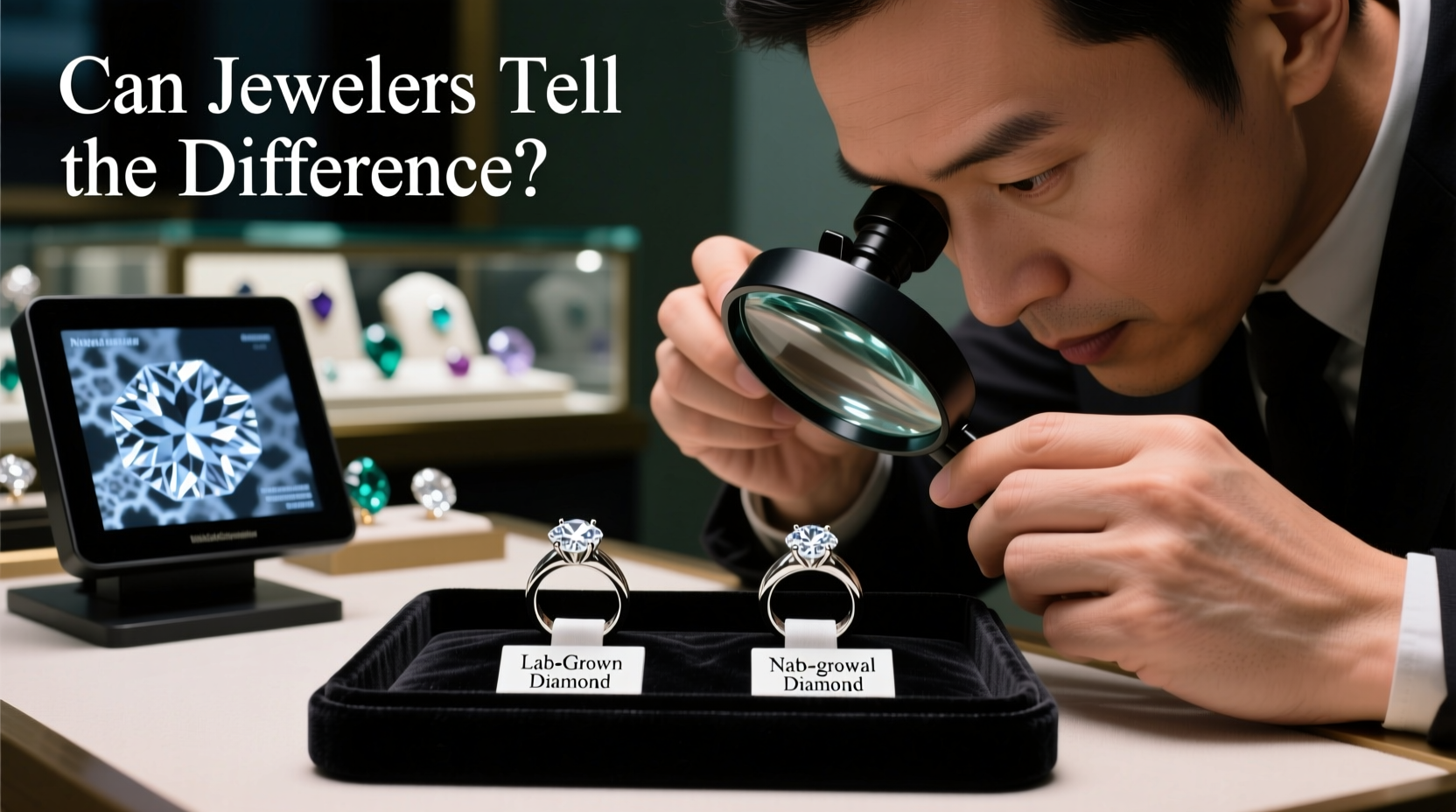
Jewelers who rely solely on loupe inspection or visual assessment cannot consistently differentiate between the two. In fact, many traditional tools like microscopes, refractometers, and loupes won’t reveal the origin of a diamond. Without specialized equipment, even professionals may misidentify a stone.
“Twenty years ago, we could confidently identify most diamonds based on inclusions and growth patterns visible under magnification. Today, that’s no longer reliable.” — Dr. Rebecca Lang, Gemological Researcher at GIA
This shift has forced the industry to adopt more sophisticated detection technologies, especially as lab grown diamonds now account for an estimated 10–15% of global diamond engagement ring sales.
How Experts Actually Tell the Difference
While casual observation fails, trained gemologists use advanced instruments and microscopic analysis to detect subtle differences. These tools go beyond basic magnification and analyze atomic structures, fluorescence patterns, and internal growth features.
Specialized Detection Equipment
Modern gem labs and high-end jewelry stores use devices designed specifically to identify lab grown diamonds. Some of the most common include:
- DiamondView (by De Beers Group): Uses ultraviolet light to reveal growth patterns. Natural diamonds often show complex, irregular growth zones, while HPHT and CVD stones display uniform, layered patterns unique to their manufacturing process.
- Photoluminescence Spectroscopy: Detects trace elements like nitrogen or silicon, which occur differently in lab grown versus natural stones. For example, CVD diamonds may contain silicon impurities introduced during chamber deposition.
- FTIR (Fourier Transform Infrared Spectroscopy): Measures how infrared light passes through the diamond, revealing information about nitrogen aggregation—a process that occurs slowly over time in nature but not in lab settings.
These tools are standard in major grading laboratories such as the Gemological Institute of America (GIA), International Gemological Institute (IGI), and HRD Antwerp. However, smaller independent jewelers may not have access to them, increasing the risk of unintentional misrepresentation.
Microscopic Clues
Even without electronic devices, trained gemologists can spot certain inclusion types associated with each origin:
- Natural Diamonds: Often contain mineral inclusions like garnet, peridot, or graphite. They may also show strain patterns due to natural formation stresses.
- HPHT Diamonds: May exhibit metallic flux inclusions (from catalyst metals like iron or nickel) that reflect light like tiny mirrors—something never found in natural stones.
- CVD Diamonds: Can show parallel graining or needle-like inclusions aligned with the growth layers. Some also display orange or red fluorescence under UV light.
However, these signs aren’t foolproof. High-quality lab grown diamonds are increasingly free of obvious indicators, making accurate identification dependent on comprehensive testing.
Can Retail Jewelers Tell the Difference?
The reality is nuanced. Most local jewelers do not possess the $15,000–$30,000 equipment required for definitive identification. While they might suspect a stone is lab grown based on price or documentation, confirmation requires sending it to a certified lab.
A survey conducted by the Jewelers’ Circular Keystone in 2023 found that only 37% of independent jewelers owned any form of advanced diamond screening device. Of those, fewer than half used it routinely for every stone.
This gap creates potential risks:
- A jeweler repairing a setting might unknowingly expose a lab grown diamond to high heat, causing discoloration if it hasn't been properly treated.
- Insurance appraisals could be inaccurate if origin isn't verified, affecting valuation and resale value.
- Consumers may believe they're buying a natural diamond when they’re not—especially if disclosure practices are lax.
That said, ethical jewelers will disclose whether a diamond is lab grown and provide certification from recognized labs. Transparency remains key.
Tip: Always ask for a grading report from GIA, IGI, or GCAL. These reports clearly state whether a diamond is natural or lab grown and detail its specifications.Comparison Table: Key Differences Between Lab Grown and Natural Diamonds
| Feature | Natural Diamond | Lab Grown Diamond |
|---|---|---|
| Origin | Earth’s mantle (geological) | Laboratory (controlled environment) |
| Formation Time | 1–3.5 billion years | 2–6 weeks |
| Price (for 1ct D VS1) | $8,000–$14,000 | $2,000–$4,000 |
| Inclusions | Mineral crystals, feathers, clouds | Metallic flux (HPHT), silicon needles (CVD) |
| Detection Tools Needed | Advanced spectroscopy, DiamondView | Same as left |
| Resale Value Trend | Stable long-term appreciation | Rapid depreciation (up to 70% off retail) |
Mini Case Study: A Bridal Shop’s Mistake
In 2022, a boutique jewelry store in Austin received a vintage-style engagement ring for repair. The customer believed it contained a natural diamond passed down from her grandmother. The jeweler examined it under a microscope, noted its excellent cut and clarity, and assumed it was natural due to its age-like appearance.
After resetting the stone, he returned it—only to receive a complaint days later. An independent appraisal revealed it was a high-clarity CVD lab grown diamond, likely purchased new five years prior. There had been no disclosure from the original seller.
The incident led to a formal complaint with the FTC and prompted the shop to invest in a portable diamond screener. It also highlighted how easily assumptions can lead to errors—even among trusted professionals.
Step-by-Step Guide: How to Verify Your Diamond’s Origin
If you're unsure whether your diamond is natural or lab grown, follow this practical sequence:
- Check the Certification: Look for a report from GIA, IGI, or GCAL. If absent, request one.
- Review the Report Details: Lab grown diamonds are labeled as such. Reports include terms like “Laboratory-Grown” or “Synthetic.”
- Look for Engraved Markings: Many lab grown diamonds have microscopic laser inscriptions on the girdle (e.g., “LG” or brand names like “Lightbox”). Use a 10x loupe to check.
- Visit a Reputable Jeweler: Ask them to scan the stone with a diamond verifier. Devices like the GIA iD100 or Presidium Tester can flag potential synthetics.
- Send to a Lab (if uncertain): For absolute certainty, submit the loose stone to a gemological lab for full analysis.
“Assuming a diamond’s origin based on price or appearance is risky. Only proper instrumentation provides confidence.” — Michael Tran, Senior Gemologist at IGI Los Angeles
Frequently Asked Questions
Can a jeweler accidentally sell a lab grown diamond as natural?
Yes, especially if they lack proper screening tools or source from unreliable suppliers. While intentional fraud exists, many cases stem from oversight or inadequate verification protocols.
Do lab grown diamonds test as real on standard diamond testers?
Yes. Standard thermal conductivity testers (commonly used since the 1980s) cannot distinguish between natural and lab grown diamonds because both are true diamonds. Only advanced spectrometers or photoluminescence tools can detect origin.
Are lab grown diamonds worth less than natural ones?
Significantly so. While visually identical, lab grown diamonds typically retail for 60–80% less than comparable natural stones. More importantly, they depreciate rapidly after purchase and have limited secondary market value.
Checklist: What to Do Before Buying a Diamond
- ✅ Request a grading report from a reputable lab (GIA, IGI, GCAL).
- ✅ Confirm whether the report states “Natural” or “Laboratory-Grown.”
- ✅ Inspect the girdle under magnification for laser inscriptions.
- ✅ Ask the jeweler directly about the diamond’s origin and return policy.
- ✅ Avoid sellers who refuse to disclose or seem evasive about sourcing.
Conclusion: Knowledge Is Your Best Investment
The line between lab grown and natural diamonds may be invisible to the eye, but the implications are far from subtle. From emotional significance to long-term value, the origin of a diamond matters—not because one is inherently superior in beauty, but because choice should be informed.
Jewelers today face new responsibilities in an era where synthetic gems are virtually indistinguishable without technology. Consumers, in turn, must become proactive advocates for transparency. Asking questions, demanding certifications, and understanding the tools behind identification empowers smarter decisions.
💬 Have you ever questioned a diamond's origin? Share your experience or ask a jeweler for a screening—your next piece of jewelry could depend on it.








