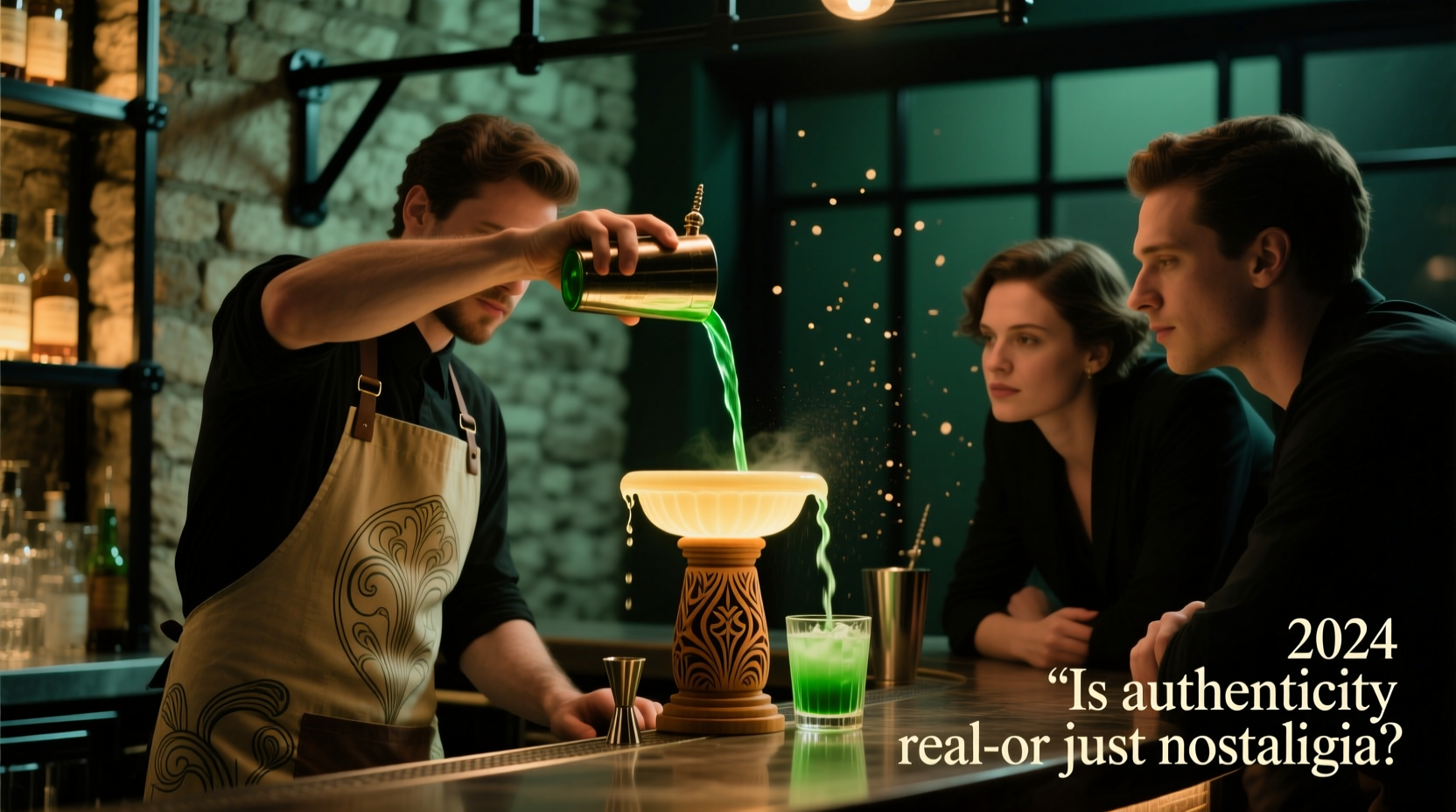
Walk into any high-end cocktail bar in Portland, Brooklyn, or Berlin today, and you’re likely to see it: a slender glass, a sugar cube perched on a slotted spoon, a slow drip of ice-cold water turning cloudy emerald. Absinthe—once banned, mythologized, and nearly erased from Western drinking culture—is back. Not as a relic, but as a featured spirit on menus, often priced at $24–$36 per serving. Its return is neither accidental nor merely decorative. Yet beneath the ritual, the green hue, and the whispered lore lies a tension that defines its modern identity: Is this revival rooted in rigorous respect for historical production, botanical integrity, and cultural continuity—or is it an elegant performance, where the spirit serves less as a drink than as a prop in a carefully staged narrative of bohemian romance?
The answer isn’t binary—but understanding the interplay between authenticity and aesthetic nostalgia reveals far more about contemporary craft beverage culture than absinthe itself. It exposes how tradition is curated, how regulation shapes perception, and why certain spirits become vessels for collective longing.
A Brief History: From Medicinal Tincture to Moral Panic
Absinthe emerged in late 18th-century Switzerland not as a recreational intoxicant but as a medicinal elixir—a maceration of wormwood (Artemisia absinthium), anise, fennel, and other alpine herbs in wine alcohol. By the 1840s, French soldiers returning from Algeria brought back “la fée verte” (“the green fairy”) as a prophylactic against malaria and dysentery. Its popularity surged in Parisian cafés, embraced by artists, writers, and intellectuals—from Baudelaire and Verlaine to Degas and Toulouse-Lautrec—who credited its complex bitterness and cerebral lift with sharpening creativity.
Yet by 1915, absinthe was outlawed across much of Europe and the United States—not because of conclusive evidence of unique toxicity, but due to a confluence of factors: aggressive lobbying by the wine industry (threatened by absinthe’s affordability and potency), sensationalist journalism linking it to madness and crime, and flawed toxicology that conflated thujone (a monoterpene in wormwood) with hallucinogenic effects. Modern analysis shows thujone levels in pre-ban absinthe were rarely above 10 mg/L—well below neurotoxic thresholds—and that the spirit’s real danger lay in its high ABV (typically 65–72%) and frequent adulteration with copper salts (for color) or antimony (to induce euphoria).
The ban didn’t erase absinthe—it fossilized it. For nearly a century, it existed only in legend, in faded posters, and in bootlegged myths. Its return wasn’t inevitable; it was negotiated.
The Regulatory Reopening: Authenticity Begins With Legality
The modern revival began not in bars, but in courtrooms and chemistry labs. In the 1990s, Swiss distillers like Claude-Alain Bugnon (La Clandestine) and later French producers such as Duplais and Jade Liqueurs petitioned regulators to reclassify absinthe—not as a dangerous drug, but as a traditional distilled spirit governed by botanical and labeling standards.
Key regulatory shifts enabled authenticity:
- EU Regulation (1988/2008): Defined absinthe as a distilled spirit containing Artemisia absinthium, with minimum anethole (from anise/fennel) and maximum thujone limits (10 mg/kg for “absinthe,” 35 mg/kg for “bitters”).
- U.S. TTB Ruling (2007): Removed the blanket thujone ban, permitting sale if thujone content is ≤10 ppm—effectively aligning with EU standards and enabling import and domestic production.
- Appellation Recognition: The Val-de-Travers region in Switzerland secured protected geographical indication (PGI) status for “Absinthe de Val-de-Travers” in 2005, mandating local wormwood, traditional copper stills, and natural coloration (no artificial dyes).
These weren’t bureaucratic footnotes—they created scaffolding for authenticity. Without them, what returned would have been imitation: green-colored vodka with a splash of anise oil. Instead, producers now invest in wild-harvested wormwood, multi-stage macerations, and fractional distillation—processes that take weeks, not hours.
“Authentic absinthe isn’t about replicating a 19th-century label. It’s about respecting the plant’s terroir, the still’s voice, and the patience required to coax complexity without shortcuts.” — David G. G. S. M. V., Master Distiller, La Fée Absinthe (France)
Aesthetic Nostalgia: The Ritual as Stagecraft
Yet legality alone doesn’t explain why absinthe commands attention on bar menus while equally historic spirits—like kümmel or benedictine—remain niche. That distinction belongs to its unparalleled aesthetic grammar: the louche (clouding), the sugar cube, the slow drip, the green glow under low light. This isn’t incidental theater—it’s deliberate semiotics.
In craft bars, absinthe service functions as a micro-performance. Bartenders don’t just pour; they conduct. They measure water precisely, rotate the spoon slowly, observe the emulsion form. Patrons aren’t merely consuming alcohol—they’re participating in a rite that signals sophistication, historical literacy, and intentional slowness in a fast-paced world.
This ritual taps into three potent currents of contemporary desire:
- Escapism: A tactile, multisensory break from digital saturation.
- Curatorial Identity: Ordering absinthe signals taste, knowledge, and alignment with artisanal values—even if the drinker has never tasted a pre-ban bottle.
- Narrative Cohesion: Bars like Attaboy (NYC) or Satan’s Whiskers (London) embed absinthe within broader themes—fin-de-siècle decadence, alchemical symbolism, or Provençal herb gardens—making the spirit part of a larger story.
Authenticity vs. Nostalgia: A Comparative Framework
The distinction isn’t theoretical—it manifests in tangible decisions made by distillers, bartenders, and consumers. The table below maps key dimensions where authenticity and aesthetic nostalgia diverge, overlap, or coexist.
| Dimension | Authenticity-Driven Practice | Aesthetic Nostalgia-Driven Practice | Where They Converge |
|---|---|---|---|
| Botanical Sourcing | Wild-harvested Artemisia absinthium from native habitats (e.g., Swiss Jura); seasonal harvesting timed to peak thujone/anethole ratios. | Organic-certified but commercially farmed wormwood; prioritizes consistency over terroir expression. | Rejection of synthetic thujone or artificial coloring—both agree on “natural” as non-negotiable. |
| Distillation Method | Copper pot stills; double or triple distillation; no cold compounding (mixing neutral spirits with extracts). | Single distillation + post-distillation infusion; use of vacuum distillation for delicate top notes. | Emphasis on clarity of flavor and absence of harsh fusel oils—both avoid industrial shortcuts. |
| Bar Service | Customized water ratio based on spirit strength; optional flame ritual only if historically documented for that brand (e.g., Bohemian-style). | Standardized 4:1 drip; theatrical sugar ignition; branded spoons and fountains as Instagram props. | Use of proper glassware (absinthe glasses with reservoirs) and emphasis on louche formation as quality indicator. |
| Consumer Education | Labels list botanical provenance, harvest date, thujone level, and distillation method. | Menu copy emphasizes “Van Gogh’s muse” or “Hemingway’s poison”—story over specs. | Both reject the “dangerous drug” trope; position absinthe as a serious, sippable spirit—not a party shot. |
Mini Case Study: The Portland Paradox
In 2019, Portland’s Bar Icarus launched “The Green Hour”—a weekly absinthe tasting series featuring six producers: two Swiss PGI-certified labels, one American craft distiller using Oregon-grown wormwood, and three European brands marketed heavily on Art Nouveau branding. Over six months, staff tracked engagement metrics: attendance, social media tags, and reorder rates.
Findings revealed a telling split:
- Attendees consistently rated the Swiss and Oregon bottles highest in blind tastings—praising their balance of bitter, sweet, and herbal notes—but accounted for only 32% of total sales.
- The most popular bottle was a French brand whose label featured a stylized Art Nouveau woman, whose website led with quotes from Rimbaud, and whose menu description read: “Sip the muse.” It drove 48% of sales and 76% of Instagram tags.
- When staff replaced the decorative fountain with a simple glass carafe and omitted the sugar cube, sales of that top-selling brand dropped 22%—despite identical liquid and water ratio.
The lesson wasn’t that customers preferred aesthetics over taste. It was that for many, the *experience*—the visual language, the ritual, the shared moment of transformation as the liquid clouded—was inseparable from the flavor. Authenticity mattered in the mouth; nostalgia mattered in the memory.
What Consumers Can Do: A Practical Checklist
You don’t need a chemistry degree or a vintage spoon collection to engage meaningfully with absinthe’s revival. These actionable steps help you navigate the line between informed appreciation and passive consumption:
- ✅ Read the label critically: Look for “distilled,” “wormwood,” and ABV (should be 55–72%). Avoid “extract,” “infused,” or ABV under 50%—these indicate compromise.
- ✅ Ask your bartender one question: “Is this served traditionally, or is there a house method?” Their answer reveals their knowledge—and your opportunity to learn.
- ✅ Taste neat first: Before adding water, sip 1/4 oz at room temperature. Note bitterness, anise intensity, and finish length. This builds your reference point.
- ✅ Compare water ratios: Try the same absinthe at 3:1, 4:1, and 5:1 water-to-spirit. The optimal louche isn’t always 4:1—some benefit from slower dilution.
- ✅ Seek out non-green expressions: Blanche (clear) absinthes highlight herbal nuance without color bias. They’re often more transparent about botanical balance.
FAQ
Is modern absinthe “safer” than pre-ban versions?
Yes—but not because it’s weaker. Pre-ban absinthe contained variable (and sometimes dangerous) adulterants: methanol from poor distillation, copper acetate for green color, and antimony trichloride for “special effects.” Modern regulated absinthe eliminates those hazards. Thujone levels are comparable to pre-ban averages, and its primary risk remains high alcohol content—no different from cognac or navy-strength rum.
Why do some absinthes taste so sweet, while others are aggressively bitter?
Sweetness comes from added sugar post-distillation (common in commercial “pastis”-style products) or from anise/fennel dominance. True bitterness arises from wormwood’s sesquiterpene lactones—and skilled distillers balance it with citrus peel, hyssop, or star anise. If bitterness overwhelms, it’s often a sign of poor botanical ratio or rushed maceration—not authenticity.
Can I make authentic absinthe at home?
No—legally or practically. Home distillation is illegal in most countries, and true absinthe requires precise fractional distillation to separate volatile compounds. “Homemade absinthe” kits typically produce wormwood-infused vodka, lacking the layered complexity, stability, and safety profile of professionally distilled spirit.
Conclusion: Toward a More Honest Reverence
Absinthe’s return isn’t a victory for either authenticity or nostalgia alone—it’s a testament to their necessary entanglement. Authenticity without aesthetic resonance risks obscurity: a perfectly distilled spirit ignored because it lacks cultural entry points. Nostalgia without authenticity devolves into caricature: green liquid masquerading as heritage while delivering little beyond spectacle.
The most compelling developments lie where the two converge: when distillers document their wormwood harvests like winemakers chart vineyards; when bartenders teach the science behind the louche alongside its symbolism; when drinkers savor the bitterness not as a challenge, but as a conversation with botany and history. That convergence doesn’t erase the past—it reanimates it with integrity.
This isn’t about choosing sides. It’s about asking better questions: Whose history is being honored? Which plants are being tended? What labor is being valued? And when the sugar dissolves and the water drips and the liquid turns milky green—what, exactly, are we toasting?
💬 Your turn: Have you experienced absinthe as ritual, revelation, or both? Share your most memorable tasting—what surprised you, what disappointed you, and what you’ll seek next. Let’s build a more thoughtful, grounded conversation around the green fairy’s second act.








