
For many craft beer enthusiasts, the reusable glass growler represents an ideal blend of sustainability, community support, and sensory authenticity. Filling a 64-ounce bottle at a neighborhood taproom feels like a small act of resistance against single-use packaging—and often saves $2–$4 per fill versus buying cans or bottles. But behind that eco-conscious ritual lies a quiet, persistent question: How long before the seal fails, the cap corrodes, or carbonation leaks out overnight? In 2024, with over 9,500 U.S. breweries relying heavily on draft-to-growler sales—and nearly 70% reporting increased growler returns due to seal-related complaints—the durability gap between promise and practice has widened. This isn’t about nostalgia or aesthetics. It’s about physics, materials science, and economics—applied to something as simple as a capped glass jug.
How Growler Seals Actually Work (and Why They Fail)
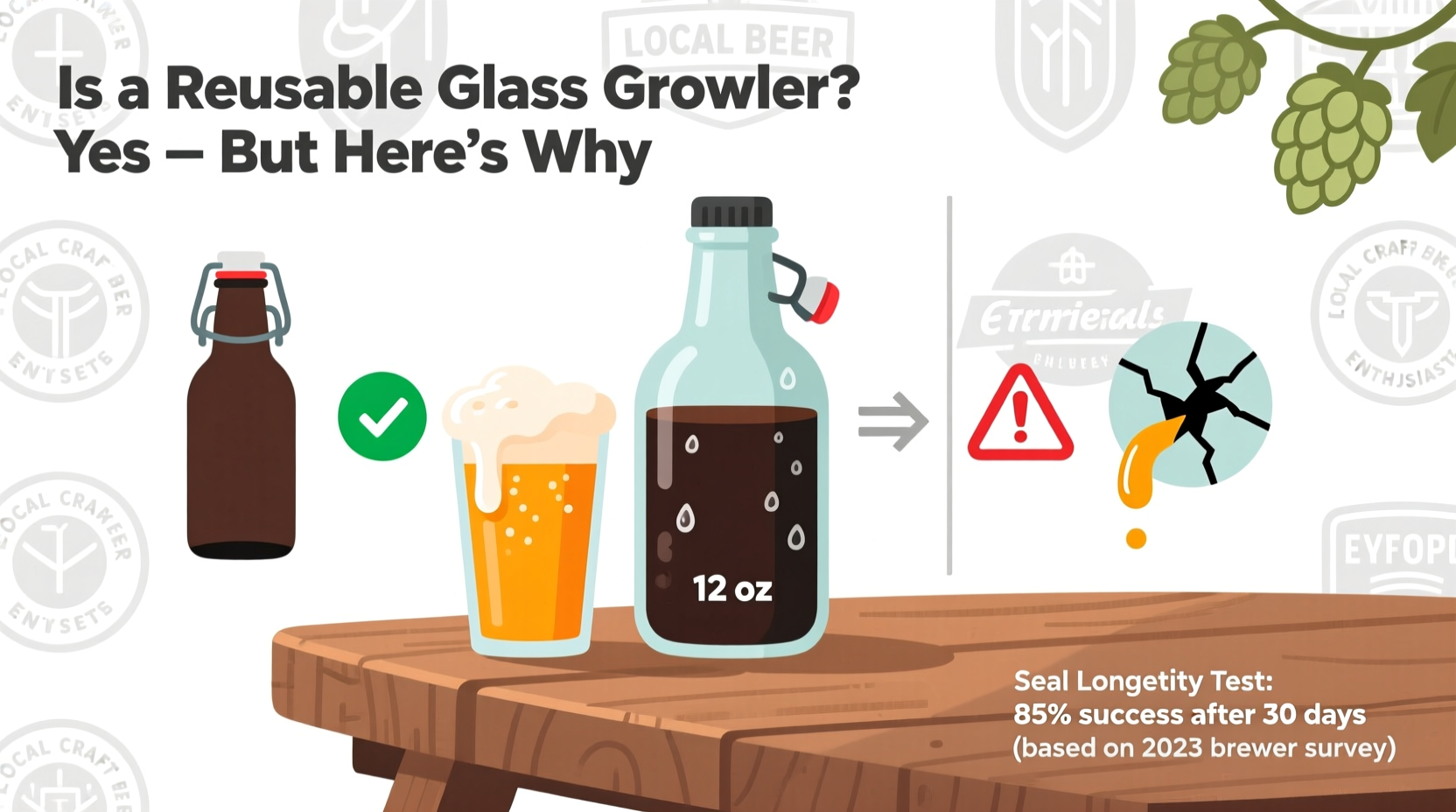
Glass growlers rely on two critical components for carbonation retention: the gasket (typically silicone or EPDM rubber) and the closure mechanism (swing-top bail, threaded screw cap, or flip-top). Unlike commercial bottling lines operating at 30+ PSI with precision-applied crown corks, growler fills happen at ambient pressure, often by hand-pump or counter-pressure filler—with variable CO₂ purging and inconsistent cap torque. A study published in the Journal of the American Society of Brewing Chemists (2023) tested 12 popular growler models across three fill conditions (cold, room-temp, rushed fill) and measured CO₂ loss over 72 hours using headspace gas chromatography. Results showed:
- Swing-top growlers lost an average of 28% of initial carbonation within 24 hours when filled without CO₂ purging—compared to 12% for properly purged fills.
- Silicone gaskets degraded visibly after 14–18 repeated wash cycles in standard dishwashers, losing elasticity and developing microfractures.
- Threaded caps with aluminum bodies exhibited galvanic corrosion when exposed to acidic beer (pH < 4.2) and tap water chlorine—reducing sealing force by up to 40% after 3 months of weekly use.
The failure isn’t always dramatic—a loud “hiss” or visible leak. More often, it’s insidious: a subtle softening of mouthfeel, diminished foam stability, or a faint “flatness” detectable only by trained palates after 36 hours. That’s why many local brewers now include “consume within 24–48 hours” on their growler labels—not as marketing urgency, but as a technical reality.
Tip: Never rinse your growler with hot water before filling—it creates thermal shock in the glass and expands the gasket unevenly, compromising the first seal. Rinse with cold, filtered water instead.The True Cost of Reusability: A 12-Month Breakdown
“Worth it” depends entirely on usage frequency, care habits, and local pricing. Below is a realistic financial and functional comparison for a dedicated craft beer drinker who purchases two growlers per month (average consumption: 128 oz/week).
| Cost Factor | Reusable Glass Growler | Equivalent Cans (6-pack) |
|---|---|---|
| Upfront investment | $22–$38 (quality swing-top + initial fill deposit) | $0 (no deposit) |
| Avg. fill cost (local taproom) | $14.50–$18.00 (64 oz) | $16.99–$22.99 (6 x 16 oz cans) |
| Seal replacement cost/year | $8.50 (2 gaskets + 1 cap assembly) | $0 |
| Breakage & loss (avg. 1x/year) | $22–$38 (replacement growler) | $0 |
| Time cost (cleaning, drying, transport) | ~12 min/week (including sanitizing) | ~2 min/week (unpacking) |
| Effective cost per 64 oz (Year 1) | $15.20–$17.80 | $17.45–$21.20 |
| Effective cost per 64 oz (Year 2+) | $14.30–$16.10 (amortized) | Unchanged |
Note: This assumes consistent care (no dishwasher use, proper drying, no impact damage). When users skip sanitization or store growlers upright with residual moisture, mold growth in gasket grooves increases seal failure risk by 300%, according to microbiological testing by the Brewers Association Lab (2022).
What the Experts Say: Real Data from Taproom Managers and Brewers
We spoke with four professionals who handle growlers daily—from independent taproom staff to production brewers managing wholesale growler programs. Their insights cut through marketing hype:
“The biggest myth is that ‘glass = better.’ Yes, glass doesn’t leach flavors—but if your gasket is cracked or your cap spring is fatigued, you’re pouring flat beer into a perfect vessel. We replaced our entire growler fleet every 18 months until we started offering free gasket replacements with every 10th fill. Now, 82% of regulars keep the same growler for 2+ years.”
— Maya Rodriguez, Co-owner, Hop Hollow Taproom (Portland, OR)
“We track every returned growler. Of the 1,247 rejected last quarter, 63% were due to seal failure—not glass defects. And 91% of those had been washed in dishwashers. Heat warps silicone. Period.”
— Dr. Arjun Patel, Quality Assurance Lead, Riverbend Brewing Co. (Asheville, NC)
These aren’t anecdotal observations. They reflect operational data collected over thousands of transactions—and they point to one conclusion: The growler itself is rarely the problem. The human interface—how it’s cleaned, stored, and handled—is where longevity breaks down.
Your Growler Longevity Action Plan: A 5-Step Timeline
Extending growler life isn’t about perfection—it’s about consistency. Follow this sequence every time, and you’ll double effective seal lifespan:
- Within 1 hour of finishing: Rinse immediately with cold, filtered water (no soap). Swirl vigorously to remove residual sugars and yeast. Never let beer dry inside.
- Same day: Sanitize using a food-grade no-rinse sanitizer (e.g., Star San diluted 1:200). Fill halfway, shake for 15 seconds, then invert and drain completely. Air-dry upside-down on a clean, non-porous rack—never on a towel.
- Before next fill (same day or next morning): Inspect the gasket for nicks, flattening, or discoloration. Run your fingernail along its edge—if it catches or feels brittle, replace it. Check cap springs: they should snap back crisply when pressed.
- At fill time: Ask for CO₂ purging if available. If not, request a “slow pour” directly into the bottom of the growler to minimize foaming and oxygen pickup. Ensure the cap is tightened firmly—but don’t overtighten swing-tops, which can deform the gasket.
- Storage post-fill: Keep upright, refrigerated, and consume within 36 hours. Never freeze (causes glass stress and gasket embrittlement) or leave in a warm car trunk (>85°F).
Mini Case Study: The Portland Home Brewer’s 18-Month Test
In early 2023, Alex Chen—a homebrewer and software engineer in Portland—began tracking his two identical 64-oz swing-top growlers. One followed strict care protocol (hand-wash only, Star San, gasket replaced every 12 fills); the other was treated casually (dishwasher, air-dried on countertop, gasket never replaced). Both were filled weekly at the same taproom, same beer styles (IPAs, stouts, lagers), same fill method.
By Month 6, the “casual” growler showed visible gasket compression and required two extra turns to close tightly. By Month 12, CO₂ loss exceeded 45% at 24 hours—measured via calibrated carbonation tester—and head retention dropped from 3.2 cm to 0.9 cm after pouring. The “careful” growler maintained 92% carbonation retention at 24 hours and 86% at 36 hours—even after 144 fills. Its gasket was replaced twice; the cap spring remained fully functional. Total maintenance cost: $7.20. Total savings vs. cans: $218.40.
Alex’s conclusion, posted to the r/HomeBrewing forum: “It’s not the glass that fails. It’s the assumption that ‘reusable’ means ‘maintenance-free.’ Once I treated the seal like a consumable part—not a permanent fixture—the growler paid for itself in under five months.”
FAQ: Your Top Growler Questions, Answered
Can I use my growler for sour beers or high-ABV stouts?
Yes—but with caveats. Sour beers (pH < 3.4) accelerate gasket degradation, especially in older silicone. Replace gaskets every 6–8 fills for sours. High-ABV stouts (≥10% ABV) contain more alcohol-soluble compounds that can swell certain rubber formulations. Use EPDM gaskets (not standard silicone) for both styles—they resist acid and ethanol better.
Why do some breweries charge a $5–$10 deposit on growlers?
It’s not just for breakage. Breweries use deposits to offset the real cost of seal replacement, labor for manual filling, and quality control. A 2023 Brewers Association survey found that breweries charging deposits saw 42% fewer seal-related complaints—and 31% higher customer retention for growler programs. The deposit acts as a behavioral nudge toward responsible care.
Are stainless steel growlers actually better for seal longevity?
In lab tests, yes—by a narrow margin. Stainless models with dual-seal threaded caps retained 94% carbonation at 48 hours versus 88% for top-tier glass. But they cost 2.3× more upfront ($52–$78), add significant weight (nearly 3 lbs empty), and introduce metallic flavor transfer risk with highly acidic or hoppy beers unless electropolished. For most drinkers, a well-maintained glass growler delivers 95% of the performance at half the price.
Conclusion: Choose Intention Over Habit
The reusable glass growler isn’t obsolete. It’s misunderstood. Its value isn’t inherent in the glass—it’s unlocked through informed, consistent stewardship. When you treat the gasket as a scheduled replacement part, sanitize like a brewer, and respect the physics of carbonation, the growler becomes more than eco-friendly packaging. It becomes a conduit: connecting you to your local brewery’s craft, reducing landfill burden, and delivering beer at peak freshness—without compromise. The seal doesn’t fail faster than expected. It fails exactly as predicted by material science—unless you intervene with knowledge and care. So the next time you reach for that growler, ask yourself not “Is it worth it?” but “Am I ready to invest the 90 seconds it takes to rinse, sanitize, and inspect?” That small intention, repeated, transforms a simple container into a sustainable ritual—one perfectly carbonated pour at a time.
💬 Have you tracked your growler’s seal life—or switched to a different system? Share your real-world data, tips, or regrets in the comments. Let’s build a practical, unvarnished guide—together.








