
The iPhone X was one of the first iPhones to support wireless charging, marking a shift toward cable-free convenience. Apple officially supports up to 7.5W charging when using certified Qi chargers, but many third-party options offer 10W output. Meanwhile, standard chargers—especially older or basic models—often max out at 5W. This raises a practical question: does stepping up from 5W to 10W make a meaningful difference in real-world charging speed for the iPhone X?
The short answer is yes—but with caveats. While a 10W charger can deliver faster charging under ideal conditions, the iPhone X's internal power management limits how much of that extra wattage it actually uses. Understanding this requires looking beyond marketing claims and into hardware limitations, thermal regulation, and charging efficiency.
How Wireless Charging Works on the iPhone X
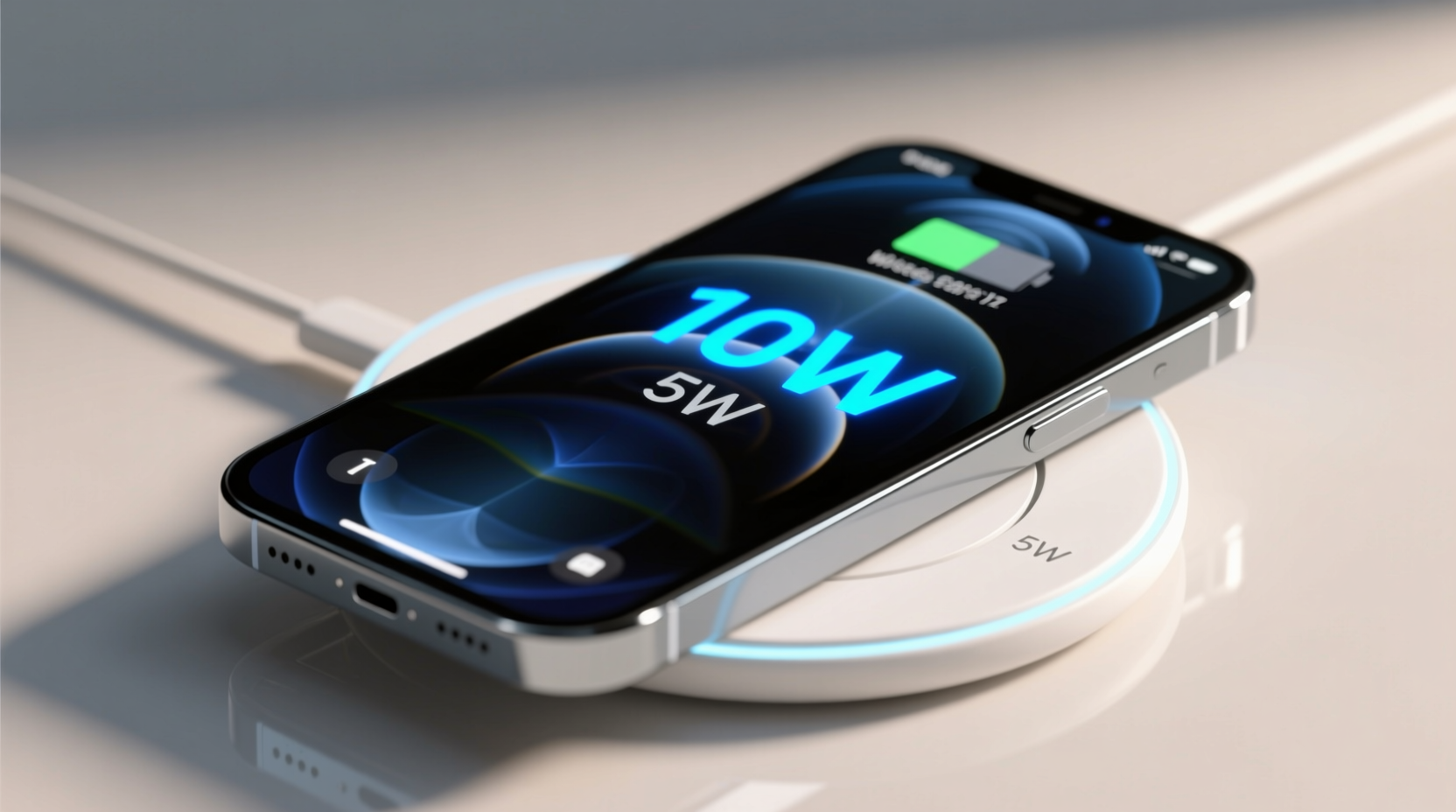
The iPhone X uses the Qi wireless charging standard, which operates through electromagnetic induction. A coil in the charger creates an alternating magnetic field, which induces a current in a corresponding coil inside the phone. That current is then converted into usable power to charge the battery.
However, not all power sent from the charger reaches the battery. Energy is lost as heat during transmission, especially if the alignment between coils isn’t perfect or if foreign materials (like thick cases) interfere. The iPhone X includes safeguards to prevent overheating, which means it dynamically adjusts input based on temperature and available power.
Apple engineered the iPhone X to accept up to 7.5W wirelessly when paired with a compatible charger. This is higher than the base 5W typically delivered by older or non-certified pads but still below the 10W offered by many modern third-party chargers.
Tip: For optimal wireless charging speed, remove thick cases and ensure the phone is centered on the pad.Power Output Comparison: 5W vs. 7.5W vs. 10W
To assess whether a 10W charger is meaningfully faster, it helps to compare actual performance across different power tiers. Below is a breakdown of what each level offers:
| Charger Type | Max Output | iPhone X Usable Input | Estimated Charge Time (0% to 80%) | Notes |
|---|---|---|---|---|
| Basic Qi Pad | 5W | 5W | ~3 hours | Common with older or uncertified chargers |
| Apple-Certified Qi | 7.5W | 7.5W | ~2 hours 15 mins | Requires MFi-certified charger; optimal supported rate |
| Third-Party 10W | 10W | 7.5W (limited by phone) | ~2 hours 15 mins | Extra power unused unless device supports higher input |
As shown, while a 10W charger may technically supply more power, the iPhone X will not draw beyond 7.5W. Therefore, once you're using a properly certified 7.5W-capable charger, upgrading to a 10W model won't reduce charging time further.
“Many users assume higher wattage always means faster charging, but device limitations often cap those gains. The bottleneck is usually the phone, not the charger.” — Dr. Alan Reyes, Power Systems Engineer at MobileTech Insights
Real-World Performance: A Mini Case Study
Consider Sarah, a freelance designer who relies on her iPhone X throughout the day. She previously used a no-name 5W wireless charger and noticed it took nearly three hours to get from 20% to full. After reading about faster charging options, she upgraded to a reputable brand’s 10W Qi charger.
Her expectation? A dramatic improvement. In practice, her charge time dropped only slightly—to about 2 hours and 20 minutes. Confused, she contacted customer support and learned her new charger was capable of 10W, but her iPhone X would only accept up to 7.5W. The improvement over her old 5W pad came from better coil alignment and consistent power delivery, not raw wattage.
When she tested the same 10W charger with a newer iPhone 12 (which supports 15W MagSafe), the difference was immediately noticeable—her phone reached 50% in just 30 minutes. This illustrates a key point: charger capability matters less than device compatibility.
Optimizing Wireless Charging: Step-by-Step Guide
To get the most out of your iPhone X wireless charging—even with a 10W charger—follow these steps:
- Use a certified 7.5W Qi charger: Look for MFi (Made for iPhone) certification or reputable brands like Anker, Belkin, or ESR.
- Remove thick or metal-backed cases: These can block the magnetic field and reduce efficiency.
- Center the phone precisely: Misalignment reduces coupling efficiency and slows charging.
- Avoid charging on soft surfaces: Pillows or couches can trap heat and trigger thermal throttling.
- Keep the phone cool: High temperatures cause the system to reduce input power to protect the battery.
- Use a wall adapter with sufficient output: Pair your wireless pad with a 12W or higher USB-A adapter; underpowered adapters limit performance.
Common Misconceptions About Charger Wattage
There’s widespread confusion around what charger wattage actually means for end users. Here are some clarifications:
- Higher wattage doesn’t damage your phone: Devices negotiate power draw—they only take what they can handle.
- Not all 10W chargers are equal: Some cheap models claim 10W but fail to maintain stable output due to poor circuitry.
- Fast charging labels can be misleading: “Fast” on a wireless pad may just mean 7.5W compared to 5W—not true fast charging like wired PD.
- Battery health matters more than speed: Frequent overnight wireless charging generates heat, which degrades lithium-ion batteries over time.
Checklist: Maximizing iPhone X Wireless Charging Efficiency
Before assuming your charger is slow, verify the following:
- ✅ Use a Qi-certified wireless charger labeled for 7.5W iPhone support
- ✅ Ensure the wall adapter outputs at least 12W (e.g., iPad charger)
- ✅ Remove protective case if thicker than 3mm or contains metal
- ✅ Place the phone in the center of the charging pad
- ✅ Avoid using the phone while charging wirelessly (generates excess heat)
- ✅ Monitor for warmth—if hot, stop charging and reposition
Frequently Asked Questions
Can I use a 10W Android wireless charger with my iPhone X?
Yes, as long as it’s Qi-compatible. However, the iPhone X will still only draw up to 7.5W, even if the charger supports more. Just ensure it’s from a reputable brand to avoid inconsistent power delivery.
Why doesn’t Apple allow 10W wireless charging on the iPhone X?
Apple prioritizes thermal management and battery longevity. Higher wattage increases heat, which accelerates battery wear. By capping wireless input at 7.5W, Apple balances speed with safety and durability.
Is wired charging still faster than wireless?
Yes. Using a USB-PD (Power Delivery) charger with a Lightning to USB-C cable enables faster speeds—up to 50% charge in around 30 minutes. Wireless charging trades speed for convenience.
Conclusion: Speed Isn’t Everything
While a 10W wireless charger sounds faster than a 5W option, the reality for iPhone X users is more nuanced. The phone simply cannot utilize the full 10W output, topping out at 7.5W under optimal conditions. So, upgrading from a true 5W pad to a reliable 7.5W-capable charger will improve charging times, but moving from 7.5W to 10W delivers no additional benefit.
The key takeaway is this: focus on compatibility, consistency, and thermal management rather than chasing higher wattage. A well-designed 7.5W charger from a trusted brand will serve your iPhone X better than a poorly made 10W model.
💬 Have you noticed a difference switching from 5W to 10W charging? Share your experience in the comments and help others understand what really works.








