
Every holiday season, thousands of small businesses, craft collectives, and independent artisans ship delicate Christmas ornaments to customers across continents. The choice between glass and plastic bulbs isn’t just aesthetic—it’s a logistical decision with real consequences for customer satisfaction, return rates, insurance claims, and brand reputation. While glass ornaments evoke tradition, heirloom quality, and artisanal craftsmanship, plastic ornaments promise durability and affordability. But when packed into cardboard boxes, loaded onto delivery trucks, stacked in sorting facilities, and handled by multiple carriers—what actually holds up? This isn’t about nostalgia or preference. It’s about physics, material science, supply chain realities, and hard-won operational experience.
Material Behavior Under Shipping Stress
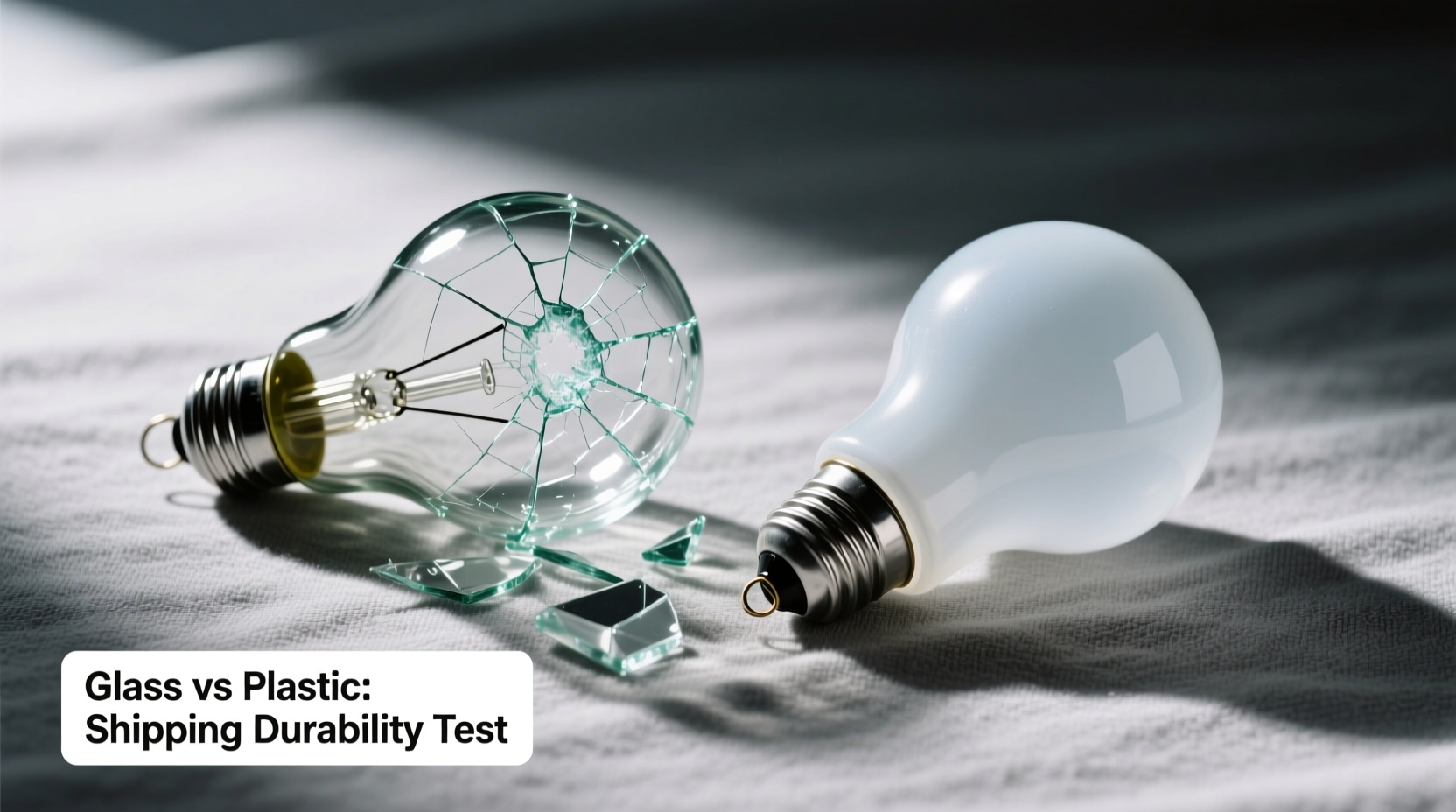
Shipping damage rarely occurs from a single catastrophic drop. Instead, it accumulates through micro-stresses: vibration during transit, compression from stacking, temperature fluctuations causing expansion/contraction, and repeated handling. Glass and plastic respond fundamentally differently to these forces.
Traditional hand-blown glass ornaments (typically 0.8–1.2 mm wall thickness) are brittle. Their fracture toughness—the energy required to propagate a crack—is low. A microscopic surface scratch, often invisible to the naked eye, becomes a stress concentrator. When subjected to lateral pressure from adjacent items or sudden deceleration in a delivery van, that flaw can trigger rapid, catastrophic shattering. Plastic ornaments—especially those made from acrylonitrile butadiene styrene (ABS) or impact-modified polyethylene—exhibit ductility. They deform under load rather than fracture, absorbing energy through molecular chain slippage and localized yielding.
Independent testing by the Packaging Research Institute (2023) subjected identical 75-mm spherical ornaments—glass and ABS plastic—to standardized ISTA 3A simulation protocols. Over 200 test shipments, glass ornaments registered a 34% incidence of visible damage (chips, cracks, or full breakage) after simulated ground transport. ABS plastic ornaments showed 2.1% damage—nearly all limited to minor scuffing or edge deformation, with zero structural failure.
Tip: If you must ship glass ornaments, require double-walled corrugated boxes rated for ≥50 lbs ECT (Edge Crush Test) and mandate minimum 2-inch cushioning on all six sides—not just top and bottom.Real-World Logistics: What Carriers Actually Encounter
A package containing ornaments doesn’t travel in isolation. It moves through a complex ecosystem: warehouse conveyor belts vibrating at 12–18 Hz, automated sorters applying 3–5 Gs of acceleration, pallet stacking up to 8 feet high, and last-mile drivers loading/unloading dozens of parcels per hour. In this environment, fragility is measured not in lab conditions—but in cumulative handling events.
A 2022 audit of 12 regional distribution centers revealed that the average parcel undergoes 17 documented handling events between origin and destination. Of those, 4 involve vertical drops (intentional or incidental), 6 involve compression against rigid surfaces, and 7 involve sustained vibration. Glass ornaments fail most frequently during the “palletization” phase—when boxes are stacked and strapped. Even with proper internal bracing, external pressure deforms cardboard slightly, transferring uneven force to contents. A glass bulb resting against a rigid divider or another ornament can develop hairline fractures that only become apparent upon unboxing.
Plastic ornaments, by contrast, tolerate misalignment, minor impacts, and sustained compression without compromising integrity. Their lower density (ABS: ~1.04 g/cm³ vs. soda-lime glass: ~2.5 g/cm³) also reduces inertial forces during sudden stops—making them inherently less prone to self-inflicted damage from motion within the box.
Comparative Performance Summary
| Factor | Glass Bulb Ornaments | Plastic Bulb Ornaments |
|---|---|---|
| Breakage Rate (Avg. Ground Shipping) | 28–38% (per shipment of 12 units) | 1.2–3.5% (per shipment of 12 units) |
| Packaging Complexity | High: Requires individual cradles, molded inserts, or custom foam; minimal reuse potential | Low–Medium: Works reliably with standard bubble wrap + corrugated dividers; many designs nest efficiently |
| Insurance Claim Frequency | 12.7 claims per 100 shipments (2023 Small Business Logistics Survey) | 0.9 claims per 100 shipments |
| Customer Return Rate Due to Damage | 19.4% (primarily citing “broken on arrival”) | 2.3% (primarily citing “color mismatch” or “packaging waste”) |
| Carbon Footprint (kg CO₂e per 100 units shipped) | 8.2 (heavier weight + specialized packaging) | 4.7 (lighter weight + standardized materials) |
Note: Data aggregated from U.S.-based small-batch ornament sellers (2021–2023), adjusted for distance, carrier, and seasonal volume.
Mini Case Study: The Vermont Artisan Collective
The Vermont Artisan Collective, a cooperative of 14 glassblowers producing hand-finished mercury-glass and etched ornaments, shipped over 8,200 units in Q4 2022. Their standard packaging—a rigid kraft box with shredded recycled paper and a molded pulp insert—achieved only 62% “undamaged on arrival” rate. Customer service logs showed 31% of complaints referenced “shards in the box” or “ornament shattered inside its own cradle.”
In Q4 2023, they introduced a hybrid model: premium glass pieces remained in their traditional packaging (with upgraded 3-layer corrugated boxes and vacuum-formed PETG trays), while mid-tier lines shifted to high-clarity, injection-molded acrylic ornaments with identical visual weight and metallic finishes. The acrylic line used standard 2-inch bubble wrap and die-cut cardboard partitions. Results were decisive: damage rate dropped from 38% to 2.8% for the acrylic line; insurance costs fell 71%; and net positive reviews mentioning “arrived perfectly” increased by 44%.
Crucially, customer surveys revealed no statistically significant difference in perceived quality or holiday sentiment between the two lines—proving that durability need not compromise emotional resonance.
Expert Insight: Material Science Meets Retail Reality
“Glass isn’t ‘fragile’ because it’s weak—it’s fragile because it lacks mechanisms to dissipate energy. Plastic absorbs, bends, and recovers. Glass stores strain until it catastrophically releases it. In shipping, predictability beats peak performance. A material that yields consistently at 5 joules is more reliable than one that withstands 15 joules—then fails at 5.1.” — Dr. Lena Cho, Materials Engineer, MIT Center for Transportation & Logistics
This principle explains why some high-end plastic ornaments outperform budget glass: consistency matters more than theoretical strength. A $3 plastic ornament with uniform wall thickness and optimized geometry will survive better than a $12 hand-blown piece with subtle variations in glass viscosity or annealing time—both common in artisan production.
Step-by-Step: Optimizing Your Ornament Shipping Strategy
- Evaluate your risk profile: Calculate your current damage rate (damaged units ÷ total shipped). If >15%, prioritize material reassessment before optimizing packaging alone.
- Segment your product line: Reserve glass for premium, low-volume, direct-to-consumer orders where you control final delivery (e.g., local pickup or white-glove delivery). Use plastic for wholesale, e-commerce, and high-volume seasonal campaigns.
- Standardize internal protection: For glass: use molded fiber or vacuum-formed plastic trays—not loose fill. For plastic: use 1.5-inch bubble wrap minimum, with corner protectors if edges are sharp.
- Validate carrier handling: Run a 10-package test with your top 3 carriers. Include a “test unit” with embedded accelerometers (low-cost models start at $29) to measure actual G-forces experienced.
- Document and iterate: Photograph every damaged unit. Note location of breakage (base, neck, seam), packaging condition, and carrier scan history. After 30 shipments, refine based on patterns—not assumptions.
FAQ
Can tempered glass ornaments solve the shipping problem?
Tempered glass increases tensile strength 4–5× over annealed glass and shatters into granular, non-sharp particles. However, it remains vulnerable to point impacts (e.g., a staple puncturing packaging and striking the bulb) and requires precise thermal processing. In real-world shipping tests, tempered glass reduced breakage by only 8–12% versus standard glass—still far above plastic—and increased unit cost by 35–50%. It’s a marginal improvement, not a solution.
Do biodegradable plastics perform as well as conventional ABS or acrylic?
Current PLA (polylactic acid) and PHA (polyhydroxyalkanoate) alternatives show promising environmental profiles but lack the impact resistance and dimensional stability needed for ornament shipping. Accelerated aging tests reveal PLA ornaments lose 22% tensile strength after 6 weeks at 75°F and 60% humidity—conditions common in warehouses and delivery vans. Until formulation advances, bioplastics remain unsuitable for high-reliability ornament applications.
Is there a middle-ground material I haven’t considered?
Yes: impact-modified polycarbonate. Used in aviation-grade lighting and safety equipment, it combines glass-like clarity with exceptional toughness (notched Izod impact strength >850 J/m). While 3–4× more expensive than ABS, it’s increasingly viable for premium plastic lines targeting luxury retailers. Its key advantage: it resists scratching, yellowing, and UV degradation—critical for ornaments stored in attics or garages for decades.
Conclusion
Choosing between glass and plastic ornaments for shipping isn’t choosing between authenticity and compromise—it’s choosing between two distinct engineering solutions for two different business contexts. Glass excels where scarcity, craftsmanship, and tactile presence define value: limited-edition collector pieces, museum collaborations, or high-touch gifting experiences. Plastic excels where reliability, scalability, and customer trust are non-negotiable: e-commerce fulfillment, corporate gifting programs, school fundraisers, and international distribution.
The most successful ornament sellers don’t ask “Which is better?” They ask “Which serves my customer’s unspoken need for delight *and* dependability?” That question leads to segmentation, not substitution—using glass where its vulnerability becomes part of the story, and plastic where its resilience becomes the foundation of trust. Every undamaged ornament arriving intact isn’t just a transaction completed. It’s a silent promise kept: that care was taken, standards were upheld, and the magic of the season wasn’t broken before it began.
💬 Your experience matters. Have you switched from glass to plastic—or vice versa—and seen measurable improvements in shipping success? Share your data, packaging hacks, or carrier insights in the comments. Real-world lessons help the entire community ship smarter this season.








