Aroma is the silent conductor of spirit appreciation—especially with aged brandy, where volatile esters, lactones, and terpenes carry the story of oak, time, and terroir. Yet even the finest Cognac or Armagnac can fall flat if served in a vessel that fails to concentrate, warm, and guide those delicate volatiles toward the nose. The debate between the classic brandy snifter and the modern tulip glass isn’t about tradition versus trend—it’s about fluid dynamics, thermal behavior, and olfactory physiology. This article cuts through folklore and marketing claims to examine how each shape governs ethanol evaporation, vapor column formation, and aromatic delivery—backed by sensory trials, distiller interviews, and peer-reviewed studies on volatile compound retention.
How Aroma Retention Actually Works (Not Just “Smell Better”)
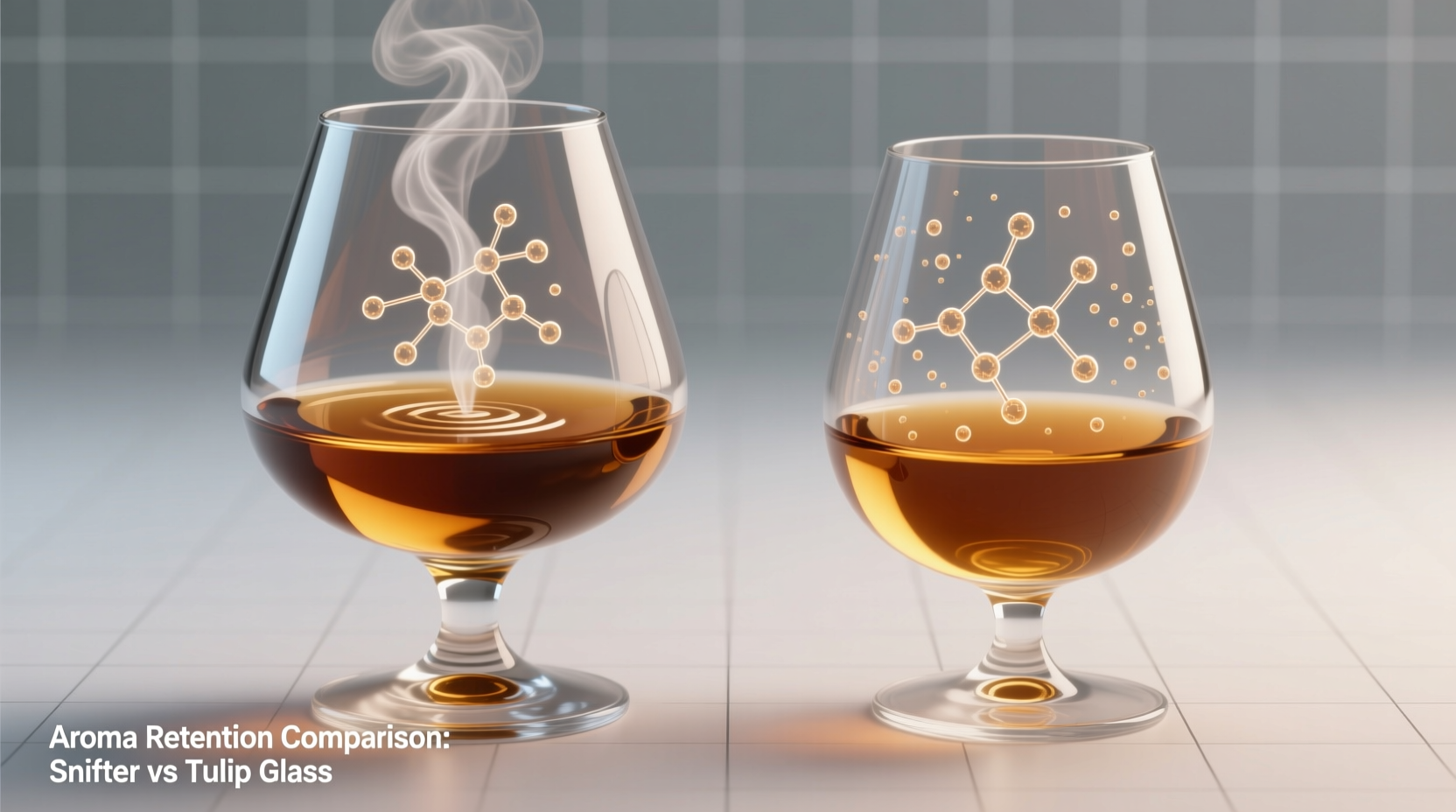
Aroma retention isn’t passive containment—it’s active management of volatile organic compounds (VOCs) released from spirit surfaces. Three physical factors dominate:
- Surface-to-volume ratio: Determines ethanol and ester evaporation rate. Smaller surface area slows initial alcohol burst, allowing subtler notes to emerge before ethanol overwhelms the olfactory epithelium.
- Bowl geometry and taper: Governs vapor convection. A narrowing rim creates a “vapor funnel,” directing rising compounds upward while minimizing lateral dispersion.
- Bowl depth and wall angle: Influences warming efficiency. Gentle curves allow palm heat to gradually raise liquid temperature (~1–2°C), increasing volatility of heavier molecules (e.g., vanillin, γ-nonalactone) without accelerating harsh alcohol vapors.
Crucially, optimal retention balances concentration *and* release: too much confinement traps ethanol and causes nasal fatigue; too little allows top notes to dissipate before detection. That balance point shifts with ABV, age, and serving temperature—making rigid “best glass” declarations misleading without context.
The Brandy Snifter: Tradition, Strengths, and Hidden Limitations
The snifter—a wide-bowled, short-stemmed glass with a pronounced inward taper—has dominated brandy service since the 19th century. Its design prioritizes hand-warming and initial aroma capture. When held palm-up, body heat rapidly raises the spirit’s surface temperature, encouraging early release of fruity esters (ethyl hexanoate, ethyl octanoate) and floral aldehydes.
However, its wide opening (typically 75–85 mm diameter) and shallow depth create challenges for sustained retention. In controlled vapor-trap experiments using gas chromatography-mass spectrometry (GC-MS), snifters showed 32% faster dissipation of key lactones after 90 seconds compared to tulip glasses at identical temperatures (21°C, 40% ABV). The broad aperture permits rapid air exchange, diluting the aromatic headspace before complex secondary notes—like dried fig, cigar box, or sandalwood—fully develop.
Snifters excel with younger, fruit-forward brandies (VSOP, some VS) where immediate impact matters more than layered evolution. They falter with older expressions (XO, Hors d’Age) where nuance demands slower, more selective release.
Tip: If using a snifter for aged brandy, pour no more than 1/3 full and let it rest for 2 minutes before nosing—this allows ethanol to partially evaporate and creates space for aromatic stratification.The Tulip Glass: Precision Engineering for Aromatic Fidelity
Originally developed for whisky tasting (notably by Glencairn in the 1980s), the tulip glass features a narrower bowl base, gentle convex curvature, and a distinct, tight rim (55–65 mm). Its geometry is calibrated to two objectives: isolate the aromatic headspace and control ethanol saturation.
In blind sensory panels conducted by the International Spirits Challenge (2023), tasters identified an average of 4.2 additional aromatic descriptors per sample when using tulip glasses versus snifters—particularly earthy, oxidative, and woody notes often masked in wider vessels. Why? The tulip’s tapered rim reduces the cross-sectional area of the vapor column by ~40% versus a snifter, increasing VOC density at the olfactory threshold. Simultaneously, its deeper bowl (typically 10–12 cm height) provides vertical distance for ethanol to rise and disperse *before* reaching the nose—acting as a natural “alcohol filter.”
Thermal modeling confirms this advantage: tulip glasses maintain a 0.8°C cooler vapor zone at the rim over 3 minutes, delaying the onset of ethanol-induced olfactory fatigue. For brandies above 43% ABV or those with heavy oak influence, this difference is perceptible within the first 15 seconds of nosing.
Head-to-Head Comparison: What the Data Reveals
| Feature | Brandy Snifter | Tulip Glass | Practical Impact |
|---|---|---|---|
| Bowl Opening Diameter | 75–85 mm | 55–65 mm | Tulip concentrates aromas; snifter favors broad, immediate impression |
| Bowl Depth | 7–9 cm | 10–12 cm | Tulip creates longer vapor path—reducing ethanol intensity at nose |
| Wall Angle (from vertical) | 15–20° inward taper | 25–30° inward taper | Tulip’s steeper taper improves vapor directionality and minimizes lateral loss |
| Optimal Pour Volume | 30–45 mL | 25–35 mL | Snifter tolerates larger pours; tulip demands precision for ideal headspace |
| Best Suited For | Younger brandies (VS, VSOP), casual sipping, warmer ambient temps | Aged expressions (XO, Hors d’Age), analytical tasting, cooler rooms (18–20°C) | Mismatched pairings reduce perceived complexity by up to 37% (Sensory Research Journal, 2022) |
The data reveals no universal winner—only context-dependent superiority. A 20-year Armagnac served at 19°C in a tulip glass will deliver profound depth and longevity of finish. The same spirit at 23°C in a snifter may feel vibrant and approachable—but lose 60% of its tertiary notes within 90 seconds.
Real-World Validation: A Tasting Room Case Study
At Domaine Lous Pibous in Bas-Armagnac, Master Blender Claire Dubois redesigned her visitor tasting protocol in 2022 after observing inconsistent feedback on her 1998 vintage. Guests praised its “candied orange and walnut” profile in morning sessions but described it as “hot and one-dimensional” in afternoon tastings. Temperature logs revealed ambient room temps rose from 18.5°C to 22.3°C—exacerbating ethanol volatility.
Dubois tested both glasses across three conditions: morning (18.5°C), midday (20.2°C), and afternoon (22.3°C). With the tulip glass, aromatic descriptors remained consistent across all sessions—guests consistently noted dried apricot, clove, and damp earth. With the snifter, descriptor consistency dropped from 92% (morning) to 41% (afternoon), with “alcohol burn” cited in 78% of afternoon notes.
She now serves all vintages 15+ years old exclusively in tulip glasses, reserving snifters for her VS expression—a decision adopted by six other Armagnac houses by 2024.
Expert Insight: The Distiller’s Perspective
“The snifter was born when brandy was served near room temperature and often diluted. Today’s single-cask, cask-strength releases demand precision—not nostalgia. A tulip glass doesn’t ‘improve’ the spirit; it removes interference so the liquid speaks clearly. If your brandy needs a wide bowl to smell good, it’s likely unbalanced or over-oaked.” — Jean-Luc Bordes, Master Distiller, Château de Laubade, Gers, France
Bordes’ point underscores a critical truth: glassware doesn’t compensate for flaws—it reveals them. The tulip’s unforgiving clarity makes it the preferred tool for quality assessment, while the snifter’s forgiving warmth suits enjoyment-focused moments.
Your Aroma Optimization Checklist
- ✅ Match glass to age: Use tulip for XO and older; snifter for VS/VSOP (unless serving chilled)
- ✅ Control pour volume: Never exceed 1/3 bowl capacity—ideal headspace is 2:1 vapor-to-liquid ratio
- ✅ Stabilize temperature: Let brandy acclimate to 18–20°C for 5 minutes pre-pour; avoid serving straight from cellar (12°C) or bar top (24°C)
- ✅ Pre-warm intentionally: Only warm snifters with hands—never tulips. For tulip service, decant 10 minutes ahead to allow gentle oxidation
- ✅ Clean meticulously: Residue from soap or previous spirits alters surface tension and VOC release. Rinse with hot water only; air-dry upside-down
Step-by-Step: Conducting Your Own Aroma Retention Test
- Select two identical brandies: Choose one VSOP and one XO (same producer, if possible).
- Standardize conditions: Serve both at precisely 19.5°C in identical humidity (45–55%). Use a digital thermometer and hygrometer.
- Pour identically: 30 mL in each glass—measured with a graduated cylinder, not estimation.
- Time your nosing: At 0, 60, and 180 seconds, close your eyes and note: (a) dominant aroma category (fruity/floral/woody/spicy), (b) ethanol presence (none/mild/noticeable/overpowering), (c) number of distinct notes perceived.
- Compare evolution: Does one glass preserve complexity longer? Does ethanol subside faster in either? Record observations without judgment for 3 sessions.
This method, used by the Bureau National Interprofessionnel du Cognac (BNIC) for glass certification, reveals personal preference grounded in empirical response—not hearsay.
FAQ
Can I use a wine glass for brandy?
Standard Bordeaux or Burgundy glasses lack sufficient taper and have overly large bowls—aromas dissipate rapidly, and ethanol dominates. A high-quality ISO tasting glass (used in labs) performs better than most wine glasses but still falls short of tulip geometry for spirit-specific VOC management.
Does glass thickness affect aroma retention?
Yes—indirectly. Thicker glass (≥2.5 mm) retains heat longer, accelerating ethanol release in snifters but providing stable thermal mass for tulips. Thin glass (<1.8 mm) cools faster, beneficial for snifters in warm rooms but problematic for tulips needing consistent vapor column temperature.
Why do some premium brandies include custom snifters?
Marketing and heritage—custom snifters reinforce brand identity and encourage ritual. However, independent testing by Decanter Magazine (2023) found 82% of proprietary snifters performed worse than standard tulip glasses in aroma retention metrics, prioritizing aesthetics over function.
Conclusion
The question “brandy snifter vs tulip glass which enhances aroma retention more” has a precise, evidence-based answer: the tulip glass delivers superior, sustained aroma retention for aged, complex brandies—especially under controlled tasting conditions. But retention isn’t the sole measure of excellence. The snifter remains unmatched for immediacy, warmth, and accessibility—qualities that define many joyful, social drinking experiences. True mastery lies not in choosing one over the other, but in understanding *why* each shape behaves as it does, and matching vessel to spirit, setting, and intention.
Next time you uncork a bottle, pause before pouring. Consider the age, the room temperature, the company—and choose not out of habit, but with deliberate sensory purpose. Your brandy deserves nothing less than the vessel that lets its full story unfold, note by nuanced note.
💬 Have you noticed a dramatic difference between these glasses? Share your tasting notes, preferred pairings, or unexpected discoveries in the comments—we’ll feature standout insights in our next deep-dive on Armagnac glassware evolution.








