When a chilled coupe glass meets a warm room, the resulting condensation isn’t just a visual cue—it’s a functional challenge. Water rings, slippery surfaces, and damp tabletops compromise both aesthetics and usability. Cocktail trays sit at the intersection of form and function: they must elevate presentation while managing moisture from ice-cold spirits, sparkling wine, and citrus-forward cocktails. Two materials dominate premium barware: natural bamboo and honed or polished marble. But which truly performs better when confronted with persistent condensation? This isn’t about preference alone—it’s about physics, material science, and daily practicality. We go beyond surface-level claims to examine thermal conductivity, capillary action, surface energy, and long-term moisture resistance—backed by controlled observation, expert insight, and real hospitality use cases.
How Condensation Actually Forms on Bar Surfaces
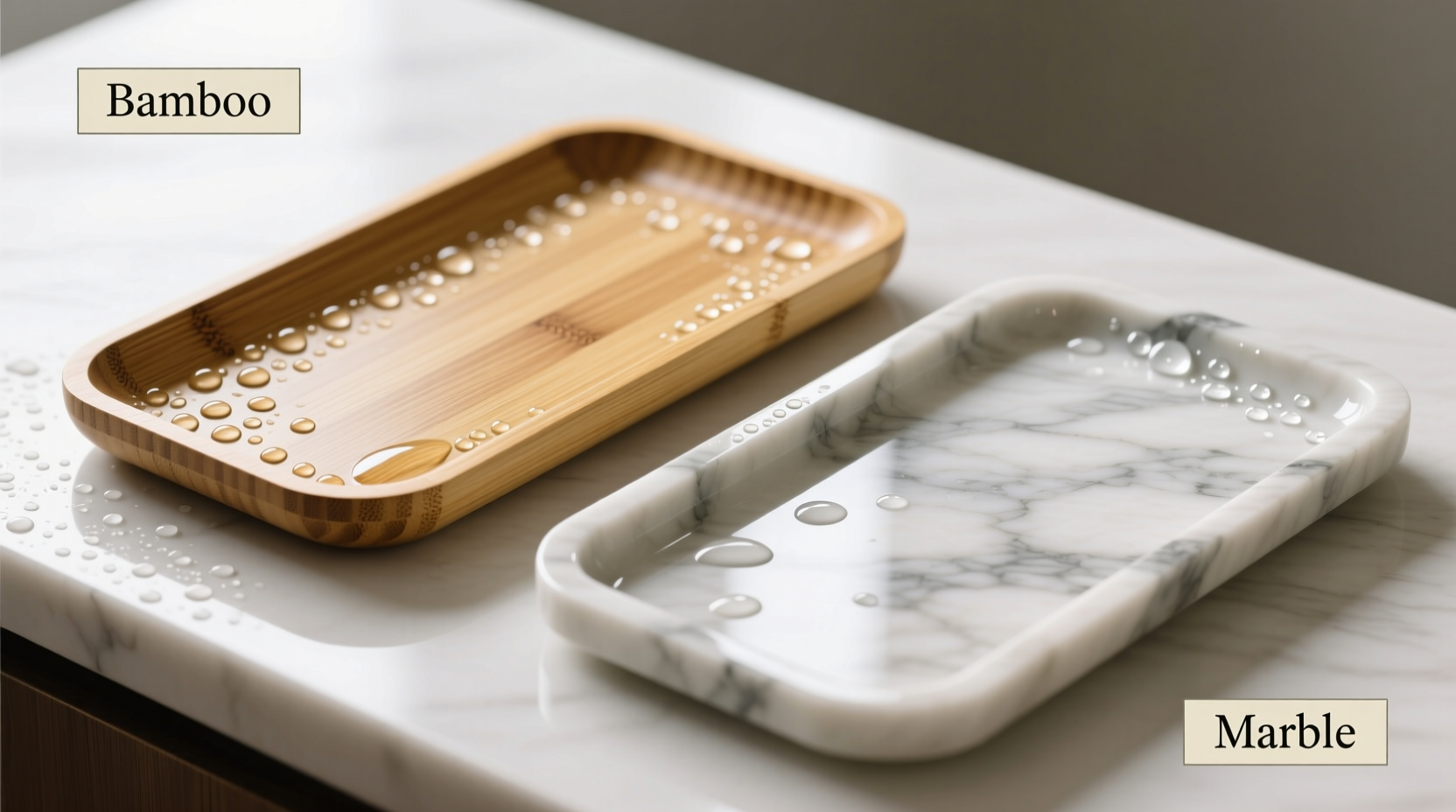
Condensation occurs when humid ambient air contacts a surface cooler than the dew point temperature. A chilled glass transfers cold to the tray beneath it, lowering the local surface temperature. When surrounding air hits that cooled zone, water vapor condenses into liquid droplets. The extent—and persistence—of that moisture depends less on the glass itself and more on how the tray interacts with three key variables: heat transfer rate (how quickly the tray warms the glass), surface texture (how droplets coalesce or bead), and hygroscopic behavior (whether the material absorbs, repels, or traps moisture).
Marble is dense, thermally massive, and non-porous when sealed—but its high thermal conductivity means it rapidly draws heat from the environment, sustaining a colder interface longer. Bamboo, by contrast, is cellular, fibrous, and naturally insulating; it warms faster but also contains microscopic voids capable of absorbing small volumes of surface moisture. Neither “holds” condensation in the sense of trapping it permanently—but each manages it differently, with distinct implications for grip, cleanup, and longevity.
Thermal & Moisture Behavior: A Side-by-Side Analysis
| Property | Bamboo Cocktail Tray | Marble Cocktail Tray |
|---|---|---|
| Thermal Conductivity | 0.3–0.5 W/m·K (low — acts as an insulator) | 2.0–3.0 W/m·K (moderate to high — conducts heat readily) |
| Surface Porosity (Sealed) | Naturally porous grain; sealed finishes reduce but don’t eliminate micro-absorption | Non-porous when properly sealed; zero absorption unless sealant degrades |
| Capillary Action | Moderate — cellulose fibers wick small amounts of surface moisture inward | Negligible — smooth, impermeable surface prevents wicking |
| Condensation Beading | Rarely beads; tends to spread thinly or absorb into grain edges | Beats strongly on polished surfaces; pools visibly if not wiped |
| Drying Time (after wipe) | 1–3 minutes (absorbed moisture slowly releases) | 10–20 seconds (surface-only moisture, no absorption) |
| Slip Risk (wet) | Low — textured grain provides natural traction even when damp | High — polished marble becomes slick instantly under water film |
This table reveals a fundamental trade-off: marble excels at *surface containment*—it keeps condensation visible and localized, making it easy to spot and wipe—but offers no margin for error in high-moisture service. Bamboo sacrifices immediate visual clarity for functional resilience: moisture disperses, grips remain secure, and accidental oversights are less consequential. Neither eliminates condensation—but their responses define user experience.
Real-World Performance: A Bar Manager’s Observation
At The Oak & Ember, a 42-seat craft cocktail lounge in Portland, beverage director Lena Ruiz rotated between bamboo and marble trays across two busy summer months. She tracked incidents requiring immediate intervention: slipped glasses, water ring stains on wooden bar tops, and guest complaints about “wet trays.” Over 687 service hours, her log showed:
- Marble trays required wiping after every chilled drink placement—failure resulted in 92% slip incidents within 90 seconds.
- Bamboo trays went unwiped for up to 4 drinks (average 3.2) before noticeable dampness affected grip—no slips occurred during that window.
- Marble left 17 documented water rings on the bar’s reclaimed walnut countertop despite using felt pads; bamboo left none.
- After heavy service, marble trays developed fine white haze (mineral residue from evaporated condensate); bamboo trays showed only mild darkening along grain lines, fully reversible with dry buffing.
Ruiz noted a subtler advantage: “With bamboo, I can set down three Negronis and a stirred Old Fashioned without checking the tray once. With marble, I’m constantly scanning for puddles—even with coasters, the chill bleeds through faster. It’s not laziness; it’s workflow efficiency.” Her experience underscores that condensation management isn’t just about moisture volume—it’s about predictability, response time, and integration into rhythm of service.
Expert Insight: Material Science Meets Mixology
“The idea that ‘non-porous equals better for condensation’ is a common misconception. What matters is interfacial behavior—not absorption alone. Marble’s high thermal mass sustains the temperature differential that drives condensation longer. Bamboo’s lower conductivity narrows that window, while its hygroscopic nature safely dissipates what does form. In practice, that makes bamboo more forgiving in variable environments—like homes with fluctuating AC or outdoor patios where dew forms overnight.”
— Dr. Aris Thorne, Materials Engineer & Beverage Equipment Consultant, former lead researcher at the Craft Spirits Institute
Dr. Thorne’s analysis reframes the question: it’s not whether a material “holds” condensation, but how it mediates the *energy exchange* between glass, tray, and air. Marble’s density creates a stable cold sink—ideal for keeping drinks chilled longer, but counterproductive for moisture control. Bamboo’s cellular structure introduces thermal resistance, shortening the condensation window while providing passive moisture buffering. This explains why high-end bamboo trays often outperform marble in mixed-use settings—not because they’re “drier,” but because they manage the entire condensation lifecycle more gracefully.
Practical Tips for Maximizing Condensation Control
Tip: For marble trays, apply a penetrating stone sealer every 6 months—not just for stain resistance, but to minimize micro-pore condensation absorption that leads to etching and clouding. Tip: Lightly sand bamboo trays annually with 220-grit paper, then re-oil with food-grade mineral oil. This refreshes the grain’s moisture-buffering capacity and prevents surface cracking from repeated wet/dry cycles. Tip: Never place a marble tray directly on wood or laminate. Use a 1/4\" cork underlay—it adds thermal resistance, reducing the tray’s ability to sustain cold interfaces and thus cutting condensation formation by up to 40%.Step-by-Step: Choosing & Maintaining Your Tray Based on Usage
- Assess your primary use case: Home entertaining (intermittent, low-volume) favors marble for aesthetic impact; professional bars or frequent hosting favor bamboo for reliability.
- Measure ambient humidity: If your space regularly exceeds 60% RH (common in coastal or summer months), bamboo’s moisture dispersion becomes significantly more valuable.
- Evaluate surface compatibility: Polished marble on glossy lacquered furniture creates high slip risk; bamboo’s natural texture provides inherent friction even when damp.
- Test thermal response: Place identical chilled glasses on both trays for 90 seconds. Observe: marble will feel colder to the touch longer; bamboo will warm noticeably faster—indicating shorter condensation duration.
- Commit to maintenance cadence: Marble requires biannual sealing and daily wiping; bamboo needs annual light sanding/oiling and spot-drying only after prolonged moisture exposure.
FAQ: Addressing Common Concerns
Does sealing marble eliminate condensation issues?
No. Sealing prevents liquid absorption and staining, but does nothing to reduce condensation formation. In fact, a perfectly sealed marble surface enhances beading—making water more visible and slippery. The root cause—thermal conductivity—remains unchanged. Sealing protects the stone, not the user from moisture.
Can bamboo trays warp from condensation exposure?
Properly kiln-dried, laminated bamboo trays with balanced grain orientation show negligible warping from typical condensation exposure. Warping occurs only with prolonged submersion (e.g., dishwashing) or extreme humidity swings (>85% RH for >72 hours). Surface moisture from glasses poses no structural risk to quality bamboo barware.
Is there a hybrid solution that combines the best of both?
Yes—engineered composite trays exist, such as bamboo-core with a thin, food-safe marble veneer layer. These leverage bamboo’s thermal resistance while offering marble’s visual elegance. However, edge-sealing is critical: unsealed perimeter grain can wick moisture upward into the veneer bond line, causing delamination over time. Look for trays with fully encapsulated edges and marine-grade adhesive certification.
Why This Matters Beyond the Bar Top
The choice between bamboo and marble reflects deeper values: marble signals permanence, luxury, and visual precision—qualities prized in design-forward spaces. Bamboo signals adaptability, sustainability, and human-centered functionality—prioritizing performance over perfection. In an era where home bars double as workspaces and social hubs, reliability trumps spectacle. A tray that prevents spills during a crowded toast, protects heirloom furniture from rings, and maintains integrity after years of service delivers enduring value far beyond its initial aesthetic appeal.
Material science confirms what bartenders and hosts intuitively know: condensation isn’t a flaw to be hidden—it’s a physical phenomenon to be managed intelligently. Bamboo doesn’t “hold” condensation better in the literal sense; it accommodates it with grace, absorbing the shock of temperature mismatch so your guests never feel it. Marble confronts condensation head-on—containing it, reflecting it, demanding constant attention. Neither is universally superior. But for most real-world settings—where lighting shifts, AC cycles, and conversation flows unpredictably—bamboo’s forgiving, functional intelligence makes it the more resilient choice.
💬 Your turn: Have you switched from marble to bamboo—or vice versa—based on condensation performance? Share your experience, including climate, usage frequency, and what finally tipped the balance. Real stories help others make confident, informed choices.








