
For decades, the debate between automatic and quartz watches has divided enthusiasts, collectors, and casual wearers alike. On one side, you have the precision and convenience of quartz technology—powered by a battery, accurate to within seconds per month. On the other, the craftsmanship and tradition of automatic watches, which rely on intricate mechanics and daily wear to function. But with that elegance comes responsibility: regular servicing, sensitivity to magnetism, and higher upkeep costs. So, is the maintenance hassle of an automatic watch truly worth it?
The answer isn’t universal. It depends on your lifestyle, values, and how you view a watch—not just as a tool for telling time, but as a statement, heirloom, or mechanical marvel. This article dives deep into the practical realities of owning each type, compares their long-term demands, and helps you decide whether the ritual of winding an automatic is a burden—or a privilege.
How Automatic and Quartz Watches Work: The Core Differences
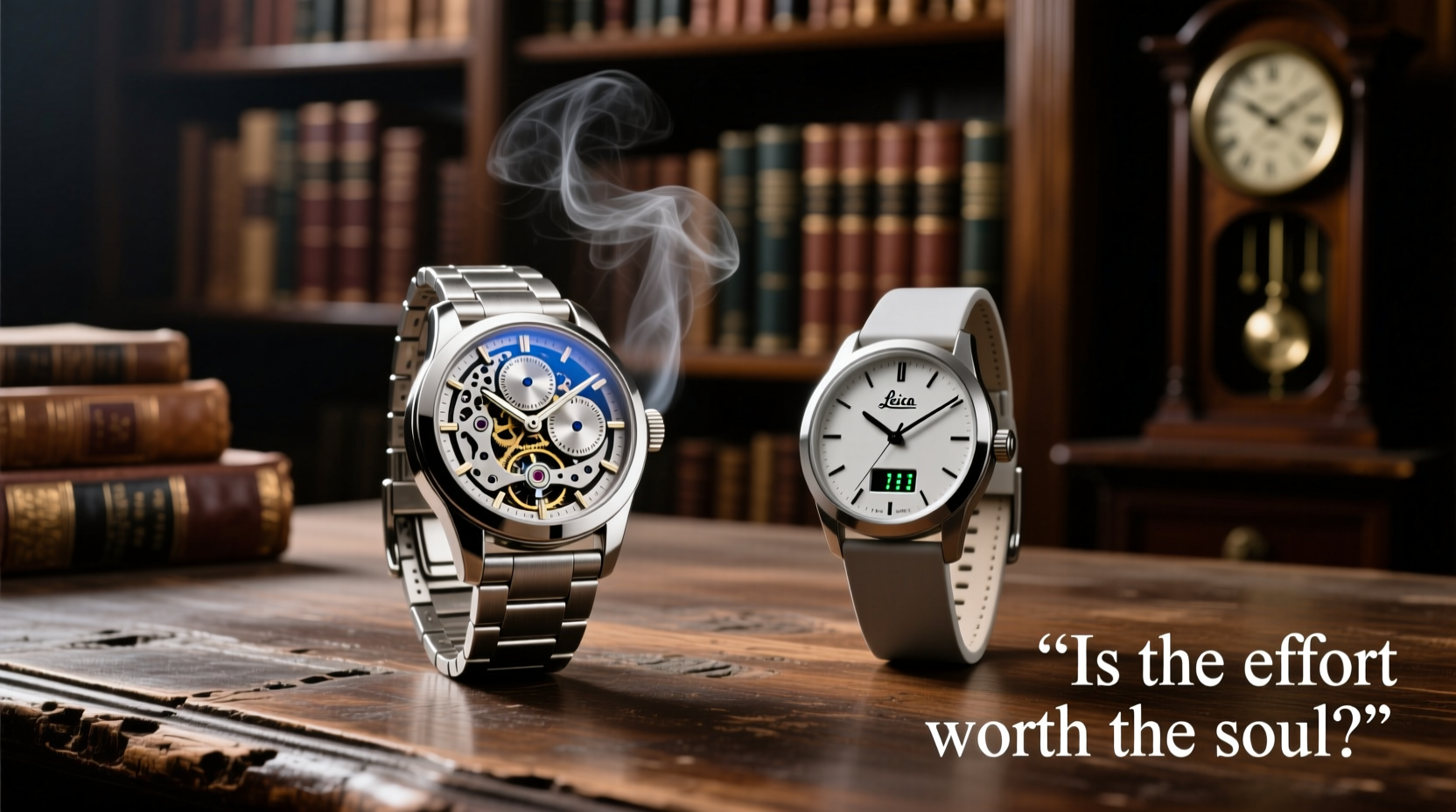
Understanding the fundamental mechanics behind both types is essential to evaluating their maintenance needs.
Quartz watches operate using a small battery that sends an electrical current through a quartz crystal. This crystal vibrates at a precise frequency (32,768 times per second), and those vibrations are regulated by a microchip to drive the motor that moves the hands. The result is exceptional accuracy—often within ±15 seconds per month—and minimal intervention beyond battery replacement every 2–5 years.
Automatic watches, also known as self-winding mechanical watches, harness kinetic energy from the wearer’s movement. A rotor inside the watch spins with motion, winding the mainspring, which stores energy. That energy is gradually released through a series of gears and springs to power the movement. Without consistent wear, they stop—typically after 38 to 72 hours—and require manual winding or a watch winder to keep running.
This mechanical complexity is what makes automatics revered among horology enthusiasts. But it also introduces points of failure: lubrication degradation, gear misalignment, and sensitivity to shocks or magnetic fields. These factors directly influence maintenance frequency and cost.
Tip: If you don’t wear your automatic watch daily, invest in a simple watch winder to maintain its power reserve and prevent oil from settling.Maintenance Comparison: Time, Cost, and Effort
Let’s break down the real-world upkeep required for each type over a 10-year period.
| Maintenance Factor | Quartz Watch | Automatic Watch |
|---|---|---|
| Battery Replacement | Every 2–5 years (~$10–$25) | Not applicable |
| Full Service Interval | Rarely needed; only if movement fails (~$100+) | Every 5–7 years (~$200–$600) |
| Daily Upkeep | None; set and forget | Wear regularly or use a winder |
| Sensitivity to Environment | Low; resistant to shock and magnetism | High; can be affected by magnets, moisture, impacts |
| Long-Term Durability | Limited by circuit lifespan; may become obsolete | Potentially indefinite with proper care |
At first glance, quartz wins on convenience. But consider this: while a $300 quartz watch might need a new movement after 10 years due to outdated parts, a well-maintained automatic can last generations. The Rolex Submariner, for example, has seen models from the 1960s still functioning perfectly today—some even increasing in value.
“Mechanical watches are not appliances. They’re miniature machines that demand respect and care. But that relationship—the daily ritual of wearing, winding, and maintaining—is part of their soul.” — Daniel Jositsch, Swiss Watchmaking Conservator
Is the Hassle Worth It? Evaluating the Value Beyond Timekeeping
To determine whether the maintenance of an automatic watch is justified, consider what you value in a timepiece.
Emotional and Aesthetic Value
An automatic watch is often more than a tool—it’s a piece of art. The sweeping motion of the second hand, the visible balance wheel through a display caseback, and the subtle ticking sound all contribute to a sensory experience no quartz watch can replicate. For many, this emotional connection outweighs the inconvenience of occasional servicing.
Moreover, automatics often feature superior craftsmanship: hand-finished movements, sapphire crystals, and premium materials. Brands like Omega, Grand Seiko, and Jaeger LeCoultre invest thousands of hours in perfecting their calibers. Owning such a watch becomes a form of appreciation for engineering heritage.
Resale and Collectibility
While most quartz watches depreciate quickly and rarely gain value, certain automatic models appreciate over time. Limited editions, vintage pieces, or discontinued references can command prices far above retail on the secondary market.
Take the Grand Seiko SBGA211 “Snowflake.” Originally priced around $4,000, it now sells for over $7,000 in unworn condition due to high demand and limited availability. This kind of appreciation is almost unheard of in the quartz world, except for rare exceptions like the Pulsar Space Chronograph.
Environmental and Ethical Considerations
Quartz watches rely on batteries, which contain heavy metals and require disposal. While modern batteries are less toxic, they still contribute to electronic waste. In contrast, a well-serviced automatic watch can run indefinitely without consumables beyond lubricants and gaskets.
Additionally, many quartz movements are sealed units. When they fail, the entire module is replaced—leading to more landfill waste. Mechanical movements, however, can be disassembled, repaired, and reassembled by skilled watchmakers, supporting a circular economy.
Tip: If sustainability matters to you, choose a brand with transparent service policies and support for long-term part availability.Real Example: Two Watches, Ten Years Apart
Consider Sarah, a professional in her early 30s who bought two watches in 2014:
- A Tissot PRX Quartz (approx. $500)
- A Tudor Black Bay 58 (approx. $3,500)
Over the next decade, here’s how ownership played out:
The Tissot required a battery change in 2017 and again in 2021. In 2023, the crown stem broke, and Tissot no longer stocked the replacement part. The watch was deemed uneconomical to repair. Total cost: ~$60 in service, but effectively a 10-year disposable accessory.
The Tudor, worn 3–4 times per week, never stopped thanks to occasional manual winding. In 2020, it received a full service costing $420. The movement was cleaned, oils refreshed, seals replaced, and accuracy calibrated. Today, it runs within -2/+4 seconds per day—better than when new. Resale value: approximately $5,200.
Sarah admits the Tudor demanded more attention, but she describes the annual ritual of checking its performance as “a grounding moment in a digital world.” She plans to pass it to her daughter one day.
Step-by-Step Guide: Maintaining Your Automatic Watch Long-Term
If you choose an automatic watch, follow this timeline to maximize longevity and minimize unexpected issues:
- Year 0 – Purchase and Initial Check
Verify timekeeping accuracy, water resistance rating, and power reserve. Keep original box and papers. - Years 1–4 – Daily Wear and Monitoring
Track accuracy weekly. Use a timing app if concerned. Avoid strong magnetic fields (e.g., speakers, MRI machines). - Year 5 – Pre-Service Inspection
Visit an authorized service center for a pressure test and amplitude check. Decide whether full service is needed based on results. - Year 6 – Full Servicing
Disassembly, cleaning, lubrication, reassembly, and calibration. Budget $250–$600 depending on brand and complexity. - Years 7–10 – Continued Wear and Care
Rotate with other watches if necessary. Store in a soft pouch when not in use. Avoid extreme temperatures. - Every 2 Years – Water Resistance Check
Essential for dive or sports watches. Replace gaskets as needed to prevent moisture damage.
Skipping service doesn’t mean immediate failure—but delaying too long allows dried lubricants to increase friction, leading to accelerated wear. Eventually, this can cause irreversible damage to gears or the escapement.
FAQ: Common Questions About Watch Maintenance
Can I service my automatic watch at any repair shop?
It’s best to use authorized service centers or highly reputable independent watchmakers familiar with your brand. Generic repairs may void warranties or use incorrect parts, compromising performance and value.
Do quartz watches ever need more than a battery change?
Yes, though rarely. Circuit failure, corrosion from old batteries, or physical damage can necessitate movement replacement. Some high-end quartz watches (like Longines VHP) offer serviceable movements, but most are treated as disposable.
How do I know if my automatic watch needs servicing?
Signs include inconsistent timekeeping (gaining/losing minutes), the second hand ‘jumping’ in 5-second intervals (indicating low power), or fog under the crystal (moisture ingress). A professional timegrapher can diagnose issues accurately.
Checklist: Choosing Between Automatic and Quartz
Use this checklist to align your decision with your priorities:
- ✅ Prefer zero maintenance and maximum accuracy → Quartz
- ✅ Want a family heirloom or collectible item → Automatic
- ✅ Wear a watch infrequently (<2x/week) → Quartz or smartwatch
- ✅ Appreciate mechanical engineering and craftsmanship → Automatic
- ✅ Concerned about long-term repairability → Automatic (with brand support)
- ✅ Need reliability for sports, diving, or field use → Depends: Quartz for consistency, Automatic for tradition
- ✅ Budget under $300 → Quartz offers better features per dollar
Conclusion: The True Cost of Ownership Is Personal
The question isn’t whether automatic watches are objectively “better” than quartz. It’s whether their requirements align with your life, values, and expectations.
For someone who wants a reliable, low-effort timepiece, quartz is the rational choice. It delivers unmatched accuracy and simplicity. But for those who find joy in mechanical precision, who appreciate the lineage of Swiss or Japanese craftsmanship, or who want to own something that can be passed down, the maintenance of an automatic watch isn’t a hassle—it’s part of the experience.
Time is intangible, but how we choose to measure it speaks volumes. An automatic watch asks for attention, but in return, it offers connection—to history, to engineering, and to the rhythm of your own life. If that trade-off resonates with you, then yes, the maintenance is absolutely worth it.
💬 What does your watch mean to you? Share your story—whether you swear by quartz efficiency or live for the sweep of a mechanical second hand. Join the conversation below.








