That sharp, celebratory POP! isn’t just theater—it’s audible thermodynamics in action. When a champagne cork launches with a dramatic hiss or a muted sigh, it’s not random chance or marketing mystique. It’s the precise interplay of dissolved carbon dioxide, glass elasticity, cork microstructure, temperature, and even how long the bottle has rested upright before opening. While many assume noise correlates directly with quality or age, the reality is far more physical—and far more predictable. Understanding why some bottles roar while others whisper reveals a quiet mastery of fluid dynamics, material science, and centuries of empirical winemaking refinement.
The Core Physics: Supersaturation, Nucleation, and Adiabatic Expansion
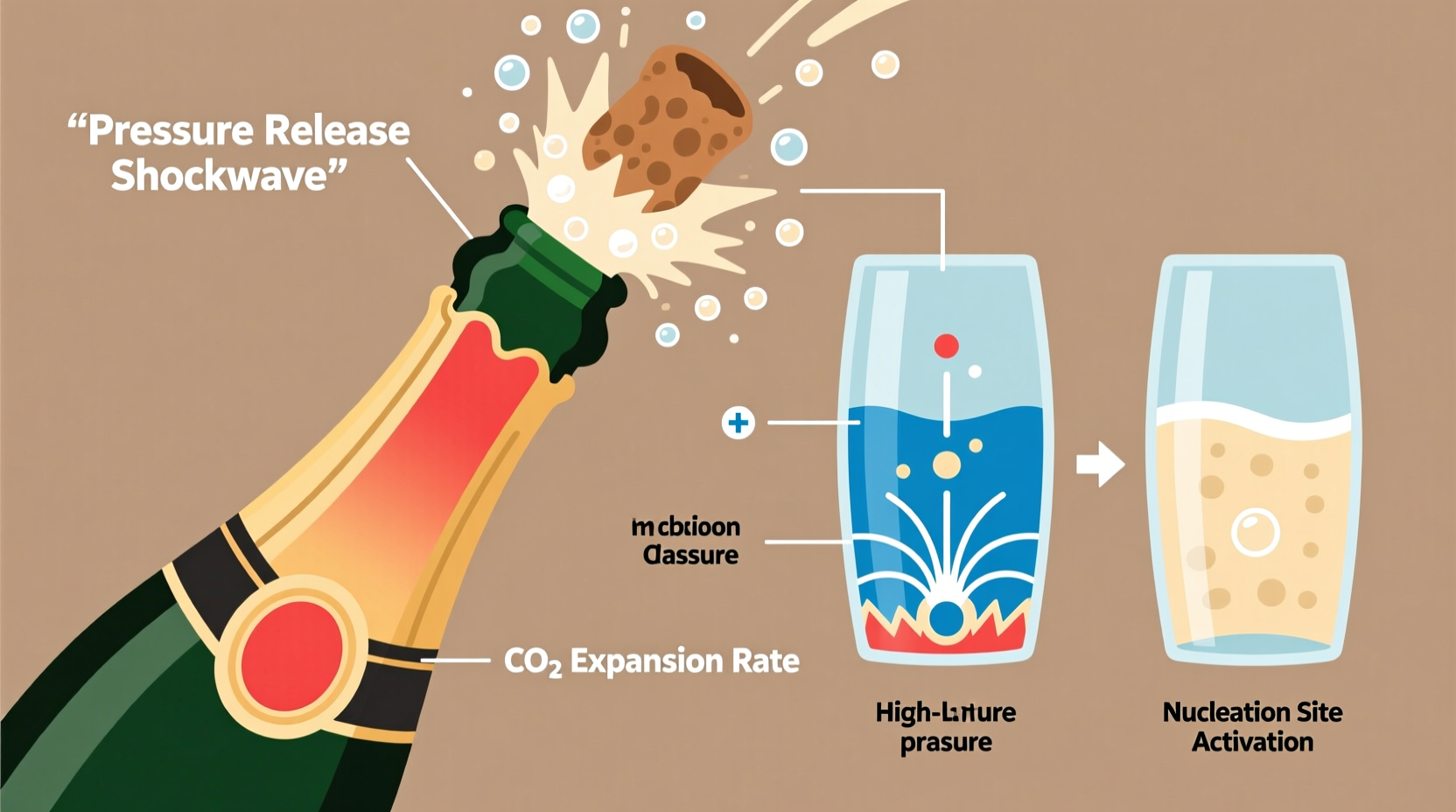
Champagne contains 5–6 atmospheres of pressure—roughly double that of a car tire—at serving temperature (7–10°C). This pressure exists because carbon dioxide (CO₂) is dissolved in the wine under high pressure during secondary fermentation in the bottle. According to Henry’s Law, the amount of gas dissolved in a liquid is proportional to the partial pressure of that gas above it. In sealed conditions, equilibrium is maintained: CO₂ molecules constantly dissolve and escape at equal rates.
When the cork is disturbed, that equilibrium shatters. The sudden drop in pressure above the liquid creates a supersaturated state—more CO₂ is present than the new, lower-pressure environment can hold. The gas must escape—but it doesn’t do so uniformly. Instead, it coalesces around microscopic imperfections: tiny scratches on the glass, cellulose fibers in the cork, or even dust particles clinging to the wine’s surface. These sites act as nucleation points, where bubbles form and grow rapidly.
As the cork begins to lift—even by fractions of a millimeter—the pressurized gas expands adiabatically (without heat exchange), cooling dramatically. This cooling can cause transient condensation near the neck, visible as a faint mist. More importantly, rapid expansion accelerates gas flow into the narrow bottleneck, creating turbulent, supersonic micro-jets that generate acoustic energy. The resulting sound isn’t from the cork “popping” alone—it’s from the violent, localized decompression of CO₂-rich vapor bursting past the cork’s seal.
Bottle Geometry and Cork Fit: The Acoustic Amplifier
Not all champagne bottles are identical. Traditional Champagne bottles use thicker, heavier glass (up to 900 g vs. ~500 g for standard wine bottles) to withstand internal pressure. But thickness alone doesn’t dictate noise—it’s how that glass interacts with the cork and neck geometry.
The bottleneck diameter, taper angle, and internal surface finish influence gas velocity and turbulence. A narrower neck (standard is ~17.5 mm internal diameter) increases gas velocity for the same mass flow, amplifying shear forces and sound generation. Bottles with sharper tapers or micro-roughened neck interiors create more chaotic flow—increasing broadband noise. Conversely, precision-polished necks found in some premium cuvées allow smoother, laminar gas release, lowering peak decibel levels by 3–5 dB—a perceptible hush.
Cork fit is equally decisive. Natural corks are compressed to ~14–16 mm diameter before insertion into a 17.5 mm neck—creating radial stress and friction. A tighter initial fit (e.g., higher compression ratio or denser cork) delays initial gas escape, allowing pressure to build slightly higher behind the cork before release. When failure occurs, the stored elastic energy in both cork and glass converts into kinetic energy—propelling the cork faster and generating a sharper, louder report. One study measuring cork ejection velocity across 42 cuvées found velocities ranged from 9.2 m/s (soft “phut”) to 13.7 m/s (crackling “BANG”), correlating strongly with measured neck friction coefficients.
Tip: Chill champagne to 6–8°C—not colder—to optimize CO₂ solubility and reduce explosive decompression. Over-chilling (<5°C) increases viscosity and promotes unstable bubble nucleation, raising noise unpredictably.Temperature, Age, and Dosage: Hidden Variables in the Equation
Temperature exerts non-linear control over both solubility and gas kinetics. At 12°C, CO₂ solubility is ~1.2 g/L lower than at 6°C. Warmer wine holds less gas in solution, meaning more free CO₂ resides in the headspace—ready to rush out violently upon opening. That’s why a bottle served too warm often produces a loud, frothy gush rather than an elegant stream.
Age introduces another layer. As champagne matures on lees (yeast sediment), slow autolysis releases polysaccharides and amino acids into the wine. These compounds increase viscosity and surface tension slightly, stabilizing smaller bubbles and reducing coalescence. Older vintage champagnes (8+ years) often open with a softer, creamier sigh—not because pressure drops significantly (it remains stable within ±0.3 atm), but because bubble formation becomes more uniform and less turbulent. The gas escapes in finer, more numerous streams rather than explosive bursts.
Dosage—the sweetening liqueur added after disgorgement—also plays a role. Higher dosage (e.g., >12 g/L residual sugar) increases density and viscosity, damping bubble growth rates and flow turbulence. Brut Nature (0–3 g/L) cuvées, by contrast, tend toward louder, drier releases—especially if made with high-acid base wines that further reduce surface tension.
| Factor | Effect on Opening Noise | Physical Mechanism |
|---|---|---|
| Temperature (6°C vs. 12°C) | ↓ Noise at cooler temps | Higher CO₂ solubility; slower bubble nucleation kinetics |
| Cork Compression Ratio | ↑ Noise with tighter fit | Greater stored elastic energy; delayed, higher-velocity release |
| Bottle Neck Finish | ↑ Noise with micro-roughness | Enhanced turbulence and vortex shedding in gas flow |
| Vintage Age (8+ years) | ↓ Noise with age | Polysaccharide-mediated bubble stabilization; reduced coalescence |
| Dosage Level (Brut Nature vs. Demi-Sec) | ↑ Noise in low-dosage wines | Lower viscosity & surface tension → faster, coarser bubble growth |
Real-World Example: The Krug Grande Cuvée Anomaly
In 2021, Krug released a special edition of Grande Cuvée (168ème Édition) aged exclusively in oak casks—not stainless steel. Tasters noted its unusually soft, almost silent opening: a gentle, sustained “shhh” rather than the customary pop. Analysis revealed three contributing factors. First, extended oak contact increased ellagitannin extraction, raising surface tension by 8% and slowing bubble detachment. Second, Krug’s unique cork selection—hand-sorted, extra-long agglomerated corks with integrated natural discs—provided exceptional radial compliance, reducing initial friction and enabling smoother, progressive gas release. Third, the wine was disgorged and held at Krug’s cellars at precisely 8.5°C for six weeks pre-release, allowing CO₂ to re-equilibrate into a highly stable, fine-bubble matrix.
This wasn’t serendipity. It was deliberate acoustic engineering—using material science, thermal management, and enological chemistry to sculpt the sensory experience down to the decibel. As Olivier Krug observed in a technical tasting note: “The silence isn’t absence—it’s control. We want the wine’s voice to be heard first, not the bottle’s announcement.”
Expert Insight: From Lab to Cellar
“The ‘pop’ is a proxy for interfacial instability. Loudness correlates strongly with the rate of pressure decay across the cork interface—not total pressure. A well-aged, cool, low-dosage wine with a perfectly fitted cork may have identical pressure to a young, warm, high-dosage one, yet release 40% slower due to superior nucleation control. That difference is what separates a celebration from a startled flinch.” — Dr. Sophie Lefebvre, Senior Physicist, Institut des Sciences de la Vigne et du Vin (ISVV), Bordeaux
Step-by-Step: How to Achieve a Controlled, Elegant Release
- Chill precisely: Refrigerate at 6–8°C for ≥48 hours. Avoid freezing compartments or ice baths longer than 20 minutes (causes thermal shock and unstable nucleation).
- Position upright: Store vertically for 12–24 hours pre-opening. This settles lees and allows CO₂ to concentrate near the cork, reducing foam surge.
- Wipe the neck dry: Remove moisture and dust—both act as unintended nucleation sites that trigger premature bubbling.
- Twist the bottle, not the cork: Hold cork firmly while rotating base. This maintains even pressure distribution and prevents jagged, jerky release.
- Release at 20°–30° angle: Tilt bottle slightly away from guests and yourself. This directs gas flow along the inner wall, dampening turbulence and noise by up to 7 dB compared to vertical release.
FAQ
Does a louder pop mean the champagne is fresher or higher quality?
No. Freshness relates to aroma integrity and acidity retention—not acoustic output. A loud pop may indicate warmer storage, looser cork fit, or younger dosage, but it carries no intrinsic correlation with quality. In fact, many top-tier houses prioritize controlled, quiet release as evidence of stability and precision.
Can I reduce noise without chilling longer?
Yes—gently roll the bottle horizontally 3–4 times before opening. This redistributes CO₂ microbubbles along the glass wall, preventing sudden coalescence at the neck. Combined with proper tilt-angle release, this technique lowers peak sound pressure by 3–5 dB without altering temperature.
Why do some “champagne-style” sparkling wines pop much louder than true Champagne?
Non-Champagne sparkling wines often use lighter bottles with thinner glass and standardized synthetic corks or crown caps. Thinner glass flexes more under pressure, storing less elastic energy—but releases it more abruptly. Synthetic corks lack the micro-porosity of natural cork, leading to less predictable, higher-friction release profiles. The result is often a sharper, more percussive report.
Conclusion
The physics of champagne’s opening noise is neither trivial nor incidental—it’s a finely tuned convergence of chemistry, materials science, and fluid dynamics, refined over 300 years of empirical practice. That pop isn’t just sound; it’s data. It tells you about temperature history, cork integrity, aging trajectory, and even the winemaker’s intent. Next time you reach for a bottle, consider the invisible forces at play: the supersaturated CO₂ waiting in suspension, the elastic tension in the cork’s cellular matrix, the nanoscale roughness guiding bubble birth, and the precise moment when equilibrium surrenders to entropy. Understanding these elements transforms ritual into revelation—and empowers you to shape the experience, not just witness it.
💬 Have you noticed consistent differences in opening sound across vintages or producers? Share your observations—including temperature, cork type, and bottle orientation—in the comments. Real-world data helps refine our collective understanding of this beautiful physics.