
Maintaining a lush, well-groomed lawn has long been a hallmark of curb appeal and outdoor comfort. For decades, homeowners have relied on push mowers—manual or gas-powered—to keep grass under control. But in recent years, robotic lawn mowers have entered the mainstream, promising hands-free maintenance and smart automation. As these autonomous machines become more common, a critical question arises: Is the automation truly reliable when compared to the time-tested push mower?
The answer isn’t a simple yes or no. It depends on your lawn size, terrain, expectations for precision, and tolerance for upfront investment. To help you decide whether automation delivers on its promises, we’ll compare robotic and push mowers across key dimensions: reliability, maintenance, cost, usability, and long-term value.
How Robotic Mowers Work: The Basics of Lawn Automation
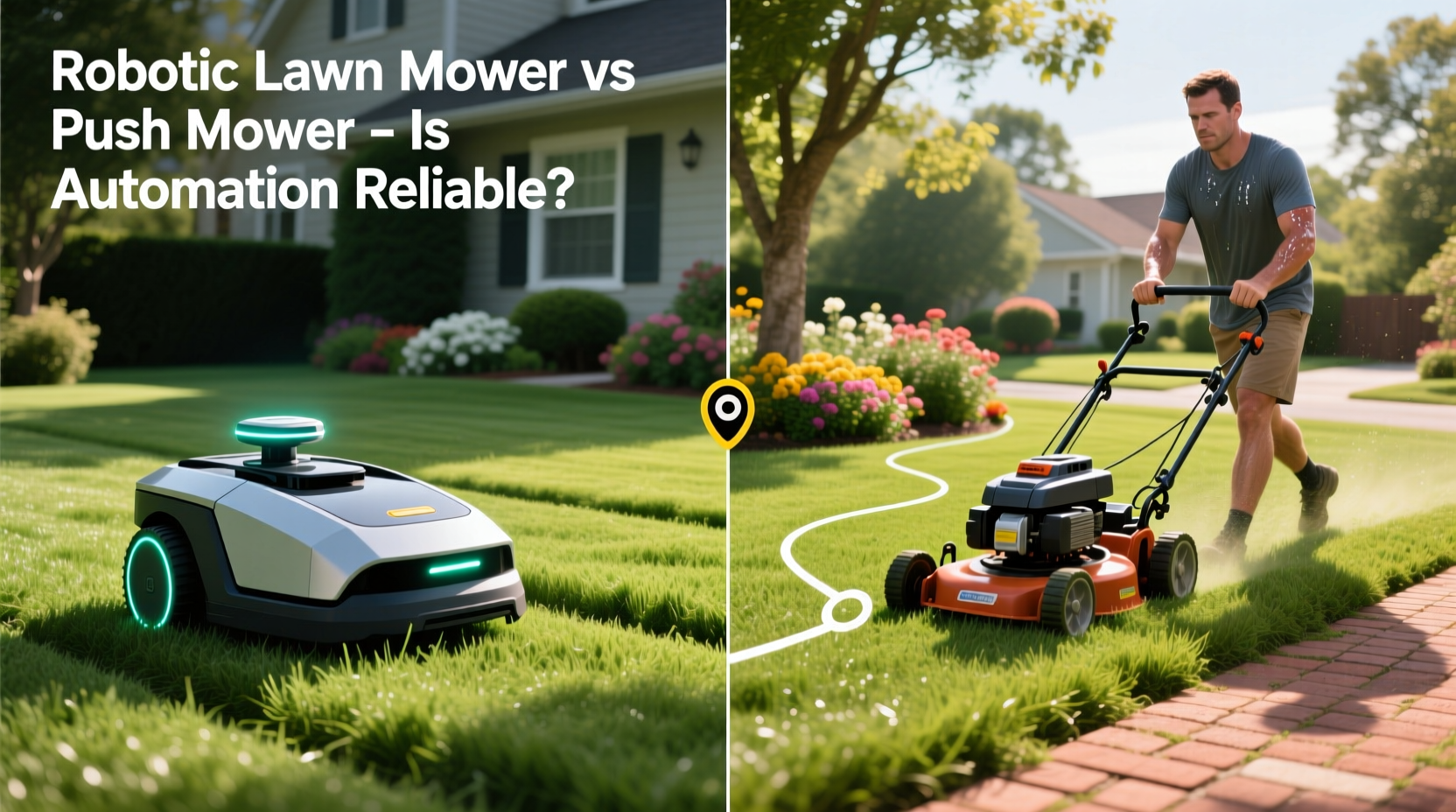
Robotic lawn mowers operate autonomously using a combination of sensors, boundary wires, and programming logic. Most models require a perimeter wire to be installed around the edge of your lawn, which acts as an invisible fence. The mower detects this signal and stays within the designated area. Advanced models use GPS, AI navigation, and smartphone apps to optimize mowing patterns and avoid obstacles.
These mowers typically follow a random or systematic pattern, cutting small amounts of grass frequently—often every day or every other day. This frequent mowing promotes healthier grass growth by reducing stress and encouraging denser turf. When not in use, the robot returns itself to a charging station, where it recharges and waits for its next scheduled run.
While the technology is sophisticated, reliability hinges on proper setup, consistent power, and environmental conditions. Unlike a push mower, which responds immediately to user input, a robotic mower relies on pre-programmed routines and environmental feedback loops. Any disruption—such as a misplaced wire, debris blockage, or software glitch—can temporarily halt operations.
Tip: Test your robotic mower’s navigation during daylight hours before relying on it at dawn or dusk, when visibility and sensor accuracy may vary.Push Mowers: Simplicity, Control, and Predictability
Push mowers—whether manual reel, electric, or gas-powered—offer direct human control over the mowing process. You decide when to start, where to go, and how closely to cut. There’s no setup beyond refueling or charging, and operation is nearly instantaneous.
Gas-powered push mowers remain popular for larger lawns due to their power and range. Electric models (corded or battery) are quieter and easier to maintain but may have runtime limitations. Reel mowers, though limited to smaller, flatter lawns, provide a clean, precise cut with zero emissions.
The reliability of a push mower is largely mechanical. If the engine starts and the blades turn, the machine will cut grass. Maintenance is straightforward: oil changes (for gas models), blade sharpening, air filter cleaning, and seasonal tune-ups. Failures are usually easy to diagnose and often repairable with basic tools.
Because they don’t rely on software or sensors, push mowers are immune to connectivity issues, firmware bugs, or false obstacle detection—a significant advantage in unpredictable environments.
Comparative Analysis: Robotic vs Push Mower Reliability
Reliability isn’t just about breakdowns—it includes consistency, predictability, and performance under real-world conditions. Below is a side-by-side comparison of key factors influencing reliability.
| Factor | Robotic Mower | Push Mower |
|---|---|---|
| Startup Consistency | Dependent on battery charge, Wi-Fi (if app-controlled), and boundary wire integrity | Immediate; pull-start or button ignition |
| Obstacle Handling | Sensors detect objects, but may stall or reroute inefficiently | User manually navigates around obstacles |
| Weather Resilience | Most stop during rain; some resume after drying | Can operate in light dampness; avoid heavy rain |
| Maintenance Complexity | Blade replacement, sensor cleaning, software updates | Blade sharpening, oil changes, spark plug checks (gas) |
| Durability (5-year avg.) | High if maintained; motors and electronics may fail | Very high; proven mechanical longevity |
| Lawn Edge Precision | Often uneven; struggles with tight borders | Precise control with trimmer or careful edging |
The data shows that while robotic mowers excel in convenience and frequency, they lag in precision and environmental adaptability. A push mower gives immediate, predictable results. A robotic mower requires trust in automation—and patience when it misjudges a path or halts mid-cycle.
“Automation in lawn care is impressive, but it’s only as reliable as its environment allows. For complex yards, human oversight still outperforms full autonomy.” — Dr. Alan Reeves, Robotics Engineer at GreenTech Labs
Real-World Example: The Suburban Homeowner’s Experience
Consider Mark T., a homeowner in Portland, Oregon, with a 0.3-acre yard featuring flower beds, a playset, and irregular terrain. He replaced his aging gas push mower with a mid-range robotic model two years ago. Initially thrilled with the “set-and-forget” promise, he soon encountered issues.
During spring rains, the robot would get stuck on wet leaves or retreat to its dock, leaving patches uncut. Squirrels chewed through the boundary wire twice, causing the mower to wander into the garden. While daily mowing kept grass healthy, edges near walkways remained ragged, requiring manual touch-ups.
After six months, Mark adjusted his expectations. He began clearing debris before mowing cycles, reinforced the perimeter wire with conduit, and accepted that occasional hand-trimming was necessary. Over time, the system became more dependable—but only because he actively managed it.
His conclusion? “It saves me time, but it’s not fully autonomous. I’m still the lawn manager. The robot is just another tool—one that needs babysitting.”
When Automation Works: Ideal Conditions for Robotic Mowers
Robotic mowers aren’t universally unreliable—they thrive under specific conditions. The following checklist helps determine if your lawn is suited for automation.
Checklist: Is Your Lawn Right for a Robotic Mower?- ✅ Lawn size under 0.5 acres (most consumer models max out here)
- ✅ Mostly flat terrain with minimal slopes (under 20-degree incline)
- ✅ Clear, definable boundaries for perimeter wire installation
- ✅ Low foot traffic and few moving obstacles (toys, pets, garden tools)
- ✅ Willingness to perform weekly maintenance (blade swaps, sensor wipes)
- ✅ Access to outdoor electrical outlet near the yard
If most items apply, a robotic mower can deliver consistent, low-effort results. However, if your yard is large, sloped, cluttered, or shared with active children or pets, a push mower remains the more reliable option.
Cost and Long-Term Value Comparison
Price is a major factor in assessing reliability. A machine that breaks down frequently or requires costly repairs undermines its value—even if it works perfectly 80% of the time.
Entry-level robotic mowers start around $800, with premium models exceeding $2,500. Add installation (professional setup averages $300–$600), replacement blades ($30–$60/year), and potential wire repairs. Over five years, total ownership costs can reach $1,500–$3,500 depending on usage and service needs.
In contrast, a quality push mower costs $200–$500. Annual maintenance (oil, filters, blade sharpening) runs $20–$50. Even with fuel or battery replacements, five-year costs rarely exceed $700. Mechanical simplicity means fewer parts to fail, and most components are replaceable at low cost.
While robotic mowers save labor time—potentially hundreds of hours over a decade—the financial return is less clear. For someone who enjoys mowing or values control, the push mower offers superior long-term value and reliability.
Frequently Asked Questions
Can robotic mowers handle steep hills?
Some models can manage slopes up to 20–30 degrees, but performance varies. On steeper inclines, robots may slow down, slip, or avoid areas altogether. Always check the manufacturer’s grade rating before purchasing.
Do robotic mowers cut as well as push mowers?
They cut differently. Robotic mowers use small, fast-spinning blades that mulch clippings finely, promoting lawn health. However, they may miss spots or leave uneven edges. Push mowers—especially those with sharp blades—offer more consistent height control and edge definition.
What happens if the robotic mower breaks down?
Repairs can be costly and time-consuming. Many manufacturers offer warranties (2–3 years), but out-of-warranty service often requires shipping the unit to a center. Replacement parts like circuit boards or drive motors can cost hundreds of dollars. In contrast, most push mower repairs can be done locally or DIY.
Step-by-Step Guide: Transitioning from Push to Robotic Mower
If you’re considering automation, follow this timeline to ensure a smooth transition:
- Week 1: Measure your lawn and assess terrain. Identify obstacles, slopes, and drainage areas.
- Week 2: Research models suited to your yard size and slope. Read user reviews focusing on reliability and customer support.
- Week 3: Install the perimeter wire. Follow the manufacturer’s layout guide, keeping wires taut and buried shallowly.
- Week 4: Set up the charging station on a level surface near an outdoor outlet. Pair the mower with your smartphone app.
- Month 2: Run test cycles during dry weather. Monitor navigation, cutting patterns, and docking behavior.
- Month 3: Fine-tune schedules and zones. Clear debris regularly and inspect sensors weekly.
- Ongoing: Replace blades every 1–2 months, clean wheels monthly, and check wire integrity seasonally.
This phased approach minimizes frustration and helps identify reliability issues early.
Conclusion: Balancing Innovation and Dependability
The rise of robotic lawn mowers represents a genuine advancement in home automation. For the right user—someone with a small, simple lawn and a desire to minimize physical effort—these machines offer real benefits. Daily mowing improves grass health, reduces weed competition, and eliminates the weekend chore of pushing a heavy mower under the sun.
Yet, automation is not yet flawless. Reliability remains conditional. Unlike a push mower, which starts when you pull the cord and cuts wherever you guide it, robotic models depend on infrastructure, software, and environmental stability. They can falter in rain, struggle with clutter, and require ongoing maintenance beyond blade changes.
The truth is, robotic mowers are reliable—but not universally so. They demand setup, monitoring, and acceptance of minor imperfections. For many, the trade-off is worth it. For others, especially those with complex landscapes or high standards for lawn perfection, the push mower remains the more dependable, predictable, and cost-effective choice.
🚀 Ready to evaluate your options? Assess your lawn’s layout, your time constraints, and your tolerance for tech troubleshooting. Whether you choose automation or stick with tradition, the goal is the same: a healthy, attractive lawn with minimal long-term hassle. Share your experience or questions below—we’d love to hear what works for you.